Page 23 of 550
Safety features of your vehicle43
WARNING
- Rear seatbacks
The rear seatback must besecurely latched. If not, passen-
gers and objects could be thrown
forward resulting in serious
injury or death in the event of a
sudden stop or collision.
Luggage and other cargo should be laid flat in the cargo area. If
objects are large, heavy, or must
be piled, they must be secured.
Under no circumstances should
cargo be piled higher than the
seatbacks. Failure to follow these
warnings could result in serious
injury or death in the event of a
sudden stop, collision or rollover.
No passenger should ride in the cargo area or sit or lie on folded
seatbacks whilst the vehicle is
moving. All passengers must be
properly seated in seats and
restrained properly whilst riding.
When resetting the seatback to the upright position, make sure it
is securely latched by pushing it
forward and reverse.
WARNING
After adjusting the seat, always
check that it is securely locked into
place by attempting to move the
seat forward or reverse without
using the lock release lever.
Sudden or unexpected movement
of the driver's seat could cause you
to lose control of the vehicle result-
ing in an accident.
WARNING
Do not adjust the seat whilstwearing seat belts. Moving the
seat cushion forward may cause
strong pressure on the abdomen.
Use extreme caution so that hands or other objects are not
caught in the seat mechanisms
whilst the seat is moving.
Do not put a cigarette lighter on the floor or seat. When you oper-
ate the seat, gas may gush out of
the lighter and cause fire.
If there are occupants in the rear seats, be careful whilst adjusting
the front seat position.
Use extreme caution when pick- ing small objects trapped under
the seats or between the seat and
the centre console. Your hands
might be cut or injured by the
sharp edges of the seats mecha-
nism.
EL(FL) UK 3.QXP 12/16/2014 8:54 PM Page 4
Page 25 of 550
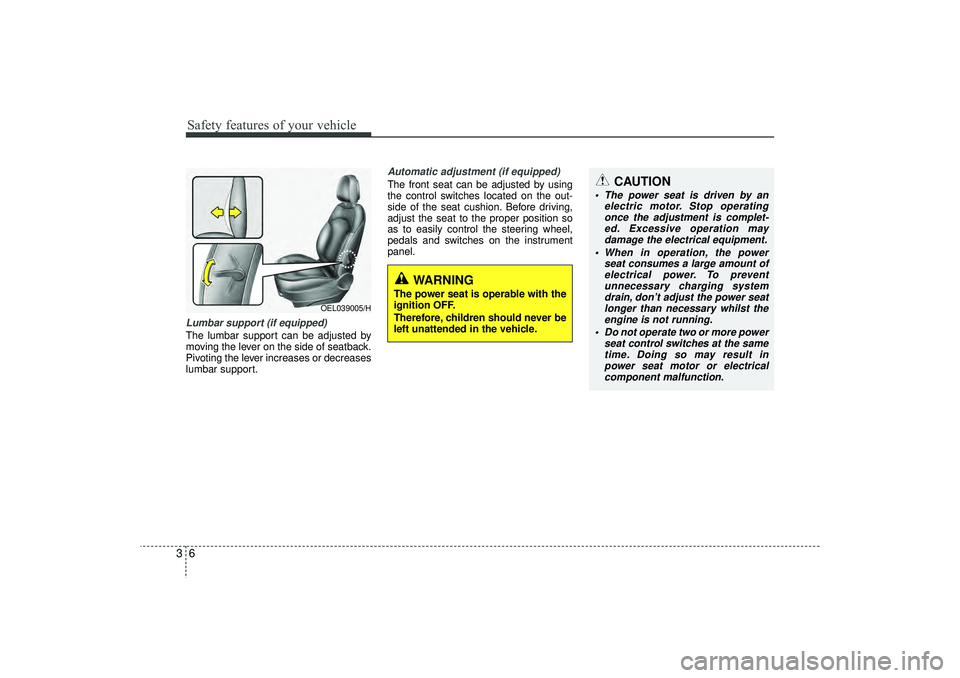
Safety features of your vehicle63Lumbar support (if equipped) The lumbar support can be adjusted by
moving the lever on the side of seatback.
Pivoting the lever increases or decreases
lumbar support.
Automatic adjustment (if equipped)The front seat can be adjusted by using
the control switches located on the out-
side of the seat cushion. Before driving,
adjust the seat to the proper position so
as to easily control the steering wheel,
pedals and switches on the instrument
panel.
WARNING
The power seat is operable with the
ignition OFF.
Therefore, children should never be
left unattended in the vehicle.
CAUTION
The power seat is driven by anelectric motor. Stop operatingonce the adjustment is complet- ed. Excessive operation maydamage the electrical equipment.
When in operation, the power seat consumes a large amount ofelectrical power. To preventunnecessary charging system drain, don’t adjust the power seatlonger than necessary whilst the engine is not running.
Do not operate two or more power seat control switches at the sametime. Doing so may result inpower seat motor or electrical component malfunction.
OEL039005/H
EL(FL) UK 3.QXP 12/16/2014 8:54 PM Page 6
Page 27 of 550
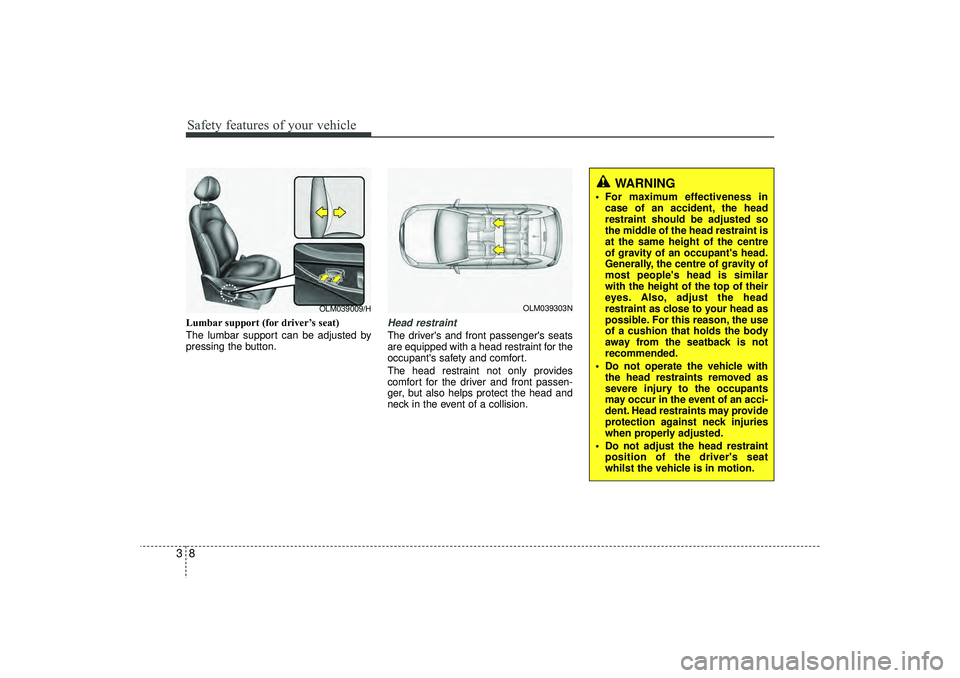
Safety features of your vehicle83Lumbar support (for driver’s seat)
The lumbar support can be adjusted by
pressing the button.
Head restraintThe driver's and front passenger's seats
are equipped with a head restraint for the
occupant's safety and comfort.
The head restraint not only provides
comfort for the driver and front passen-
ger, but also helps protect the head and
neck in the event of a collision.
OLM039303N
WARNING
For maximum effectiveness incase of an accident, the head
restraint should be adjusted so
the middle of the head restraint is
at the same height of the centre
of gravity of an occupant's head.
Generally, the centre of gravity of
most people's head is similar
with the height of the top of their
eyes. Also, adjust the head
restraint as close to your head as
possible. For this reason, the use
of a cushion that holds the body
away from the seatback is not
recommended.
Do not operate the vehicle with the head restraints removed as
severe injury to the occupants
may occur in the event of an acci-
dent. Head restraints may provide
protection against neck injuries
when properly adjusted.
Do not adjust the head restraint position of the driver's seat
whilst the vehicle is in motion.
OLM039009/H
EL(FL) UK 3.QXP 12/16/2014 8:54 PM Page 8
Page 28 of 550
39
Safety features of your vehicle
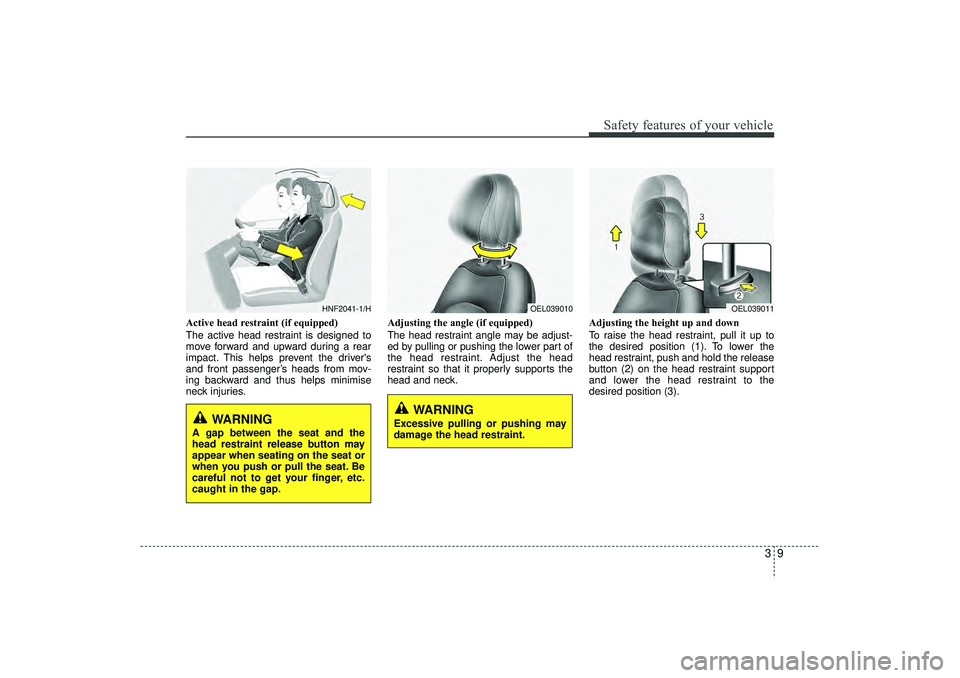
Active head restraint (if equipped)
The active head restraint is designed to
move forward and upward during a rear
impact. This helps prevent the driver's
and front passenger’s heads from mov-
ing backward and thus helps minimise
neck injuries.Adjusting the angle (if equipped)
The head restraint angle may be adjust-
ed by pulling or pushing the lower part of
the head restraint. Adjust the head
restraint so that it properly supports the
head and neck.
Adjusting the height up and down
To raise the head restraint, pull it up to
the desired position (1). To lower the
head restraint, push and hold the release
button (2) on the head restraint support
and lower the head restraint to the
desired position (3).
OEL039010
OEL039011
WARNING
Excessive pulling or pushing may
damage the head restraint.
HNF2041-1/H
WARNING
A gap between the seat and the
head restraint release button may
appear when seating on the seat or
when you push or pull the seat. Be
careful not to get your finger, etc.
caught in the gap.
EL(FL) UK 3.QXP 12/16/2014 8:54 PM Page 9
Page 29 of 550
Safety features of your vehicle10
3
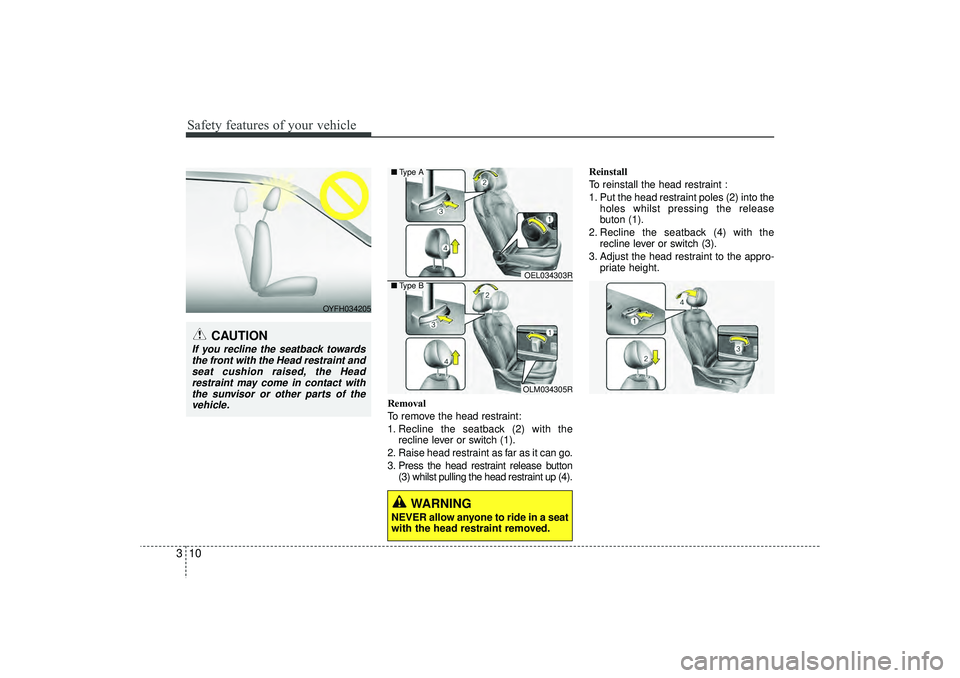
Removal
To remove the head restraint:
1. Recline the seatback (2) with the
recline lever or switch (1).
2. Raise head restraint as far as it can go.
3. Press the head restraint release button (3) whilst pulling the head restraint up (4). Reinstall
To reinstall the head restraint :
1. Put the head restraint poles (2) into the
holes whilst pressing the release
buton (1).
2. Recline the seatback (4) with the recline lever or switch (3).
3. Adjust the head restraint to the appro- priate height.
WARNING
NEVER allow anyone to ride in a seat
with the head restraint removed.
OEL034303ROLM034305R
■Type A■Type B
OYFH034205
CAUTION
If you recline the seatback towards
the front with the Head restraint andseat cushion raised, the Headrestraint may come in contact with the sunvisor or other parts of thevehicle.
EL(FL) UK 3.QXP 12/16/2014 8:55 PM Page 10
Page 30 of 550
311
Safety features of your vehicle
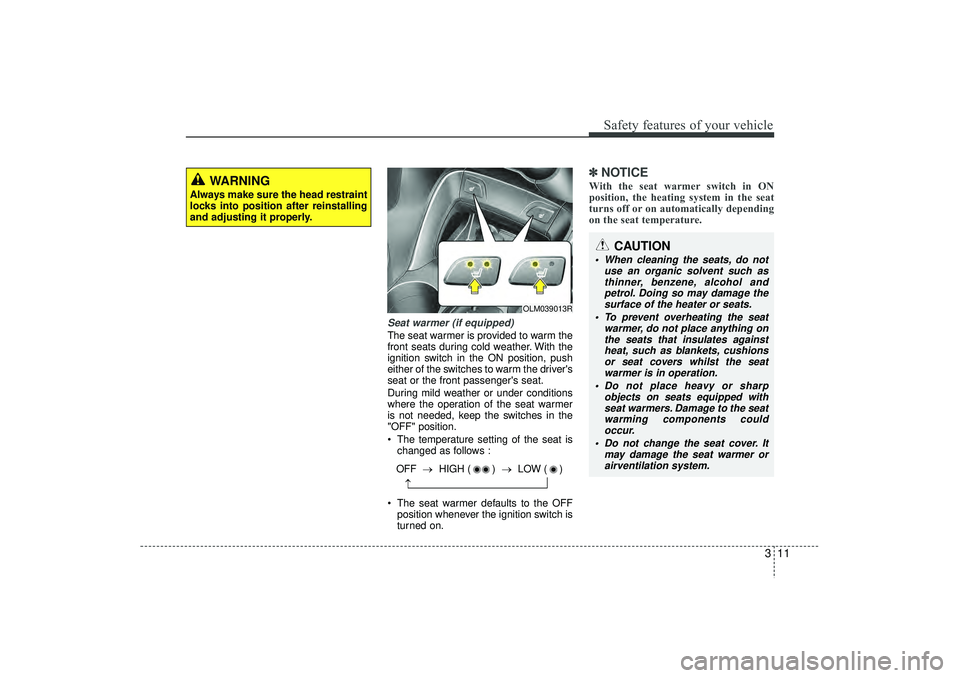
Seat warmer (if equipped)The seat warmer is provided to warm the
front seats during cold weather. With the
ignition switch in the ON position, push
either of the switches to warm the driver's
seat or the front passenger's seat.
During mild weather or under conditions
where the operation of the seat warmer
is not needed, keep the switches in the
"OFF" position.
The temperature setting of the seat ischanged as follows :
The seat warmer defaults to the OFF position whenever the ignition switch is
turned on.
✽ ✽ NOTICEWith the seat warmer switch in ON
position, the heating system in the seat
turns off or on automatically depending
on the seat temperature.
OLM039013R
OFF → HIGH ( ) → LOW ( )
→
CAUTION
When cleaning the seats, do not
use an organic solvent such asthinner, benzene, alcohol andpetrol. Doing so may damage thesurface of the heater or seats.
To prevent overheating the seat warmer, do not place anything onthe seats that insulates againstheat, such as blankets, cushions or seat covers whilst the seatwarmer is in operation.
Do not place heavy or sharp objects on seats equipped withseat warmers. Damage to the seatwarming components could occur.
Do not change the seat cover. It may damage the seat warmer orairventilation system.
WARNING
Always make sure the head restraint
locks into position after reinstalling
and adjusting it properly.
EL(FL) UK 3.QXP 12/16/2014 8:55 PM Page 11
Page 31 of 550
Safety features of your vehicle12
3
Seatback pocket The seatback pocket is provided on the
back of the front passenger’s and driver’s
seatbacks.
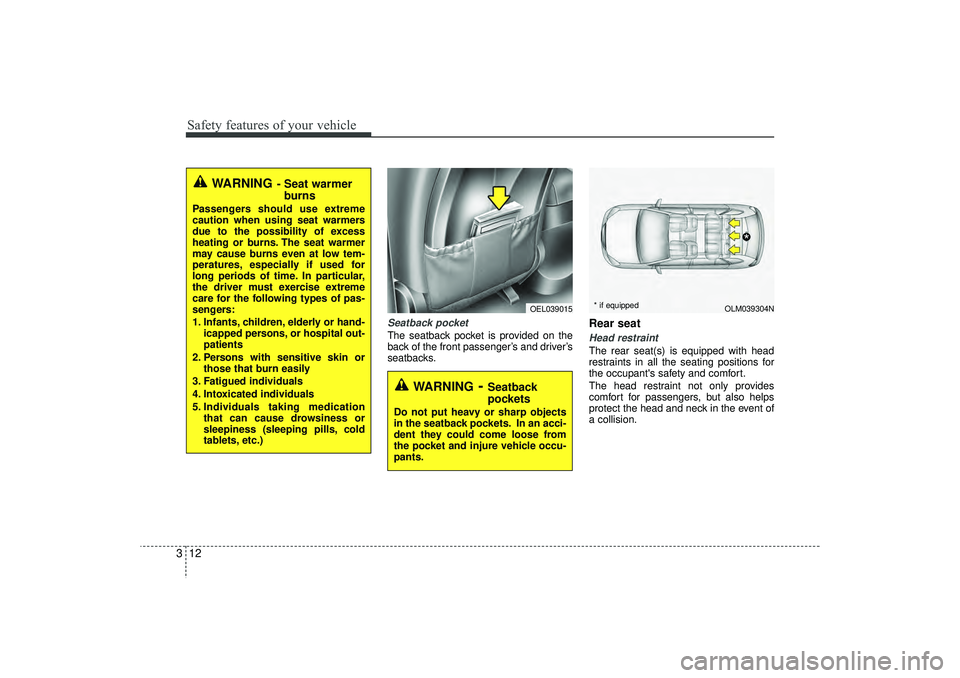
Rear seat Head restraintThe rear seat(s) is equipped with head
restraints in all the seating positions for
the occupant's safety and comfort.
The head restraint not only provides
comfort for passengers, but also helps
protect the head and neck in the event of
a collision.
OLM039304N
*
* if equipped
OEL039015
WARNING
- Seatback
pockets
Do not put heavy or sharp objects
in the seatback pockets. In an acci-
dent they could come loose from
the pocket and injure vehicle occu-
pants.
WARNING
- Seat warmer
burns
Passengers should use extreme
caution when using seat warmers
due to the possibility of excess
heating or burns. The seat warmer
may cause burns even at low tem-
peratures, especially if used for
long periods of time. In particular,
the driver must exercise extreme
care for the following types of pas-
sengers:
1. Infants, children, elderly or hand-
icapped persons, or hospital out-
patients
2. Persons with sensitive skin or those that burn easily
3. Fatigued individuals
4. Intoxicated individuals
5. Individuals taking medication that can cause drowsiness or
sleepiness (sleeping pills, cold
tablets, etc.)
EL(FL) UK 3.QXP 12/16/2014 8:55 PM Page 12
Page 32 of 550
313
Safety features of your vehicle
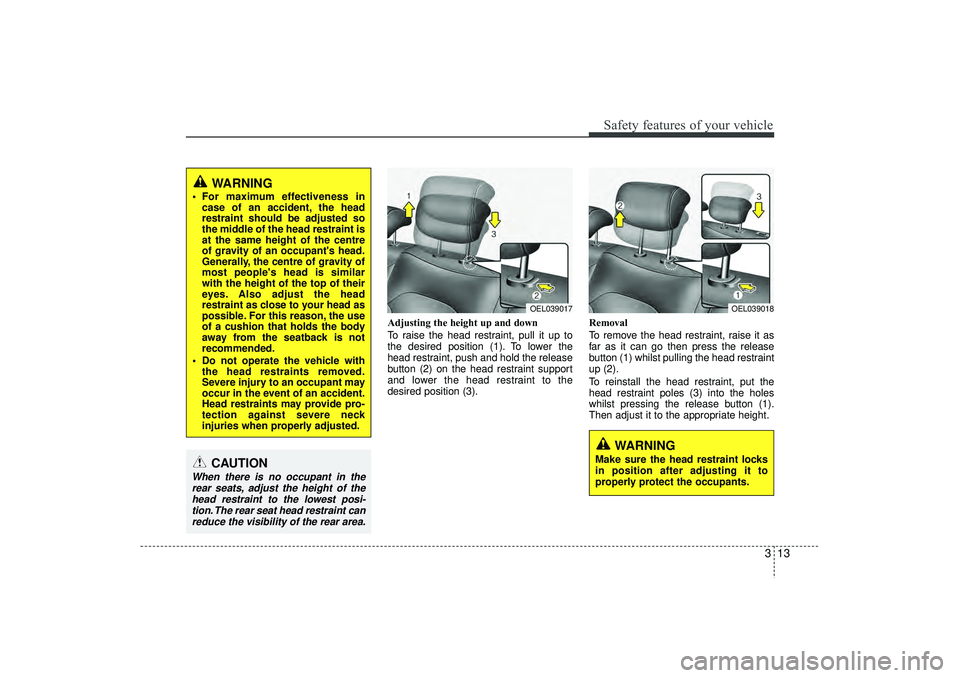
Adjusting the height up and down
To raise the head restraint, pull it up to
the desired position (1). To lower the
head restraint, push and hold the release
button (2) on the head restraint support
and lower the head restraint to the
desired position (3).Removal
To remove the head restraint, raise it as
far as it can go then press the release
button (1) whilst pulling the head restraint
up (2).
To reinstall the head restraint, put the
head restraint poles (3) into the holes
whilst pressing the release button (1).
Then adjust it to the appropriate height.
OEL039018
WARNING
Make sure the head restraint locks
in position after adjusting it to
properly protect the occupants.
WARNING
For maximum effectiveness in
case of an accident, the head
restraint should be adjusted so
the middle of the head restraint is
at the same height of the centre
of gravity of an occupant's head.
Generally, the centre of gravity of
most people's head is similar
with the height of the top of their
eyes. Also adjust the head
restraint as close to your head as
possible. For this reason, the use
of a cushion that holds the body
away from the seatback is not
recommended.
Do not operate the vehicle with the head restraints removed.
Severe injury to an occupant may
occur in the event of an accident.
Head restraints may provide pro-
tection against severe neck
injuries when properly adjusted.
OEL039017
CAUTION
When there is no occupant in the
rear seats, adjust the height of thehead restraint to the lowest posi-tion. The rear seat head restraint can reduce the visibility of the rear area.
EL(FL) UK 3.QXP 12/16/2014 8:55 PM Page 13