2015 Hyundai H350 engine
[x] Cancel search: enginePage 453 of 473

7-90
Maintenance
Diesel Particulate Filter (if equipped)
The Diesel Particulate Filter (DPF)
system removes the soot emitted
from the vehicle.
Unlike a disposable air filter, the DPF
system automatically burns (oxi-
dizes) and removes the accumulated
soot according to the driving condi-
tion. In other words, the active burn-
ing by engine control system and
high exhaust gas temperature
caused by normal/high driving condi-
tion burns and removes the accumu-lated soot.
However, if the vehicle continues to
be driven in short distance repeated-
ly or at low speed for a long time, the
accumulated soot may not be auto-
matically removed because of low
exhaust gas temperature. In this par-
ticular case, if the amount of soot is
out of detection limit, the DPF warn-
ing indicator ( ) will illuminate. In order to start the DPF regenera-
tion and to stop the DPF warning
lamp illuminating, drive the vehicle in
a safety driving circumstance with
more than 60km/h (37 mph) vehiclespeed or with more than secondgear engaged and 1500 ~ 2000
engine rpm for a certain time (for
about 25 minutes).
If the DPF warning indicator( )
continues to blink or "check emissionsystem" message comes on in the
cluster in spite of the above proce-
dure, we recommend that the system
be checked by an authorized
HYUNDAI dealer.
If you continue to drive with the indi-
cator light blinking for a long time, theDPF system can be damaged and
fuel consumption can be worsen.Diesel Fuel (if equipped with DPF) It is recommended to use the regulated automotive diesel
fuel for diesel vehicle equippedwith the DPF system.
If you use diesel fuel including high sulfur (more than 50 ppm
sulfur) and unspecified addi-
tives, it can cause the DPF sys-
tem to be damaged and whitesmoke can be emitted.
CAUTION
Page 454 of 473

8
Specifications & Consumer information
8
Specifications & Consumer information
8
Dimensions ..............................................................8-2
Engine ......................................................................8-3
Air conditioning system ........................................8-3
Bulb wattage ...........................................................8-4
Tires and wheels ....................................................8-5
Load and speed capacity tires .............................8-5
Gross vehicle weight .............................................8-6
Recommended lubricants and capacities ...........8-7Available engine oil (For Europe) ..................................8-8
Recommended SAE viscosity number ..........................8-9
Vehicle identification number (VIN) ..................8-10
Vehicle certification label ...................................8-10
Tire specification and pressure label ...............8-11
Engine number .....................................................8-11
Air conditioner compressor label ......................8-11
Declaration of conformity ..................................8-12
Page 460 of 473

8-7
8
Specifications & Consumer information
RREECCOO MM MMEENN DDEEDD LL UU BBRRIICC AA NN TTSS AA NN DD CC AA PPAA CCIITT IIEE SS
To help achieve proper engine and powertrain performance and durability, use only lubricants of the proper quality.
The correct lubricants also help promote engine efficiency that results in improved fuel economy.
These lubricants and fluids are recommended for use in your vehicle.
LubricantVolume Classification
Engine oil *1 *2
(drain and refill) Recommends
Diesel Engine8.7 l(9.19 US qt.)
ACEA C2
SAE 15W-40 : -15°C above
SAE 10W-30/40 : -20°C above SAE 5W-30/40 : -25°C aboveSAE 0W-30/40 : -30°C below
Engine Oil ConsumptionNormal driving conditionMAX. 1L /1500 Km-
Severe driving conditionMAX. 1L /1000 Km-
Manual transmission fluidWith PTO3.5 l(3.7 US qt.)API GL-4, SAE 75W/85 (Synthetic)Without PTO3.2 l(3.38 US qt.)
Rear axle oilTropical zone2.5 ± 0.25 l(2.64 ± 0.26 US qt.)API GL-5, SAE 140
Temperated/frigid zone2.5 ± 0.25 l(2.64 ± 0.26 US qt.)API GL-5, SAE 80W90
Coolant BUS15 l(15.9 US qt.)
15.2 l(16.1 US qt.) (with preheat)Mixture of antifreeze and distilled water
(Ethylene glycol base coolant for aluminum radiator)
VAN, Truck11.2 l(11.8 US qt.)
Power steering fluid1.15 l(1.2 US qt.)PSF-3
*1
Refer to the recommended SAE viscosity numbers on 8-9 page.
* 2
Engine oils labeled Energy Conserving Oil are now available. Along with other additional benefits, they contribute to fuel econo -
my by reducing the amount of fuel necessary to overcome engine friction. Often, these improvements are difficult to measure in
everyday driving, but in a year’s time, they can offer significant cost and energy savings.
Page 461 of 473

8-8
Specifications & Consumer information
Lubricant Volume Classification
Brake/clutch fluid0.984 l(1.04 US qt.)FMVSS116 DOT-4
Urea solution 22
l(23.2 US qt.) AUS 32 DIN V70070, ISO/DIS 22241-1 (If the vehicle is driven with
urea solution volume less than 4%, engine output will be limited.
And if it is less than 1%, vehicle speed will be limited to 20 km/h.)
Fuel 75
l(79.3 US gal.)
Refer to “Fuel requirements” in foreword
Urea consumption per liter 580 km
Available Engine oil (For Europe)
Supplier Product
Diesel Engine
Shell HELIX ULTRA AP-L 5W-30
Page 462 of 473
8-9
8
Specifications & Consumer information
Recommended SAE viscosity
number
Always be sure to clean the area
around any filler plug, drain
plug, or dipstick before check-
ing or draining any lubricant.
This is especially important in
dusty or sandy areas and when
the vehicle is used on unpaved
roads. Cleaning the plug and
dipstick areas will prevent dirt
and grit from entering the
engine and other mechanisms
that could be damaged.
CAUTION
Temperature Range for SAE Viscosity Numbers
Temperature°C
(°F)-30 -20 -10 0 10 20 30 40 50 -10 0 20 40 60 80 100 120
Diesel
Engine Oil5W-30/40
15W-40
10W-30/40
0W-30/40
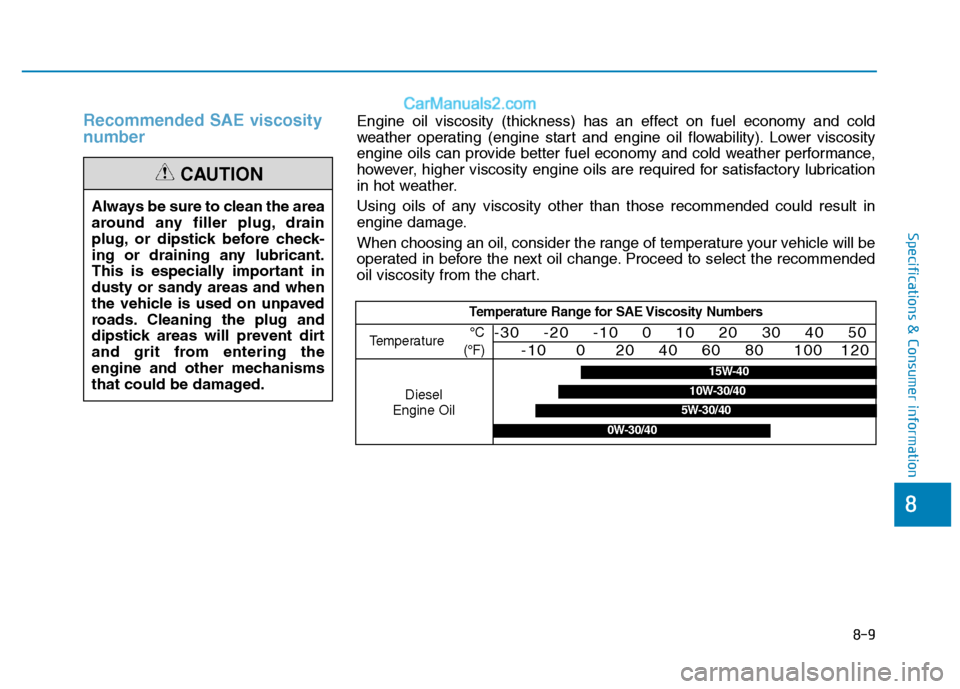
Engine oil viscosity (thickness) has an effect on fuel economy and cold
weather operating (engine start and engine oil flowability). Lower viscosity
engine oils can provide better fuel economy and cold weather performance,
however, higher viscosity engine oils are required for satisfactory lubrication
in hot weather.
Using oils of any viscosity other than those recommended could result in
engine damage.
When choosing an oil, consider the range of temperature your vehicle will be
operated in before the next oil change. Proceed to select the recommended
oil viscosity from the chart.
Page 463 of 473

8-10
Specifications & Consumer information
The vehicle identification number
(VIN) is the number used in register-
ing your vehicle and in all legal mat-
ters pertaining to its ownership, etc.
The number is punched on the
engine compartment bulkhead.The VIN is also on a plate attached
to the top of the dashboard. The
number on the plate can easily beseen through the windshield from
outside.
The vehicle certification label
attached on the driver’s (or front pas-
senger’s) side center pillar gives the
vehicle identification number (VIN).
VV
EEHH IICC LLEE IIDD EENN TTIIFF IICC AA TTIIOO NN NN UU MM BBEERR (( VV IINN )) VVEEHH IICC LLEE CC EE RR TTIIFF IICC AA TTIIOO NN
L
L AA BBEELL
OEU074057
Frame number
OEU084002
VIN label (if equipped)
OEU084003
Page 464 of 473

8-11
8
Specifications & Consumer information
The tires supplied on your new vehi-
cle are chosen to provide the best
performance for normal driving.
The tire label located on the driver's
side center pillar gives the tire pres-
sures recommended for your vehicle.The engine number is stamped on
the engine block as shown in the
drawing.
A compressor label informs you the
type of compressor your vehicle isequipped with such as model, suppli-
er part number, production number,
refrigerant (1) and refrigerant oil (2).
TT
IIRR EE SS PP EECCIIFF IICC AA TTIIOO NN AA NN DD
P
P RR EESSSSUU RREE LL AA BBEELL E
E
NN GGIINN EE NN UU MM BBEERR
OEU084004
OEU084005
OHC081001
AA IIRR CC OO NNDDIITT IIOO NNEERR
C
C OO MM PPRR EESSSSOO RR LL AA BBEELL
Page 468 of 473

I-3
Rear heating and air conditioning............................3-116
System operation......................................................3-117
Cruise control system ...................................................5-30
Declaration of conformity ............................................8-12
Defroster .....................................................................3-109
Digital tachograph ........................................................3-80
Dimensions .....................................................................8-2
Door lock ......................................................................3-11 Deadlocks...................................................................3-14
Operating door locks from inside the vehicle ...........3-12
Operating door locks from outside the vehicle .........3-11
Speed sensing door lock system ................................3-14
Economical operation ...................................................5-42 Electrical step.............................................................3-17
Electrical step warning alarm ....................................3-19
Operation and obstacle detection...............................3-19
Regular cleaning ........................................................3-21
Emergency commodity .................................................6-27 Fire extinguisher ........................................................6-27
First aid kit .................................................................6-27
Tire pressure gauge ....................................................6-28
Triangle reflector .......................................................6-28
Emergency exit .............................................................6-26 Emergency starting .........................................................6-4
Emission control system ...............................................7-87
Crankcase emission control system ...........................7-87
Evaporative emission control system ........................7-87
Exhaust emission control system...............................7-88
Engine compartment .............................................1-10, 7-3
Engine coolant ..............................................................7-24 Changing the coolant .................................................7-26
Checking the coolant level ........................................7-24
Engine number ..............................................................8-11
Engine oil......................................................................7-22 Changing the engine oil and filter .............................7-23
Checking the engine oil level ....................................7-22
Engine .............................................................................8-3
Explanation of scheduled maintenance items ..............7-19
Exterior overview (I) .....................................................1-2
Exterior overview (II) .....................................................1-3
Exterior overview (III) ...................................................1-4
Exterior overview (IV) ...................................................1-5
Exterior overview (V).....................................................1-6
Exterior overview (VI) ...................................................1-7
Fuel filler lid .................................................................3-32
Fuel filter (For diesel)...................................................7-30 Draining water from fuel filter ..................................7-30
Fuel filter cartridge replacement................................7-30
I
Index
D
E
F