2015 Hyundai Grand Santa Fe SAE
[x] Cancel search: SAEPage 253 of 717
Features of your vehicle
156 4
Air conditioning (if equipped)
HYUNDAI Air Conditioning Systems
are filled with environmentally friend-
ly refrigerant*.
1. Start the engine. Push the air con-
ditioning button.
2. Set the mode to the position.
3. Set the air intake control to the out-
side air or recirculated air position.
4. Adjust the fan speed control and
temperature control to maintain
maximum comfort.
*: Your vehicle is filled with R-134a or
R-1234yf according to the regula-
tion in your country at the time of
producing. You can find out which
air conditioning refrigerant is
applied your vehicle at the label
inside of the engine room. Refer to
section 8 for more detail location of
air conditioning refrigerant label.
✽NOTICE
• When using the air conditioning
system, monitor the temperature
gauge closely while driving up
hills or in heavy traffic when out-
side temperatures are high. Air
conditioning system operation
may cause engine overheating.
Continue to use the blower fan but
turn the air conditioning system
off if the temperature gauge indi-
cates engine overheating.
• When opening the windows in
humid weather air conditioning
may create water droplets inside
the vehicle. Since excessive water
droplets may cause damage to
electrical equipment, air condi-
tioning should only be used with
the windows closed.CAUTION
• The refrigerant system should
only be serviced by trained and
certified technicians to insure
proper and safe operation.
• The refrigerant system should
be serviced in a well-ventilat-
ed place.
• The air conditioning evaporator
(cooling coil) shall never be
repaired or replaced with one
removed from a used or sal-
vaged vehicle and new replace-
ment MAC evaporators shall be
certified (and labeled) as meet-
ing SAE Standard J2842.
Page 267 of 717
Features of your vehicle
170 4
Air conditioning (if equipped)
HYUNDAI Air Conditioning Systems
are filled with environmentally friend-
ly refrigerant*.
1. Start the engine. Push the air con-
ditioning button.
2. Set the mode to the position.
3. Set the air intake control to the
outside air or recirculated air posi-
tion.
4. Adjust the fan speed control and
temperature control to maintain
maximum comfort.
*: Your vehicle is filled with R-134a or
R-1234yf according to the regula-
tion in your country at the time of
producing. You can find out which
air conditioning refrigerant is
applied your vehicle at the label
inside of hood. Refer to section 8
for more detail location of air con-
ditioning refrigerant label.
✽NOTICE
• When using the air conditioning
system, monitor the temperature
gauge closely while driving up
hills or in heavy traffic when out-
side temperatures are high. Air
conditioning system operation
may cause engine overheating.
Continue to use the blower fan but
turn the air conditioning system
off if the temperature gauge indi-
cates engine overheating.
• When opening the windows in
humid weather air conditioning
may create water droplets inside
the vehicle. Since excessive water
droplets may cause damage to
electrical equipment, air condi-
tioning should only be used with
the windows closed.CAUTION
• The refrigerant system should
only be serviced by trained
and certified technicians to
insure proper and safe opera-
tion.
• The refrigerant system should
be serviced in a well-ventilat-
ed place.
• The air conditioning evapora-
tor (cooling coil) shall never
be repaired or replaced with
one removed from a used or
salvaged vehicle and new
replacement MAC evaporators
shall be certified (and labeled)
as meeting SAE Standard
J2842.
Page 531 of 717
Driving your vehicle
82 5
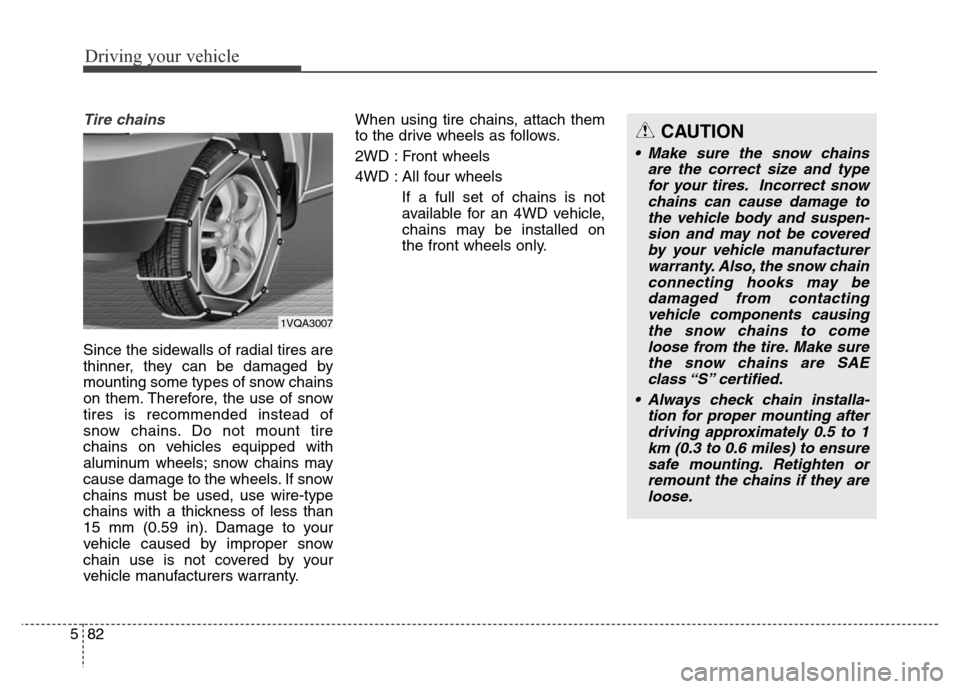
Tire chains
Since the sidewalls of radial tires are
thinner, they can be damaged by
mounting some types of snow chains
on them. Therefore, the use of snow
tires is recommended instead of
snow chains. Do not mount tire
chains on vehicles equipped with
aluminum wheels; snow chains may
cause damage to the wheels. If snow
chains must be used, use wire-type
chains with a thickness of less than
15 mm (0.59 in). Damage to your
vehicle caused by improper snow
chain use is not covered by your
vehicle manufacturers warranty.When using tire chains, attach them
to the drive wheels as follows.
2WD : Front wheels
4WD : All four wheels
If a full set of chains is not
available for an 4WD vehicle,
chains may be installed on
the front wheels only.
CAUTION
• Make sure the snow chains
are the correct size and type
for your tires. Incorrect snow
chains can cause damage to
the vehicle body and suspen-
sion and may not be covered
by your vehicle manufacturer
warranty. Also, the snow chain
connecting hooks may be
damaged from contacting
vehicle components causing
the snow chains to come
loose from the tire. Make sure
the snow chains are SAE
class “S” certified.
• Always check chain installa-
tion for proper mounting after
driving approximately 0.5 to 1
km (0.3 to 0.6 miles) to ensure
safe mounting. Retighten or
remount the chains if they are
loose.
1VQA3007
Page 630 of 717
749
Maintenance
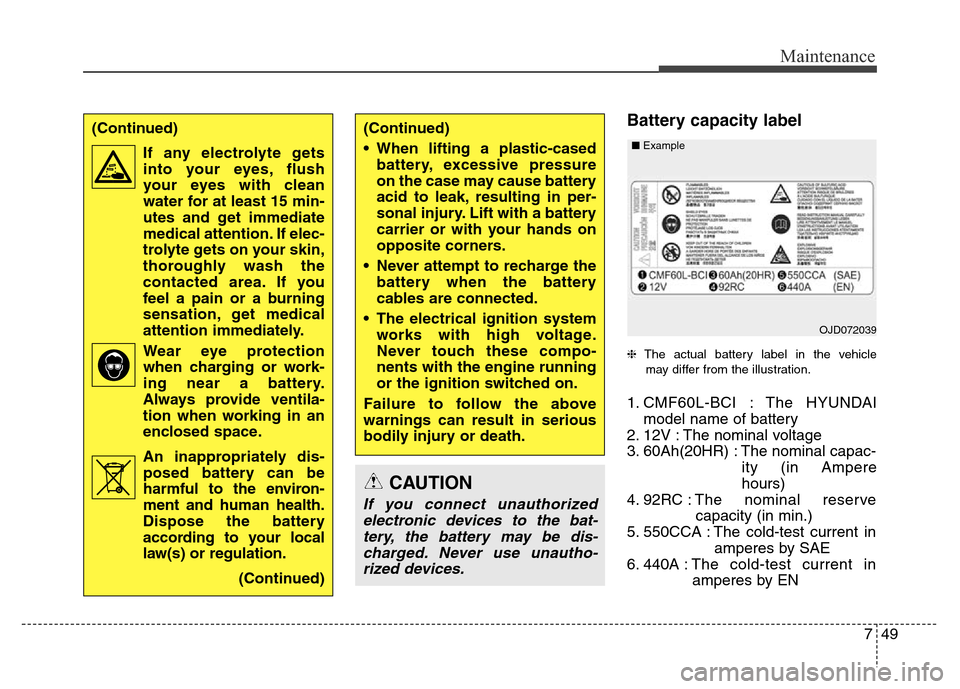
Battery capacity label
❈The actual battery label in the vehicle
may differ from the illustration.
1. CMF60L-BCI : The HYUNDAI
model name of battery
2. 12V : The nominal voltage
3. 60Ah(20HR) : The nominal capac-
ity (in Ampere
hours)
4. 92RC :The nominal reserve
capacity (in min.)
5. 550CCA : The cold-test current in
amperes by SAE
6. 440A :The cold-test current in
amperes by EN
(Continued)
• When lifting a plastic-cased
battery, excessive pressure
on the case may cause battery
acid to leak, resulting in per-
sonal injury. Lift with a battery
carrier or with your hands on
opposite corners.
• Never attempt to recharge the
battery when the battery
cables are connected.
• The electrical ignition system
works with high voltage.
Never touch these compo-
nents with the engine running
or the ignition switched on.
Failure to follow the above
warnings can result in serious
bodily injury or death.
CAUTION
If you connect unauthorized
electronic devices to the bat-
tery, the battery may be dis-
charged. Never use unautho-
rized devices.
OJD072039 ■Example
(Continued)
If any electrolyte gets
into your eyes, flush
your eyes with clean
water for at least 15 min-
utes and get immediate
medical attention. If elec-
trolyte gets on your skin,
thoroughly wash the
contacted area. If you
feel a pain or a burning
sensation, get medical
attention immediately.
Wear eye protection
when charging or work-
ing near a battery.
Always provide ventila-
tion when working in an
enclosed space.
An inappropriately dis-
posed battery can be
harmful to the environ-
ment and human health.
Dispose the battery
according to your local
law(s) or regulation.
(Continued)
Page 689 of 717
Specifications & Consumer information
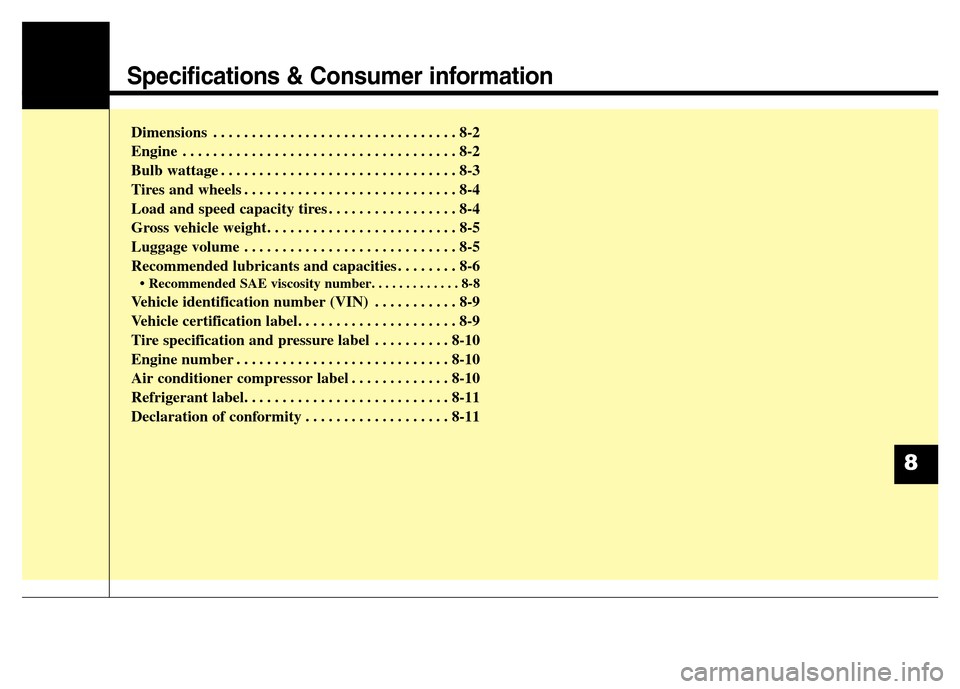
Dimensions . . . . . . . . . . . . . . . . . . . . . . . . . . . . . . . . 8-2
Engine . . . . . . . . . . . . . . . . . . . . . . . . . . . . . . . . . . . . 8-2
Bulb wattage . . . . . . . . . . . . . . . . . . . . . . . . . . . . . . . 8-3
Tires and wheels . . . . . . . . . . . . . . . . . . . . . . . . . . . . 8-4
Load and speed capacity tires . . . . . . . . . . . . . . . . . 8-4
Gross vehicle weight. . . . . . . . . . . . . . . . . . . . . . . . . 8-5
Luggage volume . . . . . . . . . . . . . . . . . . . . . . . . . . . . 8-5
Recommended lubricants and capacities . . . . . . . . 8-6
• Recommended SAE viscosity number. . . . . . . . . . . . . 8-8
Vehicle identification number (VIN) . . . . . . . . . . . 8-9
Vehicle certification label. . . . . . . . . . . . . . . . . . . . . 8-9
Tire specification and pressure label . . . . . . . . . . 8-10
Engine number . . . . . . . . . . . . . . . . . . . . . . . . . . . . 8-10
Air conditioner compressor label . . . . . . . . . . . . . 8-10
Refrigerant label. . . . . . . . . . . . . . . . . . . . . . . . . . . 8-11
Declaration of conformity . . . . . . . . . . . . . . . . . . . 8-11
8
Page 695 of 717
87
Specifications & Consumer information
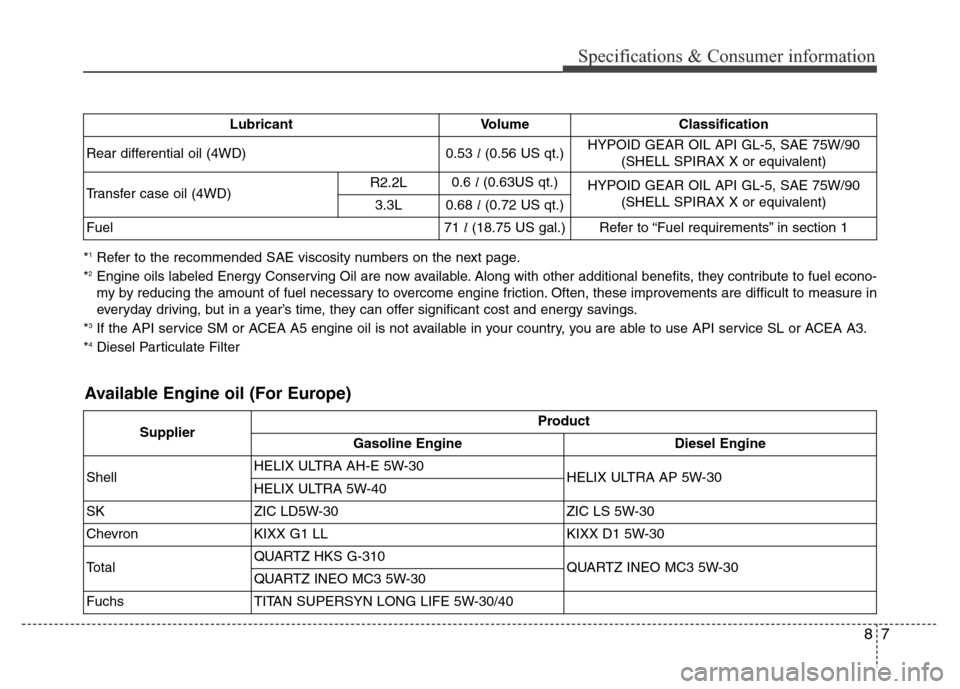
*1Refer to the recommended SAE viscosity numbers on the next page.
*2Engine oils labeled Energy Conserving Oil are now available. Along with other additional benefits, they contribute to fuel econo-
my by reducing the amount of fuel necessary to overcome engine friction. Often, these improvements are difficult to measure in
everyday driving, but in a year’s time, they can offer significant cost and energy savings.
*
3If the API service SM or ACEA A5 engine oil is not available in your country, you are able to use API service SL or ACEA A3.
*4Diesel Particulate FilterLubricant Volume Classification
Rear differential oil (4WD)0.53 l(0.56 US qt.)HYPOID GEAR OIL API GL-5, SAE 75W/90
(SHELL SPIRAX X or equivalent)
Transfer case oil (4WD) R2.2L0.6 l(0.63US qt.)
HYPOID GEAR OIL API GL-5, SAE 75W/90
(SHELL SPIRAX X or equivalent)
3.3L0.68 l(0.72 US qt.)
Fuel71 l(18.75 US gal.)
Refer to “Fuel requirements” in section 1
Available Engine oil (For Europe)
SupplierProduct
Gasoline Engine Diesel Engine
ShellHELIX ULTRA AH-E 5W-30
HELIX ULTRA AP 5W-30
HELIX ULTRA 5W-40
SK ZIC LD5W-30 ZIC LS 5W-30
Chevron KIXX G1 LL KIXX D1 5W-30
TotalQUARTZ HKS G-310
QUARTZ INEO MC3 5W-30
QUARTZ INEO MC3 5W-30
Fuchs TITAN SUPERSYN LONG LIFE 5W-30/40
Page 696 of 717
Specifications & Consumer information
8 8
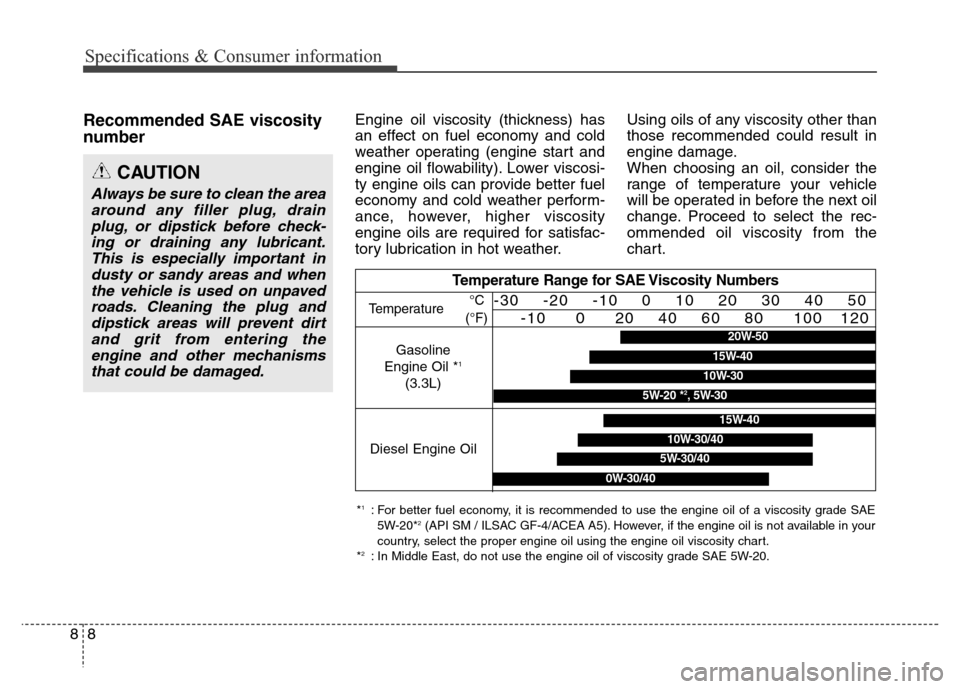
Recommended SAE viscosity
number Engine oil viscosity (thickness) has
an effect on fuel economy and cold
weather operating (engine start and
engine oil flowability). Lower viscosi-
ty engine oils can provide better fuel
economy and cold weather perform-
ance, however, higher viscosity
engine oils are required for satisfac-
tory lubrication in hot weather.Using oils of any viscosity other than
those recommended could result in
engine damage.
When choosing an oil, consider the
range of temperature your vehicle
will be operated in before the next oil
change. Proceed to select the rec-
ommended oil viscosity from the
chart.
CAUTION
Always be sure to clean the area
around any filler plug, drain
plug, or dipstick before check-
ing or draining any lubricant.
This is especially important in
dusty or sandy areas and when
the vehicle is used on unpaved
roads. Cleaning the plug and
dipstick areas will prevent dirt
and grit from entering the
engine and other mechanisms
that could be damaged.
*1: For better fuel economy, it is recommended to use the engine oil of a viscosity grade SAE
5W-20*2(API SM / ILSAC GF-4/ACEA A5). However, if the engine oil is not available in your
country, select the proper engine oil using the engine oil viscosity chart.
*
2: In Middle East, do not use the engine oil of viscosity grade SAE 5W-20.
Temperature Range for SAE Viscosity Numbers
Temperature
Gasoline
Engine Oil *1
(3.3L)
°C
(°F)-30 -20 -10 0 10 20 30 40 50
-10 0 20 40 60 80 100 120
Diesel Engine Oil5W-30/40
15W-40
10W-30/40
0W-30/40
20W-50
10W-30
15W-40
5W-20 *2, 5W-30
Page 703 of 717
Appendix
4 9
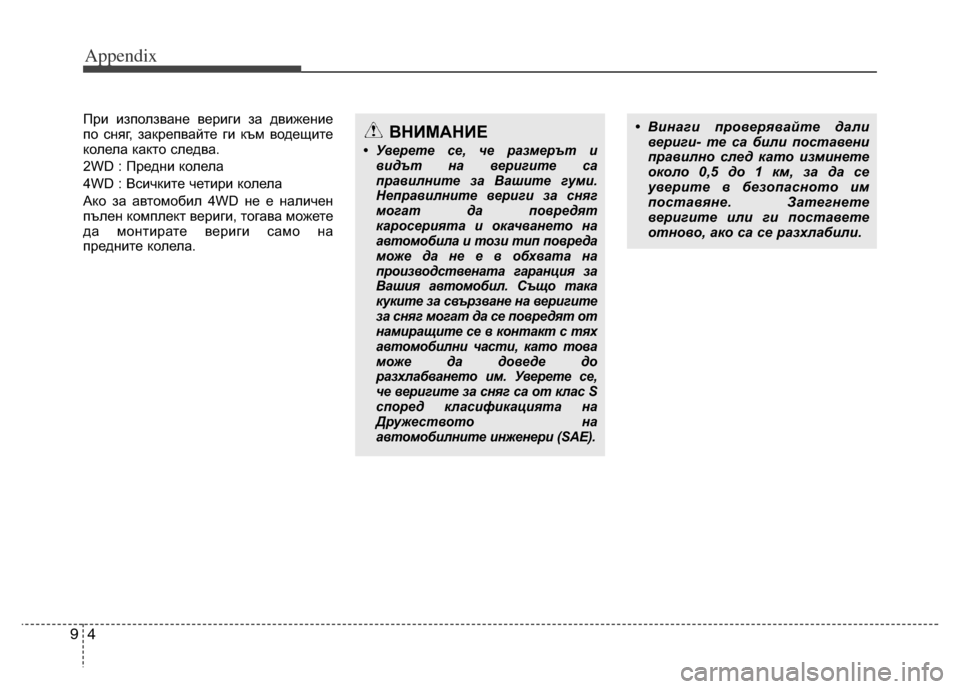
При използване вериги за движение
по сняг, закрепвайте ги към водещите
колела както следва.
2WD : Предни колела
4WD : Всичките четири колела
Ако за автомобил 4WD не е наличен
пълен комплект вериги, тогава можете
да монтирате вериги само на
предните колела.ВНИМАНИЕ
• Уверете се, че размерът и
видът на веригите са
правилните за Вашите гуми.
Неправилните вериги за сняг
могат да повредят
каросерията и окачването на
автомобила и този тип повреда
може да не е в обхвата на
производствената гаранция за
Вашия автомобил. Също така
куките за свързване на веригите
за сняг могат да се повредят от
намиращите се в контакт с тях
автомобилни части, като това
може да доведе до
разхлабването им. Уверете се,
че веригите за сняг са от клас S
според класификацията на
Дружеството на
автомобилните инженери (SAE).
• Винаги проверявайте дали
вериги- те са били поставени
правилно след като изминете
около 0,5 до 1 км, за да се
уверите в безопасното им
поставяне. Затегнете
веригите или ги поставете
отново, ако са се разхлабили.