Page 244 of 343
What to do in an emergency
16
6
When towing your vehicle in an emer- gency without wheel dollies:
1. Set the ignition switch in the ACC posi-
tion.
2. Place the transaxle shift lever in N (Neutral).
3. Release the parking brake.
Removable towing hook (front) (if equipped)
1. Open the tailgate, and remove the tow-ing hook from the tool bag.
2. Remove the hole cover pressing the lower part of the cover on the front
bumper. 3. Install the towing hook by turning it
clockwise into the hole until it is fullysecured.
4. Remove the towing hook and install the cover after use.
CAUTION
Failure to place the transaxle shift
lever in N (Neutral) may cause inter-
nal damage to the transaxle.
OBA063011OBA063012
Page 245 of 343

617
What to do in an emergency
Emergency towing
If towing is necessary, we recommend
you to have it done by an authorized
HYUNDAI dealer or a commercial tow
truck service.
If towing service is not available in an
emergency, your vehicle may be tem-
porarily towed using a cable or chain
secured to the emergency towing hook
under the front (or rear) of the vehicle.Use extreme caution when towing the
vehicle. A driver must be in the vehicle to
steer it and operate the brakes.
Towing in this manner may be done only
on hard-surfaced roads for a short dis-
tance and at low speeds. Also, the
wheels, axles, power train, steering and
brakes must all be in good condition.
Do not use the towing hooks to pull a
vehicle out of mud, sand or other con-
ditions from which the vehicle cannot
be driven out under its own power.
Avoid towing a vehicle heavier than the vehicle doing the towing.
The drivers of both vehicles should communicate with each other frequent-
ly. Before emergency towing, check that
the hook is not broken or damaged.
Fasten the towing cable or chain securely to the hook.
Do not jerk the hook. Apply it steadily with even force.
To avoid damaging the hook, do not pull from the side or at a vertical angle.
Always pull straight ahead.
OBA063012
OBA063013
■Front (if equipped)
■Rear
CAUTION
Attach a towing strap to the tow-
ing hook.
Using a portion of the vehicle other than the tow hooks for tow-ing may damage the body of yourvehicle.
Use only a cable or chain specifi- cally intended for use in towingvehicles. Securely fasten thecable or chain to the towing hookprovided.
Page 266 of 343

719
Maintenance
EXPLANATION OF SCHEDULED MAINTENANCE ITEMS
Engine oil and filter The engine oil and filter should be
changed at the intervals specified in the
maintenance schedule. If the vehicle is
being driven in severe conditions, morefrequent oil and filter changes arerequired. Drive belts
Inspect all drive belts for evidence of cuts,
cracks, excessive wear or oil saturation
and replace if necessary. Drive belts
should be checked periodically for proper
tension and adjusted as necessary. Fuel filter A clogged filter can limit the speed at
which the vehicle may be driven, damage
the emission system and cause multiple
issues such as hard starting. If an exces-
sive amount of foreign matter accumu-
lates in the fuel tank, the filter may
require replacement more frequently.
After installing a new filter, run the engine
for several minutes, and check for leaks
at the connections. We recommend that
the fuel filter be replaced by an author-
ized HYUNDAI dealer.
Fuel lines, fuel hoses and con- nections
Check the fuel lines, fuel hoses and con-
nections for leakage and damage. We
recommend that the fuel lines, fuel hoses
and connectionsr be replaced by an
authorized HYUNDAI dealer.Vapor hose and fuel filler cap
The vapor hose and fuel filler cap should
be inspected at those intervals specified
in the maintenance schedule. Make sure
that a new vapor hose or fuel filler cap iscorrectly replaced.
Vacuum crankcase ventilation hoses (if equipped)
Inspect the surface of hoses for evidence
of heat and/or mechanical damage. Hard
and brittle rubber, cracking, tears, cuts,
abrasions, and excessive swelling indi-
cate deterioration. Particular attention
should be paid to examine those hose
surfaces nearest to high heat sources,
such as the exhaust manifold. Inspect the hose routing to assure that the hoses do not come in contact with
any heat source, sharp edges or movingcomponent which might cause heat dam-
age or mechanical wear. Inspect all hose
connections, such as clamps and cou-
plings, to make sure they are secure, and
that no leaks are present. Hoses should
be replaced immediately if there is any
evidence of deterioration or damage.
Page 276 of 343

729
Maintenance
WASHER FLUID
Checking the washer fluid level
The reservoir is translucent so that you
can check the level with a quick visualinspection.
Check the fluid level in the washer fluid
reservoir and add fluid if necessary. Plain
water may be used if washer fluid is not
available. However, use washer solvent
with antifreeze characteristics in cold cli-
mates to prevent freezing. Checking the parking brake
Check the stroke of the parking brake by
counting the number of “clicks’’ heardwhile fully applying it from the released
position. Also, the parking brake alone
should securely hold the vehicle on a fair-
ly steep grade.
WARNING - Coolant
Do not use radiator coolant or antifreeze in the washer fluid
reservoir.
Radiator coolant can severely obscure visibility when sprayed
on the windshield and may cause
loss of vehicle control or damage
to paint and body trim.
Windshield Washer fluid agents contain some amounts of alcohol
and can be flammable under cer-
tain circumstances. Do not allowsparks or flame to contact thewasher fluid or the washer fluid
reservoir. Damage to the vehicle
or occupants could occur.
Windshield washer fluid is poi- sonous to humans and animals.
Do not drink and avoid contact-ing windshield washer fluid.
Serious injury or death could
occur.
OBA073008
OBA053006
OBA053006R
PARKING BRAKE
■
Left-hand drive
■Right-hand drive
Page 285 of 343

Maintenance
38
7
BATTERY
For best battery service
Keep the battery securely mounted.
Keep the battery top clean and dry.
Keep the terminals and connections clean, tight, and coated with petroleum
jelly or terminal grease.
Rinse any spilled electrolyte from the battery immediately with a solution of
water and baking soda.
If the vehicle is not going to be used for an extended time, disconnect the bat-
tery cables.
OBA073009
WARNING
To prevent SERIOUS INJURY or
DEATH to you or bystanders,
always follow these precautions
when working near or handling the
battery:
Always read and follow
instructions carefully when
handling a battery.
Wear eye protection
designed to protect the
eyes from acid splashes.
Keep all flames, sparks, or
smoking materials away
from the battery.
Hydrogen is always present in battery cells, is highly
combustible, and may
explode if ignited.
Keep batteries out of reach
of children.
Batteries contain sulfuric
acid which is highly corro-
sive. Do not allow acid to
contact your eyes, skin or
clothing.
(Continued)(Continued)
If acid gets into your eyes, flush
your eyes with clean water for at
least 15 minutes and get immediate
medical attention. If acid gets on
your skin, thoroughly wash the
area. If you feel pain or a burning
sensation, get medical attention
immediately.
When lifting a plastic-cased bat-tery, excessive pressure on the
case may cause battery acid to
leak. Lift with a battery carrier or
with your hands on opposite cor-
ners.
Do not attempt to jump start your vehicle if your battery is frozen.
NEVER attempt to recharge the battery when the vehicle’s battery
cables are connected to the bat-
tery.
The electrical ignition system works with high voltage. NEVER
touch these components with theengine running or when the igni-
tion switch is in the ON position.
Page 303 of 343
Maintenance
56
7
Main fuse (multi fuse)
If the main fuse is blown, it must be
removed as follows:
1. Disconnect the negative battery cable.
2. Remove the nuts shown in the picture
above.
3. Replace the fuse with a new one of the same rating.
4. Reinstall in the reverse order of removal.
✽✽ NOTICE
If the main fuse is blown, we recom-
mend that you consult an authorized
HYUNDAI dealer.
CAUTION
After checking the fuse box in the engine compartment, securely
install the fuse box cover. If not,electrical failures may occur fromwater leaking in.
OBA073015
Page 306 of 343

759
Maintenance
Fuse Name Symbol Fuse ratingCircuit Protected
BLOWER
7.5A PCM, A/C Control Module, Electronic A/C Compressor, Blower Switch, Blower Resistor
DR LOCK
20A Door Lock/Unlock Relay, T/Gate Unlock Relay, Crash Door Unlock Unit
HTD MIRR
10A PCM, A/C Control Module, Driver/Passenger Power Outside Mirror
MODULE 2
2 MODULE10A Stop Lamp Switch, Crash Pad Switch, Rear Parking Assist, Rear Parking Assist Sensor (Center) LH/RHSensor LH/RH
WIPER
25A Front Wiper Motor, Multifunction Switch
MEMORY
MEMORY10A Data Link Connector, Digital Clock, Instrument Cluster, BCM, Tire Pressure Motoring
Module, A/C Control Module, Crash Door Unlock Unit, Audio
INTERIOR LAMP
10A Luggage Lamp, Room Lamp
MODULE 3
3 MODULE10A E/R Junction Box (Multipurpose Check Connector), A/C Control Module
ECU
E10A PCM, Smart Key Control Module, Alternator (G3LA/G4LA)
A/CON 2
10A PCB Fuse & Relay Box (Blower Relay), A/C Control Module
MULTI MEDIA
MULTI
MEDIA20A Auido
POWER
OUTLET 2
2 POWER
OUTLET20A Rear Power Outlet
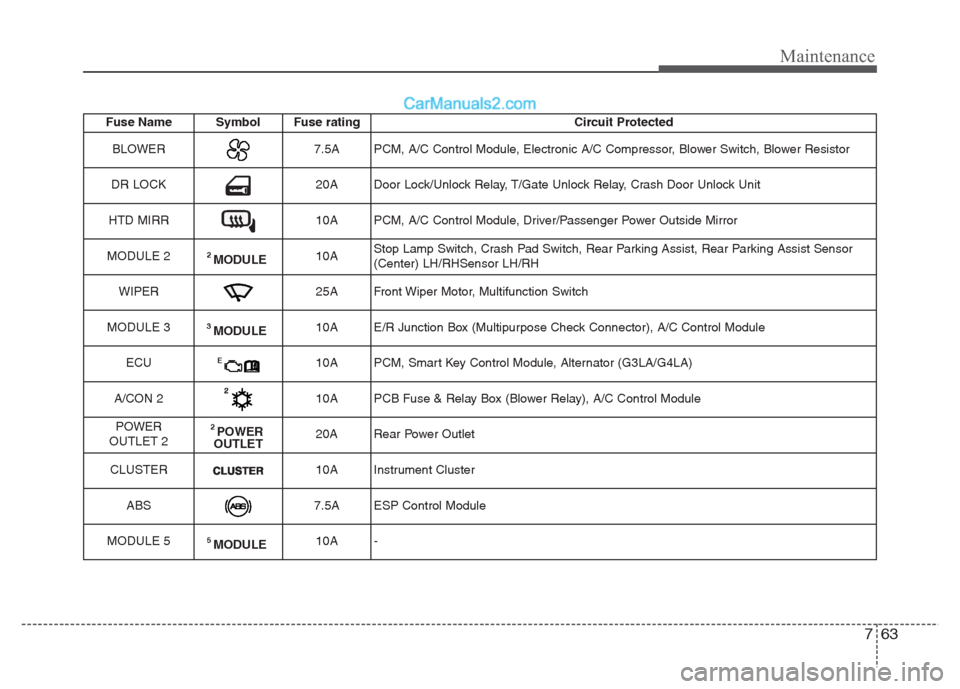
Page 310 of 343
763
Maintenance
Fuse Name Symbol Fuse ratingCircuit Protected
BLOWER
7.5A PCM, A/C Control Module, Electronic A/C Compressor, Blower Switch, Blower Resistor
DR LOCK
20A Door Lock/Unlock Relay, T/Gate Unlock Relay, Crash Door Unlock Unit
HTD MIRR
10A PCM, A/C Control Module, Driver/Passenger Power Outside Mirror
MODULE 2
2 MODULE10A Stop Lamp Switch, Crash Pad Switch, Rear Parking Assist, Rear Parking Assist Sensor (Center) LH/RHSensor LH/RH
WIPER
25A Front Wiper Motor, Multifunction Switch
MODULE 3
3 MODULE10A E/R Junction Box (Multipurpose Check Connector), A/C Control Module
ECU
E10A PCM, Smart Key Control Module, Alternator (G3LA/G4LA)
A/CON 2
10A PCB Fuse & Relay Box (Blower Relay), A/C Control Module
POWER
OUTLET 2
2 POWER
OUTLET20A Rear Power Outlet
CLUSTER
10A Instrument Cluster
ABS
7.5A ESP Control Module
MODULE 5
5 MODULE10A -