Page 381 of 501
6-24
What to do in an emergency
3.Install the towing hook by turning it
clockwise into the hole until it is
fully secured.
4.Remove the towing hook and
install the cover after use.
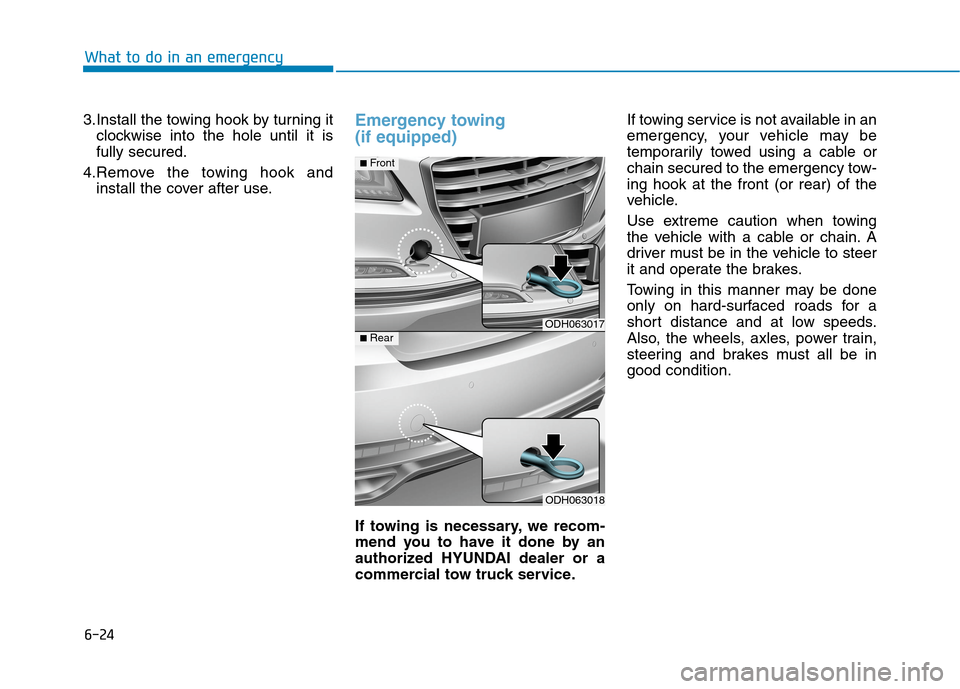
Emergency towing
(if equipped)
If towing is necessary, we recom-
mend you to have it done by an
authorized HYUNDAI dealer or a
commercial tow truck service.If towing service is not available in an
emergency, your vehicle may be
temporarily towed using a cable or
chain secured to the emergency tow-
ing hook at the front (or rear) of the
vehicle.
Use extreme caution when towing
the vehicle with a cable or chain. A
driver must be in the vehicle to steer
it and operate the brakes.
Towing in this manner may be done
only on hard-surfaced roads for a
short distance and at low speeds.
Also, the wheels, axles, power train,
steering and brakes must all be in
good condition.
ODH063017
ODH063018
■Front
■Rear
Page 382 of 501

6-25
What to do in an emergency
6
Always follow these emergency tow-
ing precautions:
Place the Engine Start/Stop button
in the ACC position so the steering
wheel is not locked.
Place the shift lever in N (Neutral).
Release the parking brake.
Depress the brake pedal with more
force than normal since you will
have reduced braking perform-
ance.
More steering effort will be
required because the power steer-
ing system will be disabled.
Use a vehicle heavier than your
own to tow your vehicle.
The drivers of both vehicles should
communicate with each other fre-
quently.
Before emergency towing, check
that the hook is not broken or dam-
aged.
Fasten the towing cable or chain
securely to the hook.
Do not jerk the hook. Apply steady
and even force. Use a towing cable or chain less
than 16 feet (5 m) long. Attach a
white or red cloth (about 12 inches
(30 cm) wide) in the middle of the
cable or chain for easy visibility.
Drive carefully so the towing cable
or chain remains tight during tow-
ing.
Before towing, check the automat-
ic transmission for fluid leaks under
your vehicle. If the automatic trans-
mission fluid is leaking, flatbed
equipment or a towing dolly must
be used.
ODH063025
To avoid damage to your vehicle
and vehicle components when
towing:
Always pull straight ahead
when using the towing hooks.
Do not pull from the side or at
a vertical angle.
Do not use the towing hooks
to pull a vehicle out of mud,
sand or other conditions from
which the vehicle cannot be
driven out under its own
power.
Limit the vehicle speed to 10
mph (15 km/h) and drive less
than 1 mile (1.5 km) when tow-
ing to avoid serious damage
to the automatic transmis-
sion.
CAUTION
Page 389 of 501

7-7
7
Maintenance
Owner maintenance schedule
When you stop for fuel:
Check the engine oil level.
Check coolant level in the engine
coolant reservoir.
Check the windshield washer fluid
level.
Check for low or under-inflated
tires.
While operating your vehicle:
Note any changes in the sound of
the exhaust or any smell of
exhaust fumes in the vehicle.
Check for vibrations in the steering
wheel. Notice if there is any
increased steering effort or loose-
ness in the steering wheel, or
change in its straight-ahead posi-
tion.
Notice if your vehicle constantly
turns slightly or “pulls” to one side
when traveling on smooth, level
road.
When stopping, listen and check
for unusual sounds, pulling to one
side, increased brake pedal travel
or “hard-to-push” brake pedal.
If any slipping or changes in the
operation of your transmission
occurs, check the transmission
fluid level.
Check the automatic transmission
P (Park) function. Check the parking brake.
Check for fluid leaks under your
vehicle (water dripping from the air
conditioning system during or after
use is normal).
At least monthly:
Check coolant level in the engine
coolant reservoir.
Check the operation of all exterior
lights, including the stoplights, turn
signals and hazard warning flash-
ers.
Check the inflation pressures of all
tires including the spare for tires
that are worn, show uneven wear,
or are damaged.
Check for loose wheel lug nuts. Be careful when checking your
engine coolant level when the
engine is hot. This may result in
coolant being blown out of the
opening and cause serious
burns and other injuries.
WARNING
Page 392 of 501
7-10
Maintenance
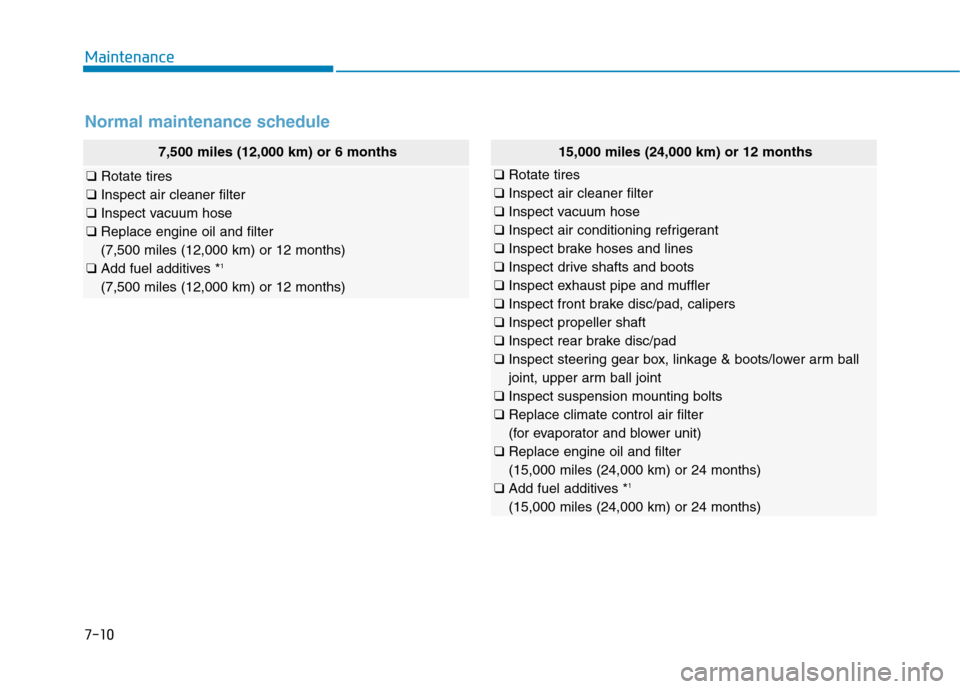
7,500 miles (12,000 km) or 6 months
❑Rotate tires
❑Inspect air cleaner filter
❑Inspect vacuum hose
❑Replace engine oil and filter
(7,500 miles (12,000 km) or 12 months)
❑Add fuel additives *
1
(7,500 miles (12,000 km) or 12 months)
15,000 miles (24,000 km) or 12 months
❑Rotate tires
❑Inspect air cleaner filter
❑Inspect vacuum hose
❑Inspect air conditioning refrigerant
❑Inspect brake hoses and lines
❑Inspect drive shafts and boots
❑Inspect exhaust pipe and muffler
❑Inspect front brake disc/pad, calipers
❑Inspect propeller shaft
❑Inspect rear brake disc/pad
❑Inspect steering gear box, linkage & boots/lower arm ball
joint, upper arm ball joint
❑Inspect suspension mounting bolts
❑Replace climate control air filter
(for evaporator and blower unit)
❑Replace engine oil and filter
(15,000 miles (24,000 km) or 24 months)
❑Add fuel additives *
1
(15,000 miles (24,000 km) or 24 months)
Normal maintenance schedule
Page 393 of 501
7-11
7
Maintenance
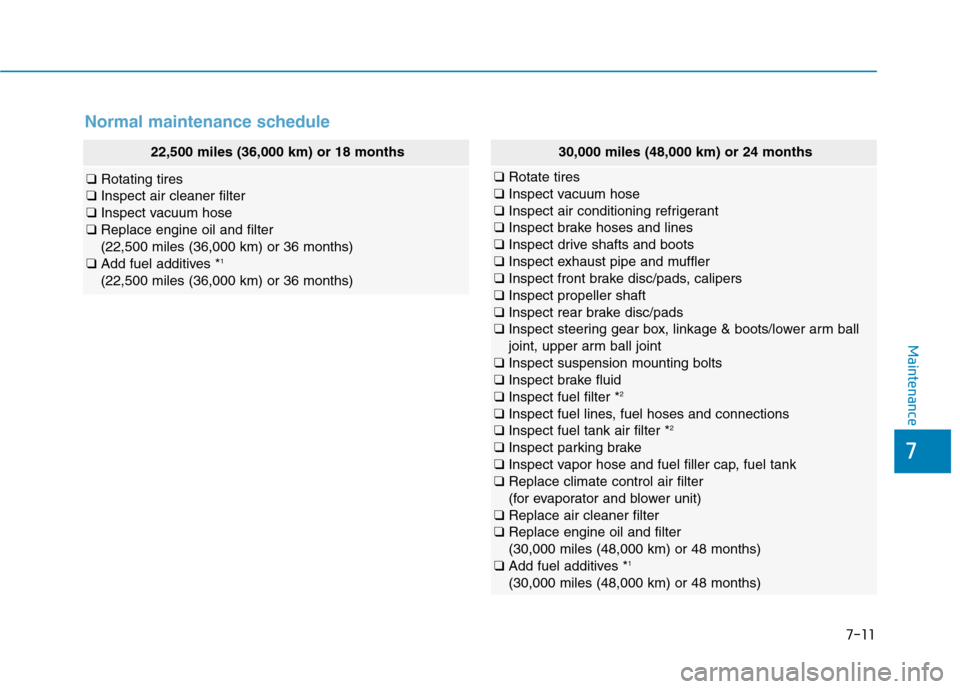
Normal maintenance schedule
22,500 miles (36,000 km) or 18 months
❑Rotating tires
❑Inspect air cleaner filter
❑Inspect vacuum hose
❑Replace engine oil and filter
(22,500 miles (36,000 km) or 36 months)
❑Add fuel additives *
1
(22,500 miles (36,000 km) or 36 months)
30,000 miles (48,000 km) or 24 months
❑Rotate tires
❑Inspect vacuum hose
❑Inspect air conditioning refrigerant
❑Inspect brake hoses and lines
❑Inspect drive shafts and boots
❑Inspect exhaust pipe and muffler
❑Inspect front brake disc/pads, calipers
❑Inspect propeller shaft
❑Inspect rear brake disc/pads
❑Inspect steering gear box, linkage & boots/lower arm ball
joint, upper arm ball joint
❑Inspect suspension mounting bolts
❑Inspect brake fluid
❑Inspect fuel filter *
2
❑Inspect fuel lines, fuel hoses and connections
❑Inspect fuel tank air filter *2
❑Inspect parking brake
❑Inspect vapor hose and fuel filler cap, fuel tank
❑Replace climate control air filter
(for evaporator and blower unit)
❑Replace air cleaner filter
❑Replace engine oil and filter
(30,000 miles (48,000 km) or 48 months)
❑Add fuel additives *
1
(30,000 miles (48,000 km) or 48 months)
Page 394 of 501
7-12
Maintenance
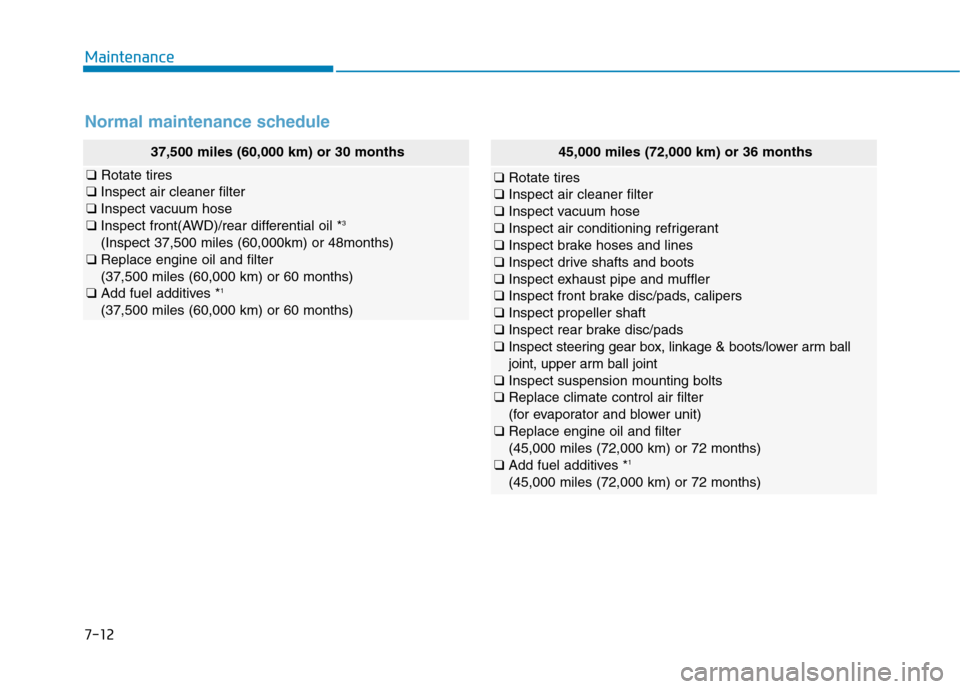
Normal maintenance schedule
37,500 miles (60,000 km) or 30 months
❑Rotate tires
❑Inspect air cleaner filter
❑Inspect vacuum hose
❑Inspect front(AWD)/rear differential oil *
3
(Inspect 37,500 miles (60,000km) or 48months)
❑Replace engine oil and filter
(37,500 miles (60,000 km) or 60 months)
❑Add fuel additives *
1
(37,500 miles (60,000 km) or 60 months)
45,000 miles (72,000 km) or 36 months
❑Rotate tires
❑Inspect air cleaner filter
❑Inspect vacuum hose
❑Inspect air conditioning refrigerant
❑Inspect brake hoses and lines
❑Inspect drive shafts and boots
❑Inspect exhaust pipe and muffler
❑Inspect front brake disc/pads, calipers
❑Inspect propeller shaft
❑Inspect rear brake disc/pads
❑Inspect steering gear box, linkage & boots/lower arm ball
joint, upper arm ball joint
❑Inspect suspension mounting bolts
❑Replace climate control air filter
(for evaporator and blower unit)
❑Replace engine oil and filter
(45,000 miles (72,000 km) or 72 months)
❑Add fuel additives *
1
(45,000 miles (72,000 km) or 72 months)
Page 395 of 501
7-13
7
Maintenance
Normal maintenance schedule
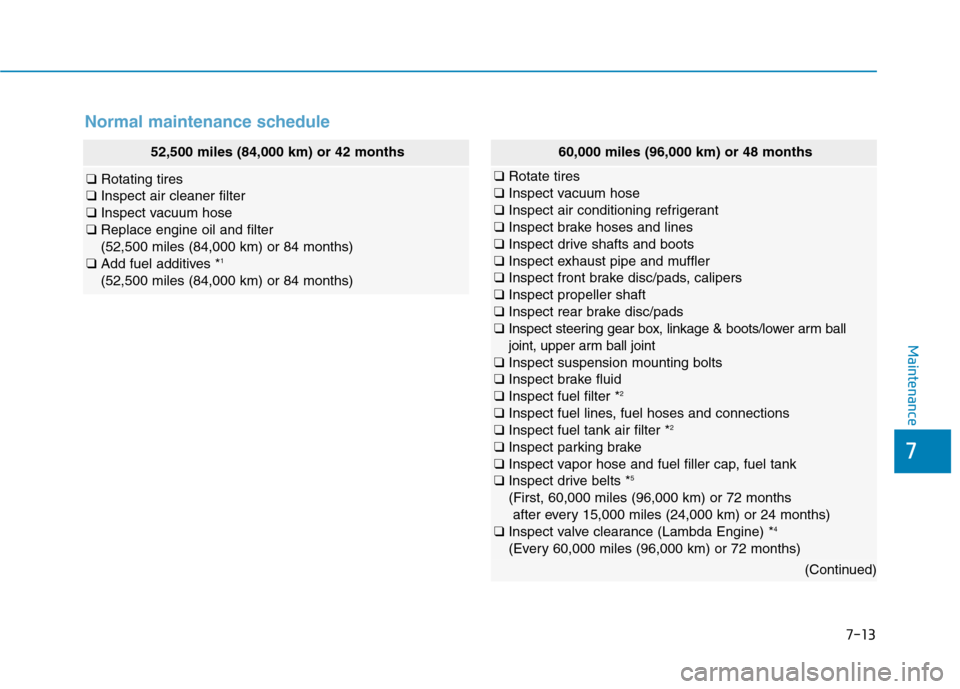
52,500 miles (84,000 km) or 42 months
❑Rotating tires
❑Inspect air cleaner filter
❑Inspect vacuum hose
❑Replace engine oil and filter
(52,500 miles (84,000 km) or 84 months)
❑Add fuel additives *
1
(52,500 miles (84,000 km) or 84 months)
60,000 miles (96,000 km) or 48 months
❑Rotate tires
❑Inspect vacuum hose
❑Inspect air conditioning refrigerant
❑Inspect brake hoses and lines
❑Inspect drive shafts and boots
❑Inspect exhaust pipe and muffler
❑Inspect front brake disc/pads, calipers
❑Inspect propeller shaft
❑Inspect rear brake disc/pads
❑Inspect steering gear box, linkage & boots/lower arm ball
joint, upper arm ball joint
❑Inspect suspension mounting bolts
❑Inspect brake fluid
❑Inspect fuel filter *
2
❑Inspect fuel lines, fuel hoses and connections
❑Inspect fuel tank air filter *2
❑Inspect parking brake
❑Inspect vapor hose and fuel filler cap, fuel tank
❑Inspect drive belts *
5
(First, 60,000 miles (96,000 km) or 72 months
after every 15,000 miles (24,000 km) or 24 months)
❑Inspect valve clearance (Lambda Engine) *
4
(Every 60,000 miles (96,000 km) or 72 months)
(Continued)
Page 397 of 501
7-15
7
Maintenance
Normal maintenance schedule
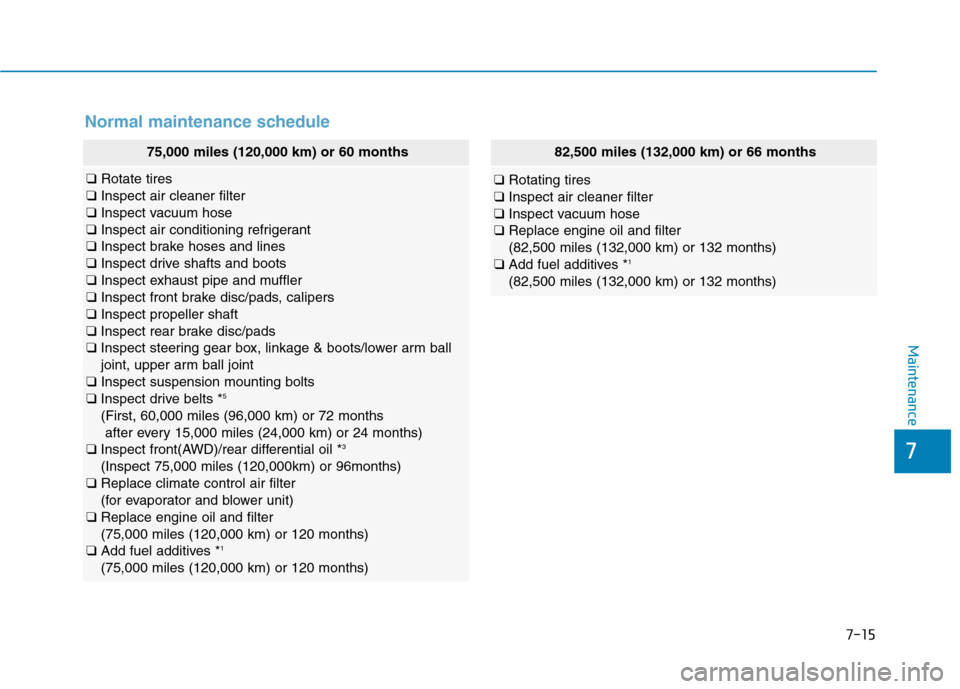
75,000 miles (120,000 km) or 60 months
❑Rotate tires
❑Inspect air cleaner filter
❑Inspect vacuum hose
❑Inspect air conditioning refrigerant
❑Inspect brake hoses and lines
❑Inspect drive shafts and boots
❑Inspect exhaust pipe and muffler
❑Inspect front brake disc/pads, calipers
❑Inspect propeller shaft
❑Inspect rear brake disc/pads
❑Inspect steering gear box, linkage & boots/lower arm ball
joint, upper arm ball joint
❑Inspect suspension mounting bolts
❑Inspect drive belts *
5
(First, 60,000 miles (96,000 km) or 72 months
after every 15,000 miles (24,000 km) or 24 months)
❑Inspect front(AWD)/rear differential oil *
3
(Inspect 75,000 miles (120,000km) or 96months)
❑Replace climate control air filter
(for evaporator and blower unit)
❑Replace engine oil and filter
(75,000 miles (120,000 km) or 120 months)
❑Add fuel additives *
1
(75,000 miles (120,000 km) or 120 months)
82,500 miles (132,000 km) or 66 months
❑Rotating tires
❑Inspect air cleaner filter
❑Inspect vacuum hose
❑Replace engine oil and filter
(82,500 miles (132,000 km) or 132 months)
❑Add fuel additives *
1
(82,500 miles (132,000 km) or 132 months)