2015 Hyundai Genesis Coupe Emergency start
[x] Cancel search: Emergency startPage 7 of 438

1
2
3
4
5
6
7
8
I
IntroductionHow to use this manual / Fuel requirements / Vehicle break-in process /
Vehicle data collection and event data recorders / Indicator symbols on the instrument cluster
Your vehicle at a glance
Exterior overview / Interior overview / Instrument panel overview / Engine compartment
Safety features of your vehicle
Seats / Seat belts / Child restraint system / Air bag
Features of your vehicleKeys / Door locks / Trunk / Windows / Hood / Fuel filler lid / Sunroof / Steering wheel / Mirrors /
Instrument cluster / Multigauge / Lighting / Wipers & Washers / Climate control system / Etc.
Driving your vehicleBefore driving / Engine start/stop button / Transmission / Brake system / Cruise control system /
Winter driving / Vehicle load limit / Etc.
What to do in an emergencyRoad warning / Emergency while driving / Emergency starting / Engine overheat / TPMS / Flat tire / Towing / Etc.
MaintenanceEngine compartment / Maintenance service / Engine oil / Engine coolant / Brake fluid / Washer fluid /
Parking brake / Air cleaner / Wiper blades / Battery / Tire and wheels / Fuses / Light bulbs / Etc.
Specifications, Consumer information and Reporting safety defects
Index
table of contents
Page 113 of 438

429
Features of your vehicle
Emergency fuel filler lid
release
If the fuel filler lid does not open, use
the fuel filler lid release located in the
left trunk side wall. Pull on the
release to manually release the fuel
filler lid.
(Continued)
When refueling, always shut
the engine off. Sparks pro-
duced by electrical compo-
nents related to the engine
can ignite fuel vapors causing
a fire. Once refueling is com-
plete, check to make sure the
filler cap and filler door are
securely closed, before start-
ing the engine.
DO NOT use matches or a
lighter and DO NOT SMOKE or
leave a lit cigarette in your
vehicle while at a gas station
especially during refueling.
Automotive fuel is highly
flammable and can, when
ignited, result in fire.
If a fire breaks out during refu-
eling, leave the vicinity of the
vehicle, and immediately con-
tact the manager of the gas
station and then contact the
local fire department or 911.
Follow any safety instructions
they provide.CAUTION
Make sure to refuel your vehi-
cle according to the “Fuel
requirements” suggested in
section 1.
If the fuel filler cap requires
replacement, use only a gen-
uine HYUNDAI cap or the
equivalent specified for your
vehicle. An incorrect fuel filler
cap can result in a serious
malfunction of the fuel system
or emission control system.
Do not spill fuel on the exteri-
or surfaces of the vehicle. Any
type of fuel spilled on painted
surfaces may damage the
paint.
After refueling, make sure the
fuel cap is installed securely
to prevent fuel spillage in the
event of an accident.
CAUTION
Do not pull the handle exces-
sively, otherwise the luggage
area trim or release handle may
be damaged.
OBK042014
Page 258 of 438
Driving your vehicle
8 5
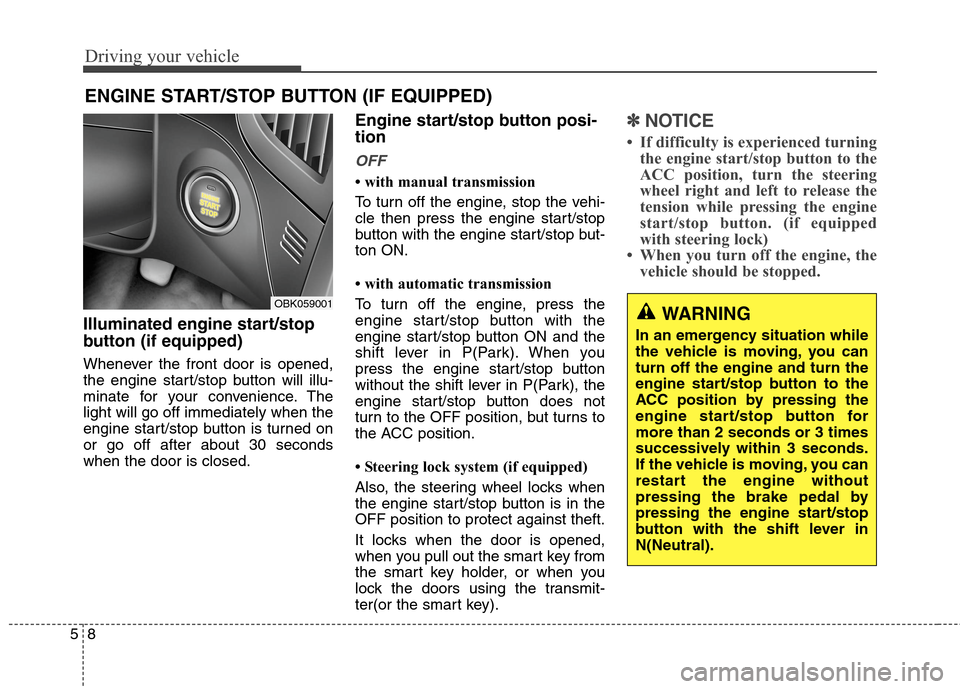
Illuminated engine start/stop
button (if equipped)
Whenever the front door is opened,
the engine start/stop button will illu-
minate for your convenience. The
light will go off immediately when the
engine start/stop button is turned on
or go off after about 30 seconds
when the door is closed.
Engine start/stop button posi-
tion
OFF
• with manual transmission
To turn off the engine, stop the vehi-
cle then press the engine start/stop
button with the engine start/stop but-
ton ON.
• with automatic transmission
To turn off the engine, press the
engine start/stop button with the
engine start/stop button ON and the
shift lever in P(Park). When you
press the engine start/stop button
without the shift lever in P(Park), the
engine start/stop button does not
turn to the OFF position, but turns to
the ACC position.
• Steering lock system (if equipped)
Also, the steering wheel locks when
the engine start/stop button is in the
OFF position to protect against theft.
It locks when the door is opened,
when you pull out the smart key from
the smart key holder, or when you
lock the doors using the transmit-
ter(or the smart key).
✽ ✽
NOTICE
• If difficulty is experienced turning
the engine start/stop button to the
ACC position, turn the steering
wheel right and left to release the
tension while pressing the engine
start/stop button. (if equipped
with steering lock)
• When you turn off the engine, the
vehicle should be stopped.
ENGINE START/STOP BUTTON (IF EQUIPPED)
OBK059001WARNING
In an emergency situation while
the vehicle is moving, you can
turn off the engine and turn the
engine start/stop button to the
ACC position by pressing the
engine start/stop button for
more than 2 seconds or 3 times
successively within 3 seconds.
If the vehicle is moving, you can
restart the engine without
pressing the brake pedal by
pressing the engine start/stop
button with the shift lever in
N(Neutral).
Page 278 of 438

Driving your vehicle
28 5
Check the brake warning light by turn-
ing the ignition switch ON (do not start
the engine). This light will be illuminat-
ed when the parking brake is applied
with the ignition switch in the START
or ON position.
Before driving, be sure the parking
brake is fully released and the brake
warning light is off.
If the brake warning light remains on
after the parking brake is released
while engine is running, there may be
a malfunction in the brake system.
Immediate attention is necessary.
WARNING
To prevent unintentional move-
ment when stopped and leav-
ing the vehicle, do not use the
gearshift lever in place of the
parking brake. Set the parking
brake AND make sure the
gearshift lever is securely posi-
tioned in 1st (First) gear or R
(Reverse) for manual transmis-
sion equipped vehicles and in
P (Park) for automatic trans-
mission equipped vehicles.
Never allow anyone who is
unfamiliar with the vehicle to
touch the parking brake. If the
parking brake is released unin-
tentionally, serious injury may
occur.
All vehicles should always
have the parking brake fully
engaged when parking to avoid
inadvertent movement of the
car which can injure occupants
or pedestrians.
W-75
CAUTION
Do not operate the parking
brake while the vehicle is mov-
ing except in an emergency sit-
uation. It could damage the
vehicle system and endanger
driving safety.
Page 309 of 438
What to do in an emergency
Road warning . . . . . . . . . . . . . . . . . . . . . . . . . . . . . 6-2
• Hazard warning flasher. . . . . . . . . . . . . . . . . . . . . 6-2
In case of an emergency while driving. . . . . . . . . . 6-2
. . . . . 6-2
. . . . . . . . . . . . . 6-2
. . . . . . . . . . . . . . . . . . 6-3
If the engine does not start . . . . . . . . . . . . . . . . . . . 6-3
. . 6-3
. . . 6-3
Emergency starting . . . . . . . . . . . . . . . . . . . . . . . . . 6-4
. . . . . . . . . . . . . . . . . . . . . . . . . . . . . 6-4
. . . . . . . . . . . . . . . . . . . . . . . . . . . . . 6-5
If the engine overheats. . . . . . . . . . . . . . . . . . . . . . . 6-6
Tire pressure monitoring system (TPMS) . . . . . . . 6-7
indicator . . . . . . . . . . . . . . . . . . . . . . . . . . . . . . . . . . . . . 6-9
. . . . . . . . . . . . . . . . . . . . . . 6-10
If you have a flat tire . . . . . . . . . . . . . . . . . . . . . . . . 6-12
. . . . . . . . . . . . . . . . . . . . . . . . . . . . . 6-12
. . . . . . . . . . . . 6-13
. . . . . . . . . . . . . . . . . . . . . . . . . . . . 6-13
. . . . . . . . . . . . . . . . . . . . . . . . . . . . . . . . . . . . 6-20
Towing . . . . . . . . . . . . . . . . . . . . . . . . . . . . . . . . . . . . 6-21
. . . . . . . . . . . . . . . . . . . . . . . . . . . . 6-21
. . . . . . . . . . . . . . . . . . . . . 6-22
. . . . . . . . . . . . . . . . . . . . . . . . . 6-23
6
Page 311 of 438

63
What to do in an emergency
2.When the car is stopped, turn on
your emergency hazard flashers,
set the parking brake and put the
transmission in P (automatic trans-
mission) or reverse (manual trans-
mission).
3.Have all passengers get out of the
car. Be sure they all get out on the
side of the car that is away from
traffic.
4.When changing a flat tire, follow
the instruction provided later in this
section.
If engine stalls while driving
1. Reduce your speed gradually,
keeping a straight line. Move cau-
tiously off the road to a safe place.
2. Turn on your emergency flashers.
3. Try to start the engine again. If
your vehicle will not start, contact
an authorized HYUNDAI dealer or
seek other qualified assistance.
If engine doesn't turn over or
turns over slowly
1. If your vehicle has an automatic
transmission, be sure the gear
selector lever is in N(Neutral) or
P(Park) and the emergency brake
is set.
2. Check the battery connections to
be sure they are clean and tight.
3. Turn on the interior light. If the light
dims or goes out when you oper-
ate the starter, the battery is dis-
charged.
4. Check the starter connections to
be sure they are securely tight-
ened.
5. Do not push or pull the vehicle to
start it. See instructions for "Jump
starting".
If the engine turns over nor-
mally but does not start
1. Check fuel level.
2. With the ignition switch in the
LOCK position, check all connec-
tors at the ignition coils and spark
plugs. Reconnect any that may be
disconnected or loose.
3. If the engine still does not start,
call an authorized HYUNDAI deal-
er or seek other qualified assis-
tance.
IF THE ENGINE WILL NOT START
WARNING
If the engine will not start, do
not push or pull the car to start
it. This could result in a collision
or cause other damage.
Page 312 of 438
What to do in an emergency
4 6
EMERGENCY STARTING
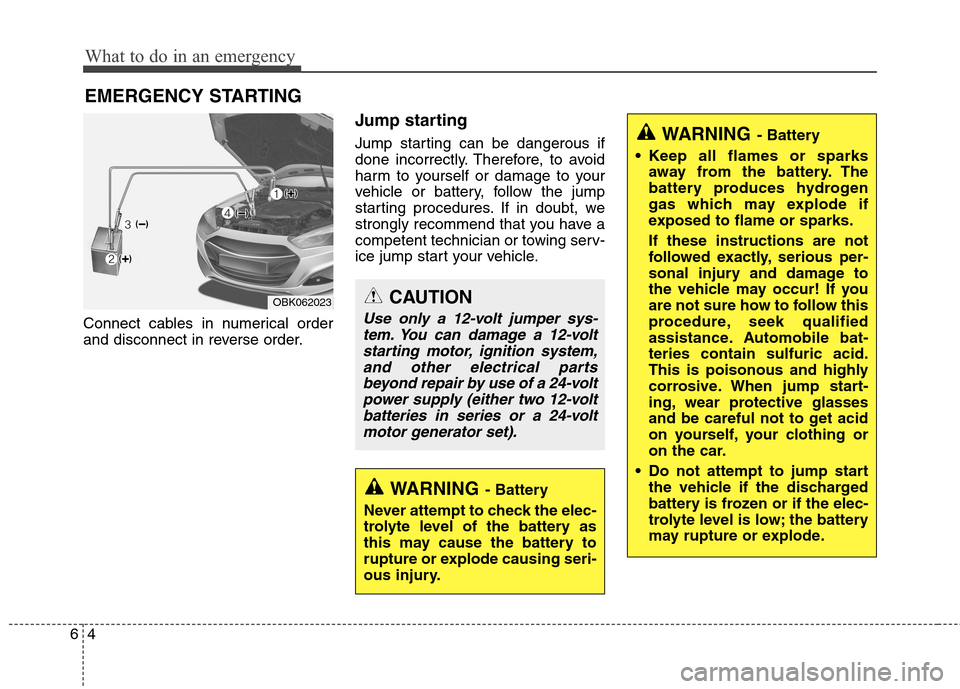
Connect cables in numerical order
and disconnect in reverse order.
Jump starting
Jump starting can be dangerous if
done incorrectly. Therefore, to avoid
harm to yourself or damage to your
vehicle or battery, follow the jump
starting procedures. If in doubt, we
strongly recommend that you have a
competent technician or towing serv-
ice jump start your vehicle.
CAUTION
Use only a 12-volt jumper sys-
tem. You can damage a 12-volt
starting motor, ignition system,
and other electrical parts
beyond repair by use of a 24-volt
power supply (either two 12-volt
batteries in series or a 24-volt
motor generator set).
WARNING- Battery
• Keep all flames or sparks
away from the battery. The
battery produces hydrogen
gas which may explode if
exposed to flame or sparks.
If these instructions are not
followed exactly, serious per-
sonal injury and damage to
the vehicle may occur! If you
are not sure how to follow this
procedure, seek qualified
assistance. Automobile bat-
teries contain sulfuric acid.
This is poisonous and highly
corrosive. When jump start-
ing, wear protective glasses
and be careful not to get acid
on yourself, your clothing or
on the car.
Do not attempt to jump start
the vehicle if the discharged
battery is frozen or if the elec-
trolyte level is low; the battery
may rupture or explode.
WARNING- Battery
Never attempt to check the elec-
trolyte level of the battery as
this may cause the battery to
rupture or explode causing seri-
ous injury.
OBK062023
Page 313 of 438
65
What to do in an emergency
Jump starting procedure
1. Make sure the booster battery is
12-volt and that its negative termi-
nal is grounded.
2. If the booster battery is in another
vehicle, do not allow the vehicles
to touch.
3. Turn off all unnecessary electrical
loads.
4. Connect the jumper cables in the
exact sequence shown in the illus-
tration. First connect one end of a
jumper cable to the positive termi-
nal of the discharged battery (1),
then connect the other end to the
positive terminal on the booster
battery (2).
Proceed to connect one end of the
other jumper cable to the negative
terminal of the booster battery (3),
then the other end to a solid, sta-
tionary, metallic point (for example,
the engine lifting bracket) away
from the battery (4). Do not con-
nect it to or near any part that
moves when the engine is cranked.
Do not allow the jumper cables to
contact anything except the correct
battery terminals or the correct
ground. Do not lean over the bat-
tery when making connections.5. Start the engine of the vehicle with
the booster battery and let it run at
2,000 rpm, then start the engine of
the vehicle with the discharged
battery.
6. After jump start of your vehicle run
the vehicle for at least 15 minutes
either at idle or driving the vehicle
before turning off the engine. This
will assure the vehicle can be
started next time after the engine
is shut off.
If the cause of your battery discharg-
ing is not apparent, you should have
your vehicle checked by an author-
ized HYUNDAI dealer.
Push-starting
Your manual transmission-equipped
vehicle should not be push-started
because it might damage the emis-
sion control system.
Vehicles equipped with automatic
transmission cannot be push-started.
Follow the directions in this section
for jump-starting.
WARNING
Never tow a vehicle to start it
because the sudden surge for-
ward when the engine starts
could cause a collision with the
tow vehicle.
CAUTION - Battery cables
Do not connect the jumper
cable from the negative terminal
of the booster battery to the
negative terminal of the dis-
charged battery. This can cause
the discharged battery to over-
heat and crack, releasing bat-
tery acid.