Page 378 of 453
377
uuReplacing Light Bulbs uBack-Up Light and Rear Turn Signal Light Bulbs
Maintenance
Back-Up Light and Rear Turn Signal Light Bulbs
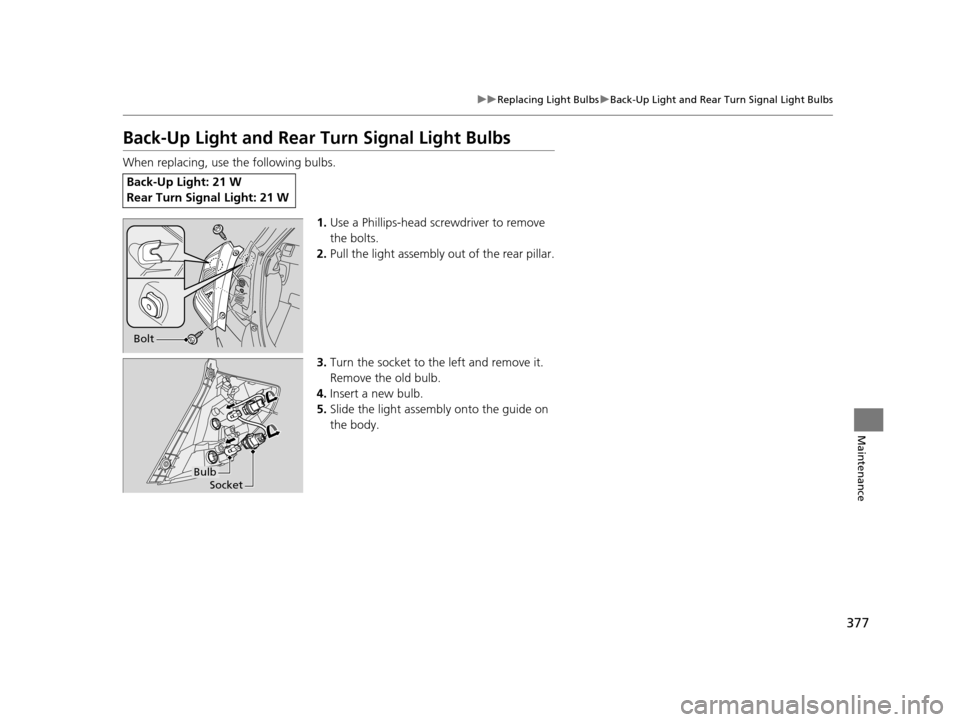
When replacing, use the following bulbs.
1.Use a Phillips-head sc rewdriver to remove
the bolts.
2. Pull the light assembly out of the rear pillar.
3. Turn the socket to th e left and remove it.
Remove the old bulb.
4. Insert a new bulb.
5. Slide the light assembly onto the guide on
the body.
Back-Up Light: 21 W
Rear Turn Signal Light: 21 W
Bolt
Bulb
Socket
15 US FIT-31T5A6000.book 377 ページ 2014年3月6日 木曜日 午後7時5分
Page 379 of 453
378
uuReplacing Light Bulbs uBrake/Tail/Rear Side Marker Light Bulbs
Maintenance
Brake/Tail/Rear Side Marker Light Bulbs
Brake/tail/rear side marker light bulbs are the LED type. Have an authorized Honda
dealer inspect and replace the light assembly.
High-Mount Brake Light Bulb
High-mount brake light bulb is a LED type. Have an authorized Honda dealer inspect
and replace the light assembly.
15 US FIT-31T5A6000.book 378 ページ 2014年3月6日 木曜日 午後7時5分
Page 380 of 453
379
uuReplacing Light Bulbs uRear License Plate Light Bulbs
Maintenance
Rear License Plate Light Bulbs
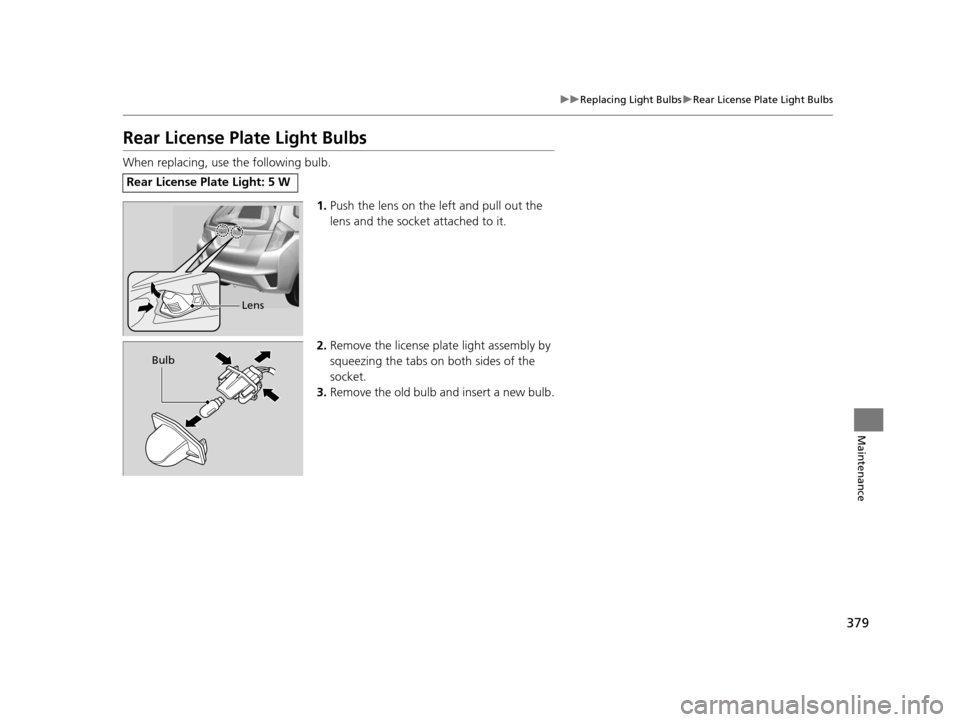
When replacing, use the following bulb.
1.Push the lens on the left and pull out the
lens and the socket attached to it.
2. Remove the license plat e light assembly by
squeezing the tabs on both sides of the
socket.
3. Remove the old bulb and insert a new bulb.
Rear License Plate Light: 5 W
Lens
Bulb
15 US FIT-31T5A6000.book 379 ページ 2014年3月6日 木曜日 午後7時5分
Page 381 of 453
380
Maintenance
Checking and Maintaining Wiper Blades
Checking Wiper Blades
If the wiper blade rubber has deteriorated, it will leave streaks and the metal wiper
arm may scratch the window glass.
Changing the Front Wiper Blade Rubber
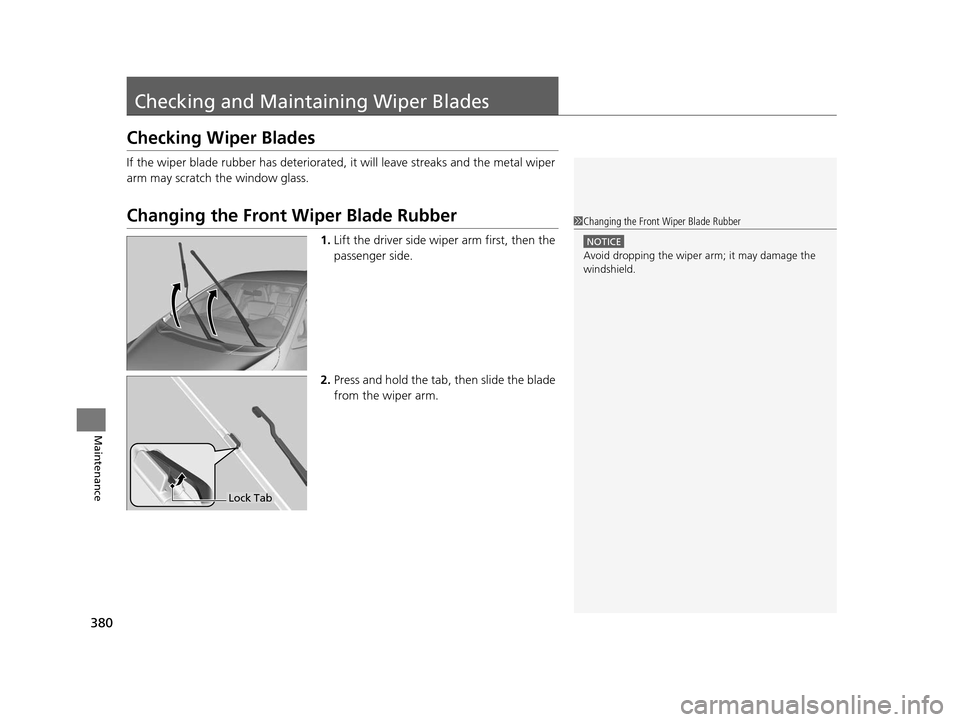
1. Lift the driver side wiper arm first, then the
passenger side.
2. Press and hold the tab, then slide the blade
from the wiper arm.
1 Changing the Front Wiper Blade Rubber
NOTICE
Avoid dropping the wiper ar m; it may damage the
windshield.
Lock Tab
15 US FIT-31T5A6000.book 380 ページ 2014年3月6日 木曜日 午後7時5分
Page 382 of 453
381
uuChecking and Maintaining Wiper Blades uChanging the Front Wiper Blade Rubber
Maintenance
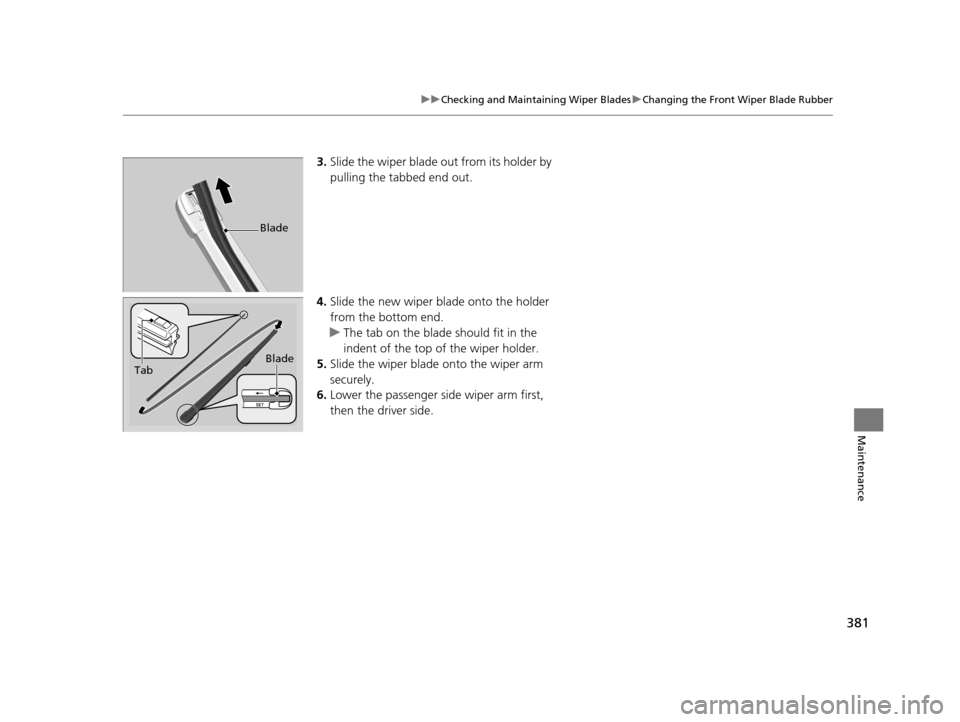
3. Slide the wiper blade out from its holder by
pulling the tabbed end out.
4. Slide the new wiper bl ade onto the holder
from the bottom end.
u The tab on the blade should fit in the
indent of the top of the wiper holder.
5. Slide the wiper blade onto the wiper arm
securely.
6. Lower the passenger side wiper arm first,
then the driver side.
Blade
Tab Blade
15 US FIT-31T5A6000.book 381 ページ 2014年3月6日 木曜日 午後7時5分
Page 383 of 453
382
uuChecking and Maintaining Wiper Blades uChanging the Rear Wiper Blade Rubber
Maintenance
Changing the Rear Wiper Blade Rubber
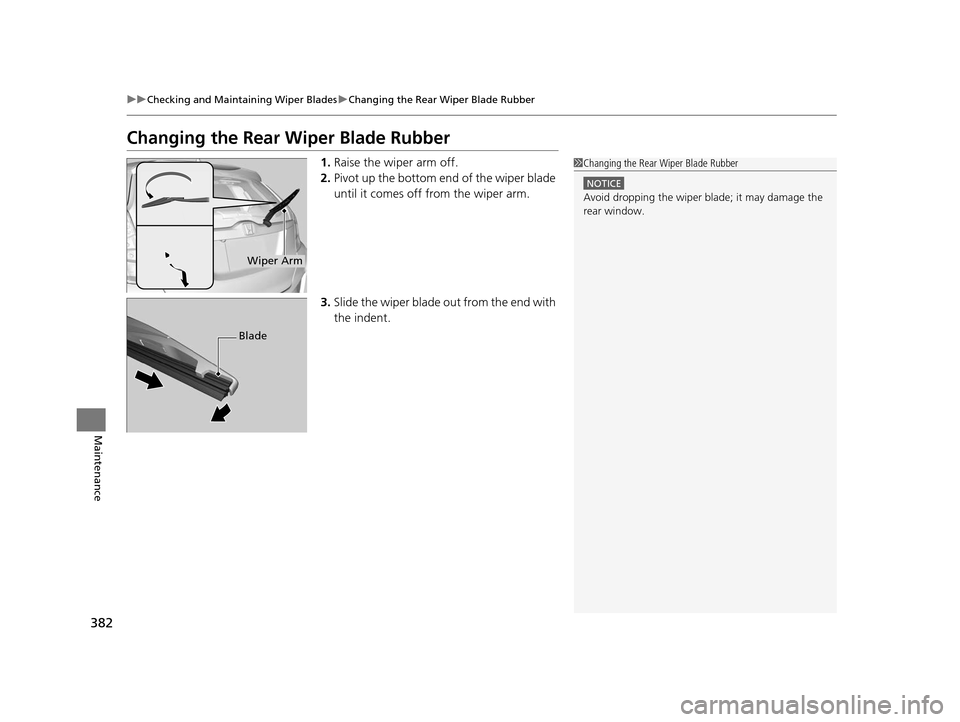
1. Raise the wiper arm off.
2. Pivot up the bottom e nd of the wiper blade
until it comes off from the wiper arm.
3. Slide the wiper blade out from the end with
the indent.1 Changing the Rear Wiper Blade Rubber
NOTICE
Avoid dropping the wiper blade; it may damage the
rear window.
Wiper Arm
Blade
15 US FIT-31T5A6000.book 382 ページ 2014年3月6日 木曜日 午後7時5分
Page 384 of 453
383
uuChecking and Maintaining Wiper Blades uChanging the Rear Wiper Blade Rubber
Maintenance
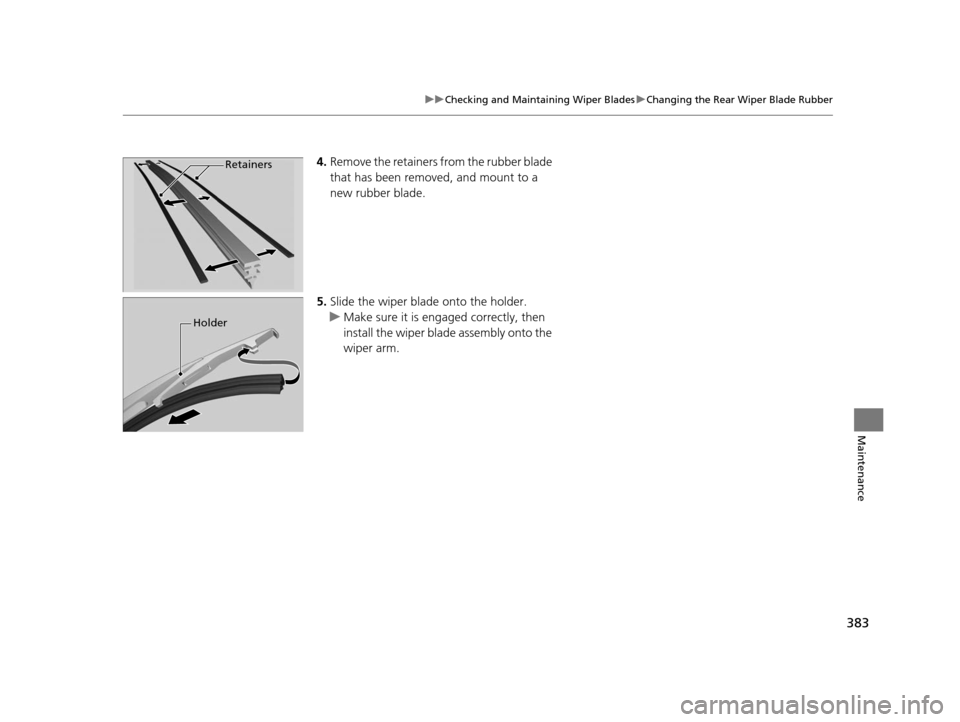
4. Remove the retainers from the rubber blade
that has been removed, and mount to a
new rubber blade.
5. Slide the wiper blade onto the holder.
u Make sure it is engaged correctly, then
install the wiper blade assembly onto the
wiper arm.Retainers
Holder
15 US FIT-31T5A6000.book 383 ページ 2014年3月6日 木曜日 午後7時5分
Page 385 of 453
384
Maintenance
Checking and Maintaining Tires
Checking Tires
To safely operate your vehicle, your tires must be of the proper type and size, in
good condition with adequate tread, and properly inflated.
■Inflation guidelines
Properly inflated tires provide the best combination of handlin g, tread life, and comfort.
Refer to the driver’s doorjamb label or spec ification’s page for the specified pressure.
Underinflated tires wear unevenly, adversely affect handling and fuel economy, and
are more likely to fail from overheating.
Overinflated tires make your vehicle ride harshly, are more prone to road hazards,
and wear unevenly.
Every day before you drive, look at each of the tires. If one looks lower than the
others, check the pressure with a tire gauge.
At least once a month or before long trips, use a gauge to measure the pressure in
all tires, including the spare. Even tires in good condition can lose 1 to 2 psi (10 to
20 kPa, 0.1 to 0.2 kgf/cm
2) per month.
■Inspection guidelines
Every time you check inflation, also examine the tires and valve stems.
Look for:
• Bumps or bulges on the side or in the tread . Replace the tire if you find any cuts,
splits, or cracks in the si de of the tire. Replace it if you see fabric or cord.
• Remove any foreign objects and inspect for air leaks.
• Uneven tread wear. Have a deal er check the wheel alignment.
• Excessive tread wear.
2 Wear Indicators P. 389
•Cracks or other damage around valve stem.
1Checking Tires
Measure the air pressure when tires are cold. This
means the vehicle has been parked for at least three
hours, or driven less than 1 mile (1.6 km). If
necessary, add or releas e air until the specified
pressure is reached.
If checked when hot, tire pressure can be as much as
4–6 psi (30–40 kPa, 0.3–0.4 kgf/cm
2) higher than if
checked when cold.
Have a dealer check the tires if you feel a consistent
vibration while driving. Ne w tires and any that have
been removed and reinst alled should be properly
balanced.
Whenever tire pressure is adjusted, you must
calibrate the TPMS.
2 TPMS Calibration P. 336
3WARNING
Using tires that are excessively worn or
improperly inflated can cause a crash in
which you can be seriously hurt or killed.
Follow all instruction s in this owner’s
manual regarding ti re inflation and
maintenance.
U.S. models
15 US FIT-31T5A6000.book 384 ページ 2014年3月6日 木曜日 午後7時5分