2015 FORD SUPER DUTY airbag
[x] Cancel search: airbagPage 29 of 470
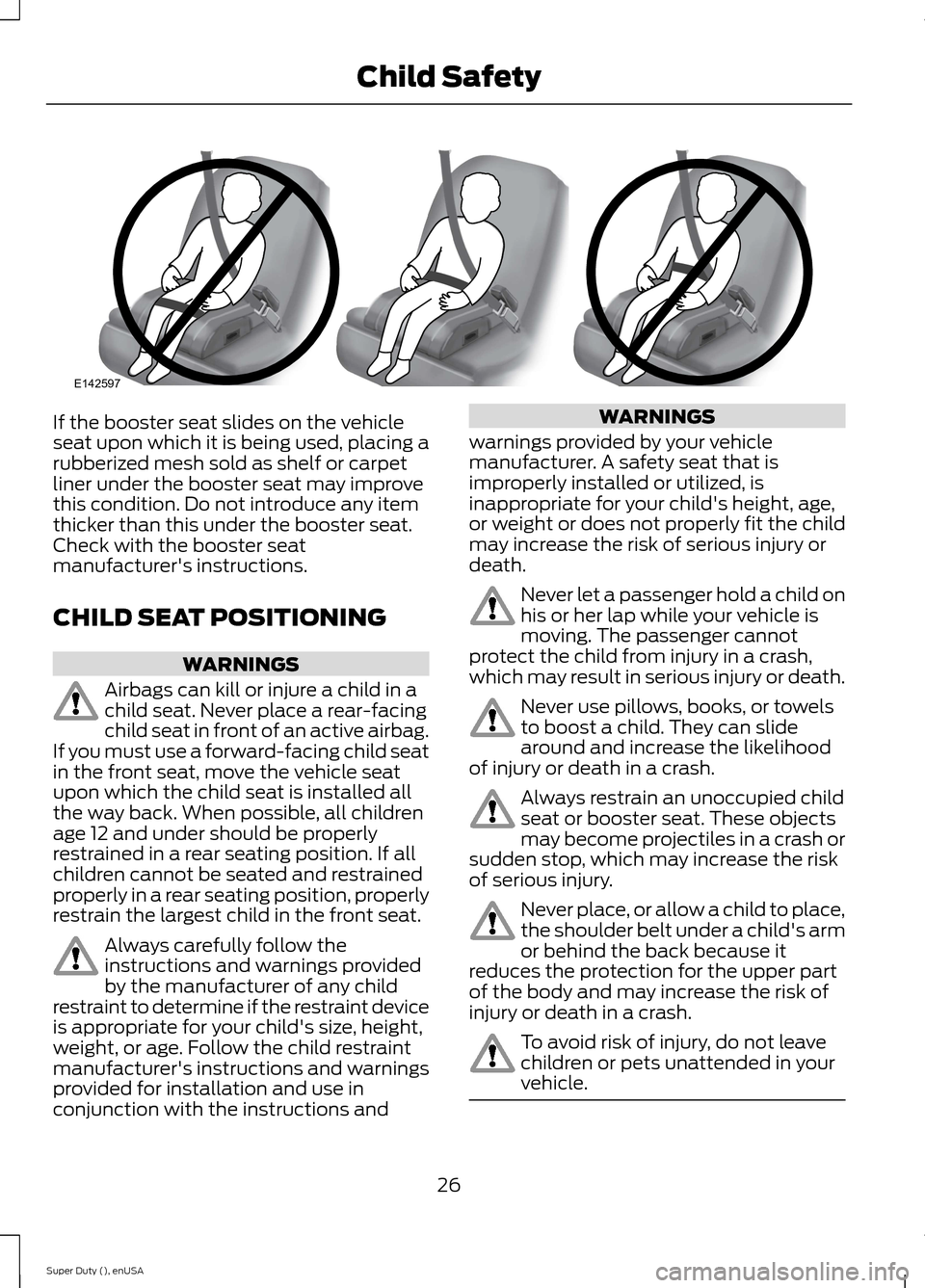
If the booster seat slides on the vehicleseat upon which it is being used, placing arubberized mesh sold as shelf or carpetliner under the booster seat may improvethis condition. Do not introduce any itemthicker than this under the booster seat.Check with the booster seatmanufacturer's instructions.
CHILD SEAT POSITIONING
WARNINGS
Airbags can kill or injure a child in achild seat. Never place a rear-facingchild seat in front of an active airbag.If you must use a forward-facing child seatin the front seat, move the vehicle seatupon which the child seat is installed allthe way back. When possible, all childrenage 12 and under should be properlyrestrained in a rear seating position. If allchildren cannot be seated and restrainedproperly in a rear seating position, properlyrestrain the largest child in the front seat.
Always carefully follow theinstructions and warnings providedby the manufacturer of any childrestraint to determine if the restraint deviceis appropriate for your child's size, height,weight, or age. Follow the child restraintmanufacturer's instructions and warningsprovided for installation and use inconjunction with the instructions and
WARNINGS
warnings provided by your vehiclemanufacturer. A safety seat that isimproperly installed or utilized, isinappropriate for your child's height, age,or weight or does not properly fit the childmay increase the risk of serious injury ordeath.
Never let a passenger hold a child onhis or her lap while your vehicle ismoving. The passenger cannotprotect the child from injury in a crash,which may result in serious injury or death.
Never use pillows, books, or towelsto boost a child. They can slidearound and increase the likelihoodof injury or death in a crash.
Always restrain an unoccupied childseat or booster seat. These objectsmay become projectiles in a crash orsudden stop, which may increase the riskof serious injury.
Never place, or allow a child to place,the shoulder belt under a child's armor behind the back because itreduces the protection for the upper partof the body and may increase the risk ofinjury or death in a crash.
To avoid risk of injury, do not leavechildren or pets unattended in yourvehicle.
26Super Duty (), enUSAChild SafetyE142597
Page 31 of 470
PRINCIPLE OF OPERATION
WARNINGS
Always drive and ride with your seatback upright and the lap belt snugand low across the hips.
To reduce the risk of injury, makesure children sit where they can beproperly restrained.
Never let a passenger hold a child onhis or her lap while the vehicle ismoving. The passenger cannotprotect the child from injury in a crashwhich may result in serious injury or death.
All occupants of the vehicle,including the driver, should alwaysproperly wear their safety belts, evenwhen an airbag supplemental restraintsystem is provided. Failure to properly wearyour safety belt could seriously increasethe risk of injury or death.
It is extremely dangerous to ride in acargo area, inside or outside of avehicle. In a crash, people riding inthese areas are more likely to be seriouslyinjured or killed. Do not allow people to ridein any area of your vehicle that is notequipped with seats and safety belts. Besure everyone in your vehicle is in a seatand using a safety belt properly.
In a rollover crash, an unbeltedperson is significantly more likely todie than a person wearing a safetybelt.
Each seating position in your vehiclehas a specific safety belt assemblywhich is made up of one buckle andone tongue that are designed to be usedas a pair. 1) Use the shoulder belt on theoutside shoulder only. Never wear theshoulder belt under the arm. 2) Neverswing the safety belt around your neck overthe inside shoulder. 3) Never use a singlebelt for more than one person.
WARNINGS
When possible, all children 12 yearsold and under should be properlyrestrained in a rear seating position.Failure to follow this could seriouslyincrease the risk of injury or death.
Safety belts and seats can becomehot in a vehicle that has been closedup in sunny weather; they could burna small child. Check seat covers andbuckles before you place a child anywherenear them.
Front and rear seat occupants,including pregnant women, shouldwear safety belts for optimumprotection in an accident.
All seating positions in this vehicle havelap and shoulder safety belts. Alloccupants of the vehicle should alwaysproperly wear their safety belts, even whenan airbag supplemental restraint systemis provided.
The safety belt system consists of:
•Lap and shoulder safety belts.
•Shoulder safety belt with automaticlocking mode, (except driver safetybelt).
•Height adjuster at the front outboardseating positions.
•Safety belt pretensioner at the frontoutboard seating positions.
•Safety belt warning light and chime.
•Crash sensors and monitoring systemwith readiness indicator.
28Super Duty (), enUSASafety Belts
Page 32 of 470
The safety belt pretensioners at the frontseating positions are designed to tightenthe safety belts when activated. In frontaland near-frontal crashes, side crashes androllovers, the safety belt pretensioners maybe activated alone or, if the crash is ofsufficient severity, together with the frontairbags.
FASTENING THE SAFETY
BELTS
The front outboard and rear safetyrestraints in the vehicle are combinationlap and shoulder belts.
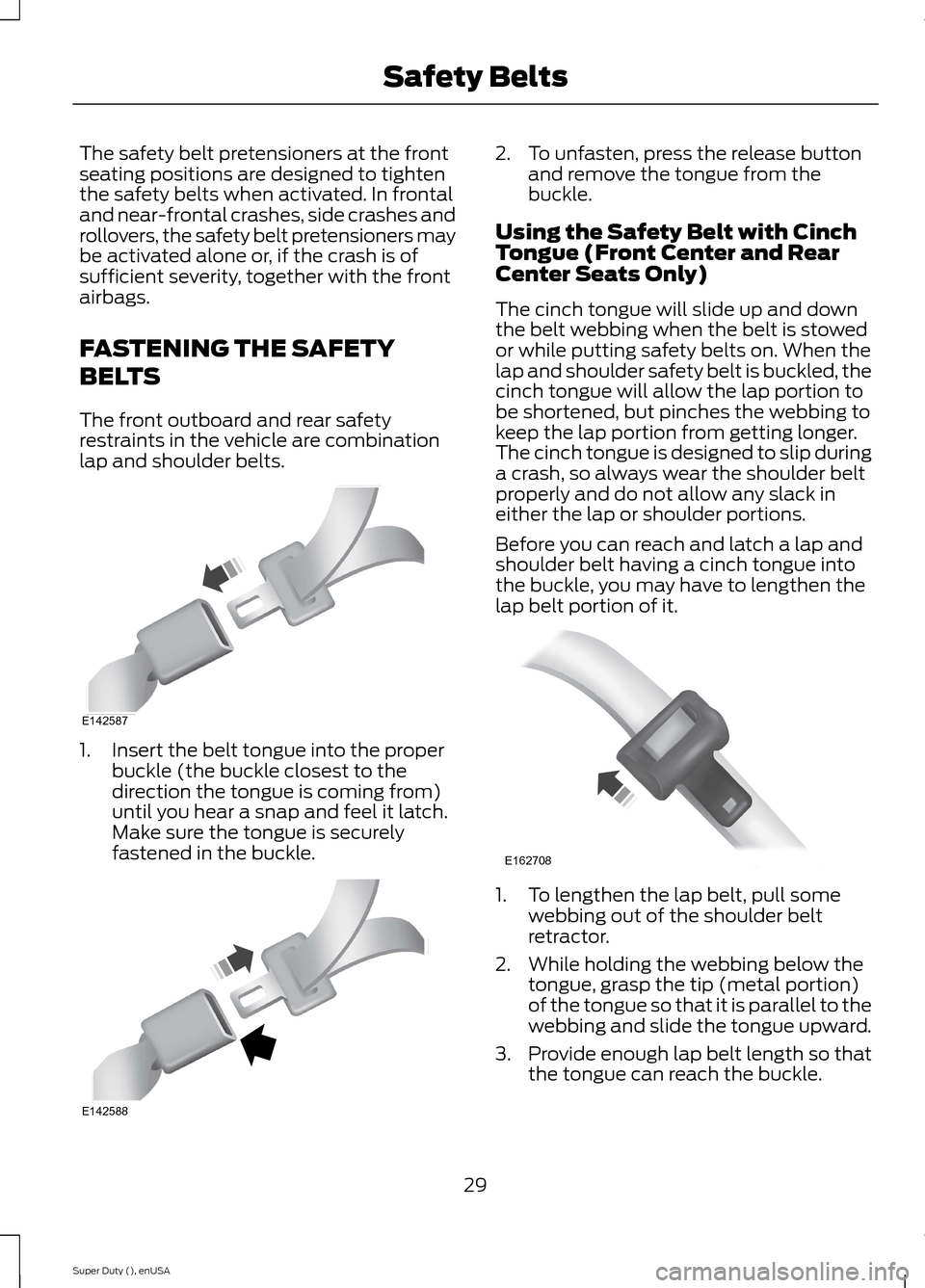
1.Insert the belt tongue into the properbuckle (the buckle closest to thedirection the tongue is coming from)until you hear a snap and feel it latch.Make sure the tongue is securelyfastened in the buckle.
2.To unfasten, press the release buttonand remove the tongue from thebuckle.
Using the Safety Belt with CinchTongue (Front Center and RearCenter Seats Only)
The cinch tongue will slide up and downthe belt webbing when the belt is stowedor while putting safety belts on. When thelap and shoulder safety belt is buckled, thecinch tongue will allow the lap portion tobe shortened, but pinches the webbing tokeep the lap portion from getting longer.The cinch tongue is designed to slip duringa crash, so always wear the shoulder beltproperly and do not allow any slack ineither the lap or shoulder portions.
Before you can reach and latch a lap andshoulder belt having a cinch tongue intothe buckle, you may have to lengthen thelap belt portion of it.
1.To lengthen the lap belt, pull somewebbing out of the shoulder beltretractor.
2.While holding the webbing below thetongue, grasp the tip (metal portion)of the tongue so that it is parallel to thewebbing and slide the tongue upward.
3.Provide enough lap belt length so thatthe tongue can reach the buckle.
29Super Duty (), enUSASafety BeltsE142587 E142588 E162708
Page 39 of 470
PRINCIPLE OF OPERATION
WARNINGS
Airbags do not inflate slowly orgently, and the risk of injury from adeploying airbag is the greatest closeto the trim covering the airbag module.
All occupants of your vehicle,including the driver, should alwaysproperly wear their safety belts, evenwhen an airbag supplemental restraintsystem is provided. Failure to properly wearyour safety belt could seriously increasethe risk of injury or death.
Always transport children 12 yearsold and under in the back seat andalways properly use appropriatechild restraints. Failure to follow this couldseriously increase the risk of injury or death.
Never place your arm over the airbagmodule as a deploying airbag canresult in serious arm fractures orother injuries.
Airbags can kill or injure a child in achild seat. Never place a rear-facingchild seat in front of an active airbag.If you must use a forward-facing child seatin the front seat, move the seat upon whichthe child seat is installed all the way back.
Do not attempt to service, repair, ormodify the airbag supplementalrestraint systems or its fuses as youcould be seriously injured or killed. Contactyour authorized dealer as soon as possible.
Several airbag system componentsget hot after inflation. To avoid riskof injury, do not touch them afterinflation.
If the airbag has deployed, the airbagwill not function again and must bereplaced immediately. If the airbagis not replaced, the unrepaired area willincrease the risk of injury in a crash.
The airbags are a supplemental restraintsystem and are designed to work with thesafety belts to help protect the driver andright front passenger from certain upperbody injuries. Airbags do not inflate slowly;there is a risk of injury from a deployingairbag.
Note:You will hear a loud bang and see acloud of harmless powdery residue if anairbag deploys. This is normal.
The airbags inflate and deflate rapidlyupon activation. After airbag deployment,it is normal to notice a smoke-like, powderyresidue or smell the burnt propellant. Thismay consist of cornstarch, talcum powder(to lubricate the bag) or sodiumcompounds (for example, baking soda)that result from the combustion processthat inflates the airbag. Small amounts ofsodium hydroxide may be present whichmay irritate the skin and eyes, but none ofthe residue is toxic.
While the system is designed to helpreduce serious injuries, contact with adeploying airbag may also cause abrasionsor swelling. Temporary hearing loss is alsoa possibility as a result of the noiseassociated with a deploying airbag.Because airbags must inflate rapidly andwith considerable force, there is the risk ofdeath or serious injuries such as fractures,facial and eye injuries or internal injuries,particularly to occupants who are notproperly restrained or are otherwise out ofposition at the time of airbag deployment.Thus, it is extremely important thatoccupants be properly restrained as faraway from the airbag module as possiblewhile maintaining vehicle control.
Routine maintenance of the airbags is notrequired.
36Super Duty (), enUSASupplementary Restraints System
Page 40 of 470
DRIVER AND PASSENGER
AIRBAGS
WARNINGS
Never place your arm or any objectsover an airbag module. Placing yourarm over a deploying airbag canresult in serious arm fractures or otherinjuries. Objects placed on or over theairbag inflation area may cause thoseobjects to be propelled by the airbag intoyour face and torso causing serious injury.
Airbags can kill or injure a child in achild seat. Never place a rear-facingchild seat in front of an active airbag.If you must use a forward-facing child seatin the front seat, move the seat upon whichthe child seat is installed all the way back.
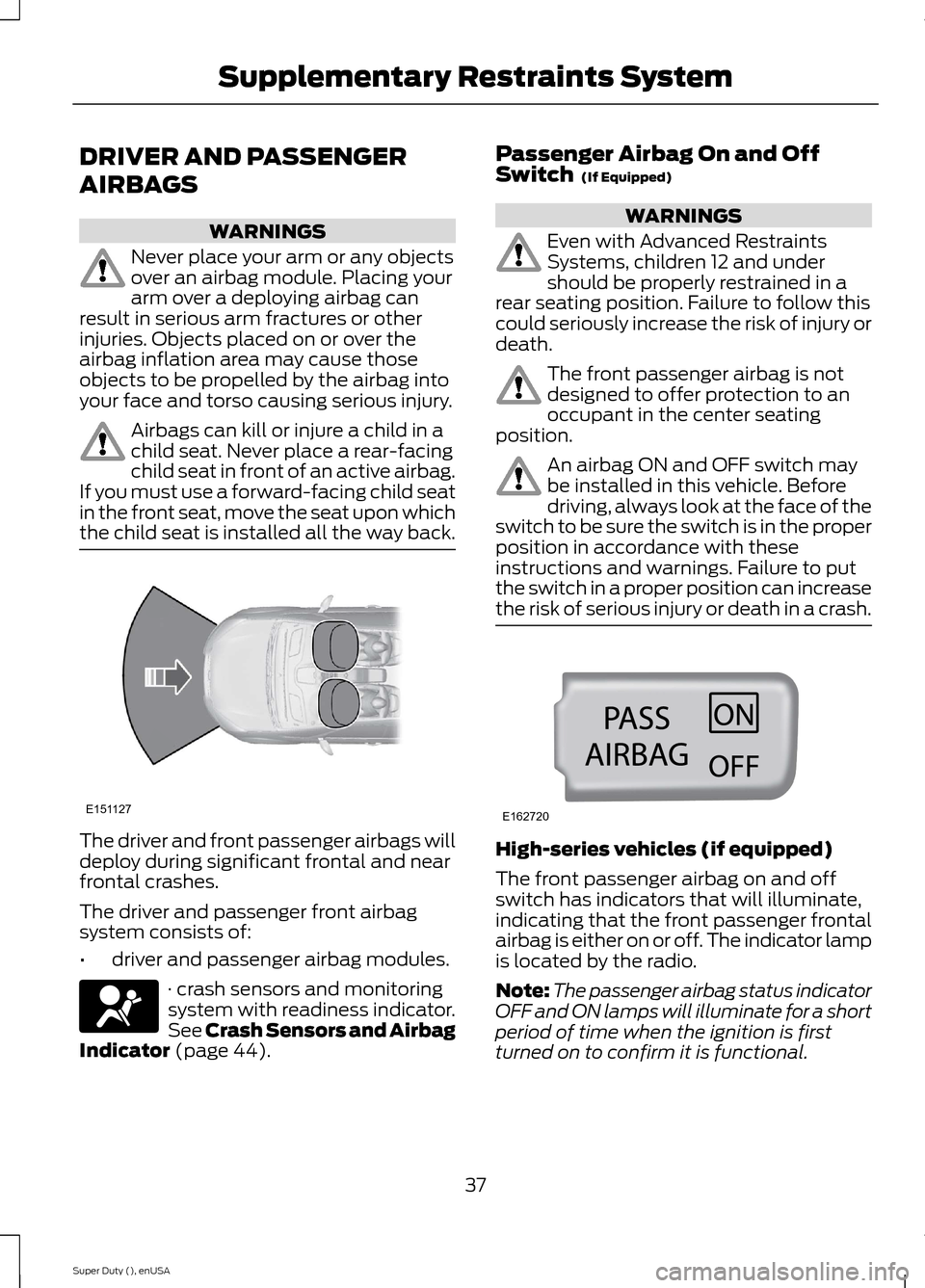
The driver and front passenger airbags willdeploy during significant frontal and nearfrontal crashes.
The driver and passenger front airbagsystem consists of:
•driver and passenger airbag modules.
· crash sensors and monitoringsystem with readiness indicator.See Crash Sensors and AirbagIndicator (page 44).
Passenger Airbag On and OffSwitch (If Equipped)
WARNINGS
Even with Advanced RestraintsSystems, children 12 and undershould be properly restrained in arear seating position. Failure to follow thiscould seriously increase the risk of injury ordeath.
The front passenger airbag is notdesigned to offer protection to anoccupant in the center seatingposition.
An airbag ON and OFF switch maybe installed in this vehicle. Beforedriving, always look at the face of theswitch to be sure the switch is in the properposition in accordance with theseinstructions and warnings. Failure to putthe switch in a proper position can increasethe risk of serious injury or death in a crash.
High-series vehicles (if equipped)
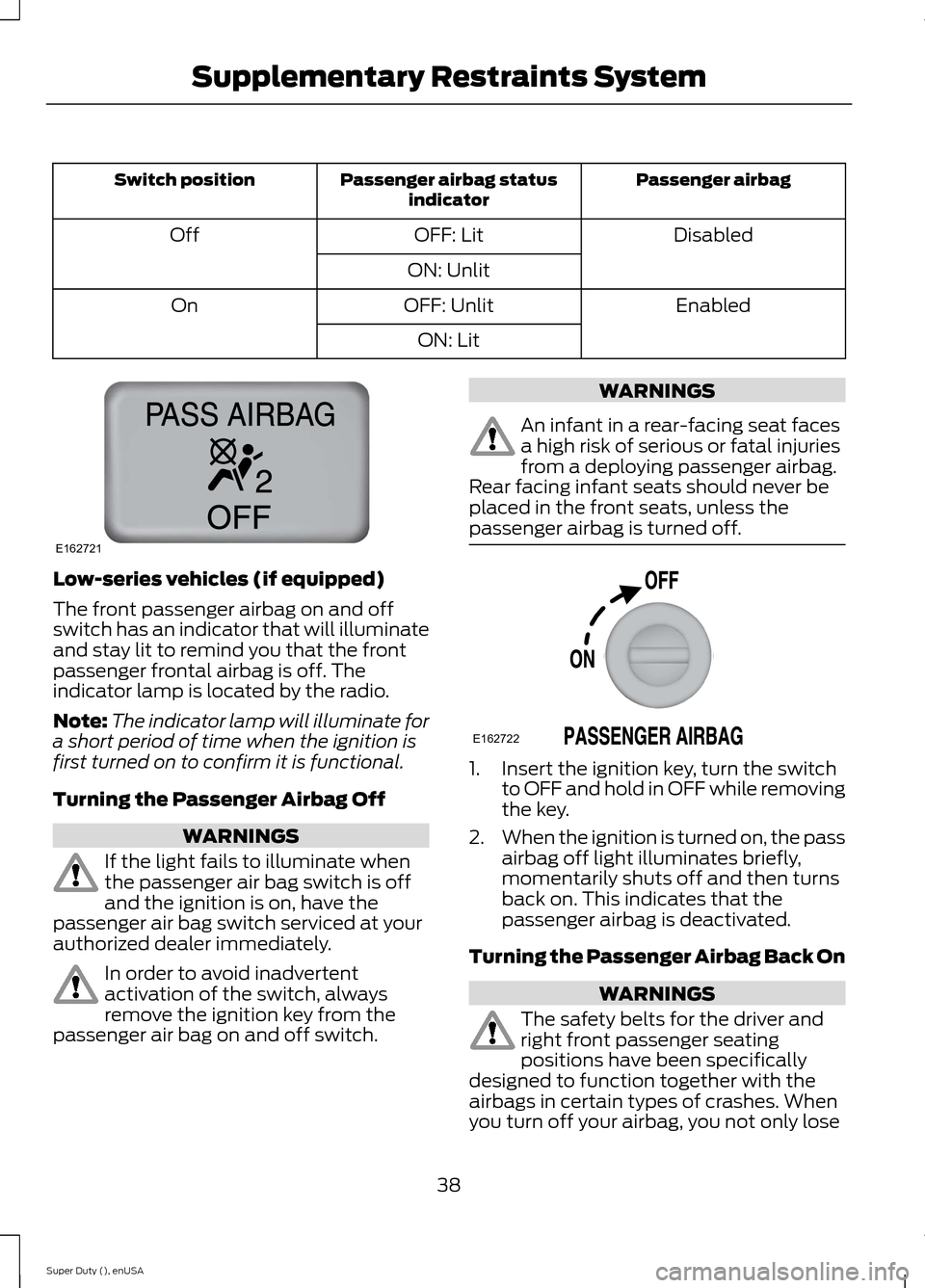
The front passenger airbag on and offswitch has indicators that will illuminate,indicating that the front passenger frontalairbag is either on or off. The indicator lampis located by the radio.
Note:The passenger airbag status indicatorOFF and ON lamps will illuminate for a shortperiod of time when the ignition is firstturned on to confirm it is functional.
37Super Duty (), enUSASupplementary Restraints SystemE151127 E162720
Page 41 of 470
Passenger airbagPassenger airbag statusindicatorSwitch position
DisabledOFF: LitOff
ON: Unlit
EnabledOFF: UnlitOn
ON: Lit
Low-series vehicles (if equipped)
The front passenger airbag on and offswitch has an indicator that will illuminateand stay lit to remind you that the frontpassenger frontal airbag is off. Theindicator lamp is located by the radio.
Note:The indicator lamp will illuminate fora short period of time when the ignition isfirst turned on to confirm it is functional.
Turning the Passenger Airbag Off
WARNINGS
If the light fails to illuminate whenthe passenger air bag switch is offand the ignition is on, have thepassenger air bag switch serviced at yourauthorized dealer immediately.
In order to avoid inadvertentactivation of the switch, alwaysremove the ignition key from thepassenger air bag on and off switch.
WARNINGS
An infant in a rear-facing seat facesa high risk of serious or fatal injuriesfrom a deploying passenger airbag.Rear facing infant seats should never beplaced in the front seats, unless thepassenger airbag is turned off.
1.Insert the ignition key, turn the switchto OFF and hold in OFF while removingthe key.
2.When the ignition is turned on, the passairbag off light illuminates briefly,momentarily shuts off and then turnsback on. This indicates that thepassenger airbag is deactivated.
Turning the Passenger Airbag Back On
WARNINGS
The safety belts for the driver andright front passenger seatingpositions have been specificallydesigned to function together with theairbags in certain types of crashes. Whenyou turn off your airbag, you not only lose
38Super Duty (), enUSASupplementary Restraints SystemE162721 E162722
Page 42 of 470
WARNINGS
the protection of the airbag, you also mayreduce the effectiveness of your safety beltsystem, which was designed to work withthe airbag. If you are not a person whomeets the requirements stated in theNational Highway Traffic SafetyAdministration or Transport Canadadeactivation criteria turning off the airbagcan increase the risk of serious injury ordeath in a crash.
If your vehicle has rear seats, alwaystransport children who are 12 andyounger in the rear seat. Always usesafety belts and child restraints properly.Do not place a child in a rear facing infantseat in the front seat unless your vehicle isequipped with an airbag on and off switchand the passenger airbag is turned off. Thisis because the back of the infant seat istoo close to the inflating airbag and therisk of a fatal injury to the infant when theairbag inflates is substantial.
If the pass airbag off light isilluminated when the passengerairbag switch is on and the ignitionis on, have the passenger airbag switchserviced at your authorized dealerimmediately.
The passenger airbag remains off until youturn it back on.
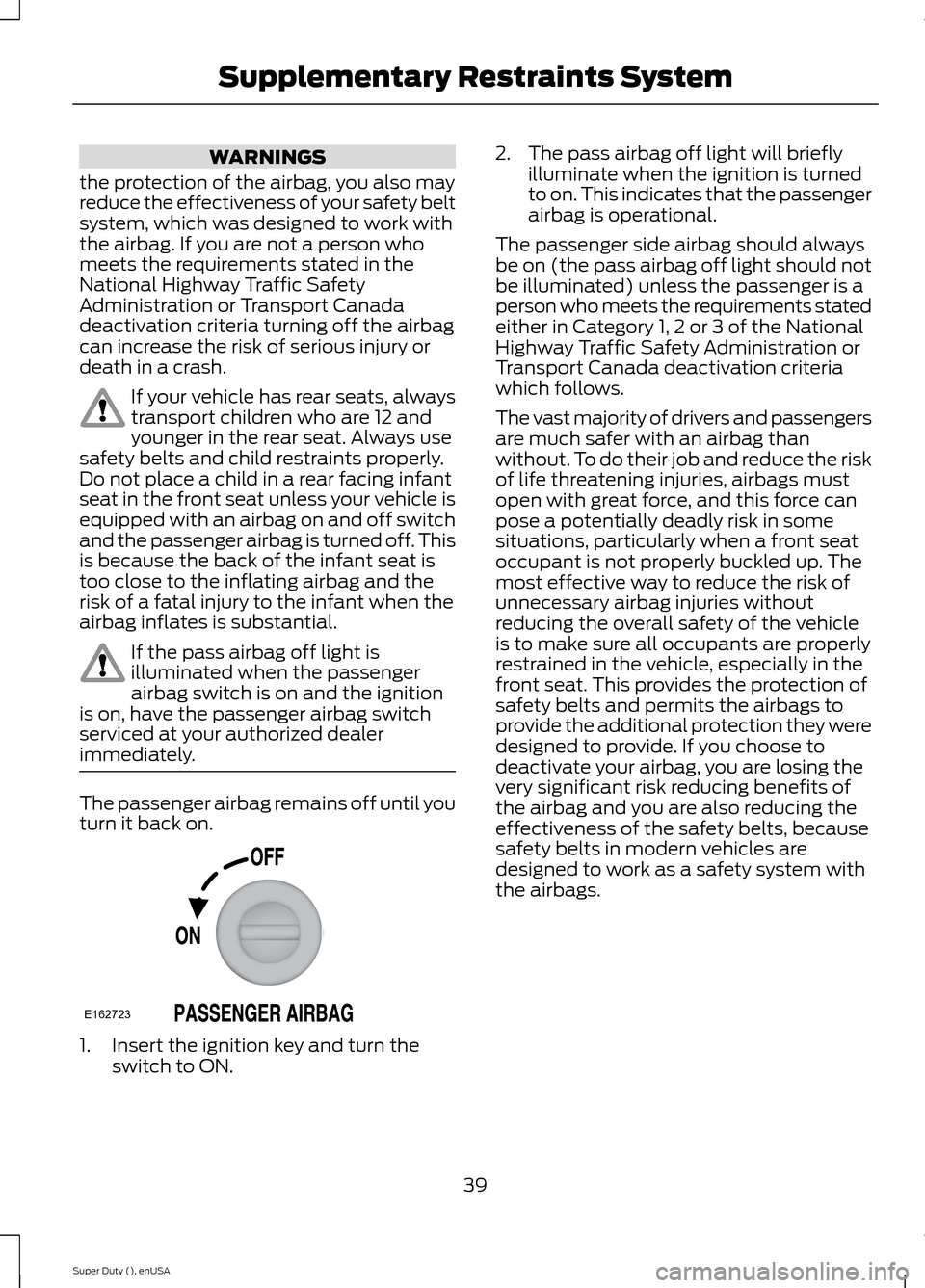
1.Insert the ignition key and turn theswitch to ON.
2.The pass airbag off light will brieflyilluminate when the ignition is turnedto on. This indicates that the passengerairbag is operational.
The passenger side airbag should alwaysbe on (the pass airbag off light should notbe illuminated) unless the passenger is aperson who meets the requirements statedeither in Category 1, 2 or 3 of the NationalHighway Traffic Safety Administration orTransport Canada deactivation criteriawhich follows.
The vast majority of drivers and passengersare much safer with an airbag thanwithout. To do their job and reduce the riskof life threatening injuries, airbags mustopen with great force, and this force canpose a potentially deadly risk in somesituations, particularly when a front seatoccupant is not properly buckled up. Themost effective way to reduce the risk ofunnecessary airbag injuries withoutreducing the overall safety of the vehicleis to make sure all occupants are properlyrestrained in the vehicle, especially in thefront seat. This provides the protection ofsafety belts and permits the airbags toprovide the additional protection they weredesigned to provide. If you choose todeactivate your airbag, you are losing thevery significant risk reducing benefits ofthe airbag and you are also reducing theeffectiveness of the safety belts, becausesafety belts in modern vehicles aredesigned to work as a safety system withthe airbags.
39Super Duty (), enUSASupplementary Restraints SystemE162723
Page 43 of 470
National Highway Traffic SafetyAdministration Deactivation Criteria(Excluding Canada)
WARNING
This vehicle has special energymanagement safety belts for thedriver and right front passenger.These particular belts are specificallydesigned to work with airbags to helpreduce the risk of injury in a crash. Theenergy management safety belt isdesigned to give or release additional beltwebbing in some accidents to reduceconcentration of force on an occupant'schest and reduce the risk of certain bonefractures and injuries to underlying organs.In a crash, if the airbag is turned off, thisenergy management safety belt mightpermit the person wearing the belt to moveforward enough to incur a serious or fatalinjury. The more severe the crash, and theheavier the occupant, the greater the riskis. Be sure the airbag is turned on for anyperson who does not qualify under theNational Highway Traffic SafetyAdministration deactivation criteria.
1.Infant. An infant (less than 1 year old)must ride in the front seat because:
•the vehicle has no rear seat;
•the vehicle has a rear seat too small toaccommodate a rear-facing infantseat; or
•the infant has a medical conditionwhich, according to the infant'sphysician, makes it necessary for theinfant to ride in the front so that thedriver can constantly monitor thechild's condition.
2.Child age 1 to 12. A child age 1 to 12 mustride in the front seat because:
•the vehicle has no rear seat;
•although children ages 1 to 12 ride in therear seat(s) whenever possible,children ages 1 to 12 sometimes mustride in the front because no space isavailable in the rear seat(s) of thevehicle; or
•the child has a medical conditionwhich, according to the child'sphysician, makes it necessary for thechild to ride in the front seat so that thedriver can constantly monitor thechild's condition.
3. Medical condition. A passenger has amedical condition which, according to hisor her physician:
•causes the passenger airbag to pose aspecial risk for the passenger;
•makes the potential harm from thepassenger airbag in a crash greaterthan the potential harm from turningoff the airbag and allowing thepassenger, even if belted, to hit thedashboard or windshield in a crash.
40Super Duty (), enUSASupplementary Restraints System