2015 FORD SUPER DUTY warning
[x] Cancel search: warningPage 53 of 84
Coolant Change
At specific mileage intervals, as listed in
the scheduled maintenance information,
the coolant should be changed. The
optional information display, if equipped,
will also display the message COOLANT
CHANGE REQUIRED at this time.
See Capacities and Specifications
(page 55). for the proper coolant.
Engine-driven Cooling Fan (Fan
Clutch)
Your vehicle is equipped with an engine
driven cooling fan drive (also called a fan
clutch). This fan drive changes the fan
speed to match the vehicle ’s changing
cooling air flow requirements. Fan speed,
fan noise level and fuel consumption all
will increase based on the driving
conditions that include trailer towing, hill
climbing, heavy loads, high speed and high
ambient temperature, individually or in
combination.
The fan drive is designed to provide the
minimum fan speed (and resulting
minimum fan noise and fuel consumption)
required to meet the ever changing vehicle
cooling air flow requirements. You will hear
the amount of fan noise increasing and
decreasing as the engine power
requirements and vehicle driving conditions
change as you drive. This is to be expected
as being normal to the operation of your
vehicle. High levels of fan noise might also
be heard when your engine is first started,
and should normally decrease after driving
for a short time. CHANGING THE ENGINE AIR
FILTER
Air Filter Restriction Gauge WARNING
To reduce the risk of vehicle damage
and/or personal burn injuries do not
start your engine with the air filter
removed and do not remove it while the
engine is running. Note:
Operating your vehicle in heavy
snowfall or extreme rain conditions may
allow excessive amounts of snow or water
into the air intake system. This could plug
or soak the air filter that could cause the
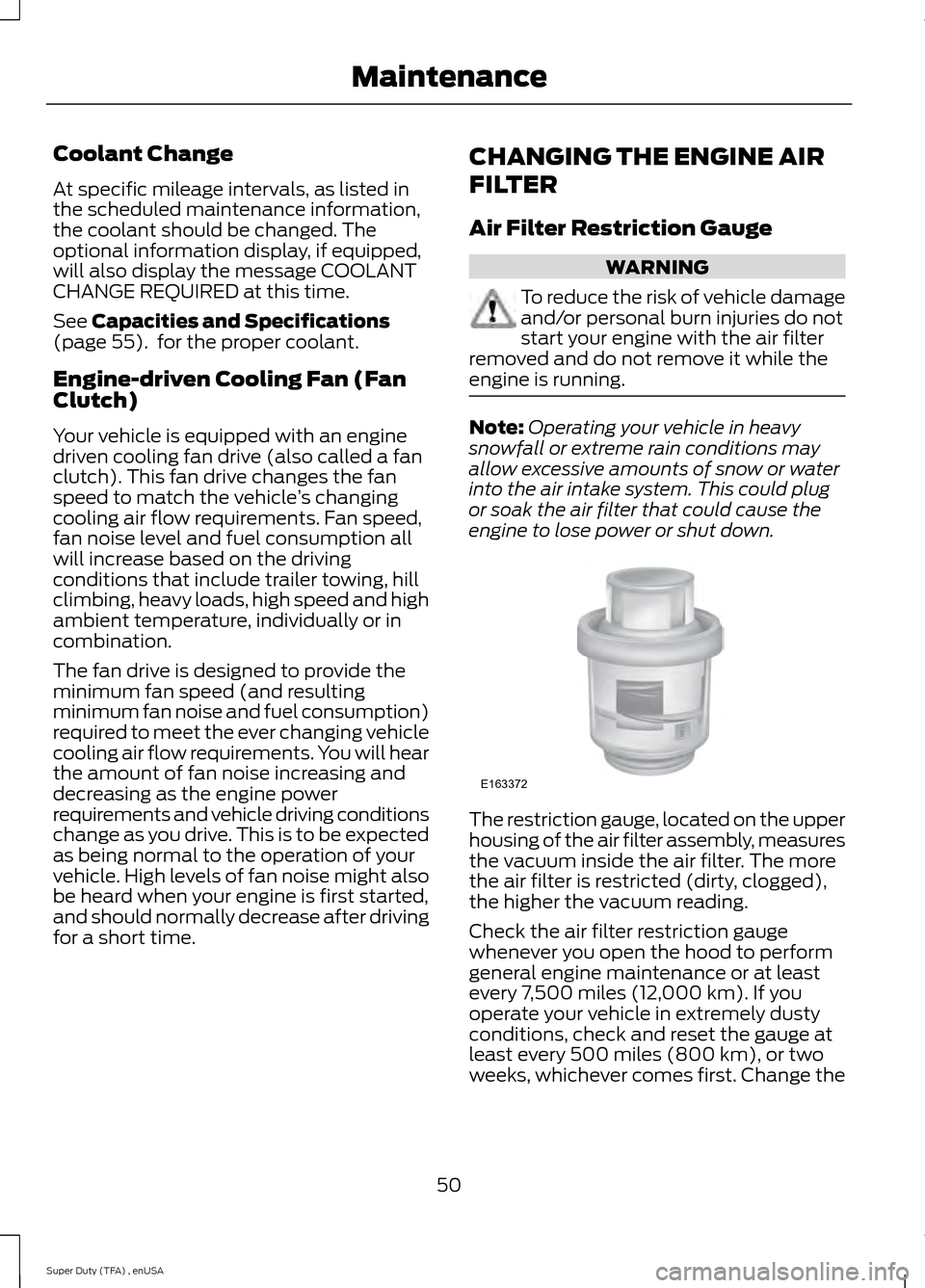
engine to lose power or shut down. The restriction gauge, located on the upper
housing of the air filter assembly, measures
the vacuum inside the air filter. The more
the air filter is restricted (dirty, clogged),
the higher the vacuum reading.
Check the air filter restriction gauge
whenever you open the hood to perform
general engine maintenance or at least
every 7,500 miles (12,000 km). If you
operate your vehicle in extremely dusty
conditions, check and reset the gauge at
least every 500 miles (800 km), or two
weeks, whichever comes first. Change the
50
Super Duty (TFA) , enUSA MaintenanceE163372
Page 57 of 84
CLEANING THE ENGINE
Engines are more efficient when they are
clean because grease and dirt buildup keep
the engine warmer than normal.
When washing:
•
Take care when using a power washer
to clean the engine. The high-pressure
fluid could penetrate the sealed parts
and cause damage.
• Do not spray a hot engine with cold
water to avoid cracking the engine
block or other engine components.
• Spray Motorcraft Engine Shampoo and
Degreaser on all parts that require
cleaning and pressure rinse clean. In
Canada, use Motorcraft Engine
Shampoo.
• Never wash or rinse the engine while it
is hot or running; water in the running
engine may cause internal damage.
• Never wash or rinse any ignition coil,
spark plug wire or spark plug well, or
the area in and around these locations.
• Cover the battery, power distribution
box, and air filter assembly to prevent
water damage when cleaning the
engine.
CLEANING THE EXHAUST WARNINGS
Failure to maintain the functional
holes, in the tailpipe section of the
exhaust, clean and free of debris or
foreign material may result in the holes
becoming blocked or plugged. Do not
modify or remove the tail-pipe section.
Blocked or plugged holes or
removal/modification of the system could
result in elevated exhaust gas
temperatures which may result in
vehicle/property damage or personal
injury. WARNINGS
The normal operating temperature
of the exhaust system is very high.
Never work around or attempt to
repair any part of the exhaust system until
it has cooled. Use special care when
working around the diesel oxidation
catalytic converter and/or the diesel
particulate filter (DPF). The diesel
oxidation catalytic converter and/or the
DPF heats up to a high temperature after
only a short period of engine operation and
can stay hot even after the engine is turned
off. Failure to follow these instructions may
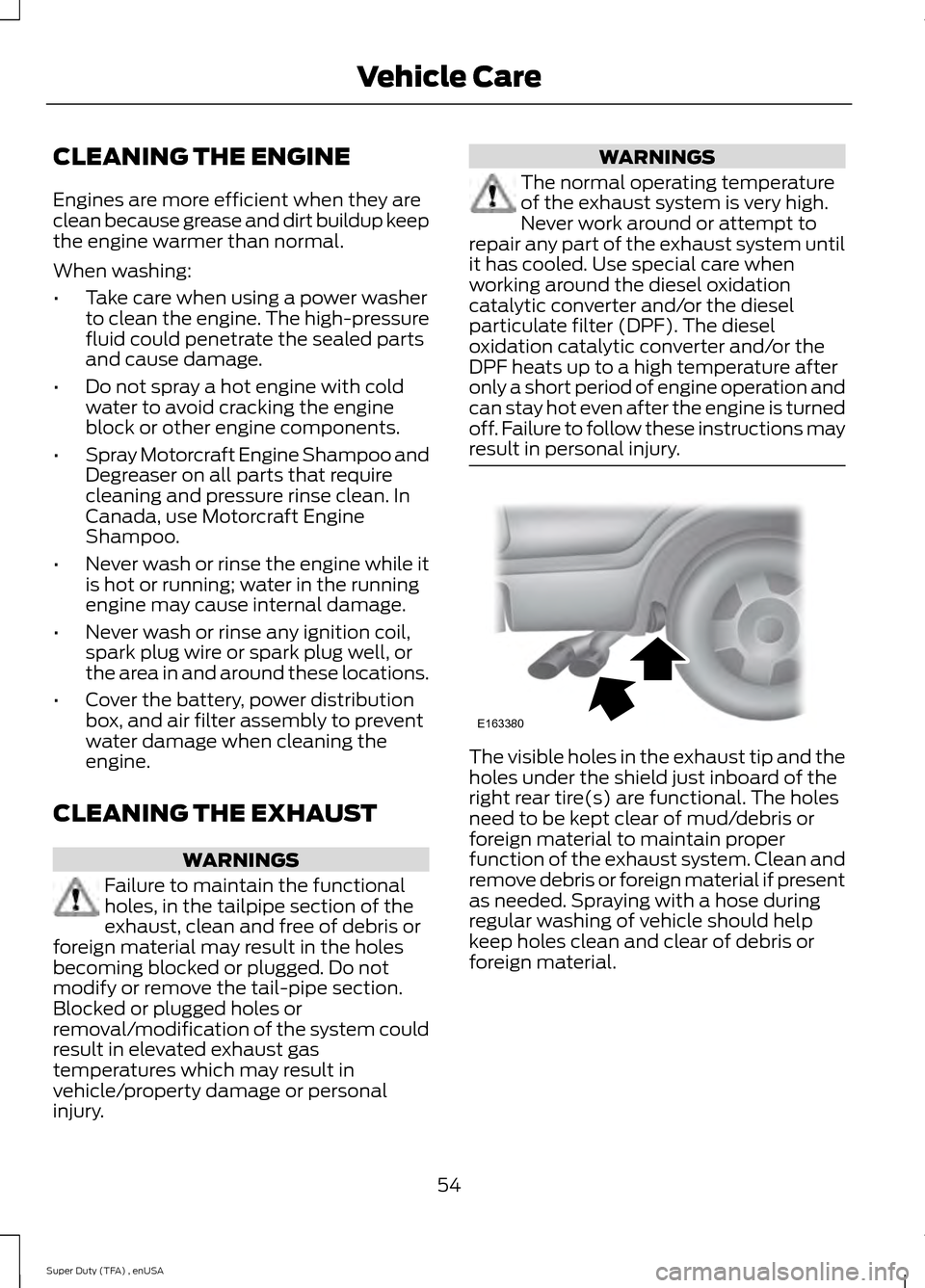
result in personal injury. The visible holes in the exhaust tip and the
holes under the shield just inboard of the
right rear tire(s) are functional. The holes
need to be kept clear of mud/debris or
foreign material to maintain proper
function of the exhaust system. Clean and
remove debris or foreign material if present
as needed. Spraying with a hose during
regular washing of vehicle should help
keep holes clean and clear of debris or
foreign material.
54
Super Duty (TFA) , enUSA Vehicle CareE163380
Page 64 of 84
Tightening lug nuts
Tighten the lug nuts to the specified torque at 500 miles
(800 km) after any wheel disturbance (such as tire rota-
tion, changing a flat tire or wheel removal).
Vehicles with single rear
wheels
Tighten the wheel lug nuts to the specified torque at 100
miles (160 km), and again at 500 miles (800 km) of new vehicle operation and after any wheel disturbance (such as tire rotation, changing a flat tire or wheel removal).
Vehicles with dual rear
wheels
Note: For the proper lug nut torque specification, see Technical specifications in the Wheels
and Tires chapter of your owner's manual.
Multi-point Inspection
In order to keep your vehicle running right,
it is important to have the systems on your
vehicle checked regularly. This can help
identify potential issues and prevent major
problems. We recommend having the
following multi-point inspection performed
at every scheduled maintenance interval
to help make sure your vehicle keeps
running great. Multi-point inspection
Horn operation
Accessory drive belt(s)
Radiator, cooler, heater and A/C hoses
Battery performance
Suspension component for leaks ordamage
Engine air filter
Steering and linkage
Exhaust system
Tires (including spare) for wear and properpressure**
Exterior lamps and hazard warning system
operation
Windshield for cracks, chips or pits
Fluid levels *
; fill if necessary
Washer spray and wiper operation
For oil and fluid leaks
* Brake, coolant recovery reservoir, automatic transmission, power steering and window
washer.
** If your vehicle is equipped with a temporary mobility kit, check the tire sealant expiration
Use By date on the canister. Replace as needed.
61
Super Duty (TFA) , enUSA Scheduled Maintenance
Page 82 of 84
A
About This Supplement.................................3
Breaking-In Your Vehicle...................................... 3
Diesel Engine Information................................... 3
Minor Troubleshooting Guide............................. 5
Warnings.................................................................... 3
ABS See: Brakes.............................................................. 37
B
Brakes
..................................................................37
General Information............................................ 37
C
Capacities and Specifications
..................55
Technical Specifications.................................... 57
Changing the Engine Air Filter...................50 Air Filter Replacement......................................... 51
Air Filter Restriction Gauge............................... 50
Cleaning the Engine......................................54
Cleaning the Exhaust...................................54
Coolant Check See: Engine Coolant Check.............................. 45
E
Emission Control System
...........................30
Diesel Exhaust System: Oxidation Catalyst
And Diesel Particulate Filter System
........................................................................\
........ 30
Engine Block Heater
.......................................14
Rapid Heat Supplemental Heating
System................................................................. 14
Engine Coolant Check..................................45 Adding Engine Coolant...................................... 45
Checking Coolant Corrosion Inhibitor Additive Strength ........................................... 48
Checking the Engine Coolant.......................... 45
Coolant Change................................................... 50
Engine and Secondary Cooling System Refill Procedure................................................ 47
Engine-driven Cooling Fan (Fan Clutch)................................................................ 50
Recycled Engine Coolant.................................. 48
Severe Climates................................................... 48Engine Idle Shutdown
...................................13
Engine Oil Check.............................................43 Changing the Engine Oil and Oil Filter.........44
Engine Oil Specifications.................................. 43
Engine Specifications
...................................55
Drivebelt Routing.................................................. 55
F
Fuel and Refueling
..........................................15
Fuel Quality.......................................................15
Biodiesel................................................................... 16
Diesel Fuel Additives ........................................... 17
Fuel And Water Separator ................................. 17
Fuel Requirements - Choosing The Right Fuel: Vehicles Operated Where Ultra Low
Sulfur Diesel Fuel Is Not Required ............15
Fuel Requirements - Choosing The Right Fuel: Vehicles Operated Where Ultra Low
Sulfur Diesel Fuel Is Required (United
States/Canada/Puerto Rico/U.S. Virgin
Islands And Other Locales) ......................... 15
Fuel Shutoff.....................................................39 Running Out Of DEF (Diesel Exhaust
Fluid).................................................................... 39
Fuel Tank Selector Switch..........................36
G
Gauges..................................................................8 Engine Boost Gauge.............................................. 8
General Maintenance Information
..........59
Multi-point Inspection......................................... 61
Owner Checks and Services............................ 60
Protecting Your Investment............................. 59
Why Maintain Your Vehicle?............................ 59
Why Maintain Your Vehicle at Your Dealership?....................................................... 59
I
Instrument Cluster...........................................8
Introduction........................................................3
79
Super Duty (TFA) , enUSA Index
Page 83 of 84
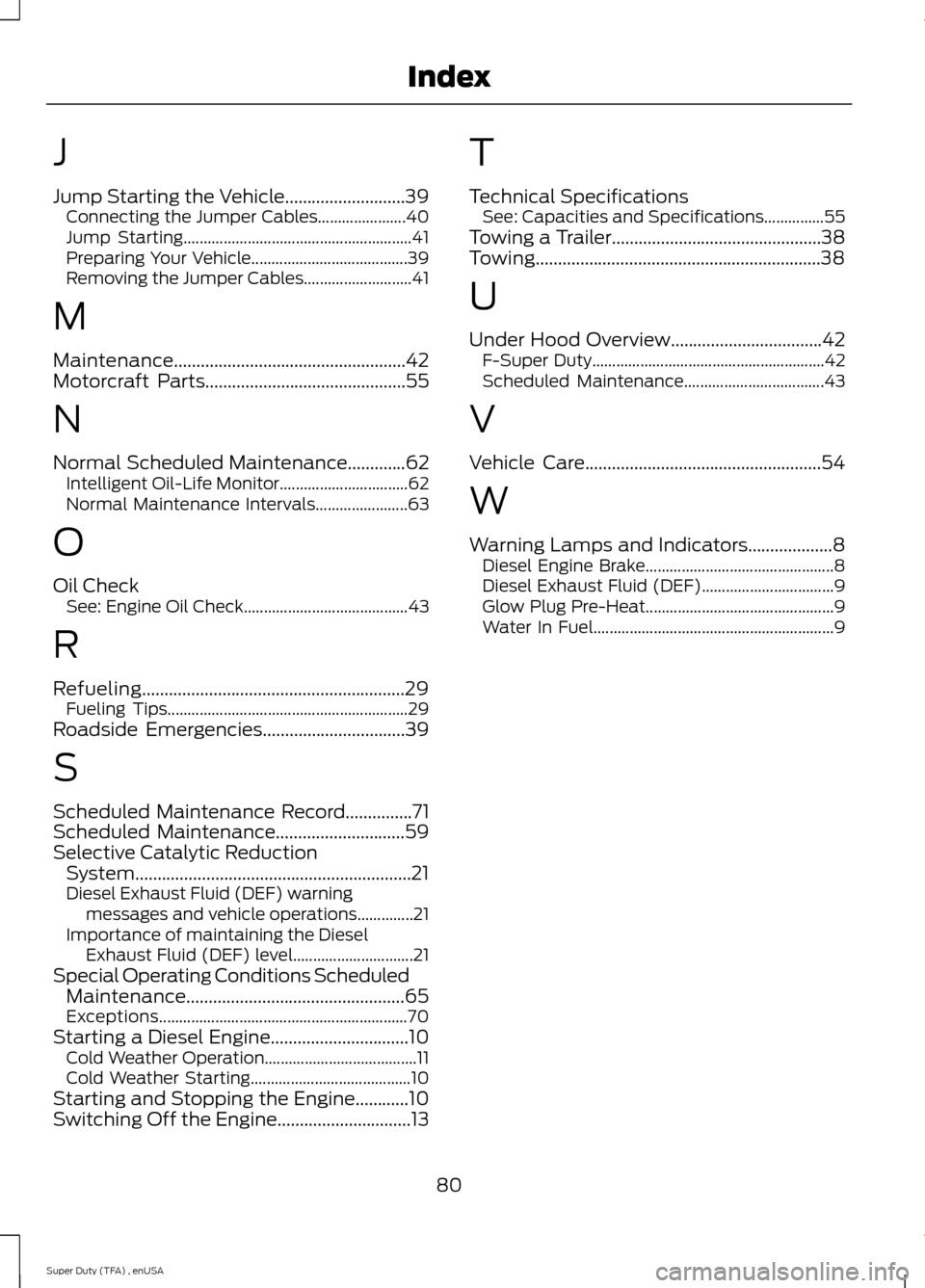
J
Jump Starting the Vehicle...........................39
Connecting the Jumper Cables...................... 40
Jump Starting......................................................... 41
Preparing Your Vehicle....................................... 39
Removing the Jumper Cables........................... 41
M
Maintenance....................................................42
Motorcraft Parts.............................................55
N
Normal Scheduled Maintenance.............62 Intelligent Oil-Life Monitor................................ 62
Normal Maintenance Intervals....................... 63
O
Oil Check See: Engine Oil Check......................................... 43
R
Refueling...........................................................29 Fueling Tips............................................................ 29
Roadside Emergencies
................................39
S
Scheduled Maintenance Record...............71
Scheduled Maintenance.............................59
Selective Catalytic Reduction System..............................................................21
Diesel Exhaust Fluid (DEF) warning messages and vehicle operations..............21
Importance of maintaining the Diesel Exhaust Fluid (DEF) level.............................. 21
Special Operating Conditions Scheduled Maintenance.................................................65
Exceptions.............................................................. 70
Starting a Diesel Engine...............................10 Cold Weather Operation...................................... 11
Cold Weather Starting........................................ 10
Starting and Stopping the Engine............10
Switching Off the Engine..............................13 T
Technical Specifications
See: Capacities and Specifications...............55
Towing a Trailer...............................................38
Towing................................................................38
U
Under Hood Overview..................................42 F-Super Duty.......................................................... 42
Scheduled Maintenance................................... 43
V
Vehicle Care
.....................................................54
W
Warning Lamps and Indicators...................8 Diesel Engine Brake............................................... 8
Diesel Exhaust Fluid (DEF)................................. 9
Glow Plug Pre-Heat............................................... 9
Water In Fuel............................................................ 9
80
Super Duty (TFA) , enUSA Index