2015 FORD SUPER DUTY stop start
[x] Cancel search: stop startPage 21 of 84
Note:
If you drain the diesel fuel conditioner
module while the system is running air will
enter into the fuel system. The engine will
not operate properly if air enters the system.
Note: With fuel tank levels above 3⁄4 tank
it may be necessary to loosen the bowl 3
turns before opening the drain. This will
actuate an anti-siphon valve at the fuel and
water separator inlet and prevent the fuel
from siphoning out of the tank.
Note: A loose drain valve can allow air to
enter the fuel system and cause drivetrain
issues. The engine will not operate properly.
Be sure that you fully tighten the drain valve.
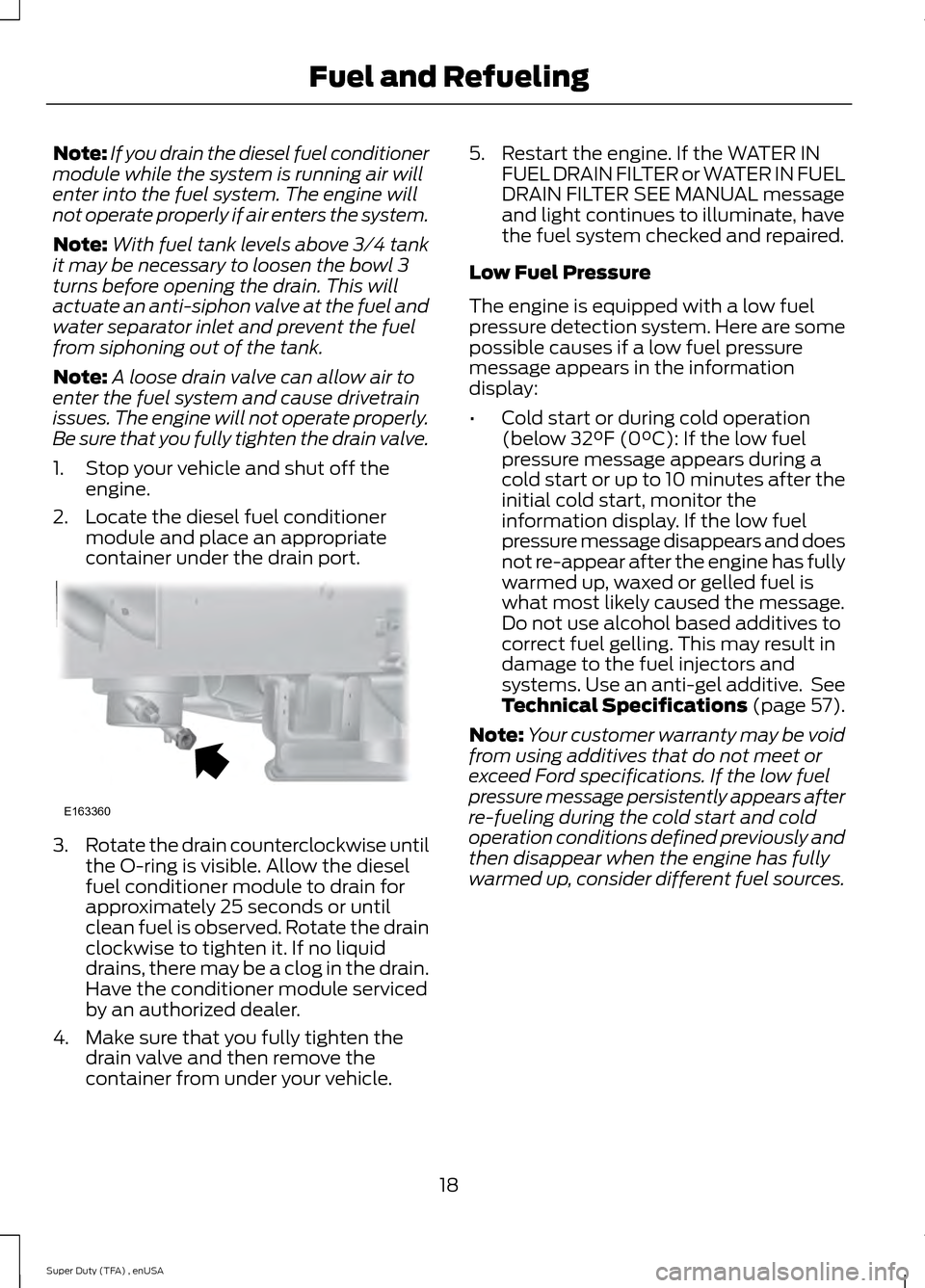
1. Stop your vehicle and shut off the engine.
2. Locate the diesel fuel conditioner module and place an appropriate
container under the drain port. 3.
Rotate the drain counterclockwise until
the O-ring is visible. Allow the diesel
fuel conditioner module to drain for
approximately 25 seconds or until
clean fuel is observed. Rotate the drain
clockwise to tighten it. If no liquid
drains, there may be a clog in the drain.
Have the conditioner module serviced
by an authorized dealer.
4. Make sure that you fully tighten the drain valve and then remove the
container from under your vehicle. 5. Restart the engine. If the WATER IN
FUEL DRAIN FILTER or WATER IN FUEL
DRAIN FILTER SEE MANUAL message
and light continues to illuminate, have
the fuel system checked and repaired.
Low Fuel Pressure
The engine is equipped with a low fuel
pressure detection system. Here are some
possible causes if a low fuel pressure
message appears in the information
display:
• Cold start or during cold operation
(below 32°F (0°C): If the low fuel
pressure message appears during a
cold start or up to 10 minutes after the
initial cold start, monitor the
information display. If the low fuel
pressure message disappears and does
not re-appear after the engine has fully
warmed up, waxed or gelled fuel is
what most likely caused the message.
Do not use alcohol based additives to
correct fuel gelling. This may result in
damage to the fuel injectors and
systems. Use an anti-gel additive. See
Technical Specifications (page 57).
Note: Your customer warranty may be void
from using additives that do not meet or
exceed Ford specifications. If the low fuel
pressure message persistently appears after
re-fueling during the cold start and cold
operation conditions defined previously and
then disappear when the engine has fully
warmed up, consider different fuel sources.
18
Super Duty (TFA) , enUSA Fuel and RefuelingE163360
Page 24 of 84
Installation – Engine-mounted fuel
filter
1. Install the new filter into the filter
bracket. Turn the filter clockwise to
lock it in place.
2. Reconnect both fuel lines.
Note: Using a fuel that has more than
average impurities may require you to
replace the fuel filter more frequently than
the service interval specifies.
Note: You will need to purge the system of
air after removal or changing of the filter.
See purging air from the fuel system later
in this chapter.
Purging air from the fuel system
Turn the ignition key to on for 30 seconds,
then turn it to off. Do this six times in a row
to purge any trapped air from the fuel
system.
After filter service, a no start or rough
running engine may indicate that air is
entering the system through the filter bowl
seal or drain. Make sure the drain is tight
and you tightened the filter bowl to the
mechanical stop.
SELECTIVE CATALYTIC
REDUCTION SYSTEM
Your vehicle is equipped with a selective
catalytic reduction system to help reduce
emission levels of oxides of nitrogen from
the exhaust of the diesel engine. The
system automatically injects Diesel
Exhaust Fluid (DEF) into the exhaust
system to enable proper selective catalytic
reduction function. Importance of maintaining the
Diesel Exhaust Fluid (DEF) level
In order for the selective catalytic reduction
system to operate properly, the DEF level
must be maintained. Generally, the DEF
tank should be filled during the oil change
service interval. See General
Maintenance Information (page 59).
However, certain conditions or driving
styles, such as trailer towing or fast rates
of acceleration, will require the refilling of
the DEF tank more often.
The engine control unit will monitor the
amount of fluid available in the DEF tank.
Running a system check in the information
display will indicate whether the DEF level
is ok or if it is less than 1/2 full. A message
will display in the information display when
the DEF level is low and needs to be
refilled. When you see this message, you
should refill your tank. See the Information
displays chapter of your Owner ’s Manual
for information display functions. For
instructions on refilling your DEF tank, see
filling the Diesel Exhaust Fluid (DEF) tank
in this supplement.
Diesel Exhaust Fluid (DEF)
warning messages and vehicle
operations WARNINGS
Diesel Exhaust Fluid (DEF) must be
refilled when low or replaced when
contaminated or your vehicle speed
will be speed limited to 50 mph (80 km/h).
In these conditions, drive with caution and
refill DEF immediately. If the DEF becomes
empty or contaminated and fluid is not
replaced, your vehicle will become limited
to idle speed only once stopped. In these
conditions, be cautious where you stop
your vehicle because you may not be able
to drive long distances and will not be able
to maintain highway speeds until you refill
or replace the DEF.
21
Super Duty (TFA) , enUSA Fuel and Refueling
Page 32 of 84
Chassis cab (non–Power Take Off)
Steady highwaydriving
Normal driving
Trailer towing /
aggressive or city driving
Driving style
7800 miles (12553km) – 9300 miles (14967 km)
4700 miles (7564
km) – 7800 miles (12553 km)
1700 miles (2736
km) – 4700 miles (7564 km)
Diesel Exhaust Fluid
(DEF) usage Chassis cab (with Power Take Off)
Cont. PTO usage — Min. PTO usage
PTO usage
0 miles (0 km) — 7800 miles (12553 km)
Diesel Exhaust Fluid
(DEF) usage
REFUELING
Fueling Tips WARNING
Do not use starting fluid such as
ether or gasoline in the diesel air
intake system. Such fluids can cause
immediate explosive damage to the engine
and possible personal injury. Truck stops have pumps and nozzles
designed for larger, heavy-duty trucks.
When refueling at truck stops: if the nozzle
shuts off repeatedly when refueling, wait
5–
10 seconds; then use a slower rate of
flow (don ’t depress the nozzle trigger as
far). If air is allowed to enter the fuel system
(during fuel filter change or if you run out
of fuel) the engine will purge the trapped
air as it runs. To purge the air sooner: prior
to engine start, prime the system by turning
the key to on for 30 seconds then to off.
Repeat this several times. The engine may
run rough and produce white smoke while
air is in the system. This is normal.
An engine that suddenly becomes noisy or
operates poorly after a fuel fill could be
using substandard fuel (for example, high
water content, low cetane rating or
gasoline in the fuel). You should purchase
diesel fuel from a reputable station that
sells a large amount of diesel fuel.
Use only clean, approved containers that
will prevent the entry of dirt or water
whenever you store diesel fuel.
Diesel fuel must not be stored in a
galvanized container. The fuel will dissolve
the zinc in the galvanized container. The
zinc will then remain in the fuel. If you run
the contaminated fuel through the engine,
the zinc will deposit in the fuel injectors
causing expensive-to-repair damage.
29
Super Duty (TFA) , enUSA Fuel and Refueling
Page 36 of 84
Information display procedure
Start with your vehicle engine fully warmed
and then press the Info button on the
steering wheel until the information display
reads one of the following choices:
• EXHST XX% FULL CLEAN? Y/N
• EXHAUST FULL CLEAN? Y/N
Answer yes to this prompt and then follow
the prompts regarding exhaust position as
needed to initiate Operator Commanded
Regeneration. Be sure to understand each
prompt. If you are not sure what is being
asked by each prompt, contact an
authorized dealer. The display will confirm
the operation has started and when it has
finished.
If the diesel particulate filter is near or at
saturation, a message requesting
permission to initiate filter cleaning will
display
EXH AT LIMIT CLEAN? Y/N.
Answer yes to this prompt and then follow
the prompts regarding exhaust position as
needed to initiate Operator Commanded
Regeneration. Be sure to understand each
prompt. If you are not sure what is being
asked by each prompt, contact an
authorized dealer. The display will confirm
the operation has started and when it has
finished. You can also drive to clean the
filter. See Active regeneration earlier in this
chapter. When the system is at the point
of oversaturation, the service
engine soon light will illuminate
and the following message
EXH OVER
LIMIT SERVICE NOW will appear . You
will not be able to allow cleaning. You
must have your vehicle serviced by an
authorized dealer. Once operator commanded regeneration
starts, the engine
’s rpm will rise to
approximately 2,000 - 2,400 rpm and the
cooling fan will increase speed; you will
hear a change in audible sound due to the
fan and engine speed increase.
It is not necessary to open the hood on the
engine compartment. Once Operator
Commanded Regeneration is complete,
the engine rpm and fan will return to
normal idling. The exhaust system will
remain very hot for several minutes even
after regeneration is complete. Do not
reposition the vehicle over materials that
could burn until the exhaust system has
had sufficient time to cool. Depending on
the amount of soot collected by the diesel
particulate filter, ambient temperature,
and altitude, Operator Commanded
Regeneration may last from 10 to 25
minutes.
How to interrupt or cancel Operator
Commanded Regeneration
If you need to cancel the Operator
Commanded Regeneration, pressing the
brake, accelerator, or shutting off the
vehicle will stop the procedure. Depending
on the amount of time you allowed the
Operator Commanded Regeneration to
operate, soot may not have had sufficient
time to be eliminated, but the exhaust
system and exhaust gas may still be hot.
If you shut your vehicle off during Operator
Commanded Regeneration, you will notice
turbo flutter. This is a normal consequence
caused by shutting off a diesel engine
during boosted operation and is considered
normal.
Filter service and maintenance
Over time, a slight amount of ash will build
up in the diesel particulate filter, which is
not removed during the regeneration
process. The filter may need to be removed
for ash cleaning at approximately 120,000
miles (193,000 km) or greater (actual
33
Super Duty (TFA) , enUSA Fuel and Refueling
Page 42 of 84
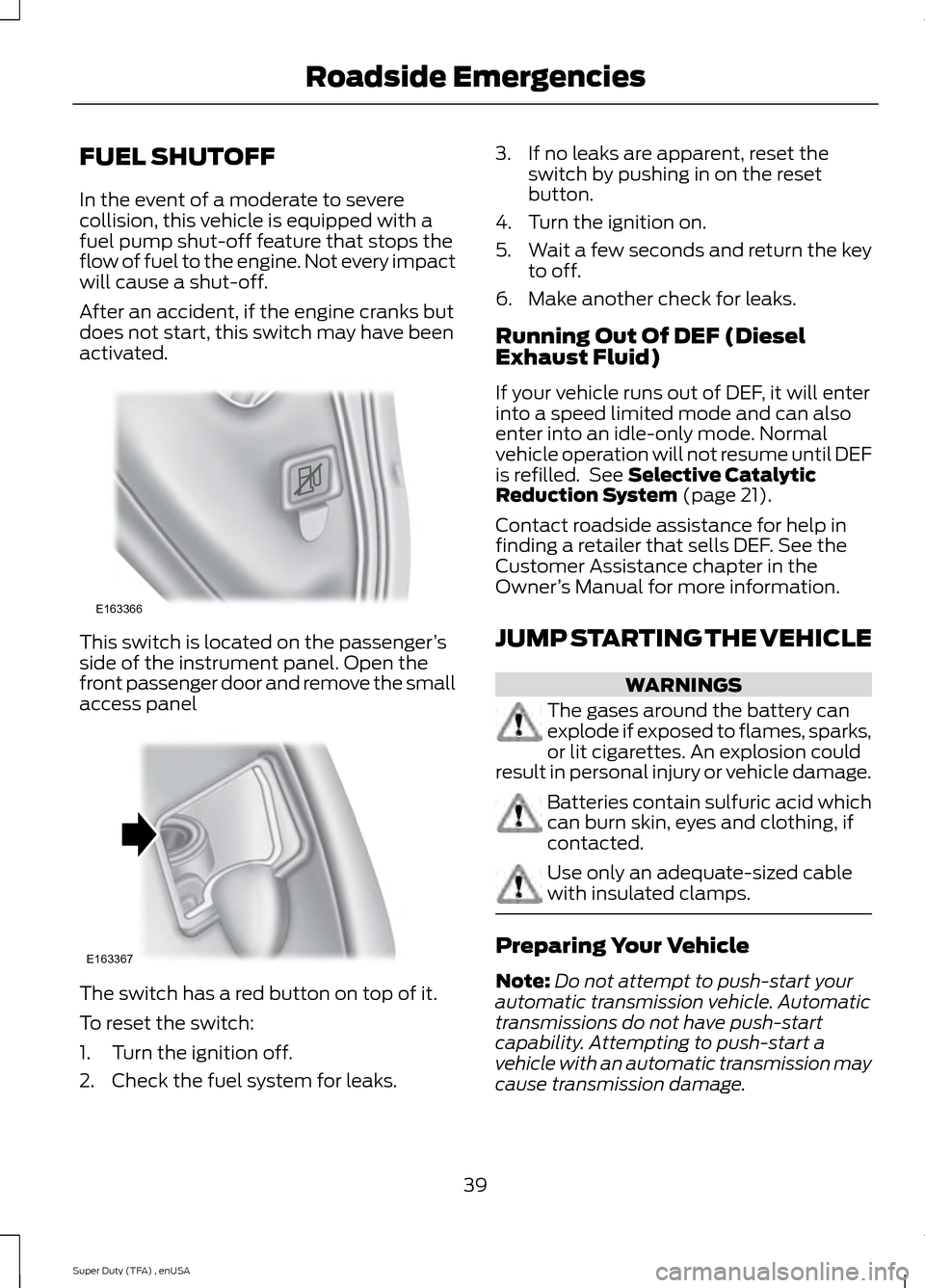
FUEL SHUTOFF
In the event of a moderate to severe
collision, this vehicle is equipped with a
fuel pump shut-off feature that stops the
flow of fuel to the engine. Not every impact
will cause a shut-off.
After an accident, if the engine cranks but
does not start, this switch may have been
activated.
This switch is located on the passenger
’s
side of the instrument panel. Open the
front passenger door and remove the small
access panel The switch has a red button on top of it.
To reset the switch:
1. Turn the ignition off.
2. Check the fuel system for leaks. 3. If no leaks are apparent, reset the
switch by pushing in on the reset
button.
4. Turn the ignition on.
5. Wait a few seconds and return the key
to off.
6. Make another check for leaks.
Running Out Of DEF (Diesel
Exhaust Fluid)
If your vehicle runs out of DEF, it will enter
into a speed limited mode and can also
enter into an idle-only mode. Normal
vehicle operation will not resume until DEF
is refilled. See Selective Catalytic
Reduction System (page 21).
Contact roadside assistance for help in
finding a retailer that sells DEF. See the
Customer Assistance chapter in the
Owner ’s Manual for more information.
JUMP STARTING THE VEHICLE WARNINGS
The gases around the battery can
explode if exposed to flames, sparks,
or lit cigarettes. An explosion could
result in personal injury or vehicle damage. Batteries contain sulfuric acid which
can burn skin, eyes and clothing, if
contacted.
Use only an adequate-sized cable
with insulated clamps.
Preparing Your Vehicle
Note:
Do not attempt to push-start your
automatic transmission vehicle. Automatic
transmissions do not have push-start
capability. Attempting to push-start a
vehicle with an automatic transmission may
cause transmission damage.
39
Super Duty (TFA) , enUSA Roadside EmergenciesE163366 E163367
Page 83 of 84
J
Jump Starting the Vehicle...........................39
Connecting the Jumper Cables...................... 40
Jump Starting......................................................... 41
Preparing Your Vehicle....................................... 39
Removing the Jumper Cables........................... 41
M
Maintenance....................................................42
Motorcraft Parts.............................................55
N
Normal Scheduled Maintenance.............62 Intelligent Oil-Life Monitor................................ 62
Normal Maintenance Intervals....................... 63
O
Oil Check See: Engine Oil Check......................................... 43
R
Refueling...........................................................29 Fueling Tips............................................................ 29
Roadside Emergencies
................................39
S
Scheduled Maintenance Record...............71
Scheduled Maintenance.............................59
Selective Catalytic Reduction System..............................................................21
Diesel Exhaust Fluid (DEF) warning messages and vehicle operations..............21
Importance of maintaining the Diesel Exhaust Fluid (DEF) level.............................. 21
Special Operating Conditions Scheduled Maintenance.................................................65
Exceptions.............................................................. 70
Starting a Diesel Engine...............................10 Cold Weather Operation...................................... 11
Cold Weather Starting........................................ 10
Starting and Stopping the Engine............10
Switching Off the Engine..............................13 T
Technical Specifications
See: Capacities and Specifications...............55
Towing a Trailer...............................................38
Towing................................................................38
U
Under Hood Overview..................................42 F-Super Duty.......................................................... 42
Scheduled Maintenance................................... 43
V
Vehicle Care
.....................................................54
W
Warning Lamps and Indicators...................8 Diesel Engine Brake............................................... 8
Diesel Exhaust Fluid (DEF)................................. 9
Glow Plug Pre-Heat............................................... 9
Water In Fuel............................................................ 9
80
Super Duty (TFA) , enUSA Index