2015 FORD POLICE INTERCEPTOR UTILITY tire size
[x] Cancel search: tire sizePage 275 of 398
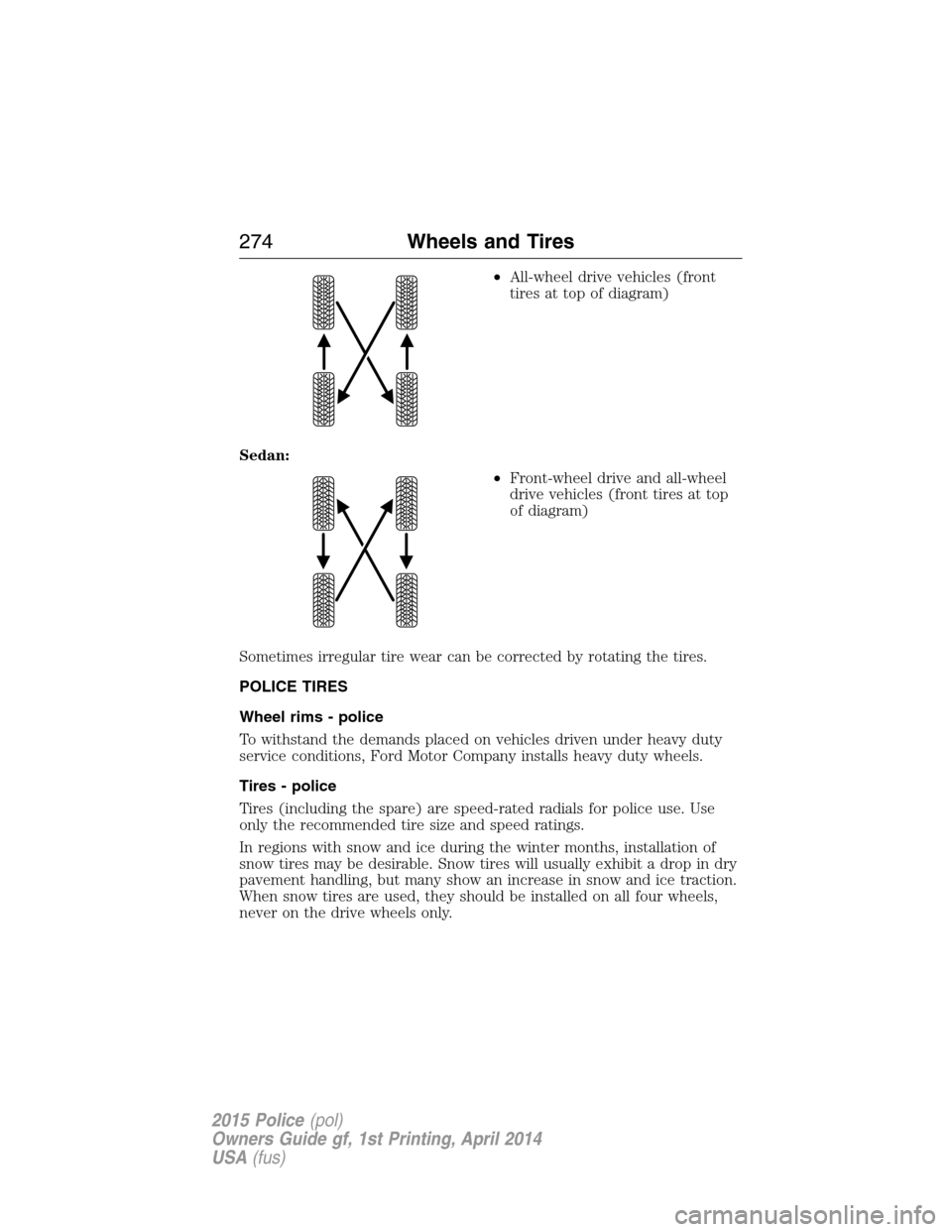
•All-wheel drive vehicles (front
tires at top of diagram)
Sedan:
•Front-wheel drive and all-wheel
drive vehicles (front tires at top
of diagram)
Sometimes irregular tire wear can be corrected by rotating the tires.
POLICE TIRES
Wheel rims - police
To withstand the demands placed on vehicles driven under heavy duty
service conditions, Ford Motor Company installs heavy duty wheels.
Tires - police
Tires (including the spare) are speed-rated radials for police use. Use
only the recommended tire size and speed ratings.
In regions with snow and ice during the winter months, installation of
snow tires may be desirable. Snow tires will usually exhibit a drop in dry
pavement handling, but many show an increase in snow and ice traction.
When snow tires are used, they should be installed on all four wheels,
never on the drive wheels only.
274Wheels and Tires
2015 Police(pol)
Owners Guide gf, 1st Printing, April 2014
USA(fus)
Page 276 of 398

Tires - long term storage
Most high performance tires are made with a nylon overlay.
As such, the following steps should be taken to avoid flatspotting when
the vehicles are not used for a period of time.
•Fleets should store the vehicles with 44 psi (303 kPa) in the tires.
•If the vehicle is stored for periods longer than 30 days, it should be
moved several feet at least once during each 30-day period, so that a
different portion of the tread contacts the ground.
•Tire pressure should be reduced to the recommended pressure shown
on the vehicle certification label before the vehicle is placed back into
service.
USING SNOW CHAINS
WARNING:Snow tires must be the same size, load index, speed
rating as those originally provided by Ford. Use of any tire or
wheel not recommended by Ford can affect the safety and performance
of your vehicle, which could result in an increased risk of loss of vehicle
control, vehicle rollover, personal injury and death. Additionally, the use
of non-recommended tires and wheels could cause steering, suspension,
axle, transfer case or power transfer unit failure.
Note:The suspension insulation and bumpers will help prevent vehicle
damage. Do not remove these components from your vehicle when using
snow tires and chains.
The tires on your vehicle have all-weather treads to provide traction in
rain and snow. However, in some climates, you may need to use snow
tires and cables . If you need to use cables, it is recommended that steel
wheels (of the same size and specifications) be used, as cables may chip
aluminum wheels.
Follow these guidelines when using snow tires and chains:
•If possible, avoid fully loading your vehicle.
•For police sedan, do not use snow chains or cables on this vehicle as
they may cause damage to your vehicle which may lead to loss of
vehicle control.
Wheels and Tires275
2015 Police(pol)
Owners Guide gf, 1st Printing, April 2014
USA(fus)
Page 278 of 398

Each tire, including the spare (if provided), should be checked
monthly when cold and inflated to the inflation pressure
recommended by the vehicle manufacturer on the vehicle
placard or tire inflation pressure label. (If your vehicle has tires of a
different size than the size indicated on the vehicle placard or tire
inflation pressure label, you should determine the proper tire inflation
pressure for those tires.)
As an added safety feature, your vehicle has been equipped with a tire
pressure monitoring system (TPMS) that illuminates a low tire pressure
telltale when one or more of your tires is significantly under-inflated.
Accordingly, when the low tire pressure telltale illuminates, you should
stop and check your tires as soon as possible, and inflate them to the
proper pressure. Driving on a significantly under-inflated tire causes the
tire to overheat and can lead to tire failure. Under-inflation also reduces
fuel efficiency and tire tread life, and may affect the vehicle’s handling
and stopping ability.
Please note that the TPMS is not a substitute for proper tire
maintenance, and it is the driver’s responsibility to maintain correct tire
pressure, even if under-inflation has not reached the level to trigger
illumination of the TPMS low tire pressure telltale.
Your vehicle has also been equipped with a TPMS malfunction indicator
to indicate when the system is not operating properly. The TPMS
malfunction indicator is combined with the low tire pressure telltale.
When the system detects a malfunction, the telltale will flash for
approximately one minute and then remain continuously illuminated.
This sequence will continue upon subsequent vehicle start-ups as long as
the malfunction exists.
When the malfunction indicator is illuminated, the system may not be
able to detect or signal low tire pressure as intended. TPMS malfunctions
may occur for a variety of reasons, including the installation of
replacement or alternate tires or wheels on the vehicle that prevent the
TPMS from functioning properly. Always check the TPMS malfunction
telltale after replacing one or more tires or wheels on your vehicle to
ensure that the replacement or alternate tires and wheels allow the
TPMS to continue to function properly.
The tire pressure monitoring system complies with part 15 of the FCC
rules and with RSS-210 of Industry Canada. Operation is subject to the
following two conditions: (1) This device may not cause harmful
interference, and (2) This device must accept any interference received,
including interference that may cause undesired operation.
Wheels and Tires277
2015 Police(pol)
Owners Guide gf, 1st Printing, April 2014
USA(fus)
Page 279 of 398
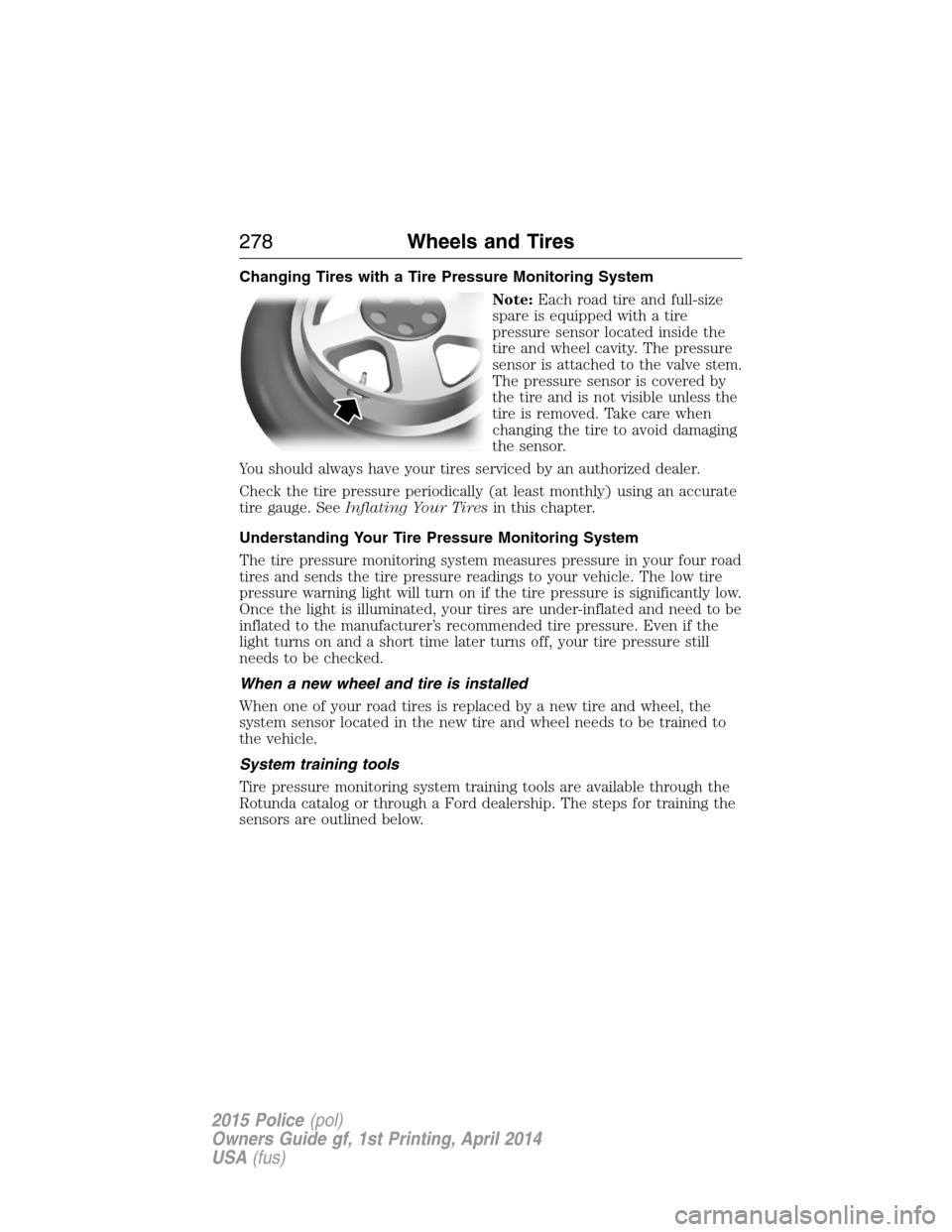
Changing Tires with a Tire Pressure Monitoring System
Note:Each road tire and full-size
spare is equipped with a tire
pressure sensor located inside the
tire and wheel cavity. The pressure
sensor is attached to the valve stem.
The pressure sensor is covered by
the tire and is not visible unless the
tire is removed. Take care when
changing the tire to avoid damaging
the sensor.
You should always have your tires serviced by an authorized dealer.
Check the tire pressure periodically (at least monthly) using an accurate
tire gauge. SeeInflating Your Tiresin this chapter.
Understanding Your Tire Pressure Monitoring System
The tire pressure monitoring system measures pressure in your four road
tires and sends the tire pressure readings to your vehicle. The low tire
pressure warning light will turn on if the tire pressure is significantly low.
Once the light is illuminated, your tires are under-inflated and need to be
inflated to the manufacturer’s recommended tire pressure. Even if the
light turns on and a short time later turns off, your tire pressure still
needs to be checked.
When a new wheel and tire is installed
When one of your road tires is replaced by a new tire and wheel, the
system sensor located in the new tire and wheel needs to be trained to
the vehicle.
System training tools
Tire pressure monitoring system training tools are available through the
Rotunda catalog or through a Ford dealership. The steps for training the
sensors are outlined below.
278Wheels and Tires
2015 Police(pol)
Owners Guide gf, 1st Printing, April 2014
USA(fus)
Page 285 of 398

WARNING:To reduce the risk of possible serious injury or
death, do not remove the full size spare tire from the factory
secured location. This location is necessary to achieve police-rated
75 mph (120 km/h) rear impact crash-test performance. Removal
increases the risk of fuel leak in high-speed rear impacts.
Note:Passengers should not remain in the vehicle when the vehicle is
being jacked.
Note:For sedan, only the original equipment tire or 245/55R18 tire with
outer diameter less than 725 millimeters will stow in the tire tub.
Utility
1. Park on a level surface, set the parking brake and activate the hazard
flashers.
2. Place the transmission in park(P)and turn the engine off.
3. Lift the floor cargo cover, then
remove the wing nut that secures
the spare tire by turning it
counterclockwise.
4. Lift and remove the spare tire
from the spare tire well.
284Wheels and Tires
2015 Police(pol)
Owners Guide gf, 1st Printing, April 2014
USA(fus)
Page 292 of 398

TECHNICAL SPECIFICATIONS
Wheel Lug Nut Torque Specifications
WARNING:When a wheel is installed, always remove any
corrosion, dirt or foreign materials present on the mounting
surfaces of the wheel or the surface of the wheel hub, brake drum or
brake disc that contacts the wheel. Make sure that any fasteners that
attach the rotor to the hub are secured so they do not interfere with
the mounting surfaces of the wheel. Installing wheels without correct
metal-to-metal contact at the wheel mounting surfaces can cause the
wheel nuts to loosen and the wheel to come off while your vehicle is in
motion, resulting in loss of control.
Retighten the lug nuts to the specified torque at 100 miles
(160 kilometers), and again at 500 miles (800 kilometers) of new vehicle
operation and after any wheel disturbance (such as tire rotation,
changing a flat tire, wheel removal).
Lug nut socket
size/bolt sizeWheel lug nut torque*
ft-lb N•m
12x 20 110 149
* Torque specifications are for nut and bolt threads free of dirt and
rust. Use only Ford recommended replacement fasteners.
Note:Inspect the wheel pilot hole
and mounting surface prior to
installation. Remove any visible
corrosion or loose particles.
Wheels and Tires291
2015 Police(pol)
Owners Guide gf, 1st Printing, April 2014
USA(fus)