Page 151 of 398

PRINCIPLES OF OPERATION
The traction control system helps avoid drive wheel spin and loss of
traction.
If your vehicle begins to slide, the system applies the brakes to individual
wheels and, when needed, reduces engine power at the same time. If the
wheels spin when accelerating on slippery or loose surfaces, the system
reduces engine power in order to increase traction.
USING TRACTION CONTROL
In certain situations (for example, stuck in snow or mud), turning the
traction control off may be beneficial as this allows the wheels to spin
with full engine power.
Turn the traction control system off through the information display. See
theInformation Displayschapter.
System indicator lights and messages
WARNING:If a failure has been detected within the
AdvanceTrac® system, the stability control light will illuminate
steadily. Verify that the AdvanceTrac® system was not manually
disabled using the information display control. If the stability control
light still illuminates steadily, have the system serviced by an authorized
dealer immediately. Operating your vehicle with AdvanceTrac® disabled
could lead to an increased risk of loss of vehicle control, vehicle
rollover, personal injury and death.
The stability control light temporarily illuminates on engine
start-up and flashes when a driving condition activates the
stability system.
The stability control off light temporarily illuminates on engine
start-up and stays on when the traction control system is
turned off.
When the traction control system is turned off or on, a message appears
in the information display showing system status.
150Traction Control
2015 Police(pol)
Owners Guide gf, 1st Printing, April 2014
USA(fus)
Page 162 of 398
Zone coverage also decreases when parking at shallow angles. Here, the
left sensor is mostly obstructed; zone coverage on that side is severely
limited.
System Lights and Messages
The BLIS® and CTA systems
illuminate a yellow alert indicator in
the outside mirror on the side of
the vehicle the approaching vehicle
is coming from.
Note:The alert indicator dims when nighttime darkness is detected.
CTA also sounds an audible alarm and a message appears in the
information display indicating a vehicle is coming from the right or left.
CTA works with the reverse sensing system which sounds its own
audible alarm; see theParking Aidschapter.
Driving Aids161
2015 Police(pol)
Owners Guide gf, 1st Printing, April 2014
USA(fus)
Page 180 of 398

The rating for the tow vehicle’s braking system operation is at
the gross vehicle weight rating, not the gross combined weight
rating.
Separate functioning brake systems are required for safe control
of towed vehicles and trailers weighing more than 1500 pounds
(680 kilograms) when loaded.
Trailer Lamps
WARNING:Never connect any trailer lamp wiring to the
vehicle’s tail lamp wiring; this may damage the electrical system
resulting in a fire. Contact an authorized dealer as soon as possible for
assistance in proper trailer tow wiring installation. Additional electrical
equipment may be required.
Trailer lamps are required on most towed vehicles. Make sure all running
lights, brake lights, turn signals and hazard lights are working.
Before Towing a Trailer
Practice turning, stopping and backing up to get the feel of your
vehicle-trailer combination before starting on a trip. When turning, make
wider turns so the trailer wheels clear curbs and other obstacles.
When Towing a Trailer
•Do not drive faster than 70 mph (113 km/h) during the first 500 miles
(800 kilometers).
•Do not make full-throttle starts.
•Check your hitch, electrical connections and trailer wheel lug nuts
thoroughly after you have traveled 50 miles (80 kilometers).
•When stopped in congested or heavy traffic during hot weather, place
the gearshift in positionPto aid engine and transmission cooling and
to help air conditioning performance.
•Turn off the speed control with heavy loads or in hilly terrain. The
speed control may turn off automatically when you are towing on
long, steep grades.
•Shift to a lower gear when driving down a long or steep hill. Do not
apply the brakes continuously, as they may overheat and become less
effective.
Towing179
2015 Police(pol)
Owners Guide gf, 1st Printing, April 2014
USA(fus)
Page 206 of 398
Fuse or relay
numberFuse amp
ratingProtected components
81 20A* Spot lights
82 15A* Rear washer (Utility)
83 — Not used
84 20A* Trailer tow park lamps (Utility)
85 — Not used
86 7.5A* Powertrain control module
keep-alive power and relay,
Canister vent solenoid
87 5A* Run/start relay coil
88 — Run/start relay
89 5A* Front blower relay coil, Electrical
power assist steering module
90 10A* Powertrain control module
run/start
91 — Not used
92 10A* Anti-lock brake system module
93 5A* Rear window defroster relay,
Run/start relay, Trunk release
relay
94 30A** Passenger compartment fuse
panel run/start
95 2A* Center console start feed
96 — Not used
97 — Not used
98 — Air conditioner clutch relay
*Mini Fuses **Cartridge Fuses
Fuses205
2015 Police(pol)
Owners Guide gf, 1st Printing, April 2014
USA(fus)
Page 241 of 398

Replacing sidemarker bulbs (Utility)
1. Rotate the bulb socket
counterclockwise and remove it from
the lamp assembly.
2. Pull the bulb straight out of the
socket.
Reverse steps to reinstall bulb(s).
Front parking lamp/turn signal flashers (wig-wags) (If equipped)
Your vehicle is equipped with an LED front parking lamp/turn signal
flashers (wig-wags). It is designed to last the life of the vehicle. If
replacement is required, it is recommended that you see your authorized
dealer.
Note:Use of the wig-wag feature overrides normal operation of the
park/turn indicator.
Spot lights (If equipped)
Your vehicle is equipped with a spot light attached to one or both of the
A-Pillars. It is designed to last the life of the vehicle. If replacement is
required, it is recommended that you see your authorized dealer.
Replacing stop/tail/turn and sidemarker lamp bulbs (Sedan)
1. Make sure the headlamp switch is in the off position and open the
trunk.
2. Remove the press pin and cargo net
fastener (if equipped) and carefully pull
the carpet away to expose the backside
of the tail lamp assembly.
3. Remove the nut and washer
assemblies, then pull the lamp assembly
away from the vehicle.
240Maintenance
2015 Police(pol)
Owners Guide gf, 1st Printing, April 2014
USA(fus)
Page 247 of 398
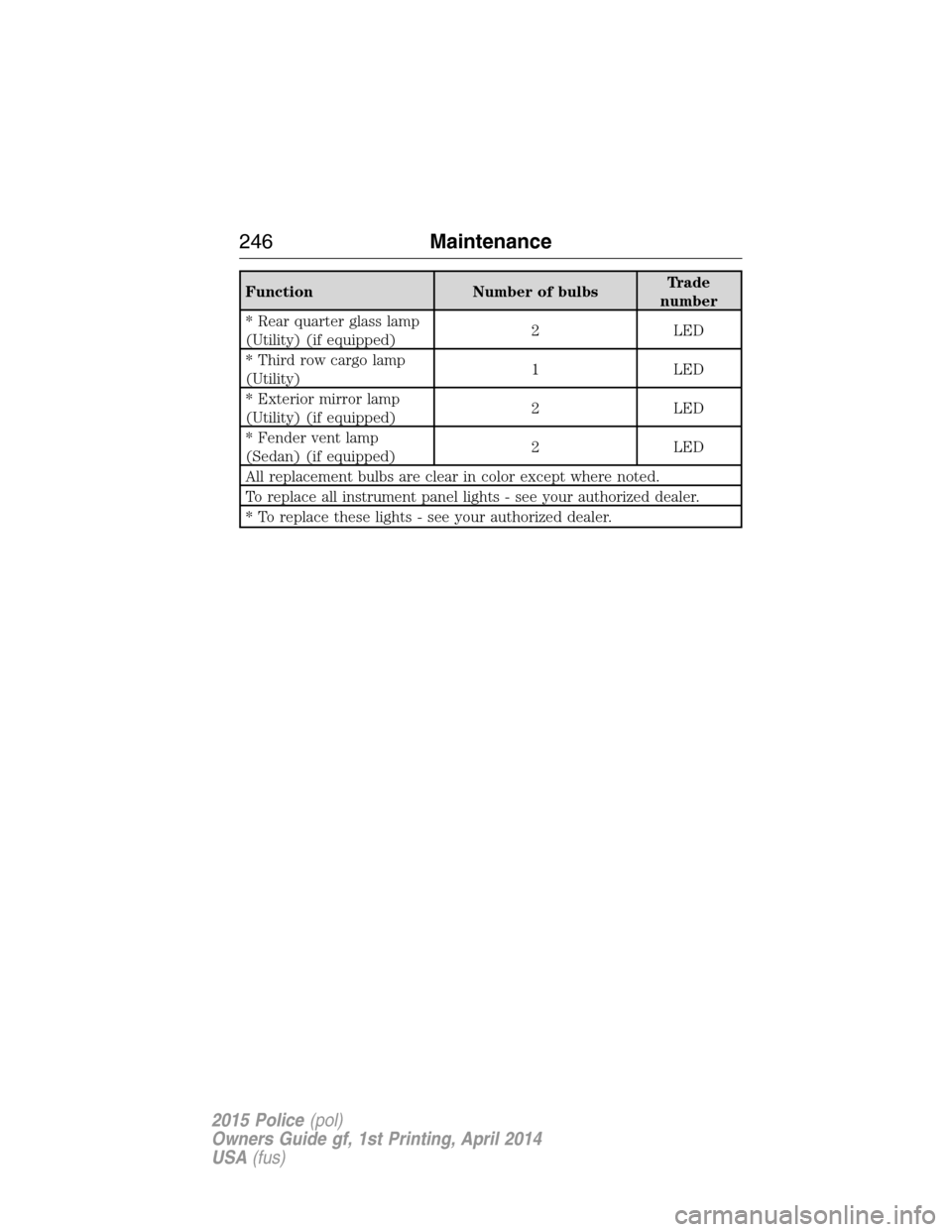
Function Number of bulbsTrade
number
* Rear quarter glass lamp
(Utility) (if equipped)2 LED
* Third row cargo lamp
(Utility)1 LED
* Exterior mirror lamp
(Utility) (if equipped)2 LED
* Fender vent lamp
(Sedan) (if equipped)2 LED
All replacement bulbs are clear in color except where noted.
To replace all instrument panel lights - see your authorized dealer.
* To replace these lights - see your authorized dealer.
246Maintenance
2015 Police(pol)
Owners Guide gf, 1st Printing, April 2014
USA(fus)
Page 375 of 398

Oils, Fluids and Flushing
In many cases, fluid discoloration is a normal operating characteristic
and, by itself, does not necessarily indicate a concern or that the fluid
needs to be changed. However, discolored fluids that also show signs of
overheating and foreign material contamination should be inspected
immediately by a qualified expert, such as the factory-trained technicians
at your dealership. Your vehicle’s oils and fluids should be changed at the
specified intervals or in conjunction with a repair. Flushing is a viable
way to change fluid for many vehicle sub-systems during scheduled
maintenance. It is critical that systems are flushed only with new fluid
that is the same as that required to fill and operate the system, or using
a Ford-approved flushing chemical.
Owner Checks and Services
Certain basic maintenance checks and inspections should be performed
every month or at six month intervals.
Check every month
Engine oil level.
Function of all interior and exterior lights.
Tires (including spare) for wear and proper pressure.
Windshield washer fluid level.
Check every six months
Battery connections. Clean if necessary.
Body and door drain holes for obstructions. Clean if necessary.
Cooling system fluid level and coolant strength.
Door weatherstrips for wear. Lubricate if necessary.
Hinges, latches and outside locks for proper operation. Lubricate if
necessary.
Parking brake for proper operation.
Safety belts and seat latches for wear and function.
Safety warning lamps (brake, ABS, airbag, safety belt) for operation.
Washer spray and wiper operation. Clean or replace blades as
necessary.
374Scheduled Maintenance
2015 Police(pol)
Owners Guide gf, 1st Printing, April 2014
USA(fus)
Page 395 of 398

Joining two calls
(multiparty/conference call) ....325
Jump-starting your vehicle ......189
K
Keys .............................................66
positions of the ignition .........121
L
Lamps
bulb replacement
specifications chart ................244
headlamps, flash to pass ..........82
interior lamps ...........................85
replacing bulbs .......................236
LATCH anchors ...........................28
Liftgate ........................................70
Lights, warning and indicator ....93
Loading instructions .................175
Load limits .................................168
Locks
childproof ..................................34
doors ..........................................67
Lubricant specifications ...........293
Lug nuts ....................................291
M
Media Bluetooth menu options
(adding, connecting, deleting,
turning on/off) ..........................353
Message center ...........................98
warning messages ...................100
Mirrors ...................................89, 91
fold away ...................................89
side view mirrors (power) .......89Motorcraft® parts .............247, 299
O
Octane rating ............................128
P
Pairing other phones ................322
Pairing your phone for the first
time ............................................321
Parking brake ............................149
Parts
(see Motorcraft® parts) ..........299
Passenger Occupant
Classification Sensor ...................49
Phone Bluetooth menu options
(adding, connecting, deleting,
turning on/off) ..........................333
Phone redial ..............................327
Playing music (by artist,
album, genre, playlist, tracks,
similar) ......................................350
Power distribution box
(see Fuses) ...............................200
Power door locks ........................67
Power mirrors .............................89
Powerpoint ................................117
Power steering ..........................164
fluid, checking and adding ....227
fluid, refill capacity ................293
fluid, specifications .................293
Power Windows ...........................87
Privacy information ..................318
Putting a call on/off hold .........325
R
Radio ..........................................307
394Index
2015 Police(pol)
Owners Guide gf, 1st Printing, April 2014
USA(fus)