2015 FORD F750 Allison
[x] Cancel search: AllisonPage 69 of 384

WARNING:Driving a vehicle with the brake system warning
light on is dangerous. A significant decrease in braking
performance may occur. It takes you longer to stop the vehicle. Have
the vehicle checked by your authorized dealer. Driving extended
distances with the parking brake engaged can cause brake failure and
the risk of personal injury.
Charging System
It illuminates when the 12–volt battery is not charging properly.
Contact an authorized dealer as soon as possible. This indicates
a problem with the electrical system or a related component.
Check Fuel Cap (gasoline engine only)
It illuminates when you may not have installed the fuel cap
properly. Continued driving with this light on may cause the
service engine soon warning indicator to come on.
Check Suspension
It illuminates when you press the air suspension dump switch.
Check Transmission (Allison automatic transmission only)
It illuminates while driving if a transmission problem exists;
shifting may be restricted. Depending on the severity of the
problem, the shifter’s digital read-out may turn blank.
On MD 3000 series transmissions, operation may continue in order to
reach service assistance. The control unit may not respond to shift
selector requests, since there are operating limitations on the
transmission (such as upshift and downshift restrictions). Direction
changes do not occur.
Cruise Control
It illuminates when you switch this feature on.
CK
SUSP
68Instrument Cluster
2015 F-650/750(f67)
Owners Guide gf(ownloose), 1st Printing, December 2013
Canadian_French(fr_can)
Page 70 of 384

Diesel Exhaust Fluid (diesel engine only)
It illuminates when the diesel exhaust fluid level falls below
0.5 gallons (1.9L) in the 5- gallon (19.0L) tank or one gallon
(3.8L) in the 9-gallon (34.0L) tank. Refill the tank or, at a
minimum, add at least one gallon (3.8L) to the 5- gallon (19.0L) tank or
two gallons (7.6L) to the 9- gallon (34.0L) tank.
Diesel Particulate Filter (diesel engine only)
It illuminates when the soot level in the diesel particulate filter
has reached a point where it requires operator assistance. See
Diesel particulate filterin theMaintenancechapter, and your
engine operator’s manual, for more details.
Do Not Shift (Allison automatic transmission only)
It illuminates while driving if a transmission problem exists;
shifting may be restricted. Depending on the severity of the
problem, the shifter’s digital read-out may turn blank.
Operation may continue in order to reach service assistance. The control
unit may not respond to shift selector requests, since there are operating
limitations on the transmission (such as. upshift and downshift
restrictions). Direction changes do not occur.
Direction Indicator
It illuminates when you turn on the left or right turn signal or
the hazard warning flasher. If the indicators stay on or flash
faster, check for a burned out bulb.
Electronic Locking Differential
It illuminates when using the electronic locking differential.
Engine Oil Pressure (gasoline engine only)
It illuminates when engine oil pressure is low.
Fasten Safety belt
It illuminates and a tone sounds to remind you to fasten your
safety belt.
Instrument Cluster69
2015 F-650/750(f67)
Owners Guide gf(ownloose), 1st Printing, December 2013
Canadian_French(fr_can)
Page 131 of 384

Position 1
•Provides maximum engine braking.
•Allows upshifts by moving gearshift lever.
•The transmission does not downshift into position1at high speeds; it
downshifts to a lower gear and then shifts into position1when your
vehicle reaches slower speeds.
Forced Downshifts
•Allowed in positionD.
•Press the accelerator to the floor.
•Allows transmission to select an appropriate gear.
Allison 2200 with Parking Pawl Feature
Note:Also, see the separateAllison Transmission Operator’s Manual.
WARNING:Always set the parking brake fully. Do not use the
gearshift in place of the parking brake.
WARNING: To avoid sudden, unexpected vehicle movement
and possible personal injury or death:
1. Bring the vehicle to a complete stop.
2. Shift the transmission into positionP.Slowly lift your foot from the
brake pedal to engage the transmission parking pawl mechanism.
3. Apply the parking brake and make sure it is holding properly. Do not
rely solely on the parking mechanism of the transmission.
4. Turn the engine off when you leave the vehicle.Never leave the
vehicle unattended when the engine is running.
A parking pawl effectively grounds the transmission’s output shaft
preventing rotation of the driveline. If your vehicle is stationary, selecting
positionPplaces the transmission in neutral and engages the parking
pawl. Always use the parking brake when parking your vehicle.
Note:If you select positionPwhen your vehicle is moving, the parking
pawl mechanism ratchets and does not hold the truck.
130Transmission
2015 F-650/750(f67)
Owners Guide gf(ownloose), 1st Printing, December 2013
Canadian_French(fr_can)
Page 132 of 384

Allison 2500
WARNING: To avoid sudden, unexpected vehicle movement
and possible personal injury or death:
1. Bring the vehicle to a complete stop.
2. Shift the transmission into positionN.
3. Apply the parking brake and make sure it is holding properly.
4. Turn the engine off when you leave the vehicle.Never leave the
vehicle unattended when the engine is running.
This transmission is available with a column-mounted gearshift lever. The
instrument cluster displays the gear positions.
Allison 3000
Note:For more information about this transmission, see the separate
Allison 3000 Series Operator’s Manual.
The Allison 3000 series offers two shift modes: Performance and
Economy.
Performance mode gives the best all-around transmission operation. The
transmission defaults to this mode when you start the engine. Pressing
MODE on the shifter switches to Economy mode and illuminates the
Mode ON lamp.
Economy mode provides operation at lower engine RPM while
maintaining adequate performance.
If the engine speed is above idle when a gear is selected using the
shifter, the vehicle does not move; the shifter must be moved to re-select
a gear after the engine speed returns to idle.
Torque Lock
If you park your vehicle on an incline without properly engaging position
P(by shifting into positionPbefore applying the parking brake), the
weight of the vehicle may generate an excessive amount of torque on the
parking pawl. This makes it difficult to shift the transmission out of
positionP.Hold the brake pedal down while shifting out of positionP,
then release the parking brake.
Transmission131
2015 F-650/750(f67)
Owners Guide gf(ownloose), 1st Printing, December 2013
Canadian_French(fr_can)
Page 133 of 384
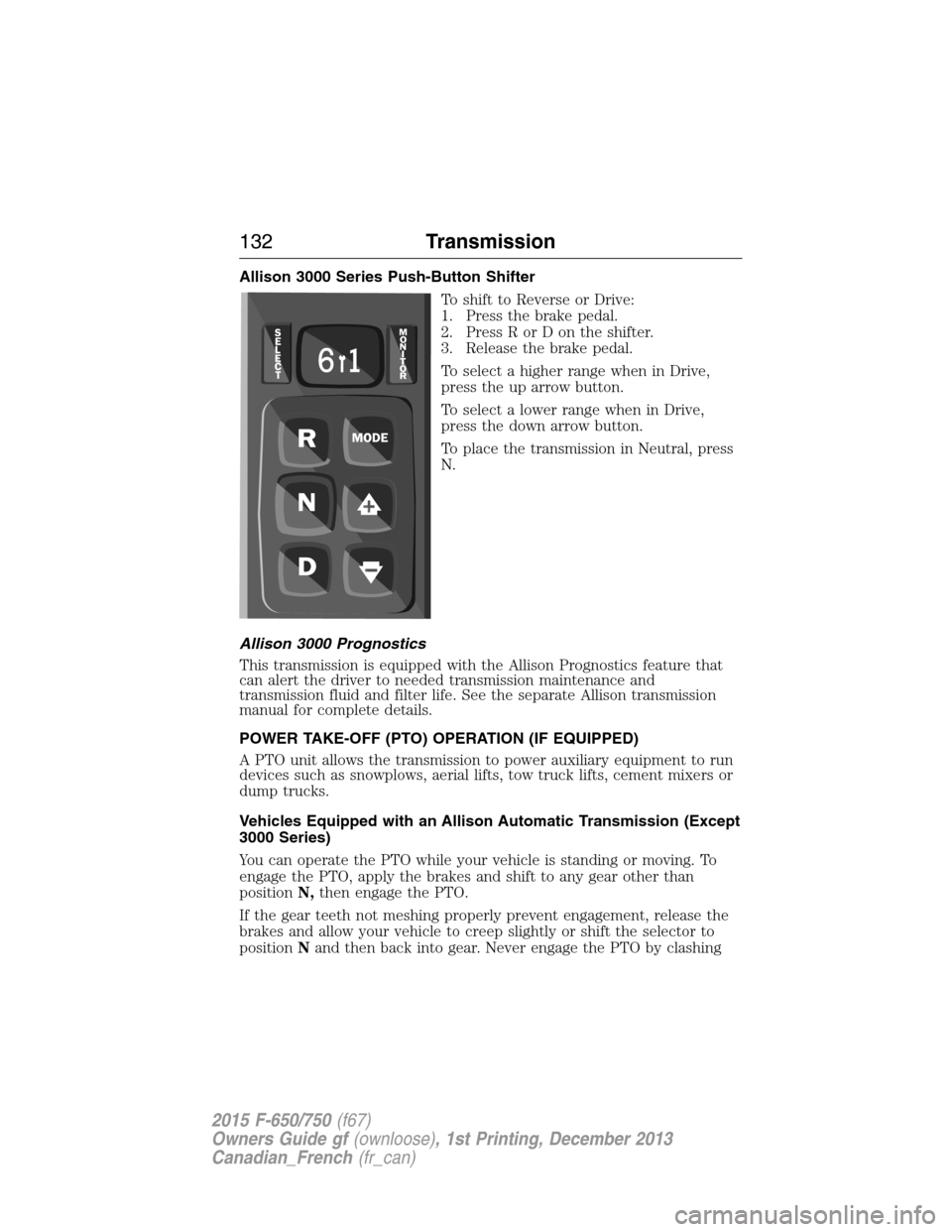
Allison 3000 Series Push-Button Shifter
To shift to Reverse or Drive:
1. Press the brake pedal.
2. Press R or D on the shifter.
3. Release the brake pedal.
To select a higher range when in Drive,
press the up arrow button.
To select a lower range when in Drive,
press the down arrow button.
To place the transmission in Neutral, press
N.
Allison 3000 Prognostics
This transmission is equipped with the Allison Prognostics feature that
can alert the driver to needed transmission maintenance and
transmission fluid and filter life. See the separate Allison transmission
manual for complete details.
POWER TAKE-OFF (PTO) OPERATION (IF EQUIPPED)
A PTO unit allows the transmission to power auxiliary equipment to run
devices such as snowplows, aerial lifts, tow truck lifts, cement mixers or
dump trucks.
Vehicles Equipped with an Allison Automatic Transmission (Except
3000 Series)
You can operate the PTO while your vehicle is standing or moving. To
engage the PTO, apply the brakes and shift to any gear other than
positionN,then engage the PTO.
If the gear teeth not meshing properly prevent engagement, release the
brakes and allow your vehicle to creep slightly or shift the selector to
positionNand then back into gear. Never engage the PTO by clashing
132Transmission
2015 F-650/750(f67)
Owners Guide gf(ownloose), 1st Printing, December 2013
Canadian_French(fr_can)
Page 134 of 384

the gear teeth. This may damage the PTO unit and the transmission PTO
drive gear teeth, resulting in further damage to the transmission and
PTO.
PTO Operation with Vehicle Stationary
WARNING:When the PTO is operated with the vehicle
stationary, the transmission must be placed in positionNwith the
parking brake set. If the transmission is not in positionNand is
equipped with a remote throttle control, an increase in engine speed
can overpower the parking brake and cause the vehicle to move,
possibly resulting in personal injury and/or property damage.
Stop your vehicle, idle the engine and set the parking brake. Make sure
the gear selector is in any forward drive range, and then engage the
PTO. After engaging the PTO, move the range selector to positionN.
Increase the engine speed until reaching the desired PTO operation
speed. To disengage the PTO after operation with your vehicle standing,
release the throttle, allow the drive equipment to come to a stop, and
then disengage the PTO.
PTO Operation while Vehicle Is Moving
After engaging the PTO for driven vehicle operation, shift to the desired
range and drive your vehicle. The speed of the PTO, during this period
of operation, always maintains direct relation to vehicle speed. PTO
speed decreases in relation to vehicle (transmission output) speed as
shifts to a higher gear occur. When operating the PTO while your vehicle
is moving, the PTO may be disengaged whenever it is no longer required.
When there is no load on the PTO gear, you can pull it out of
engagement.
Vehicles Equipped with an Allison 3000 Series Automatic
Transmission
The PTO drive gear is engine-driven and provides direct engine power.
You can operate the PTO when your vehicle is either stationary or
moving. The PTO gear is in constant mesh with the drive gear in the
torque converter housing. A friction clutch or constant drive transmits
power to the PTO.
Vehicles Equipped with a Manual Transmission
Transmission-mounted PTO units are available for local installation on
your vehicle. See yourBody Builder’s Layout Bookfor restrictions on
use and installation of PTO units.
Transmission133
2015 F-650/750(f67)
Owners Guide gf(ownloose), 1st Printing, December 2013
Canadian_French(fr_can)
Page 151 of 384

Note:Read and understand the following steps and perform them
whenever you prepare to drive the vehicle.
Note:The parking brake does not disengage unless sufficient system air
pressure is available.
If your vehicle is equipped with a dash-mounted push button (Allison
3000 Series) or steering column-mounted (Allison 2200 and 2500) gear
selector:
1. Press and hold the service brake pedal while the engine is running.
2. Select the appropriate drive gear.
3. Push and hold the yellow, dash-mounted parking brake knob until the
parking brake light turns off, then release.
If your vehicle is equipped with a manual transmission:
1. Press and hold the service brake pedal while the engine is running.
2. Press and hold the clutch pedal.
3. Select the appropriate drive gear.
4. Push and hold the yellow, dash-mounted parking brake knob until the
parking brake light turns off, then release.
Parking Brake Light Illumination Due to Low Air Pressure
If the air pressure becomes too low at any time during vehicle operation,
the parking brake may apply and the parking brake light turns on.
If the parking brake applies due to low air pressure, immediate service is
required to the parking brake system.
Parking Brake Warning System
If the parking brake light blinks and a tone sounds when pulling the
yellow control knob out, this indicates the parking brake is not
functioning properly. Seek service for the parking brake immediately.
With the ignition key not in the run position:
•A tone sounds if the parking brake remains released (or in an
unknown state). The tone stops in approximately eight minutes or
until the parking brake is applied. Seek service for the parking brake
immediately.
Diesel engines:Parking brake light operation (the light only works
when the ignition key is in the run position):
•On:Parking brake applied.
•Off:Parking brake released and no faults or malfunctions.
•Blink and tone:Parking brake released (or in an unknown state)
and faults or malfunctions exist.
150Brakes
2015 F-650/750(f67)
Owners Guide gf(ownloose), 1st Printing, December 2013
Canadian_French(fr_can)
Page 153 of 384

Air Brakes
WARNING:Do not use the gearshift selector in place of the
parking brake; unexpected and possible sudden vehicle
movement may occur if these precautions are not taken. Always set the
parking brake fully AND make sure the gearshift selector is in position
Rfor vehicles equipped with manual transmission or positionN(except
Allison 2200 transmission) orP(Allison 2200 transmission) for vehicles
with automatic transmission.
If the service brakes should fail to operate while your vehicle is moving,
you can make an emergency stop with the parking brake. Since the
parking brake only applies stopping power to the rear wheels, your
vehicle’s stopping distance greatly increases and the handling of your
vehicle is adversely affected. Make repairs immediately to an inoperative
air brake system circuit.
WARNING:This control is used for parking only. Do not leave
the vehicle unattended after setting the parking brake without
placing the transmission inpositionRfor vehicles equipped with manual
transmission or positionN(except Allison 2200 transmission) orP
(Allison 2200 transmission) for vehicles with automatic transmission.
Use of wheel chocks is also recommended in hilly or off-road usage.
Pull the yellow parking brake knob
out to apply the parking brake.
Push the knob in to release the
parking brake.
The parking brake light illuminates and remains illuminated
(when you switch the ignition to the on position) until you
release the parking brake.
Releasing Spring Brake with Air Pressure
The air system in all vehicles with spring-actuated rear wheel parking
brakes is equipped with a tank valve located on the supply or service air
tank for connection to an outside air supply. The valve lets you recharge
P
152Brakes
2015 F-650/750(f67)
Owners Guide gf(ownloose), 1st Printing, December 2013
Canadian_French(fr_can)