2015 FORD F650 engine
[x] Cancel search: enginePage 141 of 384

WARNING:Do not drive or continue to drive if the low air
pressure buzzer is sounding or the brake warning light is lit.
These warnings indicate that air pressure is not to normal operating
level. Continued use of the vehicle could result in loss of braking ability.
WARNING:Avoid repeated light application of the brake pedal.
This depletes air pressure faster and could result in loss of
braking capability.
Periodically check the air pressure
gauge while driving. Pressure should
range between approximately
100–125 psi (690–862 kPa). The air
compressor governor cut-in and
cutout pressure settings are set at
the factory and are not adjustable.
When air pressure is insufficient (below 60 psi [414 kPa]), a
warning light illuminates and a buzzer sounds when the ignition
is in the on position.
This may happen because excessive brake applications are depleting the
system air pressure. If this condition occurs, stop driving your vehicle
until the compressor has fully recharged the air system.
WARNING:Do not move the vehicle when the air pressure is
insufficient because the brake system may be inoperative.
Select a gear ratio to help slow your vehicle before descending grades.
Supplementing with brakes, as required, help to safely slow the vehicle
and avoids overspeeding the engine.
Air Chamber Stroke Indication
Air chamber push rods have orange stroke indicator markers that warn
when the braking system requires adjustment or repair. The painted
orange indicator is on the air chamber push rod at the slack adjuster
stroke dimension that requires service when visible during brake
application.
140Brakes
2015 F-650/750(f67)
Owners Guide gf(ownloose), 1st Printing, December 2013
Canadian_French(fr_can)
Page 143 of 384

HINTS ON DRIVING WITH ANTI-LOCK BRAKES
When the system is operating, the brake pedal pulses and may travel
further. Maintain pressure on the brake pedal. You may also hear a noise
from the system. This is normal.
The ABS does not eliminate the dangers inherent when:
•You drive too closely to the vehicle in front of you.
•Your vehicle is hydroplaning.
•You take corners too fast.
•The road surface is poor.
EXHAUST BRAKE (IF EQUIPPED)
WARNING:The exhaust brake is not recommended for use on
slippery or low traction road surfaces. Under these conditions a
loss of vehicle control could occur.
Note:Installing an exhaust or auxiliary brake does not necessarily
protect the engine from exceeding maximum governed speed. Use the
primary brakes to make sure the engine never exceeds maximum
governed speed under any conditions.
Note:Before starting the engine, make sure that the exhaust brake
switch is in the off position. Do not turn the exhaust brake on until the
engine has reached normal operating temperature.
Note:Maximum exhaust brake performance relates to the type of
transmission your vehicle has.
Note:Engine speed has a major influence of retarding performance.
When engine speed is stays at the maximum allowable level, the exhaust
brake operates at peak performance.
Note:Manual transmissions should be downshifted to the lowest gear
possible, without exceeding the maximum RPM limit of the engine. This
maximizes the exhaust brake’s retarding effect.
Note:Exhaust brakes operate effectively with automatic transmissions,
but performance varies with engine speed and the gear selected by the
transmission.
An exhaust brake is an auxiliary braking system that assists, but does
not replace, the primary service brake system. It helps control vehicle
speed; it is not a vehicle-stopping device.
142Brakes
2015 F-650/750(f67)
Owners Guide gf(ownloose), 1st Printing, December 2013
Canadian_French(fr_can)
Page 144 of 384

A switch on the instrument panel,
in combination with the accelerator
and clutch pedal, allows the
operator to make maximum use of
the exhaust brake in the following
conditions:
•Off-highway driving
•Mountain driving
•Heavy traffic
•High-speed highway driving.
To switch the brake on, push the switch up. Push the switch down to
turn it off.
While approaching a steep grade, make sure that the exhaust brake
switch is in the on position. The exhaust brake begins working as soon as
you remove your foot from the accelerator pedal.
Before descending a hill or steep grade, always select the proper gear. If
you take the transmission out of gear while descending, it is possible that
you cannot select another gear because of maximum governed RPM.
Make sure the engine speed does not exceed the maximum allowable
engine RPM. Exceeding the maximum allowable engine RPM can result
in damage to the engine. Apply the service brakes to reduce the engine
RPM or make a slower descent by using a lower gear.
While going down the grade, use a low enough gear to descend safely
with a minimum application of the service brakes. As a general guideline,
use the same gear as you use to ascend the hill.
Exhaust Brake Operating Characteristics
The exhaust brake turns on when you remove your feet from both the
accelerator and clutch pedals and the exhaust brake switch is in the on
position. The following conditions exist if the brake is operating properly:
•A slight change in engine sound when the exhaust brake turns on.
•A smooth braking effect. Do not expect a retarding effect similar to
sudden, hard application of the service brakes.
•The retarding force possibly felt acting against your body during
brake application (depending on the grade and vehicle load). This
force is actually preventing the vehicle from going much faster.
•Engine temperature remaining in the normal operating range.
•The tachometer showing a drop in engine RPM (depending on grade
and vehicle load) during a descent.
Brakes143
2015 F-650/750(f67)
Owners Guide gf(ownloose), 1st Printing, December 2013
Canadian_French(fr_can)
Page 151 of 384

Note:Read and understand the following steps and perform them
whenever you prepare to drive the vehicle.
Note:The parking brake does not disengage unless sufficient system air
pressure is available.
If your vehicle is equipped with a dash-mounted push button (Allison
3000 Series) or steering column-mounted (Allison 2200 and 2500) gear
selector:
1. Press and hold the service brake pedal while the engine is running.
2. Select the appropriate drive gear.
3. Push and hold the yellow, dash-mounted parking brake knob until the
parking brake light turns off, then release.
If your vehicle is equipped with a manual transmission:
1. Press and hold the service brake pedal while the engine is running.
2. Press and hold the clutch pedal.
3. Select the appropriate drive gear.
4. Push and hold the yellow, dash-mounted parking brake knob until the
parking brake light turns off, then release.
Parking Brake Light Illumination Due to Low Air Pressure
If the air pressure becomes too low at any time during vehicle operation,
the parking brake may apply and the parking brake light turns on.
If the parking brake applies due to low air pressure, immediate service is
required to the parking brake system.
Parking Brake Warning System
If the parking brake light blinks and a tone sounds when pulling the
yellow control knob out, this indicates the parking brake is not
functioning properly. Seek service for the parking brake immediately.
With the ignition key not in the run position:
•A tone sounds if the parking brake remains released (or in an
unknown state). The tone stops in approximately eight minutes or
until the parking brake is applied. Seek service for the parking brake
immediately.
Diesel engines:Parking brake light operation (the light only works
when the ignition key is in the run position):
•On:Parking brake applied.
•Off:Parking brake released and no faults or malfunctions.
•Blink and tone:Parking brake released (or in an unknown state)
and faults or malfunctions exist.
150Brakes
2015 F-650/750(f67)
Owners Guide gf(ownloose), 1st Printing, December 2013
Canadian_French(fr_can)
Page 156 of 384
PRINCIPLES OF OPERATION
The traction control system helps avoid drive wheel spin and loss of
traction.
If your vehicle begins to slide, the system applies the rear brakes to
individual wheels and, when needed, reduces engine power at the same
time. If the wheels spin when accelerating on slippery or loose surfaces,
the system reduces engine power in order to increase traction.
Note:The system does not apply the brakes when vehicle speed is
above 25 mph (40 km/h).
USING TRACTION CONTROL
WARNING:Aggressive driving in any road conditions can cause
you to lose control of your vehicle increasing the risk of severe
personal injury or property damage. The occurrence of a traction
control event is an indication that at least some of the tires have
exceeded their ability to grip the road; this may lead to an increased
risk of loss of vehicle control, vehicle rollover, personal injury and
death. If you experience a severe road event, SLOW DOWN.
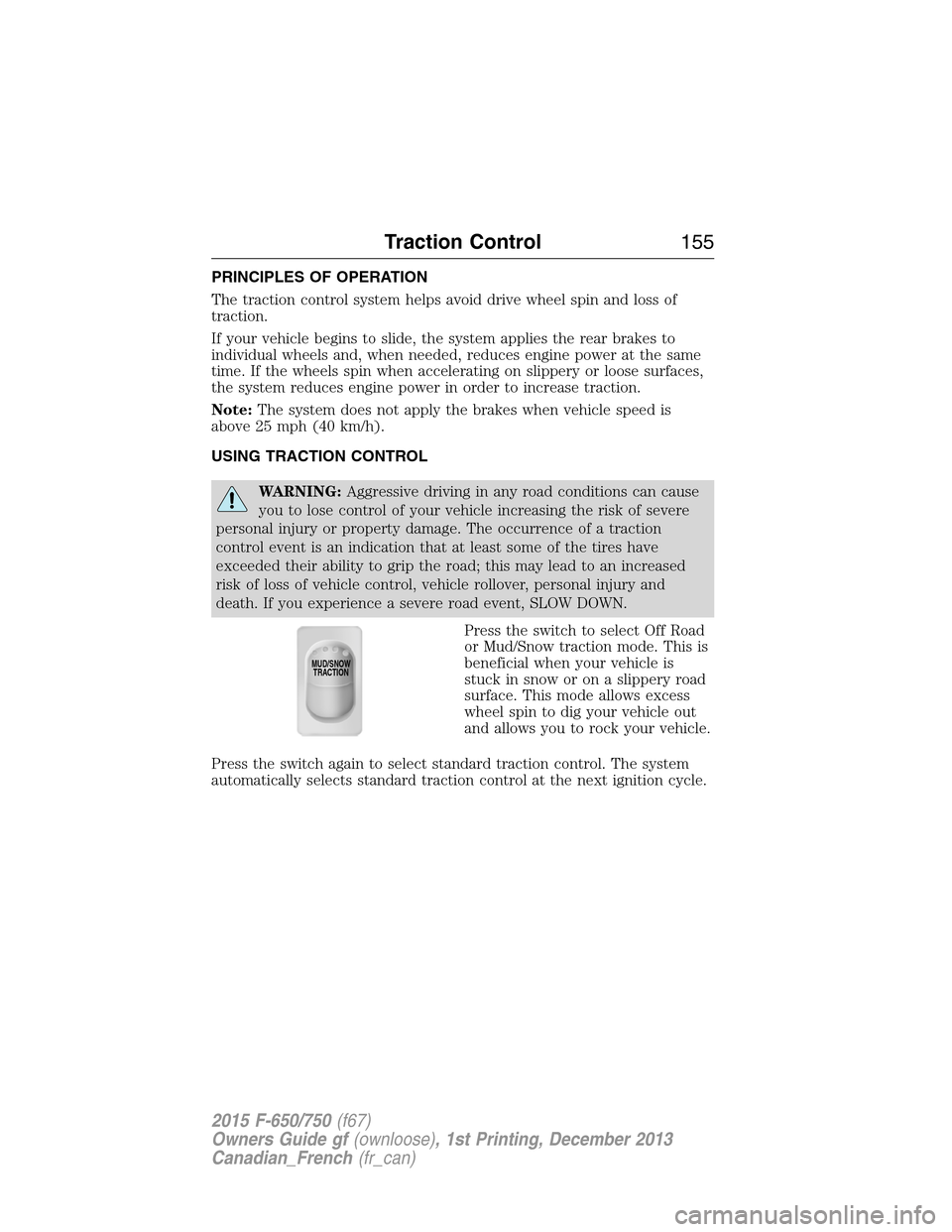
Press the switch to select Off Road
or Mud/Snow traction mode. This is
beneficial when your vehicle is
stuck in snow or on a slippery road
surface. This mode allows excess
wheel spin to dig your vehicle out
and allows you to rock your vehicle.
Press the switch again to select standard traction control. The system
automatically selects standard traction control at the next ignition cycle.
MUD/SNOW
TRACTION
Traction Control155
2015 F-650/750(f67)
Owners Guide gf(ownloose), 1st Printing, December 2013
Canadian_French(fr_can)
Page 157 of 384

System Indicator Light
Note:If the traction control light does not flash during a traction control
event or stays illuminated, the system is not functioning properly. Take
your vehicle to an authorized dealer for service.
During traction control operation, the traction control light
flashes rapidly and the engine does not rev-up when you press
further on the accelerator. This is normal and is no reason for
concern.
In Off Road or Mud/Snow mode, the traction control light illuminates and
flashes slowly. If a traction event occurs, in either mode, the light flashes
rapidly.
156Traction Control
2015 F-650/750(f67)
Owners Guide gf(ownloose), 1st Printing, December 2013
Canadian_French(fr_can)
Page 160 of 384

OPERATING YOUR VEHICLE
General Information
•Start the vehicle moving by using the highest gear speed in the
transmission that lets the engine easily start the load without slipping
the clutch.
•Accelerate smoothly and evenly. Rapid acceleration increases fuel
consumption without increasing engine performance.
•When approaching a hill, press the accelerator smoothly to start the
incline at full power, and then shift down as needed to maintain
vehicle speed.
•When going down a hill, or long steep grades, prevent overspeeding
of the engine. Normally, choose the same gear to descend the hill that
you use to ascend the hill. The engine governor has no control over
engine speed when it is being pushed by a loaded vehicle.
•Do not operate in a gear that permits an engine speed more than the
maximum governed speed or high-idle RPM (no load).
•Always shift to a lower gear at high altitudes to prevent engine
smoking.
Backing Up
WARNING:All vehicles have blind spots. To reduce the risk of
severe injury or property damage, never move your vehicle to the
side or rear or change lanes without being sure your way is clear on
both sides and to your rear.
WARNING:To reduce the risk of the possibility of personal
injury while backing up the vehicle, always be sure your vehicle’s
path is clear.
Before backing up your vehicle, be sure you can do so safely. If anything
behind the cab limits your view, do not rely on mirrors alone to make
sure that your intended path is clear. If other people are in the vicinity,
have someone standing well behind your vehicle and outside of your
intended path (visible through an exterior mirror) guide you as you back
up.
Although OSHA or some governmental regulations may require the use
of an electrical or mechanical back up alarm to warn bystanders, such an
alarm does not guarantee that the intended path is clear. When in doubt,
get out of your vehicle and visually check the intended path is clear.
Back up slowly as to allow others time to move, if necessary.
Driving Aids159
2015 F-650/750(f67)
Owners Guide gf(ownloose), 1st Printing, December 2013
Canadian_French(fr_can)
Page 161 of 384

If you install an electrical back up alarm, connect it to the backup lamp
circuit.
Parking
WARNING:When parking your vehicle, do not leave the
transmission in gear; if the key is in the on position and the
vehicle rolls, the engine could start. Failure to follow these instructions
could result in an unattended vehicle moving, possibly causing personal
injury or property damage.
Always use the parking brake. When parking on a grade, block the
wheels and turn the front wheels to one side so that if your vehicle rolls,
the front tires act against the curb to stop your vehicle. The front wheels
are more effective at stopping a rolling vehicle than the rear wheels.
Cold Weather
Note:Idling in cold weather does not heat the engine to its normal
operating temperature. Long periods of idling in cold weather can cause
a build-up of heavy deposits of carbon and rust on valve stems causing
them to stick which, in turn, can cause valvetrain damage.
Note:We recommend against using winter fronts, or other air-restrictive
devices mounted in front of the radiator on vehicles with
chassis-mounted charge air coolers, unless extremely cold weather
conditions exist. Airflow restriction can cause high exhaust temperatures,
power loss, excessive fan usage and a reduction in fuel economy. If you
must use a winter front, the device should have a permanent opening of
at least 120 square inches (774 square centimeters) directly in line with
the fan hub.
For best engine operation in temperatures of 32°F (0°C) or lower:
•Make sure the batteries are the correct type and are fully charged.
Check other electrical components to make sure they are in optimum
condition.
•Use a permanent-type engine coolant to protect the engine against
damage from freezing.
•If your vehicle is equipped with a water-fuel separator, drain it daily.
Fill the fuel tank at the end of daily operation to prevent
condensation in the fuel system.
•Use the proper engine oil and maintain it at its proper level.
160Driving Aids
2015 F-650/750(f67)
Owners Guide gf(ownloose), 1st Printing, December 2013
Canadian_French(fr_can)