Page 146 of 384
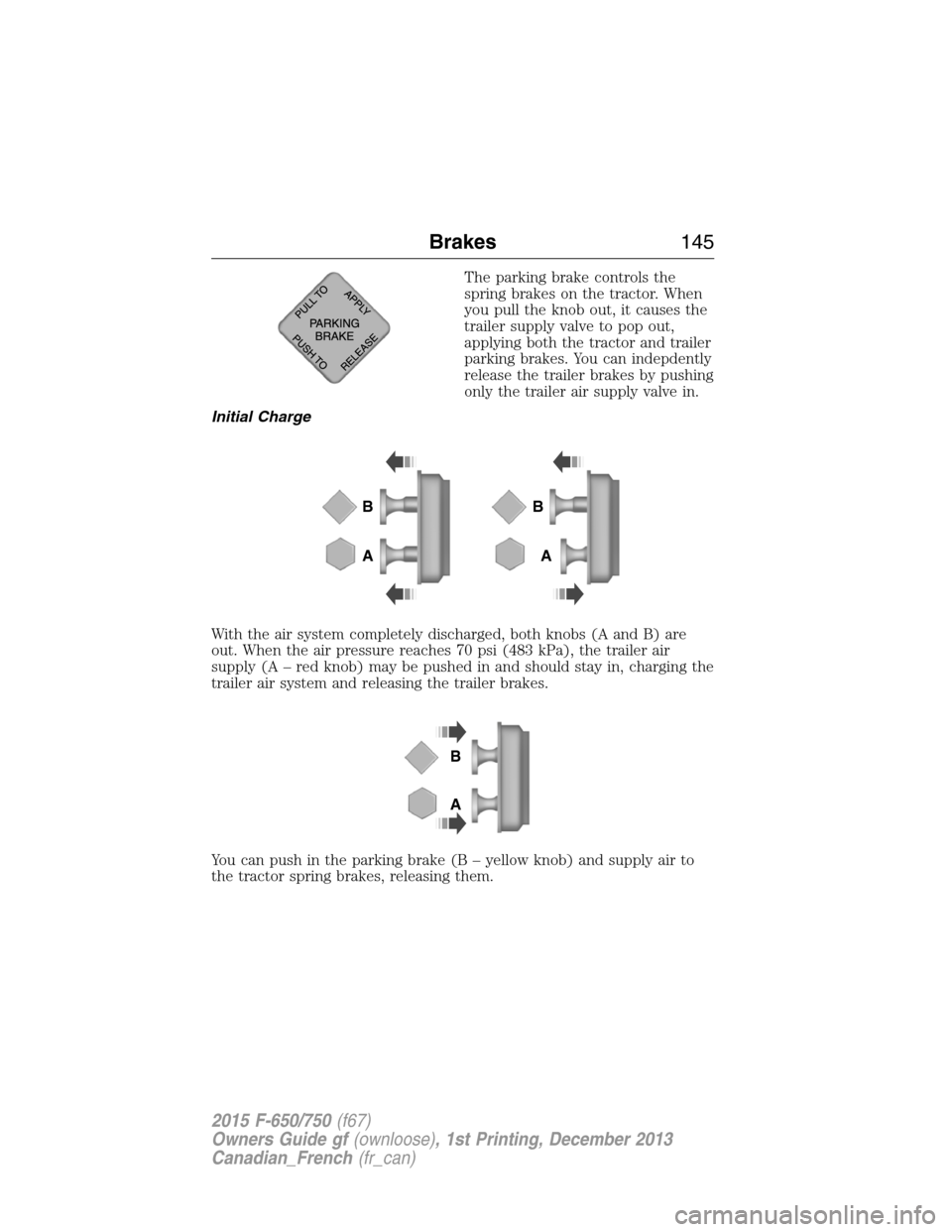
The parking brake controls the
spring brakes on the tractor. When
you pull the knob out, it causes the
trailer supply valve to pop out,
applying both the tractor and trailer
parking brakes. You can indepdently
release the trailer brakes by pushing
only the trailer air supply valve in.
Initial Charge
With the air system completely discharged, both knobs (A and B) are
out. When the air pressure reaches 70 psi (483 kPa), the trailer air
supply (A – red knob) may be pushed in and should stay in, charging the
trailer air system and releasing the trailer brakes.
You can push in the parking brake (B – yellow knob) and supply air to
the tractor spring brakes, releasing them.
B
AB
A
B
A
Brakes145
2015 F-650/750(f67)
Owners Guide gf(ownloose), 1st Printing, December 2013
Canadian_French(fr_can)
Page 147 of 384
Normal Driving Position
Push in both knobs to supply air to both trailer and tractor spring
brakes, releasing all brakes.
System Park
With both knobs pushed in (normal driving position), the parking brakes
for both the tractor and trailer can be applied by pulling the parking
brake knob (B) out, exhausting air from the tractor spring brakes,
simultaneously causing the trailer air supply valve to pop out, applying
the trailer brakes.
B
A
B
AB
AB
A
146Brakes
2015 F-650/750(f67)
Owners Guide gf(ownloose), 1st Printing, December 2013
Canadian_French(fr_can)
Page 148 of 384

Trailer Charge
If both knobs are out, and you want to recharge the trailer while leaving
the tractor spring brakes applied, the trailer air supply (A) can be
pushed in to recharge the trailer air supply line. You can also use this
mode to park a combination vehicle with tractor spring brakes.
Automatic Application
If both knobs are pushed in and the brake system air pressure is reduced
to approximately 35 psi (249 kPa), the trailer air supply (A) knob
automatically pops out applying the emergency or parking brakes on the
trailer. If the trailer air supply (A) knob is manually held in and the air
pressure is reduced to approximately 30 psi (207 kPa), a tripper piston
within the valve moves, exhausting the trailer air supply, applying the
trailer brakes. Further reduction of air pressure, while holding the trailer
air supply knob in, causes the parking brake knob to pop out at 25 psi
(172 kPa).
B
AB
A
B
A
Brakes147
2015 F-650/750(f67)
Owners Guide gf(ownloose), 1st Printing, December 2013
Canadian_French(fr_can)
Page 149 of 384

Actuation of Trailer Park (Emergency) or Tractor Bobtail Position
To actuate the trailer brakes only, pull out the trailer air supply knob
(A). This applies the trailer brakes whether the trailer uses emergency
or spring brakes.
You can also use this mode when the tractor or truck with trailer is used
during bobtail operation.
PARKING BRAKE
Hydraulic Brakes
WARNING:Do not use the gearshift selector in place of the
parking brake. Always set the parking brake fully AND make sure
the gearshift selector is in positionRfor vehicles equipped with a
manual transmission or positionP (if equipped)orNfor vehicles
equipped with an automatic transmission. Use of wheel chocks is also
recommended in hilly or off-road usage. Unexpected and possible
sudden vehicle movement may occur if these precautions are not taken.
WARNING:If the parking brake is fully released but the parking
brake warning lamp remains illuminated, the brakes may not be
working properly. See your dealer or a qualified service technician.
Apply the parking brake whenever the vehicle is parked. To set the
parking brake, pull the handle up until it snaps into the locked position.
When the parking brake is out of adjustment, seek service immediately.
The parking brake warning lamp in the instrument cluster
illuminates, and remains illuminated (when you switch on the
ignition), until you release the parking brake.
B
A
P
148Brakes
2015 F-650/750(f67)
Owners Guide gf(ownloose), 1st Printing, December 2013
Canadian_French(fr_can)
Page 164 of 384
Connecting and Disconnecting a Trailer with Air Suspension and
Air Suspension Dump Switch
When connecting to a trailer:
•Press the lower portion of the switch to exhaust air from the air
suspension system.
•Press the upper portion of the switch, and then raise the landing gear
after making the connection to the trailer.
When disconnecting the trailer:
•Lower the landing gear, and then press the lower portion of the
switch.
•Disconnect the brake hoses, trailer-side and rear light connectors,
then pull the release lever on the fifth wheel.
You must press the upper portion of the switch before operating with a
trailer or operating in the bobtail mode.
Suspension Conversions
WARNING:When operating a loaded vehicle, the driver must
keep all adjustable axles on the ground at all times, supporting
their share of the vehicle’s load. Failure to do so can overload other
axles, tires, wheels, springs, steering components, brakes and frames,
resulting in early component failure, loss of vehicle control, possible
property damage and personal injury.
We do not recommend performing, or approve of, suspension
conversions. However, we understand that, on occasion, others install
aftermarket add-on suspensions on the truck chassis that allow operator
control for weight transfer from other axles (such as air lift axles).
Driving Aids163
2015 F-650/750(f67)
Owners Guide gf(ownloose), 1st Printing, December 2013
Canadian_French(fr_can)
Page 168 of 384

TOWING A TRAILER
WARNING:Do not exceed the GVWR or the GAWR specified on
the certification label.
WARNING:Towing trailers beyond the maximum recommended
gross trailer weight exceeds the limit of the vehicle and could
result in engine damage, transmission damage, structural damage, loss
of vehicle control, vehicle rollover and personal injury.
Your vehicle’s load capacity designation is by weight, not by volume, so
you cannot necessarily use all available space when loading a vehicle.
Second-unit bodies are not included in maximum trailer weight ratings.
You must subtract the weight of the extra body from the maximum
trailer weight.
Towing a trailer places an extra load on your vehicle’s engine,
transmission, axle, brakes, tires and suspension. Inspect these
components periodically during, and after, any towing operation.
Load Placement
To help minimize how trailer movement affects your vehicle when
driving:
•Load the heaviest items closest to the trailer floor.
•Load the heaviest items centered between the left and right side
trailer tires.
•Load the heaviest items above the trailer axles or just slightly forward
toward the trailer tongue. Do not allow the final trailer tongue weight
to go above or below 10–15% of the loaded trailer weight.
Towing167
2015 F-650/750(f67)
Owners Guide gf(ownloose), 1st Printing, December 2013
Canadian_French(fr_can)
Page 169 of 384

RECOMMENDED TOWING WEIGHTS
Vehicles with diesel engine
Model Maximum
GVWR - lb (kg)Maximum
GCWR
F-650 Pro-Loader (Kick-Up
Frame)20500–26000
(9299–11792)
*
F-650 Pro-Loader (Straight
Frame)/F-650 Straight Frame20940–29000
(9498–13154)*
F-750 25999–37000
(11793–16783)*
*
Specific GCWR and maximum trailer weight applicable your vehicle is
dependent on many variables including transmission capability. Check
with your sales consultant for the exact rating on your vehicle.
Vehicles with gasoline engine
Model Maximum
GVWR - lb (kg)Maximum
GCWR
F-650 Pro-Loader (Kick-Up
Frame)20500–26000
(9299–11792)
*
F-650 Pro-Loader (Straight
Frame)/F-650 Straight Frame20940–29000
(9498–13154)*
*
Specific GCWR and maximum trailer weight applicable your vehicle is
dependent on many variables including transmission capability. Check
with your sales consultant for the exact rating on your vehicle.
ESSENTIAL TOWING CHECKS
Service your vehicle more frequently if you tow a trailer. See your
scheduled maintenance information.
For load specification terms found on the Tire Label and Safety
Compliance Certification Label and for instructions on calculating your
vehicle’s load, seeLoad limitin theLoad Carryingchapter.
Hitches
Do not use a hitch that either clamps onto the bumper or attaches to the
axle.
Distribute the trailer load so 10-15% of the total trailer weight is on the
tongue.
168Towing
2015 F-650/750(f67)
Owners Guide gf(ownloose), 1st Printing, December 2013
Canadian_French(fr_can)
Page 170 of 384

Safety Chains
Note:Do not attach safety chains to the bumper.
Always connect the trailer’s safety chains to the frame or hook retainers
of your vehicle hitch.
To connect the trailer’s safety chains, cross the chains under the trailer
tongue and allow enough slack for turning tight corners. Do not allow the
chains to drag on the ground.
Trailer Brakes
WARNING:Do not connect a trailer’s hydraulic brake system
directly to your vehicle’s brake system. Your vehicle may not have
enough braking power and your chances of having a crash greatly
increase.
Electric brakes and manual, automatic or surge-type trailer brakes are
safe if you install them properly and adjust them to the manufacturer’s
specifications. The trailer brakes must meet local and federal regulations.
The rating for the tow vehicle’s braking system operation is at
the gross vehicle weight rating, not the gross combined weight
rating.
Trailer Lamps
WARNING:Never connect any trailer lamp wiring to the
vehicle’s tail lamp wiring; this may damage the electrical system
resulting in a fire. Contact an authorized dealer as soon as possible for
assistance in proper trailer tow wiring installation. Additional electrical
equipment may be required.
Trailer lamps are required on most towed vehicles. Make sure all running
lights, brake lights, turn signals and hazard lights are working.
Before Towing a Trailer
Practice turning, stopping and backing up to get the feel of your
vehicle-trailer combination before starting on a trip. When turning, make
wider turns so the trailer wheels clear curbs and other obstacles.
When Towing a Trailer
•Check your hitch, electrical connections and trailer wheel lug nuts
thoroughly after you have traveled 50 miles (80 kilometers).
Towing169
2015 F-650/750(f67)
Owners Guide gf(ownloose), 1st Printing, December 2013
Canadian_French(fr_can)