2015 FIAT FREEMONT ABS
[x] Cancel search: ABSPage 284 of 412

12. Anti-Lock Brake (ABS) LightThis light monitors the Anti-Lock Brake Sys-
tem (ABS). The light will turn on when the
ignition switch is turned to the ON/RUN
position and may stay on for as long as four
seconds.
If the ABS light remains on or turns on while driving, it
indicates that the Anti-Lock portion of the brake sys-
tem is not functioning and that service is required.
However, the conventional brake system will continue
to operate normally if the Brake System Warning Light
is not on.
If the ABS light is on, the brake system should be
serviced as soon as possible to restore the benefit of
Anti-Lock brakes. Furthermore, the ABS light should
be checked frequently to assure that it is operating
properly. If the light does not turn on, have the system
checked by an authorized dealer. (Refer to “Electronic
Brake Control System” in “Knowing Your Vehicle” for
further information). 13. Fuel Cap Indicator
This symbol indicates the side of the vehicle
where the fuel filler cap is located.
14. Rear Fog Light Indicator This indicator will illuminate when the rear fog
lights are on. (Refer to “Rear Fog Lights” in
“Knowing Your Vehicle” for further
information).
15. Vehicle Security Light This light will flash rapidly for approximately
16 seconds when the vehicle security system
is arming and then flash slowly when the
system is armed. The light will also turn on
for about three seconds when the ignition switch is
first turned to ON/RUN. (Refer to “Vehicle Security
Alarm” or “Premium Security System” in “Knowing
Your Vehicle” for further information).
278
KNOWING YOUR
VEHICLE
SAFETY
STARTING AND
DRIVING
WARNING LIGHTSAND
MESSAGES
INAN
EMERGENC
Y
SERVICING AND
CARE
TECHNICAL
SPECIFICATIONS
CONTENTS
Page 302 of 412

WARNING! (Continued)
• Take care not to allow the contents of Tire
Service Kit to come in contact with hair, eyes, or
clothing. Tire Service Kit is harmful if inhaled,
swallowed, or absorbed through the skin. It
causes skin, eye, and respiratory irritation. Flush
immediately with plenty of water if there is any
contact with eyes or skin. Change clothing as
soon as possible, if there is any contact with
clothing.
• Tire Service Kit Sealant solution contains latex.
In case of an allergic reaction or rash, consult a
physician immediately. Keep Tire Service Kit out
of reach of children. If swallowed, rinse mouth
immediately with plenty of water and drink
plenty of water. Do not induce vomiting! Consult
a physician immediately.
SEALING A TIRE WITH TIRE SERVICE KIT
(A) Whenever You Stop To Use Tire Service
Kit:
1. Pull over to a safe location and turn on the vehicle’s Hazard Warning flashers.
2. Verify that the valve stem (on the wheel with the deflated tire) is in a position that is near to the
ground. This will allow the Tire Service Kit Hoses (6) and (7) to reach the valve stem and keep the Tire
Service Kit flat on the ground. This will provide the
best positioning of the kit when injecting the sealant
into the deflated tire and running the air pump.
Move the vehicle as necessary to place the valve
stem in this position before proceeding.
3. Place the transmission in PARK (auto transmission) or in Gear (manual transmission) and turn Off the
ignition.
4. Set the parking brake.
(B) Setting Up To Use Tire Service Kit:
1. Push in the Mode Select Knob (5) and turn to the Sealant Mode position.
2. Uncoil the Sealant Hose (6) and then remove the cap from the fitting at the end of the hose.
3. Place the Tire Service Kit flat on the ground next to the deflated tire.
4. Remove the cap from the valve stem and then screw the fitting at the end of the Sealant Hose (6) onto
the valve stem.
5. Uncoil the Power Plug (8) and insert the plug into the vehicle’s 12 Volt power outlet.
296
KNOWING YOUR
VEHICLE
SAFETY
STARTING AND
DRIVING
WARNING LIGHTSAND
MESSAGES
IN AN
EMERGENCY
SER VICING
AND
CARE
TECHNICAL
SPECIFICATIONS
CONTENTS
Page 309 of 412
3. Firmly grasp the bulb by the two side latches andsqueeze them together to unlock the bulb from the
back of the front fog lamp housing.
4. Pull the bulb straight out from the keyed opening in the housing.
5. Align the index tabs of the replacement front fog lamp bulb with the slots in the collar of the bulb
opening on the back of the front fog lamp housing.
Do not touch the new bulb with your
fingers. Oil contamination will severely
shorten bulb life. If the bulb comes in
contact with an oily surface, clean the bulb with
rubbing alcohol.
6. Insert bulb into the lamp housing until the index tabs are engaged in the slots of the collar.
7. Firmly and evenly push the bulb straight into the lamp housing until both side latches lock firmly into
place.
REAR FOG LAMP
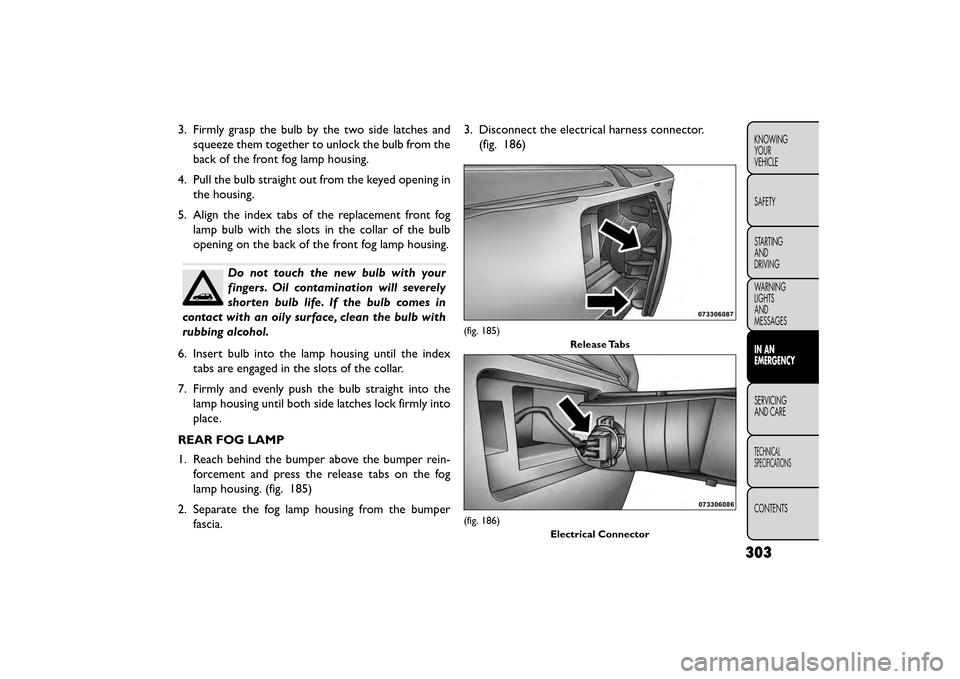
1. Reach behind the bumper above the bumper rein- forcement and press the release tabs on the fog
lamp housing. (fig. 185)
2. Separate the fog lamp housing from the bumper fascia. 3. Disconnect the electrical harness connector.
(fig. 186)
(fig. 185)
Release Tabs
(fig. 186)Electrical Connector
303
KNOWING
YOUR
VEHICLE
SAFETY
STARTING
AND
DRIVING
WARNING
LIGHTS
AND
MESSAGES
IN AN
EMERGENCY
SERVICING
AND
CARE
TECHNICAL
SPECIFICATIONS
CONTENTS
Page 310 of 412
4. Firmly grasp the bulb by the two side latches andsqueeze them together to unlock the bulb from the
back of the lamp housing.
5. Pull the bulb straight out from the keyed opening in the housing.
6. Remove the bulb from the connector socket and install the replacement bulb.
7. Align the index tabs of the replacement rear fog lamp bulb/socket assembly with the slots in the
collar of the bulb opening on the back of the lamp
housing.
8. Insert bulb into the lamp housing until the index tabs are engaged in the slots of the collar.
9. Firmly and evenly push the bulb straight into the lamp housing until both side latches lock firmly into
place.
10. Reinstall the fog lamp housing. SIDE REPEATER LAMP
The side repeater lamps are located in both front
fender panels.
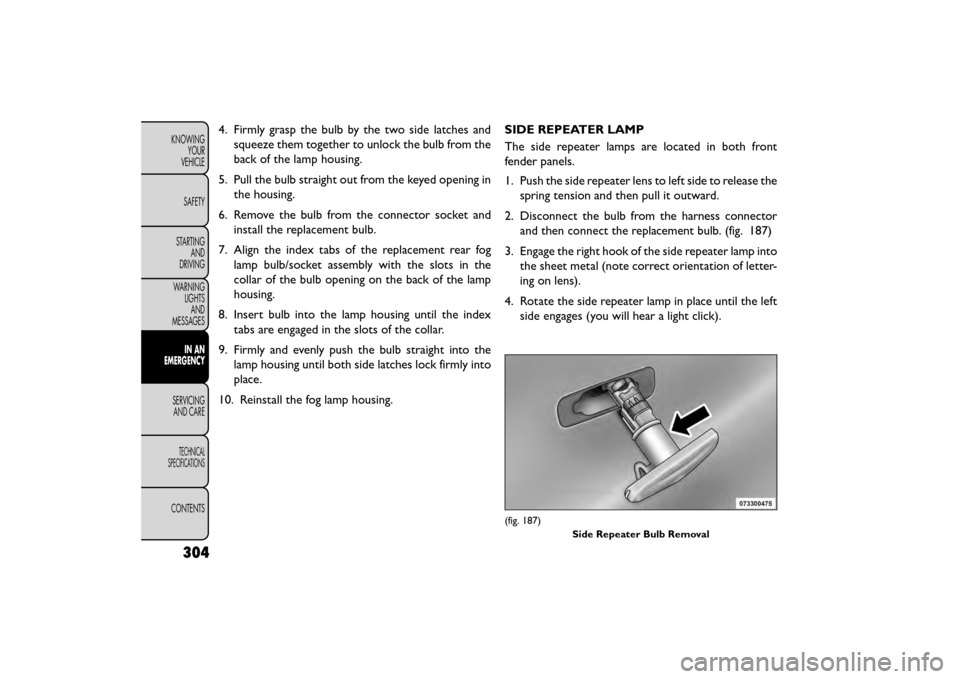
1. Push the side repeater lens to left side to release the
spring tension and then pull it outward.
2. Disconnect the bulb from the harness connector and then connect the replacement bulb. (fig. 187)
3. Engage the right hook of the side repeater lamp into the sheet metal (note correct orientation of letter-
ing on lens).
4. Rotate the side repeater lamp in place until the left side engages (you will hear a light click).
(fig. 187)
Side Repeater Bulb Removal
304
KNOWINGYOUR
VEHICLE
SAFETY
STARTING AND
DRIVING
WARNING LIGHTSAND
MESSAGES
IN AN
EMERGENCY
SER VICING
AND
CARE
TECHNICAL
SPECIFICATIONS
CONTENTS
Page 346 of 412

Refrigerant Recovery And Recycling
R-134a Air Conditioning Refrigerant is a hydrofluoro-
carbon (HFC) that is endorsed by the Environmental
Protection Agency and is an ozone-saving product.
However, the manufacturer recommends that air con-
ditioning service be performed by authorized dealer or
other service facilities using recovery and recycling
equipment.
NOTE:Use only manufacturer approved A/C system
PAG compressor oil and refrigerants.
A/C AIR FILTER
Refer to the “Maintenance Schedule” for the proper
maintenance intervals.
Car maintenance should be done at a
FIAT Dealership. For routine and minor
maintenance operations you wish to
carry out yourself, we do recommend you have
the proper equipment , genuine FIAT spare parts
and the necessary fluids; do not however carry out
these operations if you have no experience.
WARNING!
Do not remove the A/C air filter while
th e
blower is operating or personal in-
jury may result .
The A/C air filter is located in the fresh air inlet behind
the glove box. Perform the following steps to replace
the filter:
1. Open the glove box and remove all contents.
2. Push the retaining tab on each side of the glove box inward while gently pulling the glove box door
outward until both tabs clear the door opening in
the instrument panel. (fig. 200)
3. Pivot the glove box downward.
(fig. 200) Glove Box Removal
340
KNOWINGYOUR
VEHICLE
SAFETY
STARTING AND
DRIVING
WARNING LIGHTSAND
MESSAGES
IN AN
EMERGENCY
SERVICINGAND C ARE
TECHNICAL
SPECIFICATIONS
CONTENTS
Page 347 of 412

4. Disengage the two retaining tabs that secure thefilter cover to the HVAC housing and remove the
cover. (fig. 201)
5. Remove the A/C air filter by pulling it straight out of the housing.
6. Install the A/C air filter with the arrow on the filter pointing toward the floor. When installing the filter
cover, make sure the retaining tabs fully engage the
cover.The A/C air filter is identified with an
arrow to indicate airflow direction
through the filter. Failure to install the
filter properly will result in the need to replace it
more often.
7. Reinstall the glove box door. Make sure that the hinges are seated fully as you raise the door. Other-
wise, the door latch will not align properly.
BODY LUBRICATION
Locks and all body pivot points, including such items as
seat tracks, door hinge pivot points and rollers, liftgate,
tailgate, sliding doors and hood hinges, should be
lubricated periodically with a lithium based grease to
assure quiet, easy operation and to protect against rust
and wear. Prior to the application of any lubricant, the
parts concerned should be wiped clean to remove dust
and grit; after lubricating excess oil and grease should
be removed. Particular attention should also be given
to hood latching components to ensure proper func-
tion. When performing other underhood services, the
hood latch, release mechanism and safety catch should
be cleaned and lubricated.
The external lock cylinders should be lubricated twice
a year, preferably in the Fall and Spring. Apply a small
amount of a high quality lubricant directly into the lock
cylinder.
(fig. 201) A/C Air Filter Replacement
341
KNOWING
YOUR
VEHICLE
SAFETY
STARTING
AND
DRIVING
WARNING
LIGHTS
AND
MESSAGES
IN AN
EMERGENCY
SERVICING
AND CARE
TECHNICAL
SPECIFICATIONS
CONTENTS
Page 357 of 412

WARNING! (Continued)
• To avoid contamination from foreign matter or
moisture, use only new brake fluid or fluid that
has been in a tightly closed container. Keep the
master cylinder reservoir cap secured at all
times. Brake fluid in a open container absorbs
moisture from the air resulting in a lower boiling
point . This may cause it to boil unexpectedly
during hard or prolonged braking, resulting in
sudden brake failure. This could result in a acci-
dent .
• Overfilling the brake fluid reservoir can result
in spilling brake fluid on hot engine parts, causing
the brake fluid to catch fire. Brake fluid can also
damage painted and vinyl surfaces, care should
be taken to avoid its contact with these surfaces.
• Do not allow petroleum based fluid to con-
taminate the brake fluid. Brake seal components
could be damaged, causing partial or complete
brake failure.This could result in an accident . AUTOMATIC TRANSMISSION (for
versions/markets, where provided)
Selection Of Lubricant
It is important to use the proper transmission fluid to
ensure optimum transmission performance and life.
Use only the manufacturer’s specified transmission
fluid. Refer to “Fluids, Lubricants, and Genuine Parts”
in “Technical Specifications” for fluid specifications. It is
important to maintain the transmission fluid at the
correct level using the recommended fluid. No chemi-
cal flushes should be used in any transmission; only the
approved lubricant should be used.
Using a transmission fluid other than the
manufacturer ’s recommended fluid may
cause deterioration in transmission shift
quality and/or torque converter shudder, and will
require more frequent fluid and filter changes.
Refer to “Fluids, Lubricants, and Genuine Parts” in
"Technical Specifications" for fluid specifica-
tions.
351
KNOWING
YOUR
VEHICLE
SAFETY
STARTING
AND
DRIVING
WARNING
LIGHTS
AND
MESSAGES
IN AN
EMERGENCY
SERVICING
AND C ARE
TECHNICAL
SPECIFICATIONS
CONTENTS
Page 367 of 412

TIRE SAFETY INFORMATION
TIRE MARKINGS
(fig. 206)
NOTE:
• P (Passenger) — Metric tire sizing is based on U.S.design standards. P-Metric tires have the letter “P”
molded into the sidewall preceding the size designa-
tion. Example: P215/65R15 95H.
• European — Metric tire sizing is based on European design standards. Tires designed to this standard
have the tire size molded into the sidewall beginning
with the section width. The letter "P" is absent from
this tire size designation. Example: 215/65R15 96H.
• LT (Light Truck) — Metric tire sizing is based on U.S. design standards. The size designation for LT-Metric
tires is the same as for P-Metric tires except for the
letters “LT” that are molded into the sidewall pre-
ceding the size designation. Example: LT235/85R16.
• Temporary spare tires are designed for temporary emergency use only. Temporary high pressure com-
pact spare tires have the letter “T” or “S” molded
into the sidewall preceding the size designation. Ex-
ample: T145/80D18 103M.
• High flotation tire sizing is based on U.S. design standards and it begins with the tire diameter
molded into the sidewall. Example: 31x10.5 R15 LT.
(fig. 206)
1 — U.S. DOT Safety Stan-
dards Code (TIN) 4 — Maximum Load
2 — Size Designation 5 — Maximum Pressure
3 — Service Description 6 — Treadwear, Traction and Temperature Grades
361
KNOWING
YOUR
VEHICLE
SAFETY
STARTING
AND
DRIVING
WARNING
LIGHTS
AND
MESSAGES
IN AN
EMERGENCY
SERVICING
AND CARE
TECHNICAL
SPECIFICATIONS
CONTENTS