Page 273 of 367
The 500e uses high voltage components to heat and cool
the cabin, so when using automatic climate control,
consider setting temperatures a few degrees higher or
lower during hot and cold days. If your 500e has been
soaking in hot or cold temperatures for an extended
period, it is recommended that the car be preconditioned
using the FIAT Access smartphone app while still
plugged into a charging source. This will allow 500e to
use external power to establish a comfortable cabin
temperature before the drive and allow the battery to
maintain the temperature at significantly lower energy
levels.
Additional tips:
•Keep tires properly inflated
•When practical, choose surface streets over the high-
way, and work to maintain a steady speed
•Avoid carrying nonessential cargo
•Be mindful of adding external accessories that may
increase aerodynamic drag
•Perform all scheduled maintenance at recommended
intervals
Driver Behavior Gauge
To help the driver extend the driving range of the high
voltage battery your vehicle is equipped with a Driver
Behavior Gauge. The Driver Behavior Gauge is located
on the right side of the instrument cluster and contains
three driving ranges:
•Power
The needle will move into the Power range when under
acceleration.
•ECO
The needle will move into the ECO range when you are
maximizing the driving range of the high voltage battery.
5
STARTING AND OPERATING 271
Page 278 of 367
Tighten the lug nuts/bolts in a star pattern until each
nut/bolt has been tightened twice.
After 25 miles (40 km) check the lug nut/bolt torque to be
sure that all the lug nuts/bolts are properly seated
against the wheel.
WARNING!
To avoid the risk of forcing the vehicle off the jack,
do not tighten the lug nuts fully until the vehicle has
been lowered. Failure to follow this warning may
result in personal injury.
TIRE SERVICE KIT — IF EQUIPPED
Small punctures up to¼” (6 mm) in the tire tread can be
sealed with Tire Service Kit. Foreign objects (e.g., screws
or nails) should not be removed from the tire. Tire Service
Kit can be used in outside temperatures down to approxi-
mately -4°F (-20°C).
This kit will provide a temporary tire seal, allowing you
to drive your vehicle up to 100 miles (160 km) with a
maximum speed of 55 mph (90 km/h).
Torque Patterns
276 WHAT TO DO IN EMERGENCIES
Page 302 of 367
CAUTION!(Continued)
•Your vehicle has been built with improved fluids
that protect the performance and durability of your
vehicle and also allow extended maintenance inter-
vals. Do not use chemical flushes in these compo-
nents as the chemicals can damage them. Such
damage is not covered by the New Vehicle Limited
Warranty. If a flush is needed because of compo-
nent malfunction, use only the specified fluid for
the flushing procedure.
Power Electronics And Battery Thermal
Management Systems
The Power Electronics and Battery Thermal Management
Systems are completely separate and designed to regu-
late temperature for the high voltage battery and the
electric components.
Power Electronics and Battery Thermal
Management Systems — Coolant Level Check
The coolant expansion bottles provides a quick visual
method for determining that the coolant level is ad-
equate. With the vehicle off and coolant at ambient
temperature, the level of the coolant (antifreeze) in the
bottles should be between the bottom and top lines
marked “MIN-MAX FILL RANGE”.
300 MAINTAINING YOUR VEHICLE
Page 303 of 367
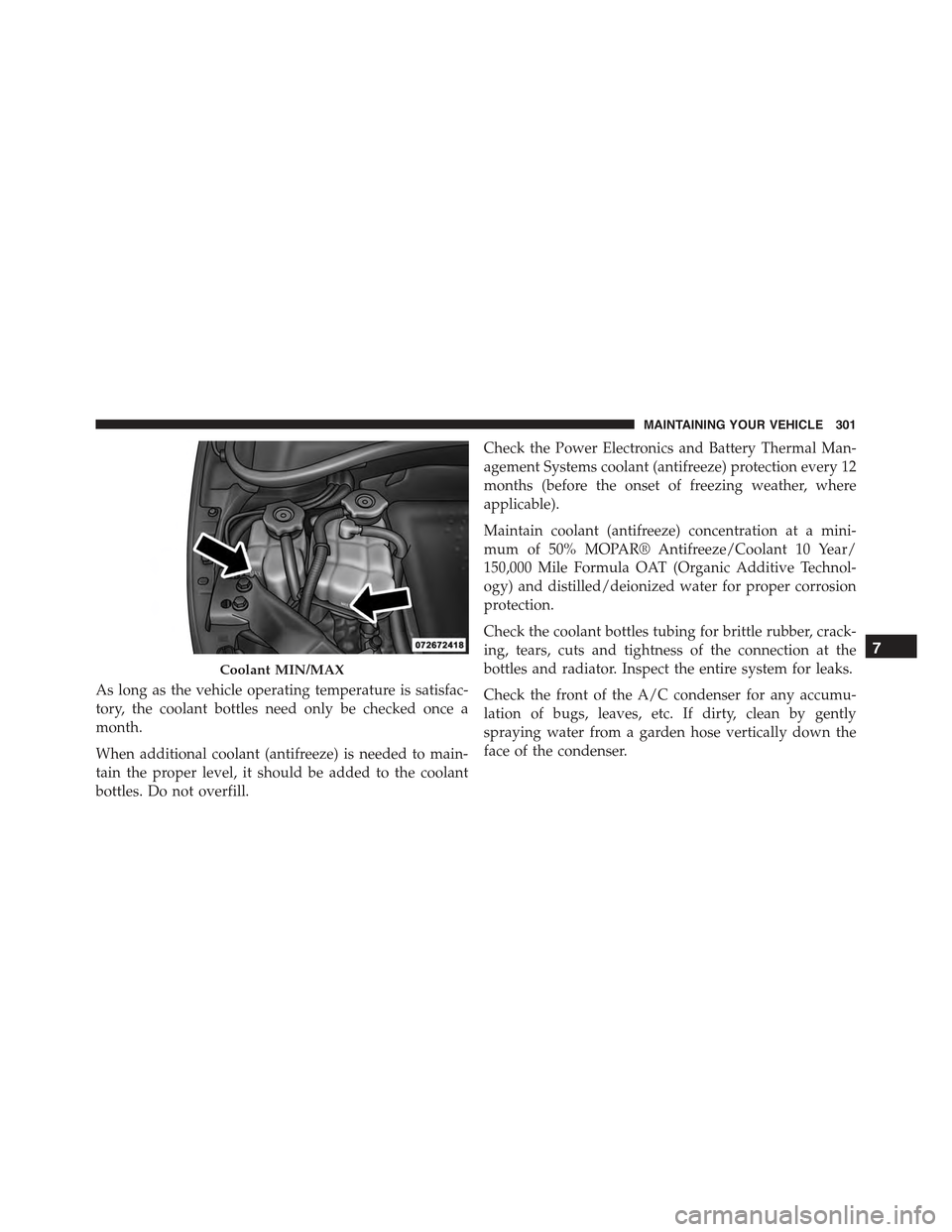
As long as the vehicle operating temperature is satisfac-
tory, the coolant bottles need only be checked once a
month.
When additional coolant (antifreeze) is needed to main-
tain the proper level, it should be added to the coolant
bottles. Do not overfill.
Check the Power Electronics and Battery Thermal Man-
agement Systems coolant (antifreeze) protection every 12
months (before the onset of freezing weather, where
applicable).
Maintain coolant (antifreeze) concentration at a mini-
mum of 50% MOPAR® Antifreeze/Coolant 10 Year/
150,000 Mile Formula OAT (Organic Additive Technol-
ogy) and distilled/deionized water for proper corrosion
protection.
Check the coolant bottles tubing for brittle rubber, crack-
ing, tears, cuts and tightness of the connection at the
bottles and radiator. Inspect the entire system for leaks.
Check the front of the A/C condenser for any accumu-
lation of bugs, leaves, etc. If dirty, clean by gently
spraying water from a garden hose vertically down the
face of the condenser.
Coolant MIN/MAX
7
MAINTAINING YOUR VEHICLE 301
Page 306 of 367

CAUTION!(Continued)
•Do not use water alone or alcohol-based coolant
(antifreeze) products. Do not use additional rust
inhibitors or antirust products, as they may not be
compatible with the radiator coolant and may plug
the radiator.
•This vehicle has not been designed for use with
propylene glycol-based coolant (antifreeze). Use of
propylene glycol-based coolant (antifreeze) is not
recommended.
Adding Coolant
Your vehicle has been built with cooling systems that allow
extended maintenance intervals. This coolant (antifreeze)
can be used up to ten years or 150,000 miles (240,000 km)
before replacement. To prevent reducing this extended
maintenance period, it is important that you use the same
coolant (antifreeze) throughout the life of your vehicle.
Please review these recommendations for using Organic
Additive Technology (OAT) coolant (antifreeze).
When adding coolant (antifreeze):
•The manufacturer recommends using MOPAR®
Antifreeze/Coolant 10 Year/150,000 Mile Formula
OAT (Organic Additive Technology).
•Mix a minimum solution of 50% OAT coolant (anti-
freeze) and distilled water. Use higher concentrations
(not to exceed 70%) if temperatures below -34ºF (-37ºC)
are anticipated.
•Use only high purity water such as distilled or deion-
ized water when mixing the water and coolant (anti-
freeze) solution. The use of lower quality water will
reduce the amount of corrosion protection in the
cooling systems.
304 MAINTAINING YOUR VEHICLE
Page 307 of 367
Please note that it is the owner ’s responsibility to main-
tain the proper level of protection against freezing ac-
cording to the temperatures occurring in the area where
the vehicle is operated.
NOTE:Mixing coolant (antifreeze) types will decrease
the life of the Power Electronics and Battery Thermal
Management Systems coolant (antifreeze) and will re-
quire more frequent coolant (antifreeze) changes.
Power Electronics and Battery Thermal
Management Systems — Drain, Flush And Refill
Refer to “Maintenance Schedules” in Section 7 of this
supplement for the proper maintenance intervals.
If the coolant (antifreeze) is dirty or contains a consider-
able amount of sediment, clean and flush with a reliable
cooling system cleaner. Follow with a thorough rinsing to
remove all deposits and chemicals. Properly dispose of
old coolant (antifreeze) solution.
CAUTION!
It is recommended to have the cooling systems ser-
viced at your authorized dealer. Failure to do so could
result in poor cooling system performance and/or
vehicle damage.
Disposal Of Used Power Electronics and Battery
Thermal Management Systems Coolant
Used antifreeze is a regulated substance requiring proper
disposal. Check with your local authorities to determine
the disposal rules for your community. To prevent inges-
tion by animals or children, do not store antifreeze in
open containers or allow it to remain in puddles on the
ground. If ingested by a child, contact a physician
immediately. Clean up any ground spills immediately.
7
MAINTAINING YOUR VEHICLE 305
Page 314 of 367

WARNING!
Commercially available windshield washer solvents
are flammable. They could ignite and burn you. Care
must be exercised when filling or working around
the washer solution.
Brake System
In order to assure brake system performance, all brake
system components should be inspected periodically.
Refer to the “Maintenance Schedule” for the proper
maintenance intervals.
WARNING!
Riding the brakes can lead to brake failure and
possibly a collision. Driving with your foot resting or
riding on the brake pedal can result in abnormally
(Continued)
WARNING!(Continued)
high brake temperatures, excessive lining wear, and
possible brake damage. Riding the brakes may also
reduce braking capacity in an emergency.
Brake Master Cylinder
The fluid level in the master cylinder should be checked
when performing under hood services, or immediately if
the “Brake Warning Light” is on and the parking brake is
not applied.
Be sure to clean the top of the master cylinder area before
removing the cap. If necessary, add fluid to bring the
fluid level up to the requirements described on the brake
fluid reservoir. Fluid level can be expected to fall as the
brake pads wear. The brake fluid level should be checked
when the pads are replaced. However, low fluid level
may be caused by a leak and a checkup may be needed.
312 MAINTAINING YOUR VEHICLE
Page 346 of 367
!DEPARTMENT OF TRANSPORTATION UNIFORM
TIRE QUALITY GRADES.................350
▫Treadwear...........................351
▫Traction Grades.......................351
▫Temperature Grades....................351
344 IF YOU NEED CONSUMER ASSISTANCE