Page 24 of 367
Type of Charge Estimated Charge Time
Level 1 (120V/15A) Approximately 23 hours
Level 2 (240V/30A) Approximately 4 hours
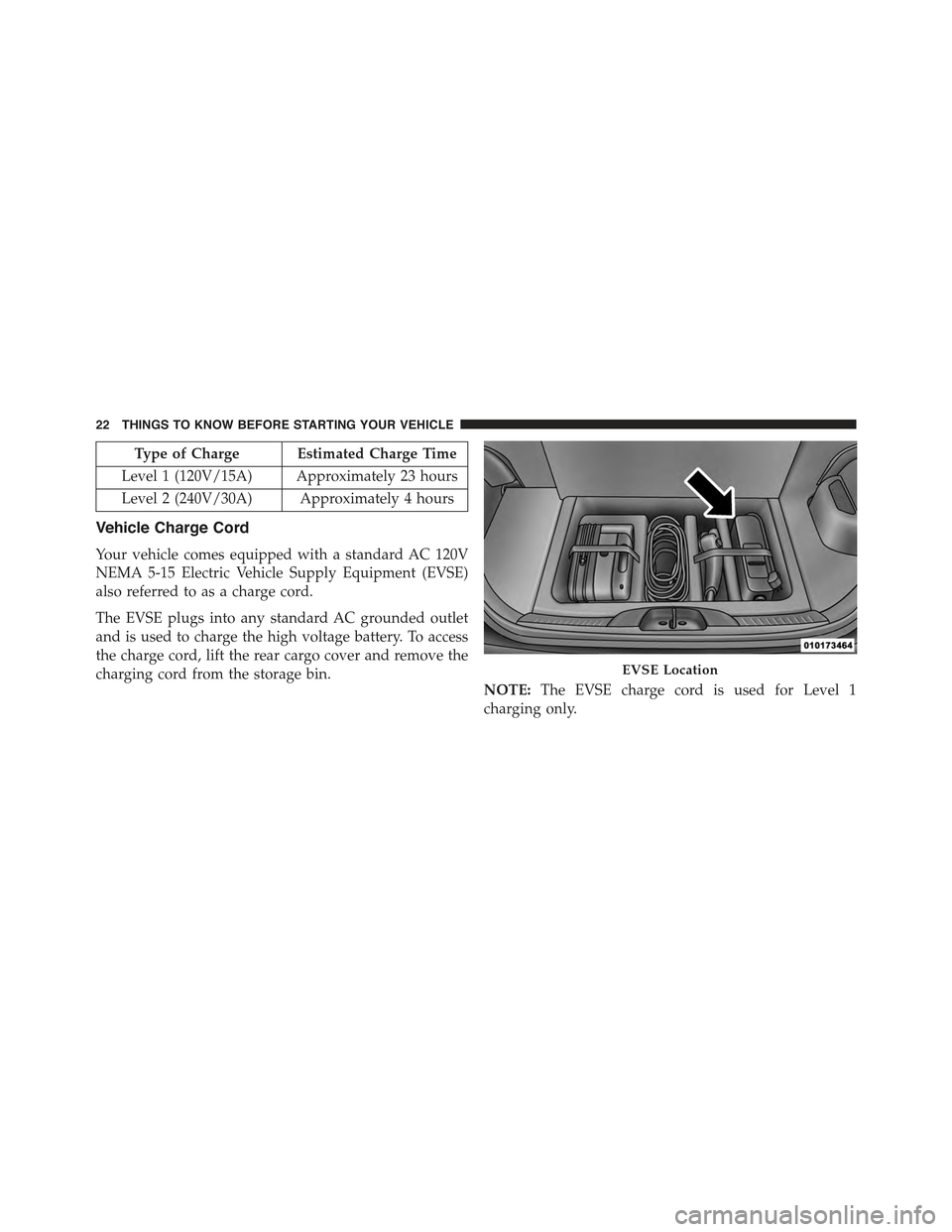
Vehicle Charge Cord
Your vehicle comes equipped with a standard AC 120V
NEMA 5-15 Electric Vehicle Supply Equipment (EVSE)
also referred to as a charge cord.
The EVSE plugs into any standard AC grounded outlet
and is used to charge the high voltage battery. To access
the charge cord, lift the rear cargo cover and remove the
charging cord from the storage bin.
NOTE:The EVSE charge cord is used for Level 1
charging only.
EVSE Location
22 THINGS TO KNOW BEFORE STARTING YOUR VEHICLE
Page 27 of 367

The EVSE LED’s will be used to indicate the vehicle’s
connection status if no faults are found during the self test.
AC LED
Fault In-
dicator
LED
Charge Level Indicator
LED’s
••••••
After the EVSE is connected to the vehicle’s charge inlet
the EVSE will continue to illuminate all LED’s green.
Once the vehicle begins charging the EVSE Charge level
LED’s will illuminate in order from left to right, then shut
off. This pattern will repeat as long as the EVSE remains
connected to AC power and the vehicle is actively
charging. Completion of charge will result in illuminat-
ing all LED’s green. If the vehicle stops charging, the LED
pattern will stop.
The LED’s are illuminated and turn off at the rate of one
change per second and the battery is charging.
AC
LED
Fault
Indica-
tor LED
Charge Level Indicator
LED’sTime
•••ooo1.0
sec
••••o o 2.0
sec
•••••o 3.0
sec
••••••4.0
sec
Refer to the Level 1 User Manual for any additional
information on its use or operation.
2
THINGS TO KNOW BEFORE STARTING YOUR VEHICLE 25
Page 28 of 367
Charging The High Voltage Battery
1. Put the vehicle in PARK.
2. Turn the ignition to the OFF position.
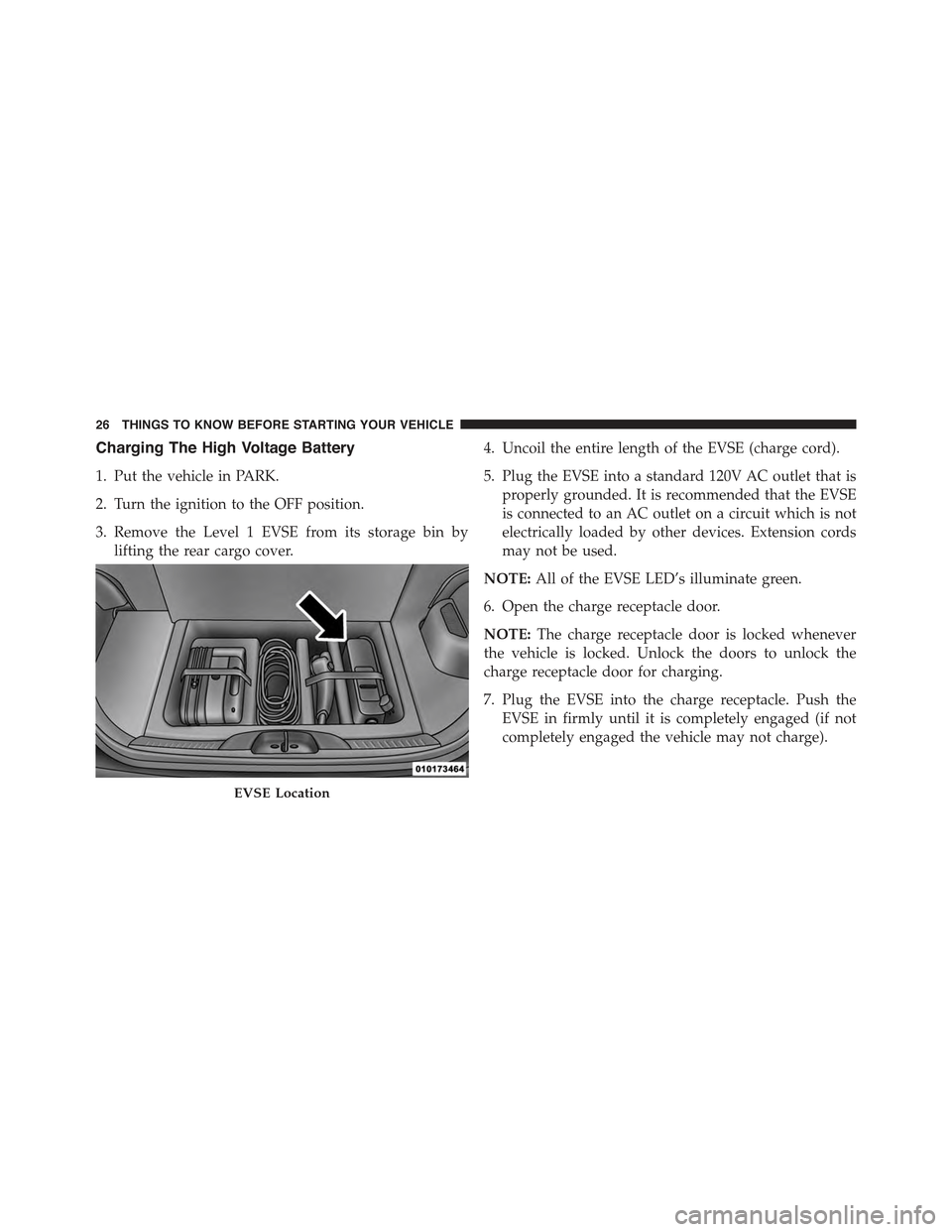
3. Remove the Level 1 EVSE from its storage bin by
lifting the rear cargo cover.
4. Uncoil the entire length of the EVSE (charge cord).
5. Plug the EVSE into a standard 120V AC outlet that is
properly grounded. It is recommended that the EVSE
is connected to an AC outlet on a circuit which is not
electrically loaded by other devices. Extension cords
may not be used.
NOTE:All of the EVSE LED’s illuminate green.
6. Open the charge receptacle door.
NOTE:The charge receptacle door is locked whenever
the vehicle is locked. Unlock the doors to unlock the
charge receptacle door for charging.
7. Plug the EVSE into the charge receptacle. Push the
EVSE in firmly until it is completely engaged (if not
completely engaged the vehicle may not charge).
EVSE Location
26 THINGS TO KNOW BEFORE STARTING YOUR VEHICLE
Page 30 of 367
NOTE:
•In the event of an error in the charging process, the AC
power to the vehicle will stop and a red indicator will
illuminate on the EVSE.
•Keep the door for the charge receptacle closed when
not in use.
Vehicle Charge Indicators
Instrument Cluster High Voltage Battery Gauge
There is a battery gauge indicator located on the instrument
cluster. The battery gauge will display, with progressive
color indication, the current state of charge for the high
voltage battery; with the percentage value located at the
bottom of the gauge.
Charge Receptacle Door
High Voltage Battery Gauge
28 THINGS TO KNOW BEFORE STARTING YOUR VEHICLE
Page 32 of 367
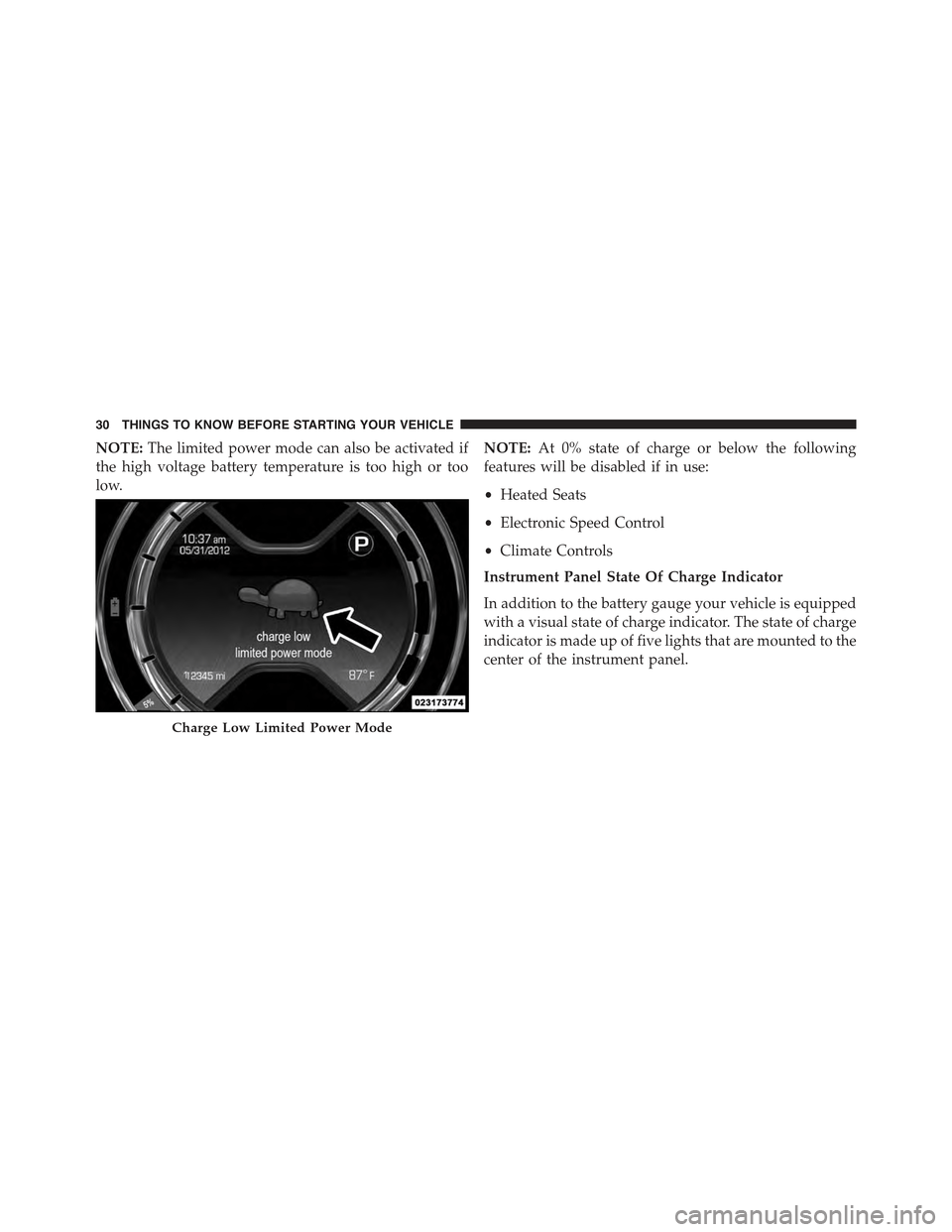
NOTE:The limited power mode can also be activated if
the high voltage battery temperature is too high or too
low.
NOTE:At 0% state of charge or below the following
features will be disabled if in use:
•Heated Seats
•Electronic Speed Control
•Climate Controls
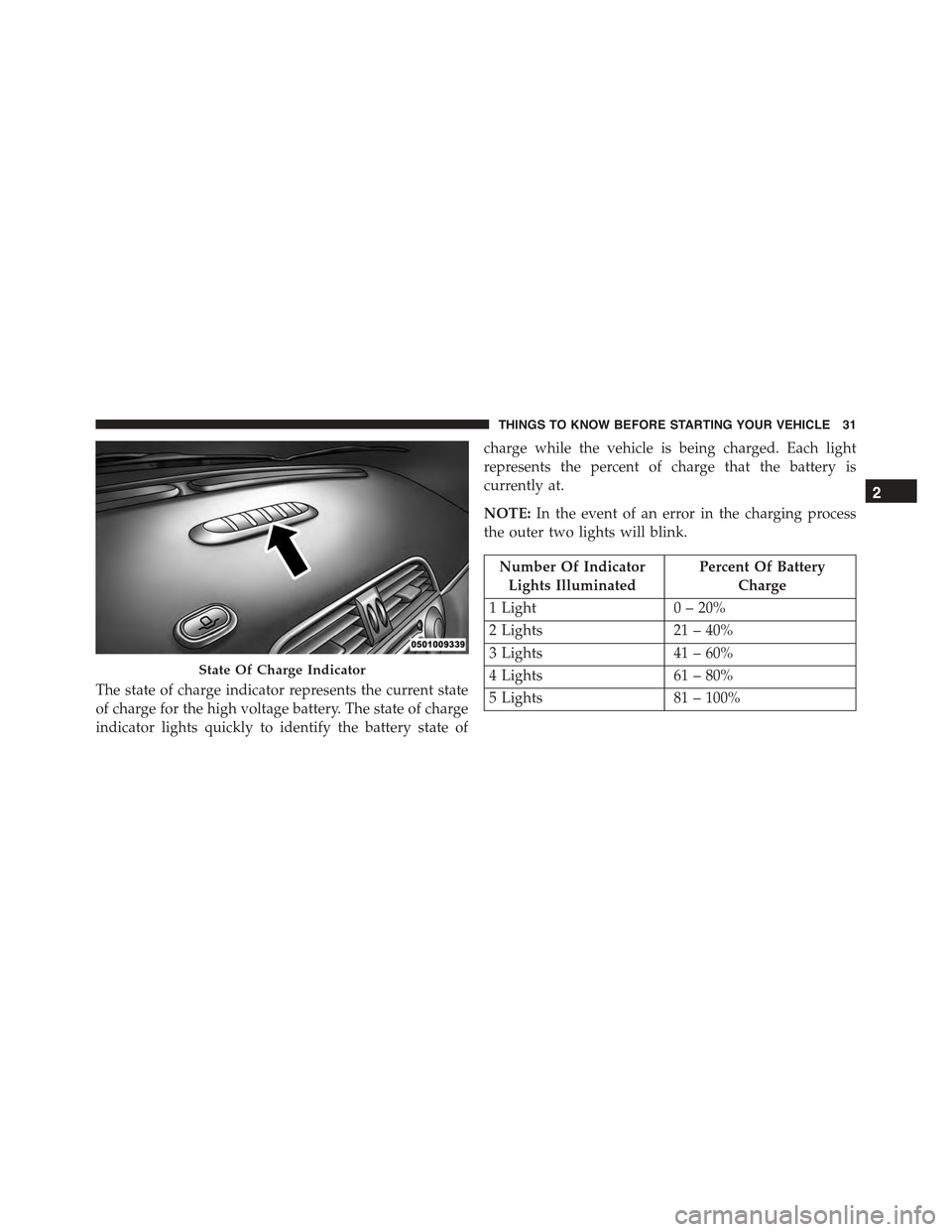
Instrument Panel State Of Charge Indicator
In addition to the battery gauge your vehicle is equipped
with a visual state of charge indicator. The state of charge
indicator is made up of five lights that are mounted to the
center of the instrument panel.
Charge Low Limited Power Mode
30 THINGS TO KNOW BEFORE STARTING YOUR VEHICLE
Page 33 of 367
The state of charge indicator represents the current state
of charge for the high voltage battery. The state of charge
indicator lights quickly to identify the battery state of
charge while the vehicle is being charged. Each light
represents the percent of charge that the battery is
currently at.
NOTE:In the event of an error in the charging process
the outer two lights will blink.
Number Of Indicator
Lights Illuminated
Percent Of Battery
Charge
1 Light0 – 20%
2 Lights21 – 40%
3 Lights41 – 60%
4 Lights61 – 80%
5 Lights81 – 100%
State Of Charge Indicator
2
THINGS TO KNOW BEFORE STARTING YOUR VEHICLE 31
Page 39 of 367
To Unlock The Doors And Liftgate
Push and release the UNLOCK button on the RKE
transmitter once to unlock the driver ’s door or twice,
within five seconds, to unlock all doors and the liftgate.
The turn signal lights will flash to acknowledge the
unlock signal. The illuminated entry system will also
turn on.
Remote Key Unlock, Driver Door/All Doors 1st
Press
This feature lets you program the system to unlock either
the driver ’s door or all doors on the first press of the
UNLOCK button on the RKE transmitter.
To Lock The Doors And Liftgate
Push and release the LOCK button on the RKE transmit-
ter to lock all doors and the liftgate. The turn signal lights
will flash and the horn will chirp to acknowledge the
signal.
Transmitter Battery Replacement
NOTE:Perchlorate Material – special handling may ap-
ply. See www.dtsc.ca.gov/hazardouswaste/perchlorate
The recommended replacement battery is CR2032.
2
THINGS TO KNOW BEFORE STARTING YOUR VEHICLE 37
Page 40 of 367
1. Push the mechanical key release button and release the
mechanical key to access the battery case screw lo-
cated on the side of the Key Fob.
2. Rotate the screw located on the side of the Key Fob
using a small screwdriver.
3. Take out the battery case. Remove and replace the
battery observing its polarity.Mechanical Key Release Button
Key Fob Screw Location
38 THINGS TO KNOW BEFORE STARTING YOUR VEHICLE