Page 232 of 367

Brake Assist System (BAS)
The BAS is designed to optimize the vehicle’s braking
capability during emergency braking maneuvers. The
system detects an emergency braking situation by sens-
ing the rate and amount of brake application and then
applies optimum pressure to the brakes. This can help
reduce braking distances. The BAS complements the
Anti-Lock Brake System (ABS). Applying the brakes very
quickly results in the best BAS assistance. To receive the
benefit of the system, you must applycontinuousbrak-
ing pressure during the stopping sequence (do not
“pump” the brakes). Do not reduce brake pedal pressure
unless braking is no longer desired. Once the brake pedal
is released, the BAS is deactivated.
WARNING!
•The Brake Assist System (BAS) cannot prevent the
natural laws of physics from acting on the vehicle,
nor can it increase the traction afforded by prevail-
ing road conditions.
•The BAS cannot prevent collisions, including those
resulting from excessive speed in turns, driving on
very slippery surfaces, or hydroplaning.
•The capabilities of a BAS-equipped vehicle must
never be exploited in a reckless or dangerous
manner which could jeopardize the user ’s safety or
the safety of others.
230 STARTING AND OPERATING
Page 237 of 367
TIRE SAFETY INFORMATION
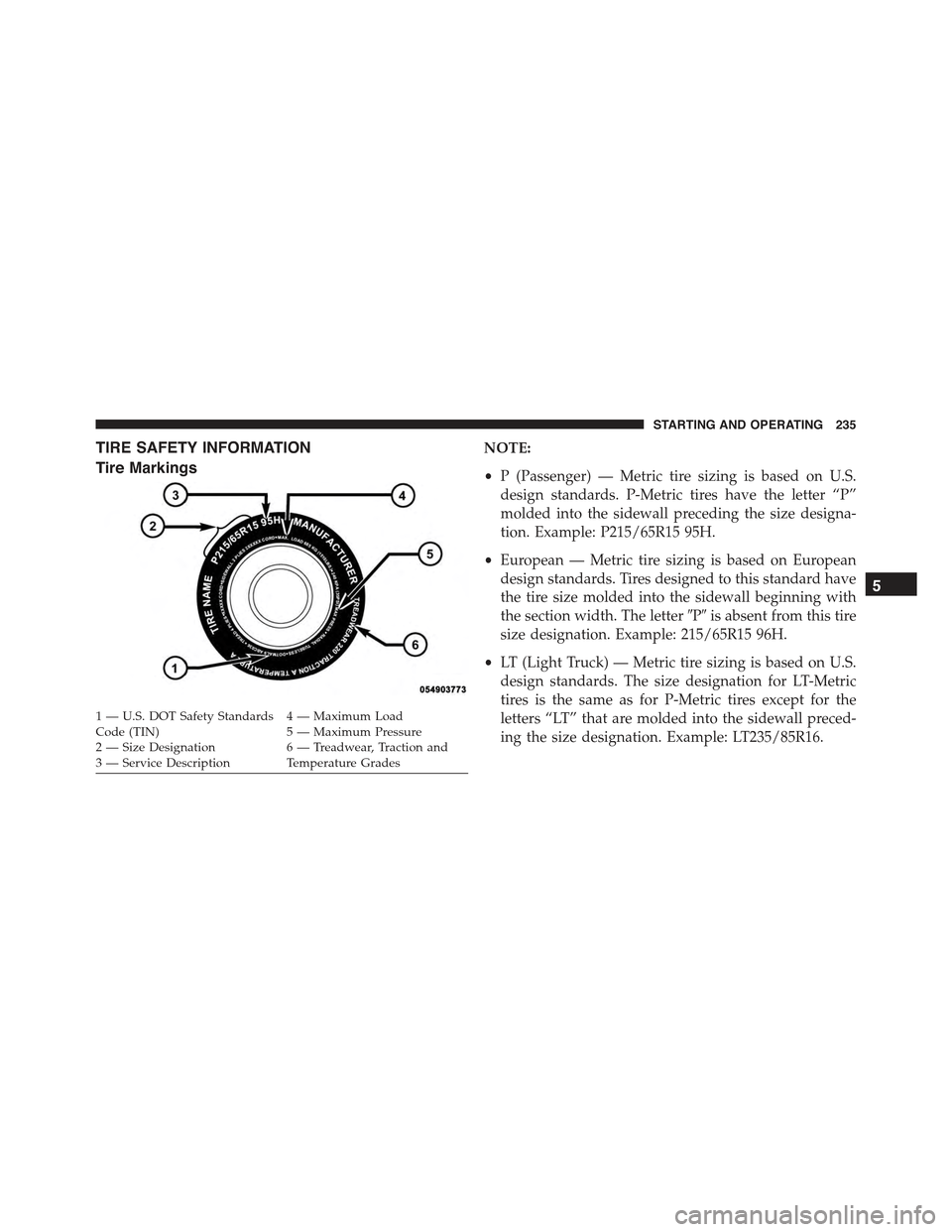
Tire Markings
NOTE:
•P (Passenger) — Metric tire sizing is based on U.S.
design standards. P-Metric tires have the letter “P”
molded into the sidewall preceding the size designa-
tion. Example: P215/65R15 95H.
•European — Metric tire sizing is based on European
design standards. Tires designed to this standard have
the tire size molded into the sidewall beginning with
the section width. The letter#P#is absent from this tire
size designation. Example: 215/65R15 96H.
•LT (Light Truck) — Metric tire sizing is based on U.S.
design standards. The size designation for LT-Metric
tires is the same as for P-Metric tires except for the
letters “LT” that are molded into the sidewall preced-
ing the size designation. Example: LT235/85R16.
1—U.S.DOTSafetyStandardsCode (TIN)4—MaximumLoad
2—SizeDesignation5—MaximumPressure
3 — Service Description6 — Treadwear, Traction andTemperature Grades
5
STARTING AND OPERATING 235
Page 240 of 367
EXAMPLE:
H= Speed Symbol
– A symbol indicating the range of speeds at which a tire can carry a load corresponding to
its load index under certain operating conditions
– The maximum speed corresponding to the speed symbol should only be achieved under
specified operating conditions (i.e., tire pressure, vehicle loading, road conditions, and
posted speed limits)
Load Identification:
Absence of the following load identification symbols on the sidewall of the tire indicates a Standard Load (SL)
tire:
•XL= Extra load (or reinforced) tire, or
•LL= Light load tire or
•C, D, E, F, G= Load range associated with the maximum load a tire can carry at a specified pressure
Maximum Load– Maximum load indicates the maximum load this tire is designed to carry
Maximum Pressure–Maximum pressure indicates the maximum permissible cold tire inflation pressure for this
tire
238 STARTING AND OPERATING
Page 282 of 367
WARNING!
•Do not attempt to seal a tire on the side of the
vehicle closest to traffic. Pull far enough off the
road to avoid the danger of being hit when using
the Tire Service Kit.
•Do not use Tire Service Kit or drive the vehicle
under the following circumstances:
– If the puncture in the tire tread is approximately
1/4” (6 mm) or larger.
– If the tire has any sidewall damage.
– If the tire has any damage from driving with
extremely low tire pressure.
– If the tire has any damage from driving on a flat
tire.
– If the wheel has any damage.
– If you are unsure of the condition of the tire or
the wheel.
(Continued)
WARNING!(Continued)
•Keep Tire Service Kit away from open flames or
heat source.
•A loose Tire Service Kit thrown forward in a
collision or hard stop could endanger the occupants
of the vehicle. Always stow the Tire Service Kit in
the place provided. Failure to follow these warn-
ings can result in injuries that are serious or fatal to
you, your passengers, and others around you.
•Take care not to allow the contents of Tire Service
Kit to come in contact with hair, eyes, or clothing.
Tire Service Kit is harmful if inhaled, swallowed,
or absorbed through the skin. It causes skin, eye,
and respiratory irritation. Flush immediately with
plenty of water if there is any contact with eyes or
skin. Change clothing as soon as possible, if there
is any contact with clothing.
(Continued)
280 WHAT TO DO IN EMERGENCIES
Page 315 of 367
NOTE:
Use only manufacturer’s recommended brake fluid. Re-
fer to “Fluids, Lubricants, and Genuine Parts” in “Main-
taining Your Vehicle” for further information.
WARNING!
•Use only manufacturer ’s recommended brake
fluid. Refer to “Fluids, Lubricants, and Genuine
Parts” in “Maintaining Your Vehicle” for further
information. Using the wrong type of brake fluid
can severely damage your brake system and/or
impair its performance. The proper type of brake
fluid for your vehicle is also identified on the
original factory installed hydraulic master cylinder
reservoir.
(Continued)
WARNING!(Continued)
•To avoid contamination from foreign matter or
moisture, use only new brake fluid or fluid that has
been in a tightly closed container. Keep the master
cylinder reservoir cap secured at all times. Brake
fluid in a open container absorbs moisture from the
air resulting in a lower boiling point. This may
cause it to boil unexpectedly during hard or pro-
longed braking, resulting in sudden brake failure.
This could result in a collision.
•Overfilling the brake fluid reservoir can result in
spilling brake fluid on hot vehicle parts, causing
the brake fluid to catch fire. Brake fluid can also
damage painted and vinyl surfaces, care should be
taken to avoid its contact with these surfaces.
(Continued)
7
MAINTAINING YOUR VEHICLE 313
Page 329 of 367
CavityMaxi
FuseMini Fuse Description
F30 – 15 Amp
Blue
Fog Lamps
F81 30 Amp
Green
– Electronic Shifter
(ESM)
F82 30 Amp
Green
– Sunroof
F84 – 25 Amp
Clear
Regen Brake Mod-
ule
F85 30 Amp
Green
– Rear Window
Heater
F87 – 5 Amp
Ta n
Electronic Shifter
(ESM)
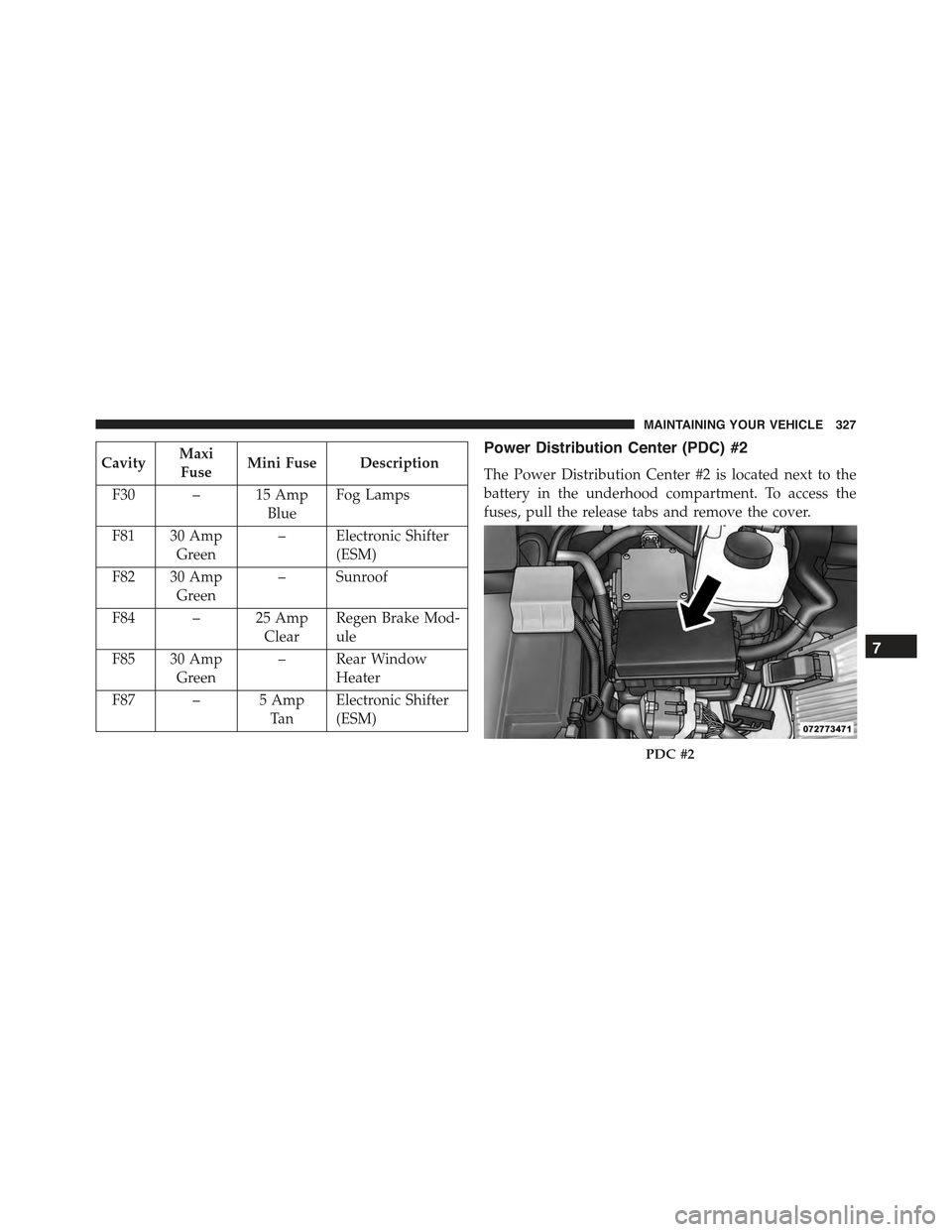
Power Distribution Center (PDC) #2
The Power Distribution Center #2 is located next to the
battery in the underhood compartment. To access the
fuses, pull the release tabs and remove the cover.
PDC #2
7
MAINTAINING YOUR VEHICLE 327
Page 350 of 367
We appreciate that you have made a major investment
when you purchased the vehicle. An authorized dealer
has also made a major investment in facilities, tools, and
training to assure that you are absolutely delighted with
the ownership experience. You will be pleased with their
sincere efforts to resolve any warranty issues or related
concerns.
WARNING!
Engine exhaust (internal combustion engines only),
some of its constituents, and certain vehicle compo-
nents contain, or emit, chemicals known to the State
of California to cause cancer and birth defects, or
other reproductive harm. In addition, certain fluids
contained in vehicles and certain products of compo-
nent wear contain, or emit, chemicals known to the
State of California to cause cancer and birth defects,
or other reproductive harm.
WARRANTY INFORMATION
See the Warranty Information Booklet, located on the
DVD, for the terms and provisions of FIAT Group
Automobiles warranties applicable to this vehicle and
market.
REPORTING SAFETY DEFECTS
In The 50 United States And Washington, D.C.
If you believe that your vehicle has a defect that could
cause a crash or cause injury or death, you should
immediately inform the National Highway Traffic Safety
Administration (NHTSA) in addition to notifying the
manufacturer.
If NHTSA receives similar complaints, it may open an
investigation, and if it finds that a safety defect exists in
a group of vehicles, it may order a recall and remedy
348 IF YOU NEED CONSUMER ASSISTANCE
Page 356 of 367

Adding Washer Fluid......................311
Air bag . . . . . . . . . . . . . . . . . . . . . . . . . . . . . . . . .59
Air Bag
Air bag Operation.......................62
Air Bag Warning Light....................72
Driver Knee Air Bag......................63
Enhanced Accident Response................69
Event Data Recorder (EDR).................75
Front Air Bag . . . . . . . . . . . . . . . . . . . . . . . . . . .59
If A Deployment Occurs...................68
Knee Impact Bolsters.....................63
Maintaining Your Air Bag System............74
Air bag Deployment........................59
Air bag Light.............................72
Air bag Maintenance........................74
Air Conditioner Maintenance.................308
Air Conditioning Refrigerant.................308
Air Conditioning System....................202
Air Pressure, Tires.........................249
Alterations/Modifications, Vehicle...............8
Anti-Lock Brake System (ABS)................228
Anti-Lock Warning Light....................158
Appearance Care.........................314
Automatic Dimming Mirror..................103
Automatic Temperature Control (ATC)..........202
Automatic Transaxle........................32
Automatic Transmission....................215
Gear Ranges...........................218
Battery.................................306
Keyless Transmitter Replacement (RKE)........37
Belts, Seat...............................96
Body Mechanism Lubrication.................309
B-Pillar Location..........................242
Brake Assist System.......................230
Brake Fluid.............................334
Brake, Parking...........................226
Brakes.................................312
354 INDEX