Page 283 of 400

CAUTION!(Continued)
•The use of fuel additives, which are now being
sold as octane enhancers, is not recommended.
Most of these products contain high concentrations
of methanol. Fuel system damage or vehicle perfor-
mance problems resulting from the use of such
fuels or additives is not the responsibility of the
manufacturer and may void or not be covered
under the New Vehicle Limited Warranty.
NOTE:Intentional tampering with the emissions control
system can result in civil penalties being assessed against
you.
Carbon Monoxide Warnings
WARNING!
Carbon monoxide (CO) in exhaust gases is deadly.
Follow the precautions below to prevent carbon
monoxide poisoning:
•Do not inhale exhaust gases. They contain carbon
monoxide, a colorless and odorless gas, which can
kill. Never run the engine in a closed area, such as
a garage, and never sit in a parked vehicle with the
engine running for an extended period. If the
vehicle is stopped in an open area with the engine
running for more than a short period, adjust the
ventilation system to force fresh, outside air into
the vehicle.
(Continued)
5
STARTING AND OPERATING 281
Page 284 of 400

WARNING!(Continued)
•Guard against carbon monoxide with proper main-
tenance. Have the exhaust system inspected every
time the vehicle is raised. Have any abnormal
conditions repaired promptly. Until repaired, drive
with all side windows fully open.
•Keep the trunk closed when driving your vehicle to
prevent carbon monoxide and other poisonous ex-
haust gases from entering the vehicle.
ADDING FUEL
1. Press the fuel filler door release switch (located in the
driver’s door map pocket).
2. Open the fuel filler door.
NOTE:In certain cold conditions, ice may prevent the
fuel door from opening. If this occurs, lightly push on the
fuel door to break the ice buildup and re-release the fuel
door using the inside release button. Do not pry on the
door.
3. There is no fuel filler cap. A flapper door inside the
pipe seals the system.
4. Insert the fuel nozzle fully into the filler pipe – the
nozzle opens and holds the flapper door while refuel-
ing.
NOTE:Only the correct size nozzle opens the latches
allowing the flapper door to open.
5. Fill the vehicle with fuel – when the fuel nozzle
“clicks” or shuts off the fuel tank is full.
6. Remove the fuel nozzle and close the fuel door.
282 STARTING AND OPERATING
Page 285 of 400
NOTE:A funnel is provided (located in the trunk in the
spare tire area) to open the flapper door to allow for
emergency refueling with a gas can.
CAUTION!
To avoid fuel spillage and overfilling, do not “top
off” the fuel tank after filling.
WARNING!
•Never have any smoking materials lit in or near the
vehicle when the fuel door is open or the tank is
being filled.
•Never add fuel when the engine is running. This is
in violation of most state and federal fire regula-
tions and may cause the “Malfunction Indicator
Light” to turn on.
•A fire may result if fuel is pumped into a portable
container that is inside of a vehicle. You could be
burned. Always place fuel containers on the
ground while filling.
5
STARTING AND OPERATING 283
Page 286 of 400
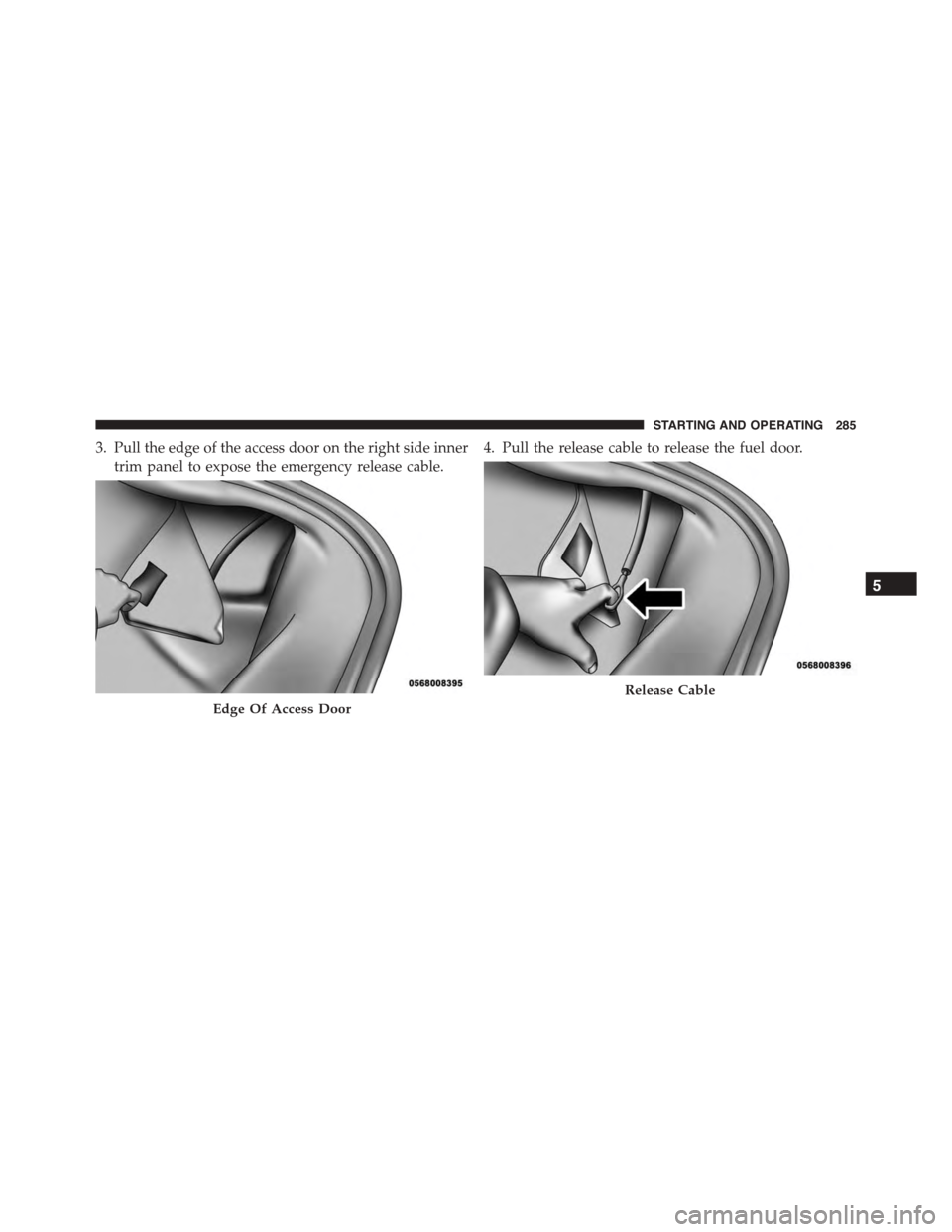
Emergency Fuel Filler Door Release
If you are unable to open the fuel filler door, use the fuel
filler door emergency release procedure by following the
proceeding steps.
1. Open the liftgate.
2. Locate the carpet access door (on the right side inner
trim panel of the trunk).
Carpet Access Door
284 STARTING AND OPERATING
Page 287 of 400
3. Pull the edge of the access door on the right side inner
trim panel to expose the emergency release cable.
4. Pull the release cable to release the fuel door.
Edge Of Access Door
Release Cable
5
STARTING AND OPERATING 285
Page 288 of 400
5. Return the release cable to the original position (inside
the inner trim panel) and push the carpet back into the
original position.
TRAILER TOWING
Trailer towing with this vehicle is not recommended.
Fuel Door Open
Carpet Into Original Position
286 STARTING AND OPERATING
Page 305 of 400

4. Clean any remaining sealant from the Tire Service Kit
housing.
5. Position the new Sealant Bottle (1) in the housing so
that the Sealant Hose (6) aligns with the hose slot in
the front of the housing. Push the bottle into the
housing. An audible click will be heard indicating the
bottle is locked into place.
6. Verify that the cap is installed on the fitting at the end
of the Sealant Hose (6) and return the hose to its
storage area (located on the bottom of the air pump).
7. Return the Tire Service Kit to its storage location in the
vehicle.
JUMP-STARTING PROCEDURES
WARNING!
•Take care to avoid the radiator cooling fan when-
ever the hood is raised. It can start anytime the
ignition switch is ON. You can be hurt by the fan.
•Do not attempt to push or tow your vehicle to get it
started. Unburned fuel could enter the catalytic
converter and once the engine has started, ignite
and damage the converter and vehicle. If the ve-
hicle has a discharged battery, booster cables may
be used to obtain a start from another vehicle. This
type of start can be dangerous if done improperly,
so follow this procedure carefully.
•Wear eye protection and remove any metal jewelry
such as watch bands or bracelets that might make
an inadvertent electrical contact. You could be
seriously injured.
6
WHAT TO DO IN EMERGENCIES 303
Page 314 of 400

ONBOARD DIAGNOSTIC SYSTEM (OBD II)
To meet new government regulations and promote
cleaner air, your vehicle is equipped with a sophisticated
onboard diagnostic system called OBD II. This system
monitors the performance of the emissions and engine
control systems. When these systems are operating prop-
erly, your vehicle will provide excellent performance and
fuel economy, as well as engine emissions well within
current government regulations.
If any of these systems require service, the OBD II system
will turn on the Malfunction Indicator Light. It will also
store diagnostic codes and other information to assist
your service technician in making repairs. Although your
vehicle will usually be drivable and not need towing, see
your authorized dealer for service as soon as possible.
CAUTION!
Prolonged driving with the light on could cause
further damage to the emission control system. It
could also affect fuel economy and driveability. The
vehicle must be serviced before any state emissions
tests can be performed.
If the light is flashing, severe catalytic converter damage
and power loss will soon occur. Immediate service is
required.
EMISSIONS INSPECTION AND MAINTENANCE
PROGRAMS
In some localities, it may be a legal requirement to pass
an inspection of your vehicle’s emissions control system.
Failure to pass could prevent vehicle registration.
For states that require an Inspection and Mainte-
nance (I/M), this check verifies the “Malfunction
312 MAINTAINING YOUR VEHICLE