Page 43 of 400
Pregnant women should wear the lap part of the seat belt
across the thighs and as snug across the hips as possible.
Keep the seat belt low so that it does not come across the
abdomen. That way the strong bones of the hips will take
the force if there is a collision.
Seat Belt Pretensioner
The front seat belt system is equipped with pretensioning
devices that are designed to remove slack from the seat
belt in the event of a collision. These devices may
improve the performance of the seat belt by removing
slack from the seat belt early in a collision. Pretensioners
work for all size occupants, including those in child
restraints.
NOTE:These devices are not a substitute for proper seat
belt placement by the occupant. The seat belt still must be
worn snugly and positioned properly.
The pretensioners are triggered by the Occupant Re-
straint Controller (ORC). Like the air bags, the preten-
sioners are single use items. A deployed pretensioner or
a deployed air bag must be replaced immediately.
Energy Management Feature
This vehicle has a seat belt system with an Energy
Management feature in the front seating positions that
may help further reduce the risk of injury in the event of
a collision. This seat belt system has a retractor assembly
that is designed to release webbing in a controlled
manner.
Automatic Locking Retractor (ALR) — If Equipped
The seat belt in the passenger seating position is
equipped with a switchable Automatic Locking Retractor
(ALR) which is used to secure a child restraint system.
Refer to “Installing Child Restraints Using The Vehicle
2
THINGS TO KNOW BEFORE STARTING YOUR VEHICLE 41
Page 73 of 400
Every state in the United States, and every Canadian
province, requires that small children ride in proper
restraint systems. This is the law, and you can be pros-
ecuted for ignoring it.
Children 12 years or younger should ride properly
buckled up in a rear seat, if available. According to crash
statistics, children are safer when properly restrained in
the rear seats rather than in the front.
WARNING!
In a collision, an unrestrained child can become a
projectile inside the vehicle. The force required to
hold even an infant on your lap could become so
great that you could not hold the child, no matter
how strong you are. The child and others could be
badly injured. Any child riding in your vehicle
should be in a proper restraint for the child’s size.
There are different sizes and types of restraints for
children from newborn size to the child almost large
enough for an adult seat belt. Always check the child seat
Owner ’s Manual to make sure you have the correct seat
for your child. Carefully read and follow all the instruc-
tions and warnings in the child restraint Owner ’s Manual
and on all the labels attached to the child restraint.
Before buying any restraint system, make sure that it has
a label certifying that it meets all applicable Safety
Standards. You should also make sure that you can install
it in the vehicle where you will use it.
NOTE:
•For additional information, refer to www.seatcheck.org
or call 1–866–SEATCHECK (732–8243). Canadian resi-
dents should refer to Transport Canada’s website for
additional information:
•www.tc.gc.ca/eng/roadsafety/
safedrivers-childsafety-index-53.htm
2
THINGS TO KNOW BEFORE STARTING YOUR VEHICLE 71
Page 77 of 400

WARNING!(Continued)
•When your child restraint is not in use, secure it in
the vehicle with the seat belt or LATCH anchor-
ages, or remove it from the vehicle. Do not leave it
loose in the vehicle. In a sudden stop or accident, it
could strike the occupants or seatbacks and cause
serious personal injury.
Children Too Large For Booster Seats
Children who are large enough to wear the shoulder belt
comfortably, and whose legs are long enough to bend
over the front of the seat when their back is against the
seatback, should use the seat belt in a rear seat. Use this
simple 5-step test to decide whether the child can use the
vehicle’s seat belt alone:
1. Can the child sit all the way back against the back of
the vehicle seat?
2. Do the child’s knees bend comfortably over the front
of the vehicle seat – while they are still sitting all the
way back?
3. Does the shoulder belt cross the child’s shoulder
between their neck and arm?
4. Is the lap part of the seat belt as low as possible,
touching the child’s thighs and not their stomach?
5. Can the child stay seated like this for the whole trip?
If the answer to any of these questions was “no,” then the
child still needs to use a booster seat in this vehicle. If the
child is using the lap/shoulder belt, check seat belt fit
periodically and make sure the seat belt buckle is latched.
A child’s squirming or slouching can move the seat belt
out of position. If the shoulder belt contacts the face or
neck, move the child closer to the center of the vehicle, or
use a booster seat to position the seat belt on the child
correctly.
2
THINGS TO KNOW BEFORE STARTING YOUR VEHICLE 75
Page 83 of 400

8. Remove slack from the tether strap according to the
child restraint manufacturer ’s directions.
WARNING!
An incorrectly anchored tether strap could lead to
increased head motion and possible injury to the
child. Use only the anchorage position directly be-
hind the child seat to secure a child restraint top
tether strap.
Transporting Pets
Air Bags deploying in the front seat could harm your pet.
An unrestrained pet will be thrown about and possibly
injured, or injure a passenger during panic braking or in
a collision.
Pets should be restrained in the rear seat in pet harnesses
or pet carriers that are secured by seat belts.
BREAK-IN RECOMMENDATIONS
A long break-in period is not required for the drivetrain
(engine, transmission, and rear axle) in your new vehicle.
Following these few simple guidelines is all that is
necessary for a good break-in.
For the first 500 miles (800 km):
•Keep your vehicle speed below the legal, posted speed
limit and your engine speed below 4,000 RPM.
•Avoid driving at a constant speed, either fast or slow,
for long periods.
•Do not make any full throttle starts and avoid full
throttle acceleration.
•Use the proper gear for your speed range.
•Wait until the engine has reached normal operating
temperature before driving at the recommended maxi-
mum break-in speed.
2
THINGS TO KNOW BEFORE STARTING YOUR VEHICLE 81
Page 86 of 400

Front seat belt assemblies must be replaced after a
collision. Seat belt assemblies must be replaced after a
collision if they have been damaged (i.e., bent retractor,
torn webbing, etc.). If there is any question regarding belt
or retractor condition, replace the belt.
Air Bag Warning Light
The light should come on and remain on for four to eight
seconds for a bulb check when the ignition is first cycled
to ON. If the light is not lit during starting, see your
authorized dealer. If the light stays on, flickers, or comes
on while driving, have the system checked by an autho-
rized dealer.
Defroster
Check operation by selecting the defrost mode and place
the blower control on high speed. You should be able to
feel the air directed against the windshield. See your
authorized dealer for service if your defroster is inoper-
able.
Floor Mat Safety Information
Always use floor mats designed to fit the foot well of
your vehicle. Use only floor mats that leave the pedal
area unobstructed and that are firmly secured so that
they cannot slip out of position and interfere with the
pedals or impair safe operation of your vehicle in other
ways.
Periodic Safety Checks You Should Make Outside
The Vehicle
Tires
Examine tires for excessive tread wear and uneven wear
patterns. Check for stones, nails, glass, or other objects
lodged in the tread. Inspect the tread and sidewall for
cuts and cracks. Check the wheel nuts for tightness.
Check the tires for proper pressure.
84 THINGS TO KNOW BEFORE STARTING YOUR VEHICLE
Page 91 of 400
▫Canadian/Gate Operator Programming......125
▫Using HomeLink®....................127
▫Security............................127
▫Troubleshooting Tips...................127
▫General Information....................129
!ELECTRICAL POWER OUTLETS...........129
▫Auxiliary Jumper Harness...............132
!CUPHOLDERS — IF EQUIPPED...........134
!STORAGE............................134
▫Glove Compartment...................134
▫Console Features......................135
▫Door Storage.........................137
!REAR WINDOW FEATURES..............138
▫Rear Window Defroster.................138
3
UNDERSTANDING THE FEATURES OF YOUR VEHICLE 89
Page 101 of 400
CAUTION!
Do not place any article under a power seat or
impede its ability to move as it may cause damage to
the seat controls. Seat travel may become limited if
movement is stopped by an obstruction in the seat’s
path.
Non-Adjustable Head Restraints
The non-adjustable head restraints are form fitted into
the upper structure of the seatback and are designed to
reduce the risk of injury by restricting head movement in
the event of a rear impact. The seatback should be
properly adjusted to an upright position where the head
restraint is positioned as close as possible to the back of
your head.
WARNING!
Be certain that the seatback is locked securely into
position. Otherwise, the seat will not provide the
proper stability for passengers. An improperly
latched seatback could cause serious injury.
3
UNDERSTANDING THE FEATURES OF YOUR VEHICLE 99
Page 103 of 400
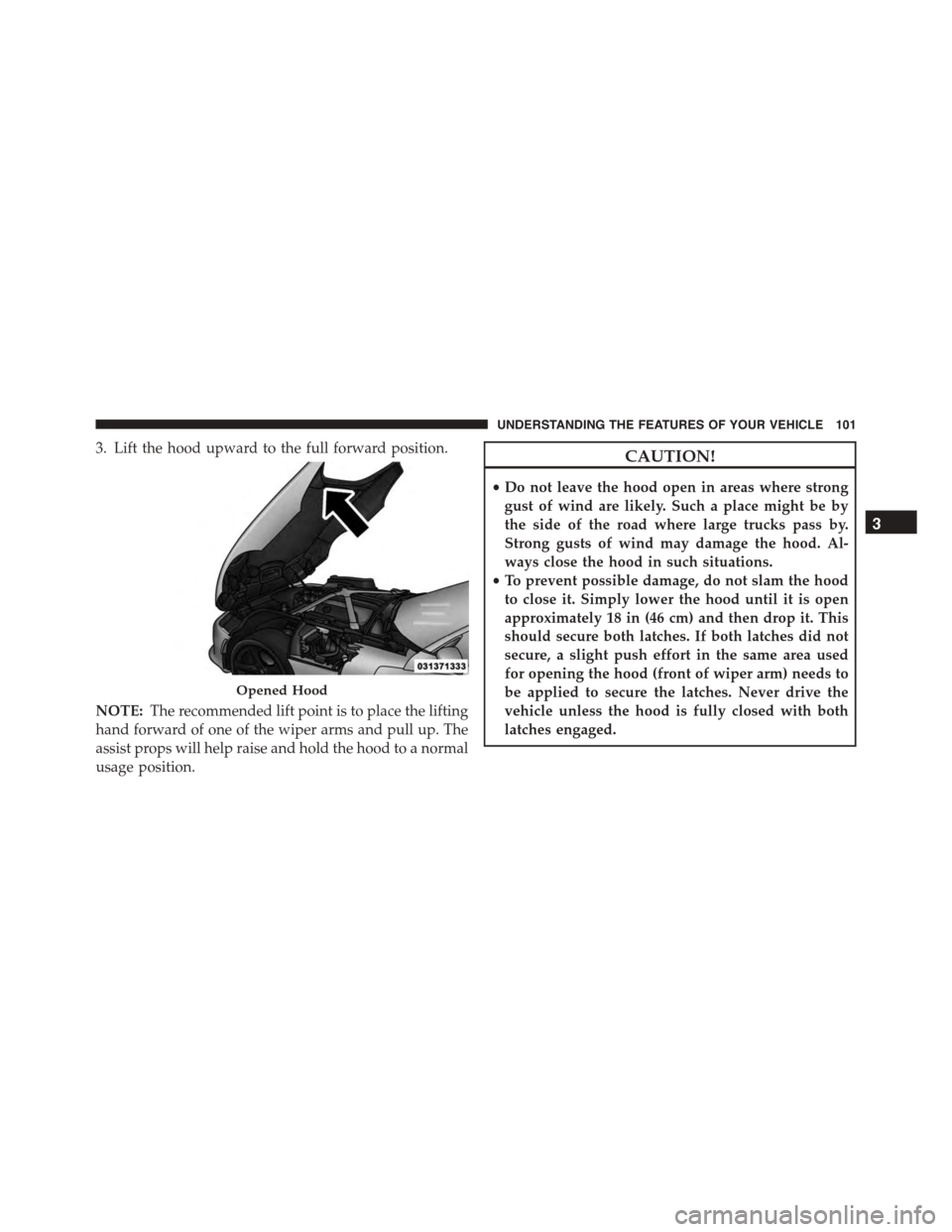
3. Lift the hood upward to the full forward position.
NOTE:The recommended lift point is to place the lifting
hand forward of one of the wiper arms and pull up. The
assist props will help raise and hold the hood to a normal
usage position.
CAUTION!
•Do not leave the hood open in areas where strong
gust of wind are likely. Such a place might be by
the side of the road where large trucks pass by.
Strong gusts of wind may damage the hood. Al-
ways close the hood in such situations.
•To prevent possible damage, do not slam the hood
to close it. Simply lower the hood until it is open
approximately 18 in (46 cm) and then drop it. This
should secure both latches. If both latches did not
secure, a slight push effort in the same area used
for opening the hood (front of wiper arm) needs to
be applied to secure the latches. Never drive the
vehicle unless the hood is fully closed with both
latches engaged.
Opened Hood
3
UNDERSTANDING THE FEATURES OF YOUR VEHICLE 101