Page 72 of 689

On the other hand, depending on the type and location of
impact, Advanced Front Air Bags may deploy in crashes
with little vehicle front-end damage but that produce a
severe initial deceleration.
Because air bag sensors measure vehicle deceleration
over time, vehicle speed and damage by themselves are
not good indicators of whether or not an air bag should
have deployed.
Seat belts are necessary for your protection in all colli-
sions, and also are needed to help keep you in position,
away from an inflating air bag.
When the ORC detects a collision requiring the Ad-
vanced Front Air Bags, it signals the inflator units. A large
quantity of non-toxic gas is generated to inflate the
Advanced Front Air Bags.
The steering wheel hub trim cover and the upper right
side of the instrument panel separate and fold out of the
way as the air bags inflate to their full size. The Advanced
Front Air Bags fully inflate in less time than it takes to
blink your eyes. The air bags then quickly deflate while
helping to restrain the driver and front passenger.
Knee Impact Bolsters
The Knee Impact Bolsters help protect the knees of the
driver and front passenger, and position the front occu-
pants for improved interaction with the Advanced Front
Air Bags.
WARNING!
•Do not drill, cut, or tamper with the knee impact
bolsters in any way.
•Do not mount any accessories to the knee impact
bolsters such as alarm lights, stereos, citizen band
radios, etc.
70 THINGS TO KNOW BEFORE STARTING YOUR VEHICLE
Page 514 of 689

CAUTION!
Only vehicles with the E-85 fuel filler door label can
operate on E-85.
Ethanol Fuel (E-85)
E-85 is a mixture of approximately 85% ethanol and 15%
unleaded gasoline.
WARNING!
Ethanol vapors are extremely flammable and could
cause serious personal injury. Never have any smok-
ing materials lit or products that can cause spark in or
near the vehicle when removing the fuel filler tube
cap (gas cap) or filling the tank. Do not use E-85 as a
cleaning agent and never use it near an open flame.
Fuel Requirements
If your vehicle is E-85 compatible, it will operate on
unleaded gasoline with any octane rating, or solely E-85
fuel, or any mixture of these fuels.
For best results, avoid fueling patterns alternating
between E-85 and unleaded gasoline.
When switching fuel types:
•Add 5 gallons (19 Liters) or more when refueling.
•Drive the vehicle immediately after refueling for at
least 5 miles (8 km).
Observing these precautions will avoid possible hard
starting and/or driveability problems during warm up.
512 STARTING AND OPERATING
Page 615 of 689

•Check the coolant freeze point in the radiator and in
the coolant expansion bottle. If engine coolant (anti-
freeze) needs to be added, the contents of the coolant
expansion bottle must also be protected against freez-
ing.
•If frequent engine coolant (antifreeze) additions are
required, the cooling system should be pressure tested
for leaks.
•Maintain engine coolant (antifreeze) concentration at a
minimum of 50% OAT coolant (conforming to
MS.90032) and distilled water for proper corrosion
protection of your engine which contains aluminum
components.
•Make sure that the coolant expansion bottle overflow
hoses are not kinked or obstructed.
•Keep the front of the radiator clean. If your vehicle is
equipped with air conditioning, keep the front of the
condenser clean.
•Do not change the thermostat for Summer or Winter
operation. If replacement is ever necessary, install
ONLY the correct type thermostat. Other designs may
result in unsatisfactory engine coolant (antifreeze)
performance, poor gas mileage, and increased emis-
sions.
Brake System
In order to assure brake system performance, all brake
system components should be inspected periodically.
Refer to the “Maintenance Schedule” for the proper
maintenance intervals.
WARNING!
Riding the brakes can lead to brake failure and
possibly a collision. Driving with your foot resting or
riding on the brake pedal can result in abnormally
(Continued)
7
MAINTAINING YOUR VEHICLE 613
Page 681 of 689
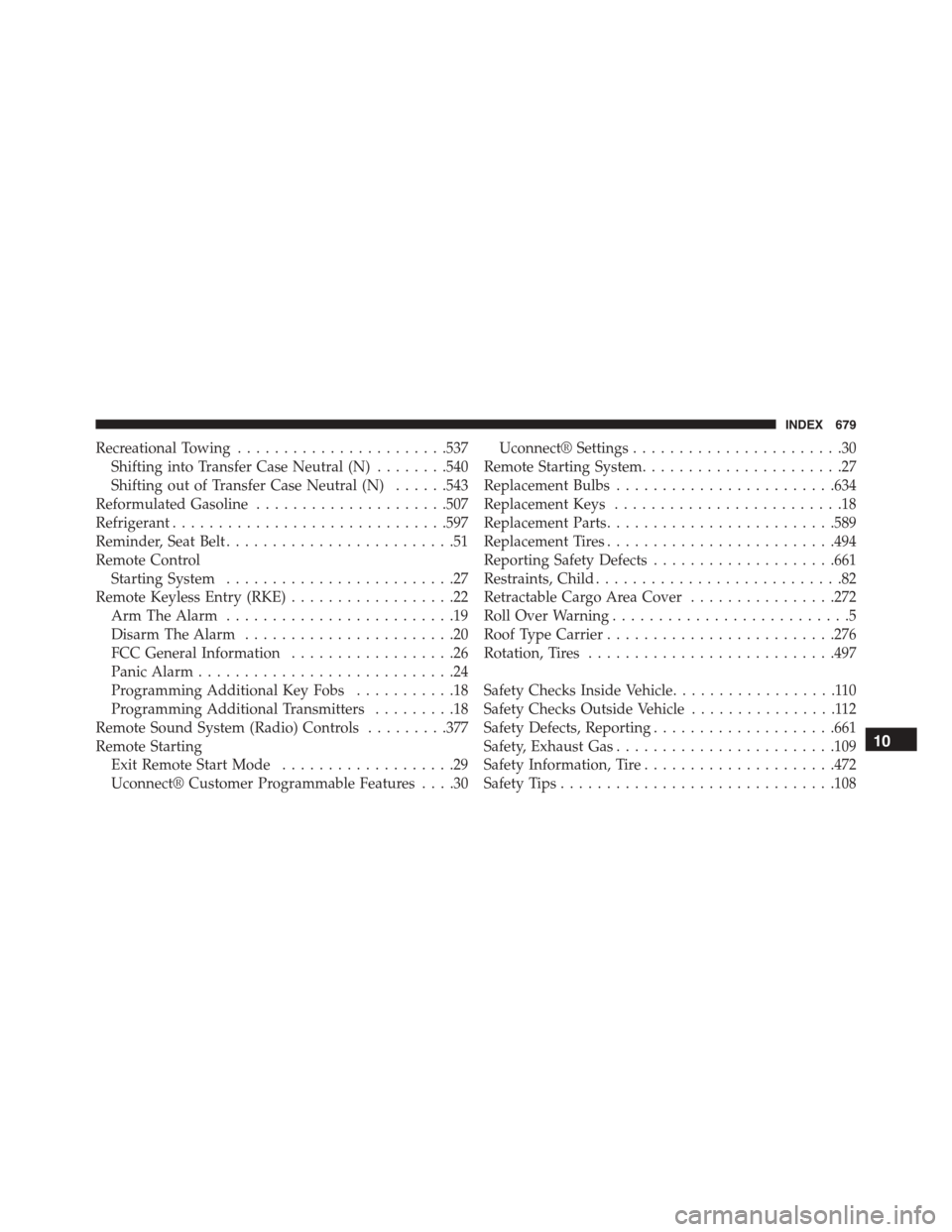
Recreational Towing.......................537
Shifting into Transfer Case Neutral (N)........540
Shifting out of Transfer Case Neutral (N)......543
Reformulated Gasoline.....................507
Refrigerant..............................597
Reminder, Seat Belt.........................51
Remote Control
Starting System.........................27
Remote Keyless Entry (RKE)..................22
Arm The Alarm.........................19
Disarm The Alarm.......................20
FCC General Information..................26
Panic Alarm............................24
Programming Additional Key Fobs...........18
Programming Additional Transmitters.........18
Remote Sound System (Radio) Controls.........377
Remote Starting
Exit Remote Start Mode...................29
Uconnect® Customer Programmable Features....30
Uconnect® Settings.......................30
Remote Starting System......................27
Replacement Bulbs........................634
Replacement Keys.........................18
Replacement Parts.........................589
Replacement Tires.........................494
Reporting Safety Defects....................661
Restraints, Child...........................82
Retractable Cargo Area Cover................272
Roll Over Warning..........................5
Roof Type Carrier.........................276
Rotation, Tires...........................497
Safety Checks Inside Vehicle..................110
Safety Checks Outside Vehicle................112
Safety Defects, Reporting....................661
Safety, Exhaust Gas........................109
Safety Information, Tire.....................472
Safety Tips..............................108
10
INDEX 679