Page 587 of 689
ENGINE COMPARTMENT — 3.6L
1 — Power Distribution Center (Fuses)6 — Air Cleaner Filter2 — Engine Oil Dipstick7 — Washer Fluid Reservoir3 — Engine Oil Fill8 — Coolant Pressure Cap (Radiator)4—BrakeFluidReservoir9—EngineCoolantReservoir5 — Power Steering Fluid Reservoir
7
MAINTAINING YOUR VEHICLE 585
Page 588 of 689
ENGINE COMPARTMENT — 5.7L
1 — Remote Jump Start Terminals6 — Washer Fluid Reservoir2—EngineOilFill7—EngineOilDipstick3 — Air Cleaner Filter8 — Coolant Pressure Cap4—BrakeFluidReservoir9—EngineCoolantReservoir5 — Power Steering Fluid Reservoir10 — Power Distribution Center (Fuses)
586 MAINTAINING YOUR VEHICLE
Page 593 of 689

CAUTION!(Continued)
•Your vehicle has been built with improved fluids
that protect the performance and durability of your
vehicle and also allow extended maintenance inter-
vals. Do not use chemical flushes in these compo-
nents as the chemicals can damage your engine,
transmission, power steering or air conditioning.
Such damage is not covered by the New Vehicle
Limited Warranty. If a flush is needed because of
component malfunction, use only the specified
fluid for the flushing procedure.
Engine Oil
Checking Oil Level
To assure proper lubrication of your vehicle’s engine, the
engine oil must be maintained at the correct level. Check
the oil level at regular intervals, such as every fuel stop.
The best time to check the engine oil level is about five
minutes after a fully warmed up engine is shut off.
Checking the oil while the vehicle is on level ground will
improve the accuracy of the oil level readings. Always
maintain the oil level within the SAFE zone on the
dipstick. Adding one quart of oil when the reading is at
the bottom of the SAFE zone will result in a reading at the
top of the safe zone on these engines.
CAUTION!
Overfilling or underfilling the crankcase will cause
aeration or loss of oil pressure. This could damage
your engine.
7
MAINTAINING YOUR VEHICLE 591
Page 628 of 689
WARNING!(Continued)
•If a general protection fuse for safety systems (air
bag system, braking system), power unit systems
(engine system, gearbox system) or steering system
blows, contact an authorized dealer.
Power Distribution Center
The Power Distribution Center is located in the engine
compartment near the battery. This center contains car-
tridge fuses, micro fuses, relays, and circuit breakers. A
description of each fuse and component may be stamped
on the inside cover, otherwise the cavity number of each
fuse is stamped on the inside cover that corresponds to
the following chart.
Cavity Cartridge Fuse Micro FuseDescription
F0360 Amp Yellow–Radiator Fan
F0540 Amp Green–Compressor for Air Suspension - If Equipped
Power Distribution Center
626 MAINTAINING YOUR VEHICLE
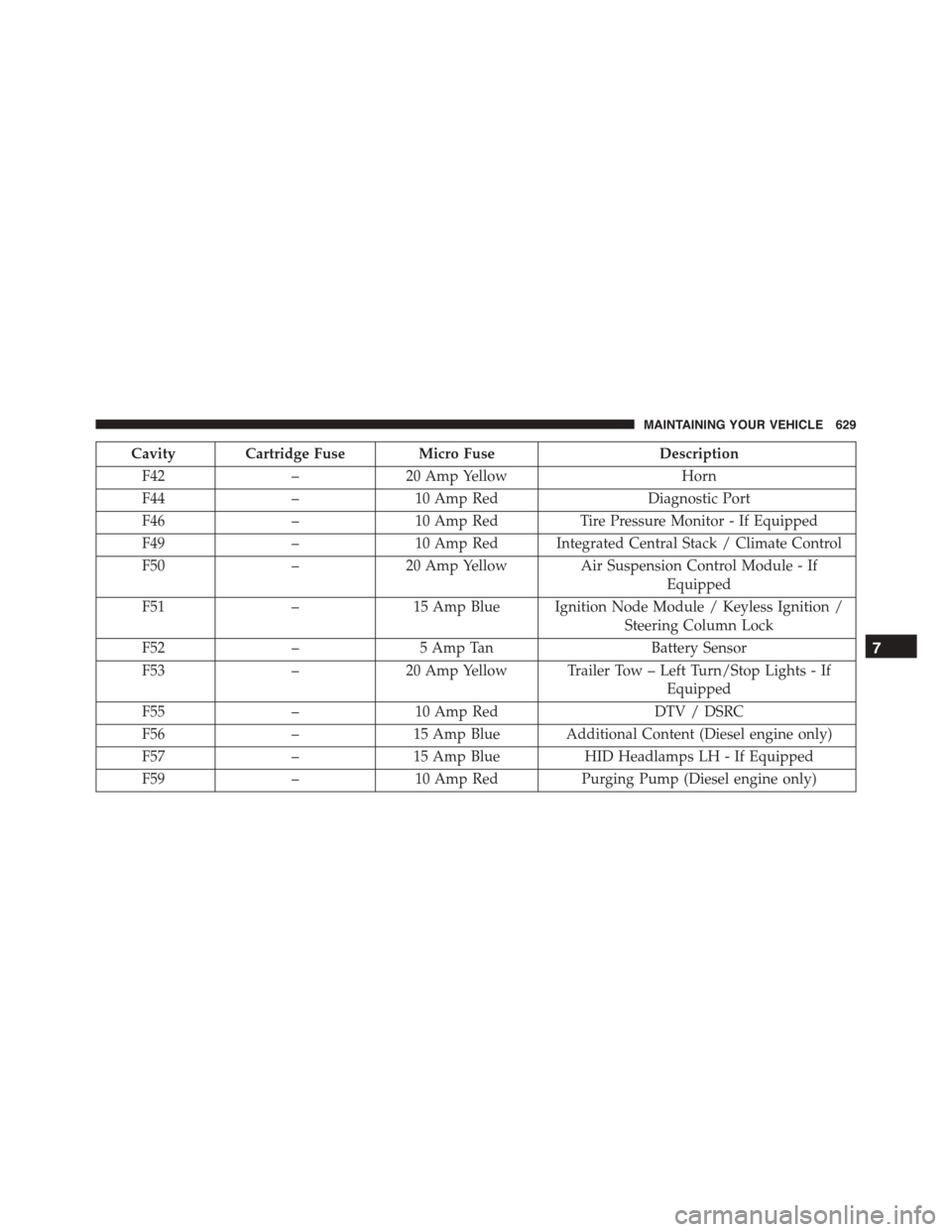
Page 631 of 689
Cavity Cartridge Fuse Micro FuseDescription
F42–20 Amp YellowHorn
F44–10 Amp RedDiagnostic Port
F46–10 Amp RedTire Pressure Monitor - If Equipped
F49–10 Amp Red Integrated Central Stack / Climate Control
F50–20 Amp Yellow Air Suspension Control Module - If
Equipped
F51–15 Amp Blue Ignition Node Module / Keyless Ignition /
Steering Column Lock
F52–5 Amp TanBattery Sensor
F53–20 Amp Yellow Trailer Tow – Left Turn/Stop Lights - If
Equipped
F55–10 Amp RedDTV / DSRC
F56–15 Amp Blue Additional Content (Diesel engine only)
F57–15 Amp BlueHID Headlamps LH - If Equipped
F59–10 Amp RedPurging Pump (Diesel engine only)
7
MAINTAINING YOUR VEHICLE 629
Page 633 of 689
Cavity Cartridge Fuse Micro FuseDescription
F74–20 Amp YellowBrake Vacuum Pump - If Equipped
F76–10 Amp Red Anti-lock Brakes/Electronic Stability Control
F77–10 Amp Red Drivetrain Control Module/Front Axle Dis-
connect Module
F78–10 Amp Red Engine Control Module / Electric Power
Steering - If Equipped
F80–10 Amp Red Universal Garage Door Opener / Compass /
Anti-Intrusion Module
F81–20 Amp Yellow Trailer Tow Right Turn/Stop Lights
F82–10 Amp Red Steering Column Control Module/ Cruise
Control
F83–10 Amp RedFuel Door
F84–15 Amp BlueSwitch Bank/Instrument Cluster
F85–10 Amp RedAirbag Module
F86–10 Amp RedAirbag Module
7
MAINTAINING YOUR VEHICLE 631
Page 634 of 689
Cavity Cartridge Fuse Micro FuseDescription
F87–10 Amp Red Air Suspension – If Equipped / Trailer Tow
/ Steering Column Control Module
F88–15 Amp BlueInstrument Panel Cluster
F90/F91–20 Amp Yellow Power Outlet (Rear seats) Selectable
F92–10 Amp RedRear Console Lamp - If Equipped
F93–20 Amp YellowCigar Lighter
F94–10 Amp RedShifter / Transfer Case Module
F95–10 Amp RedRear Camera / ParkSense®
F96–10 Amp Red Rear Seat Heater Switch / Flashlamp Char-
ger - If Equipped
F97–20 Amp Yellow Rear Heated Seats & Heated Steering Wheel
- If Equipped
F98–20 Amp YellowFront Heated Seats - If Equipped
F99–10 Amp Red Climate Control / Driver Assistance Systems
Module
632 MAINTAINING YOUR VEHICLE
Page 639 of 689

WARNING!
A transient high voltage occurs at the bulb sockets of
High Intensity Discharge (HID) headlamps when the
headlamp switch is turned ON. It may cause serious
electrical shock or electrocution if not serviced prop-
erly. See your authorized dealer for service.
NOTE:On vehicles equipped with High Intensity Dis-
charge (HID) headlamps, when the headlamps are
turned on, there is a blue hue to the lamps. This dimin-
ishes and becomes more white after approximately 10
seconds, as the system charges.
Bi-Halogen Headlamps — If Equipped
1. Turn the steering wheel to the left to replace the bulb
from the right hand lamp, or to the right to replace the
bulb from the left hand lamp.
2. Turn the access cap located on the wheel liner coun-
terclockwise to remove from liner.
3. Locate the headlamp bulb access cap through the
opening in the wheel liner.
4. Firmly grasp the access cap and rotate counterclock-
wise to remove lamp housing.
5. Firmly grasp the low/high beam bulb and connector
assembly and rotate counterclockwise to remove from
housing.
6. Disconnect the electrical connector and then connect
the replacement bulb.
7. Install the bulb and connector assembly into the
headlamp housing and rotate clockwise to lock in
place.
8. Install the bulb access cap in the headlamp housing
and rotate clockwise to lock it in place.
7
MAINTAINING YOUR VEHICLE 637