2015 DODGE CHARGER engine overheat
[x] Cancel search: engine overheatPage 524 of 638
least amount of accelerator pedal pressure that will
maintain the rocking motion, without spinning the
wheels or racing the engine.
NOTE:Shifts between DRIVE and REVERSE can only be
achieved at wheel speeds of 5 mph (8 km/h) or less.
Whenever the transmission remains in NEUTRAL for
more than 2 seconds, you must push the brake pedal to
engage DRIVE or REVERSE.
CAUTION!
Racing the engine or spinning the wheels may lead to
transmission overheating and failure. Allow the en-
gine to idle with the transmission in NEUTRAL for at
least one minute after every five rocking-motion
cycles. This will minimize overheating and reduce
the risk of transmission failure during prolonged
efforts to free a stuck vehicle.
NOTE:Push the#ESC Off#switch, to place the Electronic
Stability Control (ESC) system in#Partial Off#mode,
before rocking the vehicle. Refer to “Electronic Brake
Control” in “Starting And Operating” for further infor-
mation. Once the vehicle has been freed, push the#ESC
Off#switch again to restore#ESC On#mode.
CAUTION!
•When “rocking” a stuck vehicle by shifting be-
tween DRIVE and REVERSE, do not spin the
wheels faster than 15 mph (24 km/h), or drivetrain
damage may result.
•Revving the engine or spinning the wheels too fast
may lead to transmission overheating and failure.
It can also damage the tires. Do not spin the wheels
above 30 mph (48 km/h) while in gear (no trans-
mission shifting occurring).
522 WHAT TO DO IN EMERGENCIES
Page 553 of 638
WARNING!(Continued)
•A hot exhaust system can start a fire if you park
over materials that can burn. Such materials might
be grass or leaves coming into contact with your
exhaust system. Do not park or operate your ve-
hicle in areas where your exhaust system can con-
tact anything that can burn.
CAUTION!
•The catalytic converter requires the use of un-
leaded fuel only. Leaded gasoline will destroy the
effectiveness of the catalyst as an emissions control
device and may seriously reduce engine perfor-
mance and cause serious damage to the engine.
(Continued)
CAUTION!(Continued)
•Damage to the catalytic converter can result if your
vehicle is not kept in proper operating condition.
In the event of engine malfunction, particularly
involving engine misfire or other apparent loss of
performance, have your vehicle serviced promptly.
Continued operation of your vehicle with a severe
malfunction could cause the converter to overheat,
resulting in possible damage to the converter and
vehicle.
Under normal operating conditions, the catalytic con-
verter will not require maintenance. However, it is im-
portant to keep the engine properly tuned to assure
proper catalyst operation and prevent possible catalyst
damage.
7
MAINTAINING YOUR VEHICLE 551
Page 554 of 638
NOTE:Intentional tampering with emissions control
systems can result in civil penalties being assessed
against you.
In unusual situations involving grossly malfunctioning
engine operation, a scorching odor may suggest severe
and abnormal catalyst overheating. If this occurs, stop
the vehicle, turn off the engine and allow it to cool.
Service, including a tune-up to manufacturer’s specifica-
tions, should be obtained immediately.
To minimize the possibility of catalytic converter damage:
•Do not shut off the engine or interrupt the ignition,
when the transmission is in gear and the vehicle is in
motion.
•Do not try to start the engine by pushing or towing the
vehicle.
•Do not idle the engine with any spark plug wires
disconnected or removed, such as when diagnostic
testing, or for prolonged periods during very rough
idle or malfunctioning operating conditions.
Cooling System
WARNING!
•When working near the radiator cooling fan, dis-
connect the fan motor lead or cycle the ignition
switch to the LOCK position. The fan is tempera-
ture controlled and can start at any time the igni-
tion switch is in the ON position.
•You or others can be badly burned by hot engine
coolant (antifreeze) or steam from your radiator. If
you see or hear steam coming from under the hood,
do not open the hood until the radiator has had
time to cool. Never try to open a cooling system
pressure cap when the radiator is hot.
552 MAINTAINING YOUR VEHICLE
Page 559 of 638
WARNING!
•Do not open hot engine cooling system. Never add
engine coolant (antifreeze) when the engine is
overheated. Do not loosen or remove the cap to cool
an overheated engine. Heat causes pressure to
build up in the cooling system. To prevent scalding
or injury, do not remove the pressure cap while the
system is hot or under pressure.
•Do not use a pressure cap other than the one
specified for your vehicle. Personal injury or en-
gine damage may result.
Disposal Of Used Engine Coolant
Used ethylene glycol-based engine coolant (antifreeze) is
a regulated substance requiring proper disposal. Check
with your local authorities to determine the disposal
rules for your community. To prevent ingestion by ani-
mals or children, do not store ethylene glycol-based
engine coolant in open containers or allow it to remain in
puddles on the ground. If ingested by a child or pet, seek
emergency assistance immediately. Clean up any ground
spills immediately.
Coolant Level
The coolant bottle provides a quick visual method for
determining that the coolant level is adequate. With the
engine OFF and cold, the level of the engine coolant
(antifreeze) in the bottle should be between the ranges
indicated on the bottle.
The radiator normally remains completely full, so there is
no need to remove the radiator/coolant pressure cap
unless checking for engine coolant (antifreeze) freeze
point or replacing coolant. Advise your service attendant
of this. As long as the engine operating temperature is
satisfactory, the coolant bottle need only be checked once
a month.
7
MAINTAINING YOUR VEHICLE 557
Page 621 of 638

Brake Assist System.....................424
Traction Control System...................423
Electronic Power Distribution Center (Fuses)......572
Electronic Speed Control (Cruise Control)........174
Electronic Stability Control (ESC)..............425
Emergency Deck Lid Release..................45
Emergency, In Case of
Freeing Vehicle When Stuck................521
Jacking...............................498
Jump Starting..........................517
Overheating...........................495
Towing..............................526
Emergency Trunk Release....................45
Emission Control System Maintenance..........535
Engine.................................534
Air Cleaner...........................543
Block Heater..........................398
Break-In Recommendations.................96
Checking Oil Level......................538
Compartment..........................533
Compartment Identification................533
Coolant (Antifreeze).....................553
Cooling..............................552
Exhaust Gas Caution.....................98
Fails to Start...........................396
Flooded, Starting.......................396
Fuel Requirements......................464
Jump Starting..........................517
Oil . . . . . . . . . . . . . . . . . . . . . . . . . . . . . . . . ..538
Oil Filler Cap..........................541
Oil Selection...........................540
Oil Synthetic..........................542
Overheating...........................495
Starting..............................393
Temperature Gauge......................263
Engine Oil Viscosity.......................541
Engine Oil Viscosity Chart...................541
EnhancedAccident Response Feature............70
10
INDEX 619
Page 628 of 638
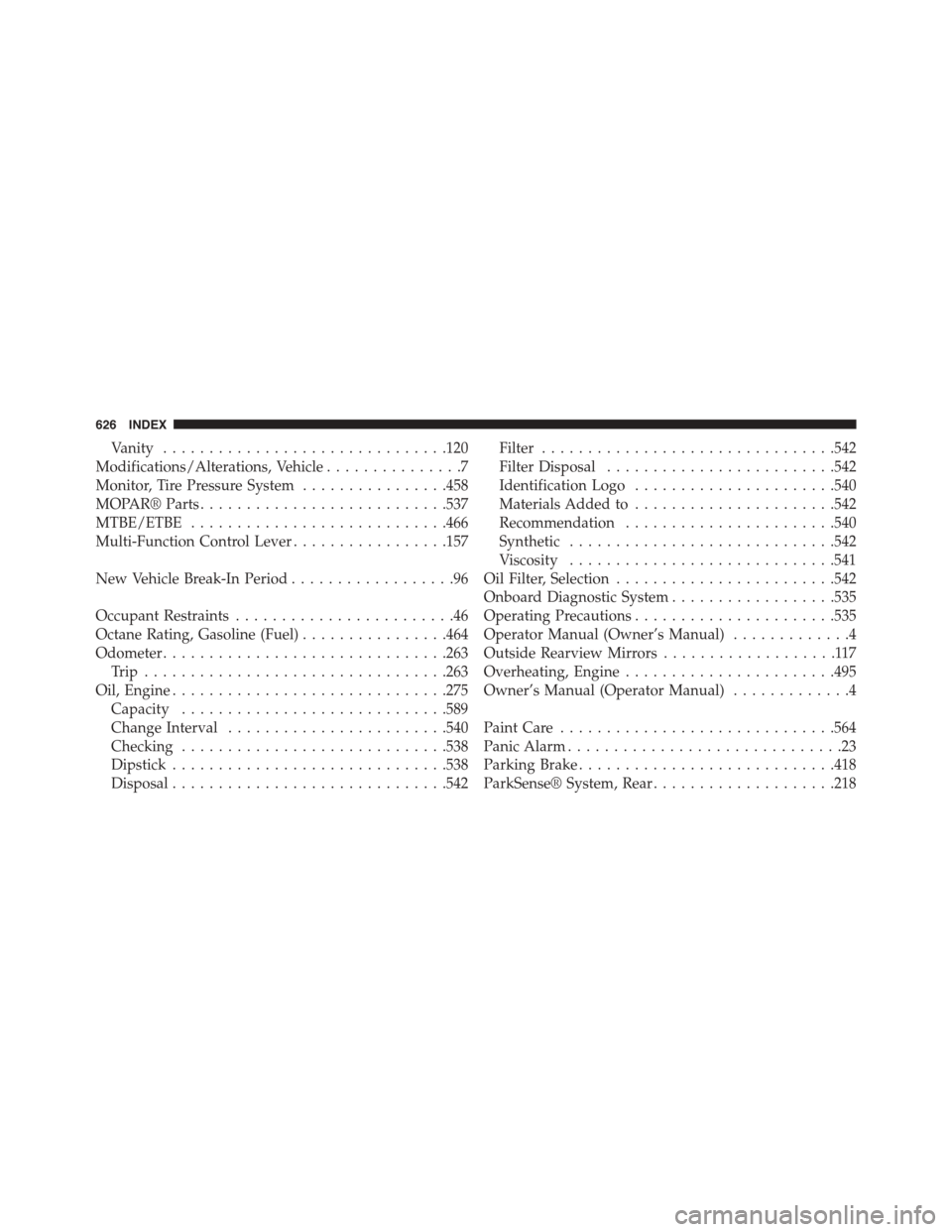
Vanity...............................120
Modifications/Alterations, Vehicle...............7
Monitor, Tire Pressure System................458
MOPAR® Parts...........................537
MTBE/ETBE............................466
Multi-Function Control Lever.................157
New Vehicle Break-In Period..................96
Occupant Restraints........................46
Octane Rating, Gasoline (Fuel)................464
Odometer...............................263
Tr i p . . . . . . . . . . . . . . . . . . . . . . . . . . . . . . . ..263
Oil, Engine..............................275
Capacity.............................589
Change Interval........................540
Checking.............................538
Dipstick..............................538
Disposal..............................542
Filter................................542
Filter Disposal.........................542
Identification Logo......................540
Materials Added to......................542
Recommendation.......................540
Synthetic.............................542
Viscosity.............................541
Oil Filter, Selection........................542
Onboard Diagnostic System..................535
Operating Precautions......................535
Operator Manual (Owner’s Manual).............4
Outside Rearview Mirrors...................117
Overheating, Engine.......................495
Owner’s Manual (Operator Manual).............4
Paint Care..............................564
Panic Alarm..............................23
Parking Brake............................418
ParkSense® System, Rear....................218
626 INDEX