Page 374 of 575

9. Keep the vehicle pointed straight.
Launch control will be active until the vehicle reaches
62 mph (100 km/h), at which point the ESC system will
return to its current ESC mode.
Launch control will abort before launch completion,
display “Launch Aborted” in the cluster under any the
following conditions:
•The accelerator pedal is released during launch.
• The ESC system detects that the vehicle is no longer
moving in a straight line.
• The “ESC OFF” button is pressed to change the system
to another mode.
NOTE: After launch control has been aborted, ESC will
return to its current ESC mode. Manual Transmission — If Equipped
Vehicles with a manual transmission have an adjustable
launch RPM controlled through the Uconnect® system.
Launch Control is only available when the following
procedure is followed:
1. Pressing the “LAUNCH” button on the center stack
switch bank.
NOTE: Pushing the SRT button on the center stack or
pressing the “SRT & Apps” button on the touchscreen are
two other options to access launch control features.
Please refer to “Uconnect® Settings” within your Own-
er ’s Manual on the DVD for further information.
2. Press the “Launch RPM Set-Up” button on the touch- screen. This screen will allow you to adjust your
launch RPM’s for optimum launch/traction.
3. Press the “Activate Launch Mode” button on the touchscreen.
372 STARTING AND OPERATING
Page 375 of 575

4. Make sure the vehicle is not moving.
5. Make sure the steering wheel is pointing straight.
6. Fully depress the clutch pedal and make sure thevehicle is in first gear.
7. While holding the clutch depressed, rapidly apply the accelerator pedal to wide open throttle. The engine
speed will hold at the pre-selected launch RPM. The
engine speed will hold at the RPM that was set in the
“Launch RPM Set-up” screen.
NOTE: Messages will appear in the Driver Information
Display (DID) to inform the driver if one or more of the
above conditions have not been met.
8. When conditions 5 through 8 have been met, the Driver Information Display (DID) will read “Launch
Ready Release Clutch”. Release the clutch quickly and continue to hold wide open throttle to launch execute
shifts. Refer to “Manual Transmission – Shifting” in
this section for further information.
Release the brake and continue to hold wide open
throttle to launch.
9. Keep the vehicle pointed straight.
Launch control will be active until the vehicle reaches
62 mph (100 km/h), at which point the ESC system will
return to its current ESC mode.
Launch control will abort before launch completion,
display “Launch Aborted” in the cluster and return to
ESC Full ON under any the following conditions:
• The brake is applied during launch.
• The ESC system detects that the vehicle is no longer
moving in a straight line.
5
STARTING AND OPERATING 373
Page 376 of 575

•The “ESC OFF” button is pressed to change the ESC
system to another mode.
NOTE: After launch control has been aborted, ESC will
return to its current ESC mode.
CAUTION!
Do not attempt to shift when the drive wheels are
spinning and do not have traction. Damage to the
transmission may occur.
Guidelines For Track Use
NOTE: Because of the extreme conditions encountered
during track use, any damage or wear associated with
track use is not covered by warranty.
• If your SRT vehicle is equipped with Drive Modes they
will alter the vehicle’s performance in various driving situations. It is recommended that your vehicle oper-
ates in SPORT or TRACK modes during the track
event.
• Prior to each track event/day, verify all fluids are at
the correct levels. Refer to “Fluid Capactites” in “Main-
taining Your Vehicle” for further information.
• Prior to each track event, verify the front and rear
brake pads have more than ½ pad thickness remain-
ing. If the brake pads require changing, please burnish
prior to track outing at full pace.
• At the conclusion of each track event, it is recom-
mended that a brake bleed procedure is performed to
maintain the pedal feel and stopping capability of your
Brembo High Performance brake system.
• It is recommended that each track outing should end
with a minimum of 1 cool down lap using minimal
braking.
374 STARTING AND OPERATING
Page 377 of 575

•If equipped with a removable lower front fascia grille,
it is recommended to remove it for track use during
warm/hot weather to improve cooling airflow to
critical powertrain and cooling system components.
• All SRT vehicles are track tested for 24 hours of
endurance, however, it is recommended that suspen-
sion system, brake system, prop shaft, and ½ shaft
boots should be checked for wear or damage after
every track event.
• Track usage results in increased operating tempera-
tures of the engine, transmission, clutch – if equipped,
driveline and brake system. This may affect noise
(NVH) countermeasures designed into your vehicle.
New components may need to be installed to return
the system to the original NVH performance.
• Tire pressure:
• 40psi hot, recommend 32psi front, 30psi rear cold NOTE:
It is recommended that you target 40psi Hot Tire
Pressure at the conclusion of each track session. Starting
at 32psi Front & 30psi Rear Cold and adjusting based on
ambient & track conditions is recommended. Tire pres-
sure can be monitored via the Driver Information Display
(DID) and can assist with adjustments.
Track burnishing your brakes:
To avoid “green lining fade” during track use, the brake
pads and rotors must have a thermal burnish for factory
installed components or when new brake friction com-
ponents are installed:
1. Use one track session to burnish brakes by driving at 75% speed. Brake at approximately 0.60-0.80g max
without ABS intervention.
2. Lap the track in this manner until you start smelling the brakes. Continue for another ½ lap at speed, then
5
STARTING AND OPERATING 375
Page 384 of 575
WARNING!
Continued operation with reduced power steering
assist could pose a safety risk to yourself and others.
Service should be obtained as soon as possible.
CAUTION!
Prolonged operation of the steering system at the end
of the steering wheel travel will increase the steering
fluid temperature and it should be avoided when
possible. Damage to the power steering pump may
occur.
FUEL SAVER TECHNOLOGY — IF EQUIPPED
This feature offers improved fuel economy by shutting
off four of the engine’s eight cylinders during light load
and cruise conditions. The system is automatic with no
driver inputs or additional driving skills required.NOTE:
This system may take some time to return to full
functionality after a battery disconnect.
PARKING BRAKE
Before leaving the vehicle, make sure that the parking
brake is fully applied and place the shift lever in the
PARK or REVERSE (manual transmission only) position.
When the parking brake is applied and the ignition
switch is in the ON position (RUN position with Keyless
Enter-N-Go™), the “Brake Warning Light” in the instru-
ment cluster will illuminate.
NOTE:
• When the parking brake is applied and the transmis-
sion is placed in gear, the “Brake Warning Light” will
flash. If vehicle speed is detected, a chime will sound
to alert the driver. Fully release the parking brake
before attempting to move the vehicle.
382 STARTING AND OPERATING
Page 385 of 575
•This light only shows that the parking brake is ap-
plied. It does not show the degree of brake application.
When parking on a hill, it is important to turn the front
wheels toward the curb on a downhill grade and away
from the curb on an uphill grade. For vehicles equipped
with an automatic transmission, apply the parking brake
before placing the shift lever in PARK, otherwise the load
on the transmission locking mechanism may make it
difficult to move the shift lever out of PARK. The parking
brake should always be applied whenever the driver is
not in the vehicle.
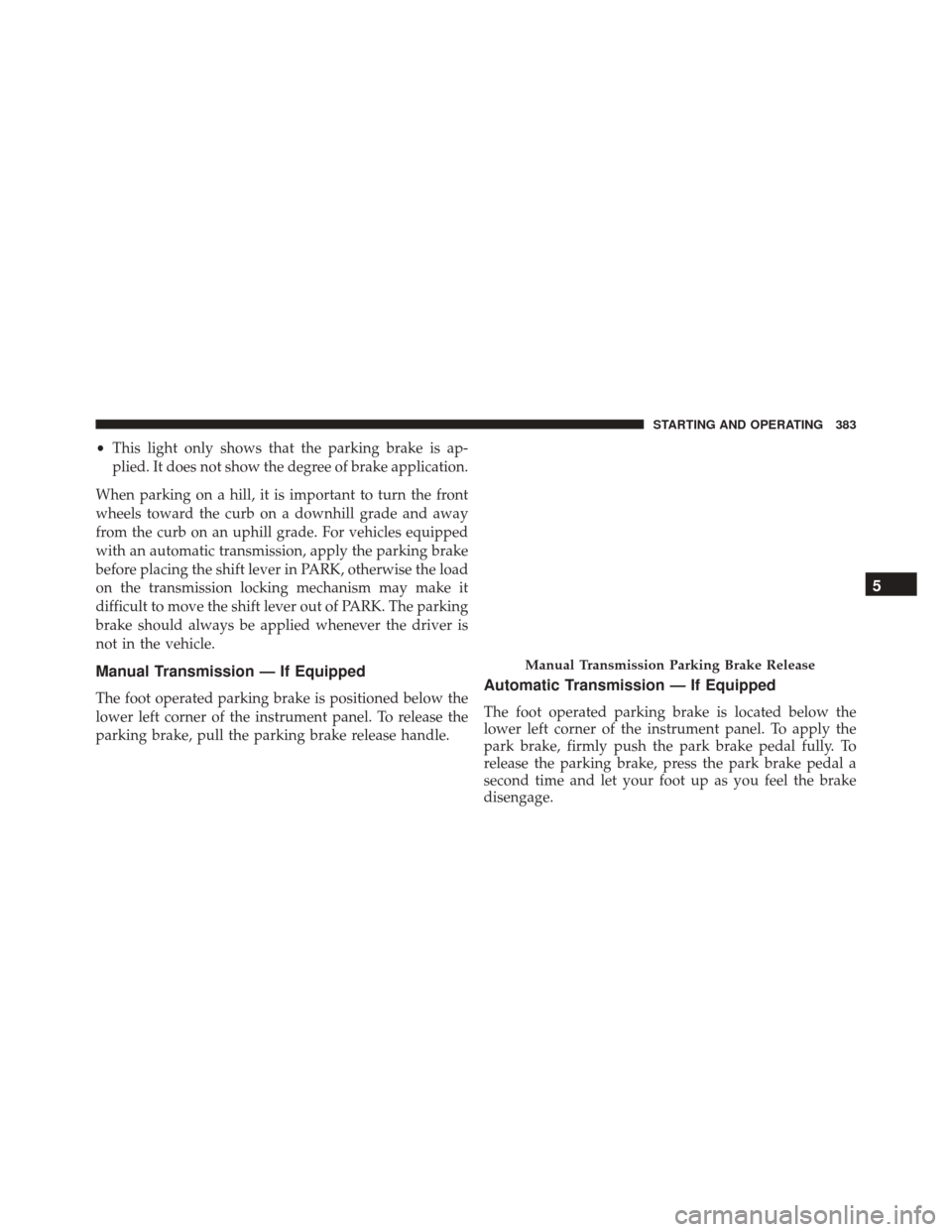
Manual Transmission — If Equipped
The foot operated parking brake is positioned below the
lower left corner of the instrument panel. To release the
parking brake, pull the parking brake release handle.Automatic Transmission — If Equipped
The foot operated parking brake is located below the
lower left corner of the instrument panel. To apply the
park brake, firmly push the park brake pedal fully. To
release the parking brake, press the park brake pedal a
second time and let your foot up as you feel the brake
disengage.
Manual Transmission Parking Brake Release
5
STARTING AND OPERATING 383
Page 386 of 575
WARNING!
•Never use the PARK position as a substitute for the
parking brake. Always apply the parking brake
(Continued)
WARNING! (Continued)
fully when parked to guard against vehicle move-
ment and possible injury or damage.
• When leaving the vehicle, always remove the Key
Fob from the ignition and lock your vehicle.
• Never leave children alone in a vehicle, or with
access to an unlocked vehicle. Allowing children to
be in a vehicle unattended is dangerous for a
number of reasons. A child or others could be
seriously or fatally injured. Children should be
warned not to touch the parking brake, brake pedal
or the shift lever.
• Do not leave the Key Fob in or near the vehicle (or
in a location accessible to children), and do not
leave the ignition of a vehicle equipped with
Keyless Enter-N-Go™ in the ACC or ON/RUN
mode. A child could operate power windows, other
controls, or move the vehicle.
(Continued)
Automatic Transmission Parking Brake
384 STARTING AND OPERATING
Page 387 of 575
WARNING!(Continued)
•Be sure the parking brake is fully disengaged
before driving; failure to do so can lead to brake
failure and a collision.
• Always fully apply the parking brake when leav-
ing your vehicle, or it may roll and cause damage or
injury. Also be certain to leave the transmission in
PARK. Failure to do so may allow the vehicle to roll
and cause damage or injury.
CAUTION!
If the “Brake Warning Light” remains on with the
parking brake released, a brake system malfunction
is indicated. Have the brake system serviced by an
authorized dealer immediately.
(Continued)
BRAKE SYSTEM
Your vehicle is equipped with dual hydraulic
brake systems. If either of the two hydraulic
systems loses normal capability, the remaining
system will still function. There will be some
loss of overall braking effectiveness. This may be evident
by increased pedal travel during application, greater
pedal force required to slow or stop, and potential
activation of the “Brake Warning Light”.
In the event power assist is lost for any reason (for
example, repeated brake applications with the engine
OFF) the brakes will still function. The effort required to
brake the vehicle will be much greater than that required
with the power system operating.
5
STARTING AND OPERATING 385