2015 DODGE CHALLENGER SRT transmission fluid
[x] Cancel search: transmission fluidPage 473 of 575

CAUTION!(Continued)
•Your vehicle has been built with improved fluids
that protect the performance and durability of your
vehicle and also allow extended maintenance inter-
vals. Do not use chemical flushes in these compo-
nents as the chemicals can damage your engine,
transmission, power steering or air conditioning.
Such damage is not covered by the New Vehicle
Limited Warranty. If a flush is needed because of
component malfunction, use only the specified
fluid for the flushing procedure.
Engine Oil
Checking Oil Level
To assure proper engine lubrication, the engine oil must
be maintained at the correct level. Check the oil level at regular intervals, such as every fuel stop. The best time to
check the engine oil level is about five minutes after a
fully warmed engine is shut off.
Checking the oil while the vehicle is on level ground will
improve the accuracy of the oil level readings. Maintain
the oil level in the “SAFE” range. Adding 1.0 quart (.95
liters) of oil when the reading is at the bottom of the
“SAFE” range will result in an oil level at the top of the
“SAFE” range on these engines.
CAUTION!
Overfilling or underfilling will cause oil aeration or
loss of oil pressure. This could damage your engine.
Change Engine Oil
The oil change indicator system will remind you that it is
time to take your vehicle in for scheduled maintenance.
Refer to “Maintenance Schedule” for further information.
7
MAINTAINING YOUR VEHICLE 471
Page 495 of 575

WARNING!(Continued)
cylinder reservoir cap secured at all times. Brake
fluid in a open container absorbs moisture from the
air resulting in a lower boiling point. This may
cause it to boil unexpectedly during hard or pro-
longed braking, resulting in sudden brake failure.
This could result in a collision.
• Overfilling the brake fluid reservoir can result in
spilling brake fluid on hot engine parts, causing
the brake fluid to catch fire. Brake fluid can also
damage painted and vinyl surfaces, care should be
taken to avoid its contact with these surfaces.
• Do not allow petroleum based fluid to contaminate
the brake fluid. Brake seal components could be
damaged, causing partial or complete brake failure.
This could result in a collision. Use only brake fluid that has been in a tightly closed
container to avoid contamination from foreign matter or
moisture.
Clutch Hydraulic System (Manual Transmission)
— If Equipped
The clutch hydraulic system is fed by a segregated
volume of fluid within the brake system master cylinder
reservoir. In the event of leakage or wear, use only the
manufacturer’s recommended brake fluid. Refer to “Flu-
ids, Lubricants, And Genuine Parts” in “Maintaining
Your Vehicle” for further information.
Manual Transmission — If Equipped
Fluid Level Check
Check the fluid level by removing the fill plug on the left
side of the transmission. The fluid level should be 1/4
inch (6.4mm) below the bottom of the fill hole. Add fluid,
7
MAINTAINING YOUR VEHICLE 493
Page 496 of 575

if necessary, to maintain the proper level. Refer to “Flu-
ids, Lubricants, and Genuine Parts” in “Maintaining Your
Vehicle” for further information.
Change Transmission Fluid
If contaminated with water, change the fluid immedi-
ately. See your authorized dealer for service.
Refer to the “Maintenance Schedule” for the proper
maintenance intervals.
Automatic Transmission — If Equipped
Selection Of Lubricant
It is important to use the proper transmission fluid to
ensure optimum transmission performance and life. Use
only the manufacturer ’s specified transmission fluid.
Refer to “Fluids, Lubricants, And Genuine Parts” in this
section for fluid specifications. It is important to maintain
the transmission fluid at the correct level using the
recommended fluid. No chemical flushes should be usedin any transmission; only the approved lubricant should
be used.
CAUTION!
Using a transmission fluid other than the manufac-
turer ’s recommended fluid may cause deterioration
in transmission shift quality and/or torque converter
shudder. Refer to “Fluids, Lubricants, and Genuine
Parts” in this section for fluid specifications.
Special Additives
The manufacturer strongly recommends against using
any special additives in the transmission.
Automatic Transmission Fluid (ATF) is an engineered
product and its performance may be impaired by supple-
mental additives. Therefore, do not add any fluid addi-
tives to the transmission. The only exception to this
policy is the use of special dyes for diagnosing fluid
494 MAINTAINING YOUR VEHICLE
Page 497 of 575

leaks. Avoid using transmission sealers as they may
adversely affect seals.
CAUTION!
Do not use chemical flushes in your transmission as
the chemicals can damage your transmission compo-
nents. Such damage is not covered by the New
Vehicle Limited Warranty.
Fluid Level Check
The fluid level is preset at the factory and does not
require adjustment under normal operating conditions.
Routine fluid level checks are not required, therefore the
transmission has no dipstick. Your authorized dealer can
check your transmission fluid level using special service
tools.
If you notice fluid leakage or transmission malfunction,
visit your authorized dealer immediately to have thetransmission fluid level checked. Operating the vehicle
with an improper fluid level can cause severe transmis-
sion damage.
CAUTION!
If a transmission fluid leak occurs, visit your autho-
rized dealer immediately. Severe transmission dam-
age may occur. Your authorized dealer has the proper
tools to adjust the fluid level accurately.
Fluid And Filter Changes
Under normal operating conditions, the fluid installed at
the factory will provide satisfactory lubrication for the
life of the vehicle.
Routine fluid and filter changes are not required. How-
ever, change the fluid and filter if the fluid becomes
contaminated (with water, etc.), or if the transmission is
disassembled for any reason.
7
MAINTAINING YOUR VEHICLE 495
Page 527 of 575
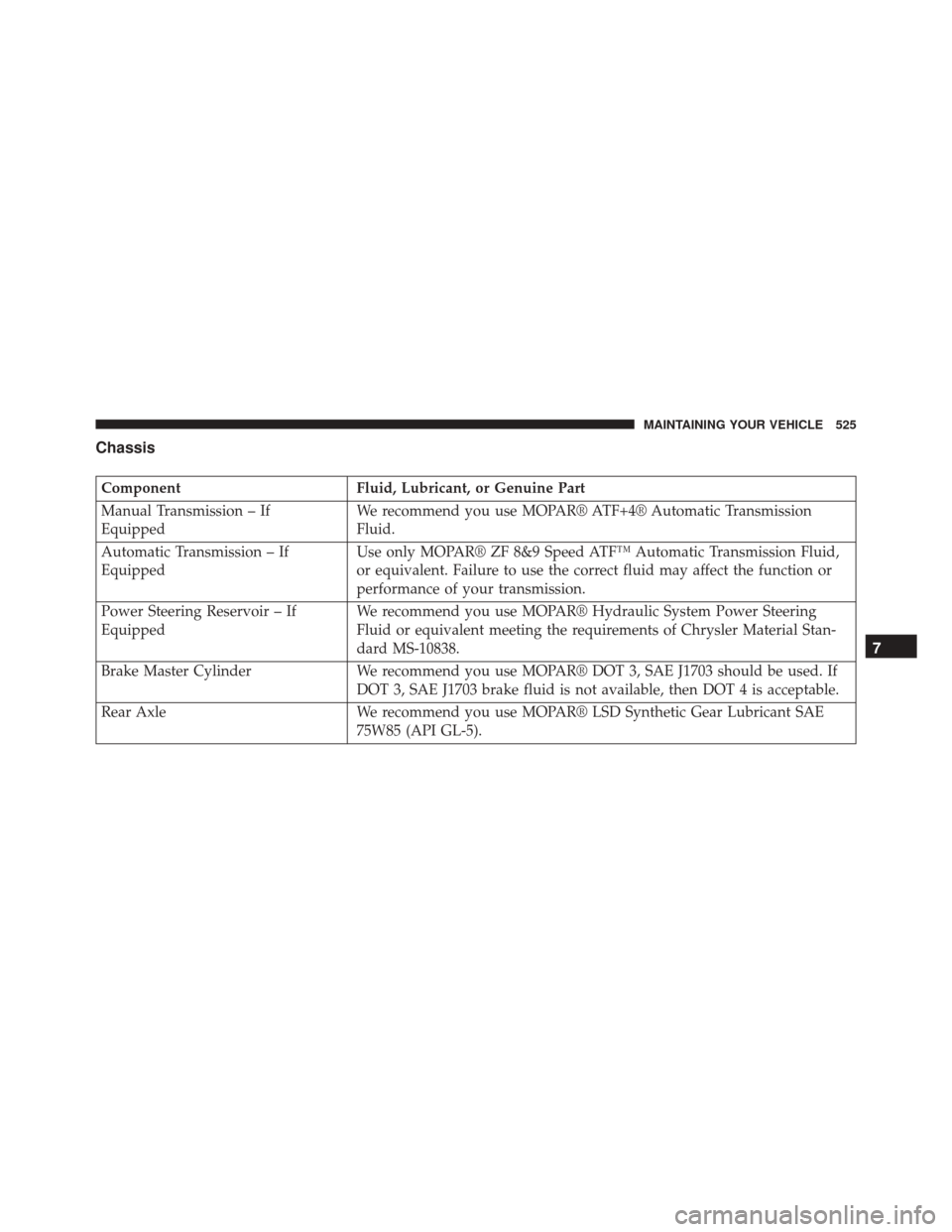
Chassis
ComponentFluid, Lubricant, or Genuine Part
Manual Transmission – If
Equipped We recommend you use MOPAR® ATF+4® Automatic Transmission
Fluid.
Automatic Transmission – If
Equipped Use only MOPAR® ZF 8&9 Speed ATF™ Automatic Transmission Fluid,
or equivalent. Failure to use the correct fluid may affect the function or
performance of your transmission.
Power Steering Reservoir – If
Equipped We recommend you use MOPAR® Hydraulic System Power Steering
Fluid or equivalent meeting the requirements of Chrysler Material Stan-
dard MS-10838.
Brake Master Cylinder We recommend you use MOPAR® DOT 3, SAE J1703 should be used. If
DOT 3, SAE J1703 brake fluid is not available, then DOT 4 is acceptable.
Rear Axle We recommend you use MOPAR® LSD Synthetic Gear Lubricant SAE
75W85 (API GL-5).
7
MAINTAINING YOUR VEHICLE 525
Page 555 of 575
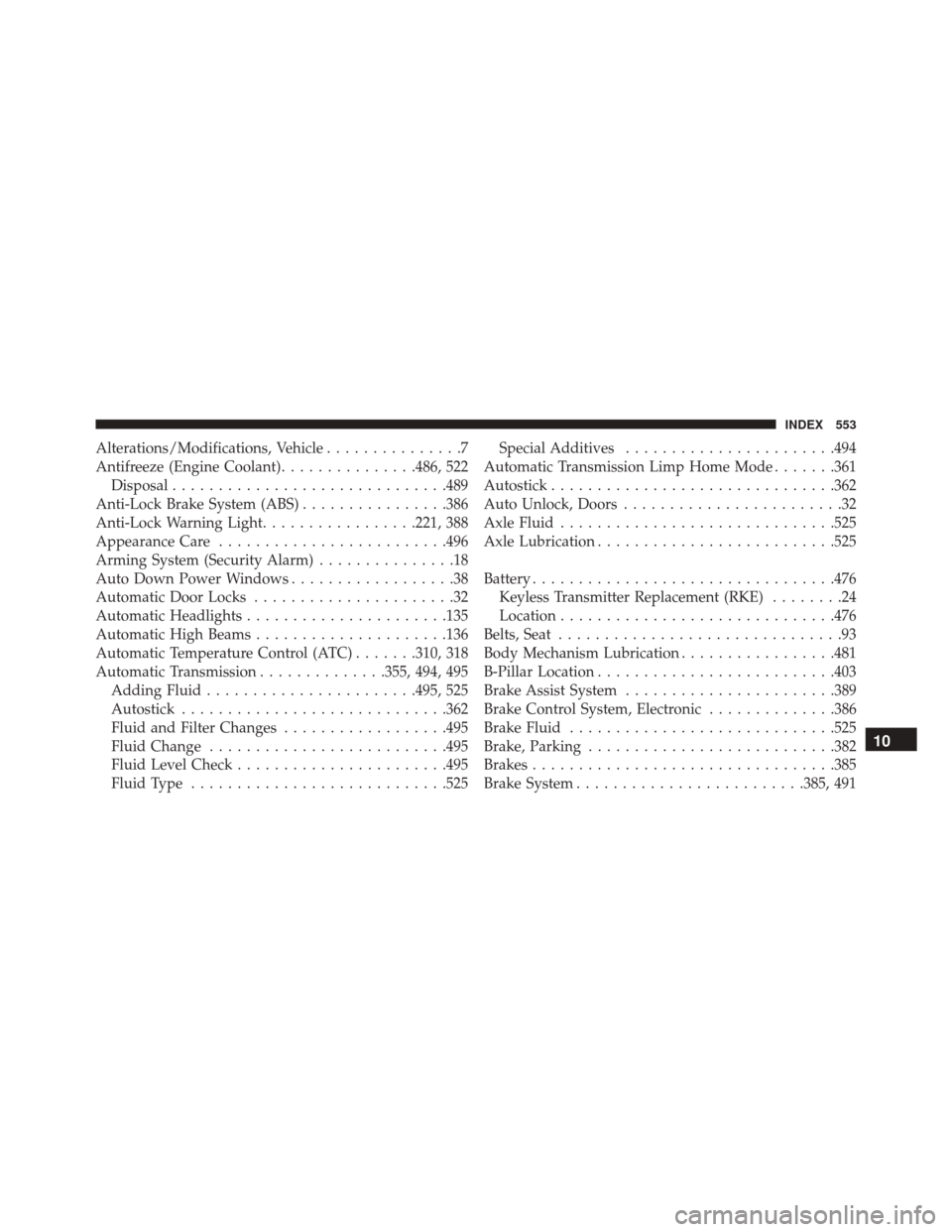
Alterations/Modifications, Vehicle...............7
Antifreeze (Engine Coolant) ...............486, 522
Disposal ............................. .489
Anti-Lock Brake System (ABS) ................386
Anti-Lock Warning Light .................221, 388
Appearance Care ........................ .496
Arming System (Security Alarm) ...............18
Auto Down Power Windows ..................38
Automatic Door Locks ......................32
Automatic Headlights ..................... .135
Automatic High Beams .....................136
Automatic Temperature Control (ATC) .......310, 318
Automatic Transmission ..............355, 494, 495
Adding Fluid ...................... .495, 525
Autostick ............................ .362
Fluid and Filter Changes ..................495
Fluid Change ......................... .495
Fluid Level Check ...................... .495
Fluid Type ........................... .525Special Additives
...................... .494
Automatic Transmission Limp Home Mode .......361
Autostick .............................. .362
Auto Unlock, Doors ........................32
Axle Fluid ............................. .525
Axle Lubrication ......................... .525
Battery ................................ .476
Keyless Transmitter Replacement (RKE) ........24
Location ............................. .476
Belts, Seat ...............................93
Body Mechanism Lubrication .................481
B-Pillar Location ......................... .403
Brake Assist System ...................... .389
Brake Control System, Electronic ..............386
Brake Fluid ............................ .525
Brake, Parking .......................... .382
Brakes ................................ .385
Brake System ........................ .385,
491
10
INDEX 553
Page 556 of 575

Anti-Lock (ABS)....................... .386
Fluid Check ....................... .492, 525
Master Cylinder ....................... .492
Parking ............................. .382
Warning Light ..................... .221, 385
Brake/Transmission Interlock .................354
Brightness, Interior Lights ...................142
Bulb Replacement ..................... .516, 519
Bulbs, Light .......................... .95, 516
Camera, Rear ........................... .192
Capacities, Fluid ......................... .522
Caps, Filler Fuel ................................ .430
Oil (Engine) .......................... .472
Radiator (Coolant Pressure) ................489
Carbon Monoxide Warning ................92, 429
Cargo (Vehicle Loading) ....................432
Car Washes ............................ .497Cellular Phone
.......................... .308
Center High Mounted Stop Light ..............521
Certification Label ........................ .432
Chains, Tire ............................ .417
Chart, Tire Sizing ........................ .398
Check Engine Light (Malfunction Indicator Light) . .468
Checking Your Vehicle For Safety ...............91
Checks, Safety ............................91
Child Restraint ............................68
Child Restraints Booster Seats ...........................73
Center Seat LATCH ......................81
Child Restraints .........................68
Child Seat Installation .....................86
How To Stow An Unused ALR Seat Belt ........82
Infants And Child Restraints ................71
Install A LATCH-Compatible Child Restraint ....81
Installing Child Restraints Using The Vehicle Seat
Belt ..................................83
554 INDEX
Page 560 of 575

FlashersHazard Warning ....................... .438
Turn Signal ..................... .95, 139, 221
Flash-To-Pass ........................... .140
Flooded Engine Starting ....................346
Fluid, Brake ............................ .525
Fluid Capacities ......................... .522
Fluid Leaks ..............................95
Fluid Level Checks Automatic Transmission ..................495
Brake ............................... .492
Cooling System ........................ .485
Engine Oil ........................... .471
Fluids, Lubricants and Genuine Parts ...........523
Fog Lights ............................. .221
Folding Rear Seat ........................ .131
Forward Collision Warning ..................180
Freeing A Stuck Vehicle .....................455
Fuel .................................. .426Adding
............................. .430
Additives ............................ .428
Clean Air ............................ .426
Ethanol ............................. .427
Filler Cap (Gas Cap) .....................430
Gasoline ............................. .426
Gauge .............................. .221
Materials Added ....................... .428
Methanol ............................ .427
Octane Rating ..................... .426, 523
Requirements ......................... .426
Specifications ......................... .523
Tank Capacity ......................... .522
Fueling ............................... .430
Fuses ................................. .502
Garage Door Opener (HomeLink®) .........195, 202
Gas Cap (Fuel Filler Cap) ................430,
467
Gasoline, Clean Air ....................... .426
558 INDEX