Page 490 of 603

▫Brake System........................517
▫Clutch Hydraulic System — Manual Transmission
(If Equipped).........................520
▫Manual Transmission — If Equipped.......520
▫Automatic Transmission — If Equipped.....521
▫Rear Axle...........................522
▫Appearance Care And Protection From
Corrosion...........................523
!FUSES..............................529
▫Front Power Distribution Center (Fuses).....530
▫Rear Power Distribution Center (Fuses).....535
!VEHICLE STORAGE....................542
!REPLACEMENT BULBS.................543
!BULB REPLACEMENT..................545
▫Low Beam Headlamp, High Beam Headlamp,
Park/Turn Lamp — Models with Halogen
Headlamps — If Equipped...............545
▫Low Beam Headlamp, High Beam Headlamp, and
Park/Turn Lamp — Models with High Intensity
Discharge (HID) Headlamps — If Equipped . . .546
▫Front/Rear Side Marker Lamp............547
▫Tail/Turn And Stop Lamp...............547
▫Center Tail/Backup Lamp...............547
▫Center High-Mounted Stop Lamp (CHMSL) . .547
▫License Lamp........................547
!FLUID CAPACITIES....................548
!FLUIDS, LUBRICANTS AND GENUINE PARTS . .549
▫Engine.............................549
▫Chassis............................552
488 MAINTAINING YOUR VEHICLE
Page 491 of 603
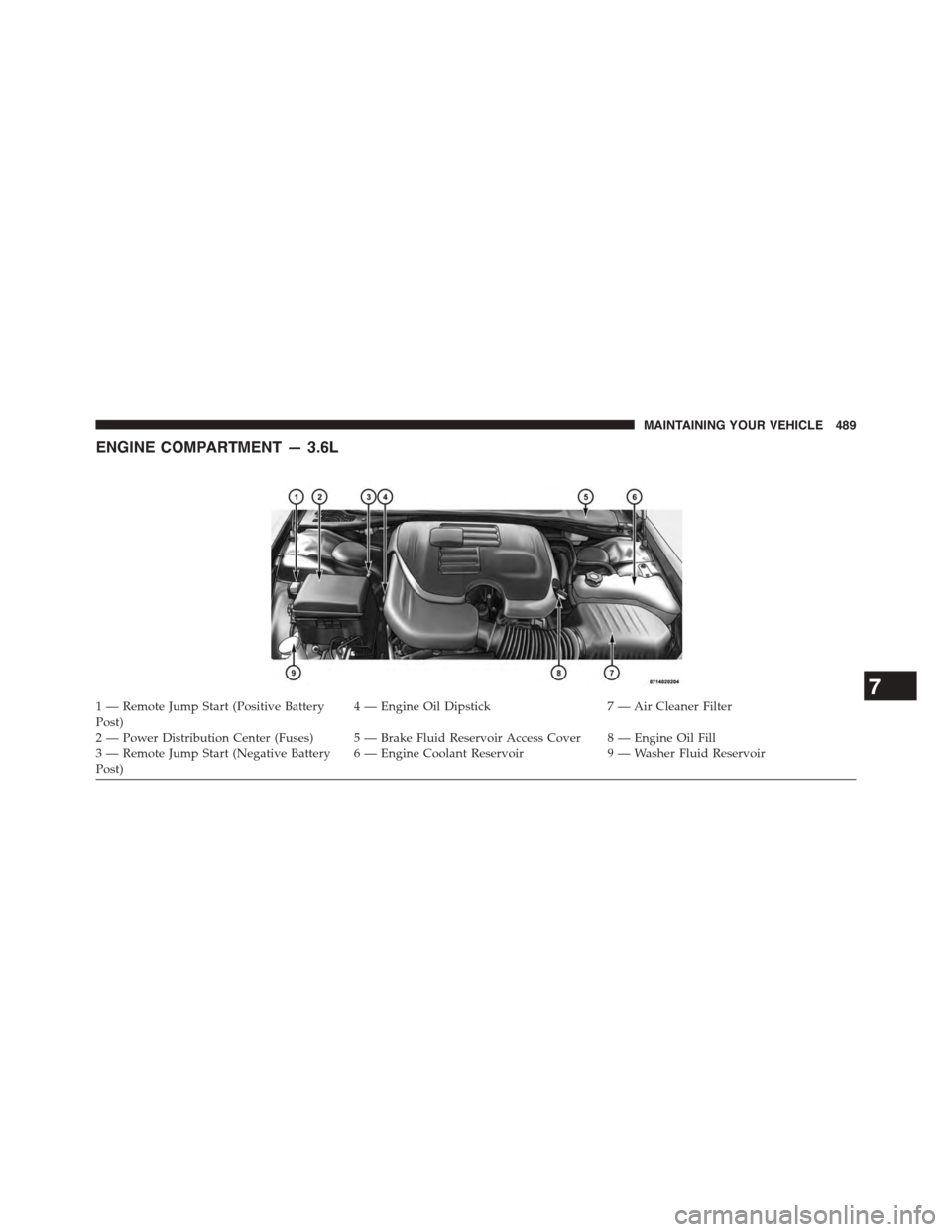
ENGINE COMPARTMENT — 3.6L
1 — Remote Jump Start (Positive BatteryPost)4 — Engine Oil Dipstick7 — Air Cleaner Filter
2 — Power Distribution Center (Fuses) 5 — Brake Fluid Reservoir Access Cover 8 — Engine Oil Fill3 — Remote Jump Start (Negative BatteryPost)6 — Engine Coolant Reservoir9 — Washer Fluid Reservoir
7
MAINTAINING YOUR VEHICLE 489
Page 492 of 603
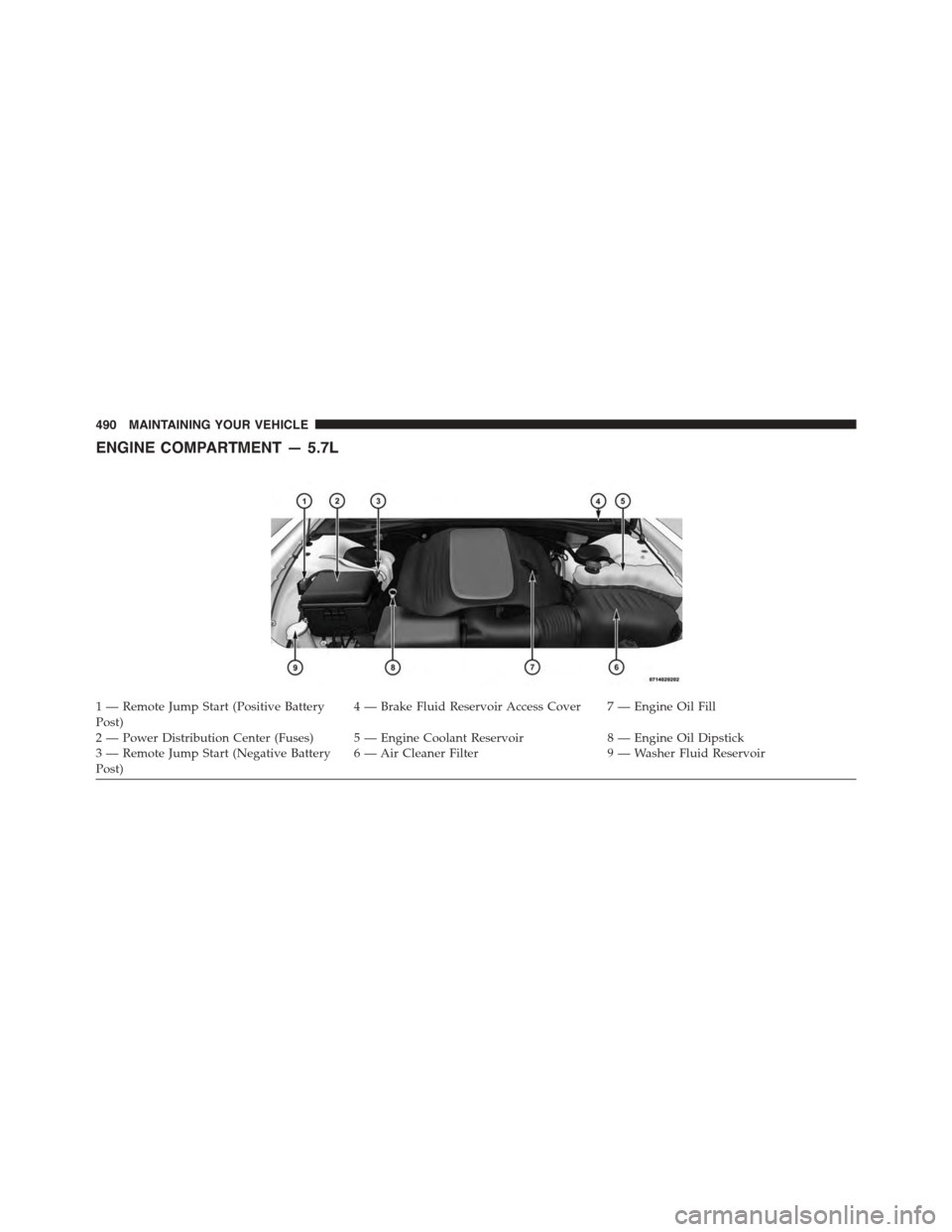
ENGINE COMPARTMENT — 5.7L
1 — Remote Jump Start (Positive BatteryPost)4 — Brake Fluid Reservoir Access Cover 7 — Engine Oil Fill
2 — Power Distribution Center (Fuses) 5 — Engine Coolant Reservoir 8 — Engine Oil Dipstick3 — Remote Jump Start (Negative BatteryPost)6 — Air Cleaner Filter9 — Washer Fluid Reservoir
490 MAINTAINING YOUR VEHICLE
Page 493 of 603
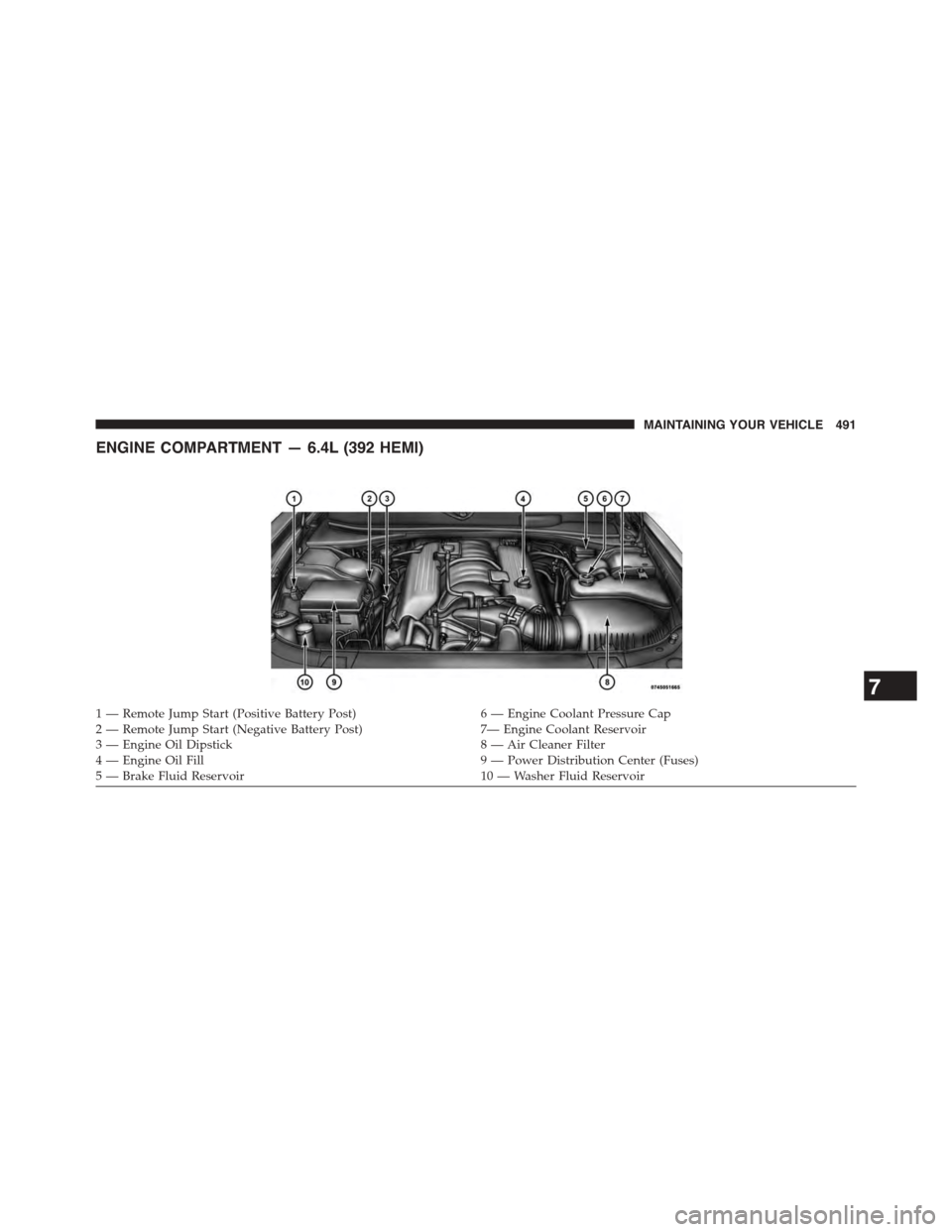
ENGINE COMPARTMENT — 6.4L (392 HEMI)
1—RemoteJumpStart(PositiveBatteryPost)6—EngineCoolantPressureCap2 — Remote Jump Start (Negative Battery Post)7— Engine Coolant Reservoir3 — Engine Oil Dipstick8 — Air Cleaner Filter4 — Engine Oil Fill9 — Power Distribution Center (Fuses)5 — Brake Fluid Reservoir10 — Washer Fluid Reservoir
7
MAINTAINING YOUR VEHICLE 491
Page 519 of 603
If an examination of your engine compartment shows no
evidence of radiator or hose leaks, the vehicle may be
safely driven. The vapor will soon dissipate.
•Do not overfill the coolant expansion bottle.
•Check the coolant freeze point in the radiator and in
the coolant expansion bottle. If engine coolant (anti-
freeze) needs to be added, the contents of the coolant
expansion bottle must also be protected against freez-
ing.
•If frequent engine coolant (antifreeze) additions are
required, the cooling system should be pressure tested
for leaks.
•Maintain engine coolant (antifreeze) concentration at a
minimum of 50% OAT coolant (conforming to MS-
12106) and distilled water for proper corrosion protec-
tion of your engine which contains aluminum compo-
nents.
•Make sure that the coolant expansion bottle overflow
hoses are not kinked or obstructed.
•Keep the front of the radiator clean. If your vehicle is
equipped with air conditioning, keep the front of the
condenser clean.
•Do not change the thermostat for Summer or Winter
operation. If replacement is ever necessary, install
ONLY the correct type thermostat. Other designs may
result in unsatisfactory engine coolant (antifreeze)
performance, poor gas mileage, and increased emis-
sions.
Brake System
In order to assure brake system performance, all brake
system components should be inspected periodically.
Refer to the “Maintenance Schedule” for the proper
maintenance intervals.
7
MAINTAINING YOUR VEHICLE 517
Page 520 of 603
WARNING!
Riding the brakes can lead to brake failure and
possibly a collision. Driving with your foot resting or
riding on the brake pedal can result in abnormally
high brake temperatures, excessive lining wear, and
possible brake damage. You would not have your full
braking capacity in an emergency.
Master Cylinder — Brake Fluid Level Check
Check the fluid level in the master cylinder immediately
if the brake system warning light indicates system fail-
ure.
Check the fluid level in the master cylinder when per-
forming underhood services.
Clean the top of the master cylinder area before removing
the cap. Add fluid to bring the level up to the “MAX”
mark on the side of the master cylinder reservoir.
Overfilling of fluid is not recommended because it may
cause leaking in the system.
Add enough fluid to bring the level up to the require-
ments described on the brake fluid reservoir. With disc
brakes, fluid level can be expected to fall as the brake
pads wear. However, low fluid level may be caused by a
leak and a checkup may be needed.
Use only manufacturer’s recommended brake fluid. Re-
fer to “Fluids, Lubricants, and Genuine Parts” in “Main-
taining Your Vehicle” for further information.
518 MAINTAINING YOUR VEHICLE
Page 521 of 603
WARNING!
•Use only manufacturer’s recommended brake
fluid. Refer to “Fluids, Lubricants, and Genuine
Parts” in “Maintaining Your Vehicle” for further
information. Using the wrong type of brake fluid
can severely damage your brake system and/or
impair its performance. The proper type of brake
fluid for your vehicle is also identified on the
original factory installed hydraulic master cylinder
reservoir.
•To avoid contamination from foreign matter or
moisture, use only new brake fluid or fluid that has
been in a tightly closed container. Keep the master
cylinder reservoir cap secured at all times. Brake
fluid in a open container absorbs moisture from the
air resulting in a lower boiling point. This may
(Continued)
WARNING!(Continued)
cause it to boil unexpectedly during hard or pro-
longed braking, resulting in sudden brake failure.
This could result in a collision.
•Overfilling the brake fluid reservoir can result in
spilling brake fluid on hot engine parts, causing
the brake fluid to catch fire. Brake fluid can also
damage painted and vinyl surfaces, care should be
taken to avoid its contact with these surfaces.
•Do not allow petroleum based fluid to contaminate
the brake fluid. Brake seal components could be
damaged, causing partial or complete brake failure.
This could result in a collision.7
MAINTAINING YOUR VEHICLE 519
Page 522 of 603
Clutch Hydraulic System — Manual Transmission
(If Equipped)
The clutch hydraulic system is fed by a segregated
volume of fluid within the brake system master cylinder
reservoir. In the event of leakage or wear, use only the
manufacturer’s recommended brake fluid. Refer to “Flu-
ids, Lubricants, and Genuine Parts” in “Maintaining Your
Vehicle” for further information.
Manual Transmission — If Equipped
Fluid Level Check
Check the fluid level by removing the fill plug on the left
side of the transmission. The fluid level should be 1/4
inch (6.4mm) below the bottom of the fill hole. Add fluid,
if necessary, to maintain the proper level. Refer to “Flu-
ids, Lubricants, and Genuine Parts” in “Maintaining Your
Vehicle” for further information.
CAUTION!
Using a transmission fluid other than the manufac-
turer’s recommended fluid may cause deterioration
in transmission shift quality and/or damage to the
transmission. Refer to “Fluids, Lubricants, and
Genuine Parts” in this section for fluid specifica-
tions.
Change Transmission Fluid
If contaminated with water, change the fluid immedi-
ately. See your authorized dealer for service.
Refer to the “Maintenance Schedule” for the proper
maintenance intervals.
520 MAINTAINING YOUR VEHICLE