2015 Citroen NEMO Instruments
[x] Cancel search: InstrumentsPage 32 of 192
30
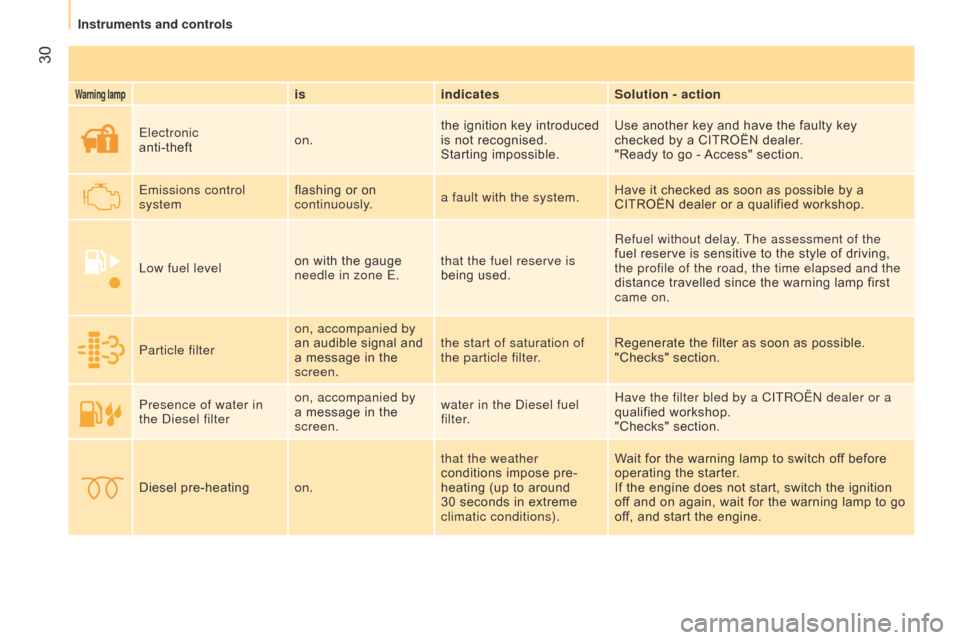
Warning lampisindicates Solution - action
Electronic
anti-theft on.the ignition key introduced
is not recognised.
Starting impossible. Use another key and have the faulty key
checked by a CITROËN dealer.
"Ready to go - Access" section.
Emissions control
system flashing or on
continuously.
a fault with the system. Have it checked as soon as possible by a
CITROËN dealer or a qualified workshop.
Low fuel level on with the gauge
needle in zone E.that the fuel reserve is
being used. Refuel without delay. The assessment of the
fuel reserve is sensitive to the style of driving,
the profile of the road, the time elapsed and the
distance travelled since the warning lamp first
came on.
Particle filter on, accompanied by
an audible signal and
a message in the
screen.the start of saturation of
the particle filter.
Regenerate the filter as soon as possible.
"Checks" section.
Presence of water in
the
d
iesel filter on, accompanied by
a message in the
screen. water in the
d iesel fuel
filter. Have the filter bled by a CITR
o Ë n dealer or a
qualified workshop.
"Checks" section.
Diesel pre-heating on.that the weather
conditions impose pre-
heating (up to around
30 seconds in extreme
climatic conditions). Wait for the warning lamp to switch off before
operating the starter.
If the engine does not start, switch the ignition
off and on again, wait for the warning lamp to go
off, and start the engine.
Instruments and controls
Page 33 of 192

31
Warning lampisindicates Solution - action
Sidelamps on.a manual selection. Turn the ring on the lighting control stalk to the
first position.
d
ipped beam
headlamps
on.a manual selection.
Turn the ring on the lighting control stalk to the
first position.
Main beam headlamps a pull on the control stalk.Pull the lighting control stalk to return to dipped
beam.
d
irection indicators flashing with an
audible signal. a change of direction
using the lighting control
stalk. To the Right: press the stalk upwards.
To the Left: press the stalk downwards.
Hazard warning lamps flashing with an
audible signal.the hazard warning lamp
switch, located in the
middle of the dashboard,
has been pressed. The left and right direction indicators, and the
associated warning lamps, flash simultaneously.
Front foglamps on.that the button on the
dashboard has been
pressed. Manual selection.
The foglamps only operate if the sidelamps or
dipped beam headlamps are on.
Rear foglamps on.that the button on the
dashboard has been
pressed. Manual selection.
The foglamps only operate if the dipped beam
headlamps are on. When visibility is normal,
switch the foglamps off.
3
READY TO GO
Instruments and controls
Page 34 of 192

32
Warning lampisindicates Solution - action
Cruise control on.activation of the cruise
control. Manual selection.
"Ready to go - Steering mounted controls" section.
Intelligent traction
control on.activation of the intelligent
traction control section. Manual selection.
"Safety - Driving safety" section.
Instruments and controls
Page 35 of 192

33
Displaydisplaysindicates Solution - action
Stop & Start on.
engine STOP mode
invoked following a stop of
the vehicle.
a
s soon as you want to move off, the
warning lamp goes off and the engine starts
automatically in ST
a
RT mode.
flashes for a few
seconds then
goes off. temporary unavailability
of ST
o
P mode or
START mode invoked
automatically. Particular case with ST
o
P mode and ST
a
RT
mode.
"Ready to go - Starting and stopping" section.
Gear shift indicator the arrow pointing up. a suggested change up. "Ready to go - Gearbox and steering wheel"
section.
Headlamp beam height adjustment of the
headlamps.a position from 0 to 3
according to the load in
the vehicle. Adjust using the buttons in the side control
panel.
"Ready to go - Steering mounted controls
section".
a
mbient temperature
(°C /°F) the temperature,
flashing and
accompanied by a
message in the screen.weather conditions
which could result in the
presence of ice on the
road.
Be especially vigilant and do not brake sharply.
"Safety - Driving safety" section.
Date (YYYY/MM/DD)
Time (HH:MM) a setting:
of the
d ate.
of the Time. a configuration via the
SET / Back button on the
side control panel.
"Technology on board - Vehicle configuration"
menu.
3
READY TO GO
Instruments and controls
Page 36 of 192

34
FUEL GAUGE
The fuel level is tested every time the
ignition is switched on.
If the gauge is positioned on:
-
f (full):
the capacity of the fuel tank is
approximately 45 litres.
-
e (empty):
the reserve is now being
used, the warning lamp comes on
continuously.
The low fuel warning first comes on when
approximately 6 litres of fuel is left.
COOLANT TEMPERATURE
- wait approximately 15 minutes to allow
the engine to cool down in order to check
the level and top it up if necessary. The
cooling system is pressurised. In order to
avoid any risk of scalding, unscrew the
cap by two turns to allow the pressure to
drop.
When the pressure has dropped, check the
level and remove the cap to top up.
If the needle remains in the red zone,
contact a CITROËN or a qualified workshop.
EMISSIONS CONTROL
EOBD (European On Board Diagnosis) is a
diagnostics system which meets the exhaust
emissions standards for:
-
CO (carbon monoxide),
-
HC (unburnt hydrocarbons),
-
NOx (nitrous oxides) or particles detected
by oxygen sensors placed upstream and
downstream of the catalytic converters.
Refer to the "Checks - Levels" section. Refer to the "Checks - Levels" section.
The driver is warned of any
fault with this emission control
system by flashing of this specific
warning lamp in the instrument
panel.
If the needle enters the red zone, or
if the warning lamp comes on:
The needle is positioned between c (cold)
and h (hot): normal operation.
In arduous conditions of use or hot climatic
conditions, the needle may move close to
the red graduations.
-
stop immediately
, switch off the ignition.
The cooling fan may continue to operate
for a certain time up to approximately
10 minutes.
Instruments and controls
Page 37 of 192

35SERVICE INDICATORENGINE OIL WARNING LAMP
L IGHTING DIMMER
The dimmer is active when the sidelamps
are on.
Refer to the list of checks in the
maintenance and warranty guide which
was given to you on delivery of the
vehicle.
a
fter a few seconds, the screen returns to its
usual functions.
Use these controls to adjust the
brightness of the instrument
panel and the audio system panel
lighting.
The screen in the instrument panel informs
you when the next service is due, in
accordance with the Manufacturer's servicing
schedule indicated in the maintenance
and warranty guide. This information is
determined in relation to the distance
travelled since the previous service.
Low engine oil pressure
Oil deterioration (1.3 HDi 75 hp engine only)The warning lamp comes on
continuously, accompanied by a
message in the instrument panel
screen, when the system detects
that the oil pressure is too low.
The warning lamp flashes,
accompanied by a message in the
instrument panel screen, when the
system detects deterioration of the
engine oil. The flashing of this warning lamp
should not be considered as a fault wit the
vehicle, but rather as an indication to the
driver that the normal use of the vehicle now
requires that the oil be changed.
If the oil is not changed, when a
second level of deterioration is
reached, the emissions warning
lamp comes on in the instrument
panel and the engine speed is restricted to
3000 rpm. To avoid damaging the engine, it is
recommended that the oil be changed
on flashing of the engine oil warning lamp.
Stop as soon as it is safe to do so: park,
switch off the ignition and contact a
CITROËN dealer or a qualified workshop. If the oil is still not changed, when a third
level of deterioration is reached, the engine
speed is restricted to 1500 rpm, so as to
avoid any damage.
3
READY TO GO
Instruments and controls
Page 149 of 192

147These regular maintenance operations will
keep your vehicle in good working order.
Ask for advice from a CITROËN dealer
or a qualified workshop or refer to the
maintenance and warranty guide provided in
the handbook pack.
LEVELS
Oil level
Check the level regularly and top up
between changes. The maximum oil
consumption is 0.5 litre per 600 miles
(1 000
km). Check the level with the vehicle
level, engine cold, using the dipstick.
Dipstick There are two marks on the
dipstick:
A= maximum
If you fill past this mark,
contact a CITR
o Ë n dealer
or a qualified workshop.
B = minimum
n
ever allow the level to fall
below this mark.
To preserve the reliability of engines and
emission control systems, the use of
additives in engine oil is prohibited. Oil change
Brake fluid level
The brake fluid must be changed at
the specified interval, as given in the
manufacturer's servicing schedule.
Use fluids recommended by the
manufacturer, which meets the DOT4
standard.
The level must be between the MIN and
MAX marks on the reservoir.
If fluid has to be added frequently, this
indicates a fault which must be checked by a
CITROËN dealer or a qualified workshop as
soon as possible.
Warning lamps
Checking by means of the warning
lamps in the instrument panel is
described in the "Ready to go -
Instruments and controls" section.
This must be carried out at the specified
interval and the viscosity grade of the oil
selected must fulfil the requirements of the
manufacturer's servicing schedule. Ask for
advice from a CITR
o
Ë
n
dealer or a qualified
workshop.
Remove the dipstick before filling.
Check the level after filling (never exceed
the maximum mark).
Refit the filler cap before closing the bonnet.
8
CHECKS
Levels