Page 38 of 344

36
C5_en_Chap01_controle-de-marche_ed01-2014
With the Audio system switched on, once
this menu is selected, you can configure
your Bluetooth hands-free kit (pairing), view
the different telephone directories (calls log,
services...) and manage your calls (start a call,
end a call, double call, secret mode...).Adjusting the date time
"Bluetooth - Telephone -
A udio" menu
For safety reasons, configuration of the
multifunction screen by the driver must
only be done when stationary. For more information, refer to the Audio
system section.
F
P
ress on A
.
F
U
se C to select the "Date and time" menu,
then confirm your choice with a press on
C
on the steering wheel or D on the audio
system.
F
S
elect the screen configuration using C .
Confirm with a press on C on the steering
wheel or D on the audio system.
F
S
elect the date and the time settings,
using B. Confirm with a press on C on the
steering wheel or D on the audio system.
F
Press C to select the values you wish to
modify. Confirm your choice with a press
on C on the steering wheel or D on the
audio system.
F
C
onfirm with "OK" on the screen.
Monitoring
Page 47 of 344

45
C5_en_Chap02_ouverture_ed01-2014
Deactivation
F Press the unlocking button on the remote control.
The alarm system is deactivated: the indicator
lamp in the button goes off.
Locking the vehicle
with exterior perimeter
monitoring only
Deactivate the interior volumetric and anti-tilt
monitoring to avoid unwanted triggering of the
alarm in certain cases such as:
-
l
eaving a pet in the vehicle,
-
l
eaving a window partially open,
-
w
ashing your vehicle,
-
c
hanging a wheel,
-
h
aving your vehicle towed,
-
t
ransport by sea.
Deactivation of the interior
volumetric and anti-tilt
monitoring
F Switch off the ignition.
F W ithin ten seconds, press the button until
the indicator lamp is on continuously.
F
G
et out of the vehicle.
F
P
ress the locking button on the remote
control immediately.
The exterior perimeter monitoring alone is
activated: the indicator lamp in the button
flashes once per second.
To be effective, this deactivation must be
carried out each time the ignition is switched
of f.
Reactivation of the interior
volumetric and anti-tilt monitoring
F Press the unlocking button on the remote control to deactivate the exterior perimeter
monitoring.
F
P
ress the locking button on the remote
control to activate all the monitoring
functions.
The indicator lamp in the button again flashes
once per second.
2
Access
Page 64 of 344
62
C5_en_Chap03_ergo-et-confort_ed01-2014
Steering wheel adjustment
F First, adjust the driver's seat to the most suitable position.
F
W
hen stationary , lower the lever A to
release the steering wheel adjustment.
F
A
djust for height and reach.
F
R
aise the lever to lock the steering wheel
adjustment.
After locking, if you press firmly on the steering
wheel, a slight click may be heard. The steering wheel can be adjusted for height and reach to adapt the driving position to the size of
the driver.
Adjustment
as a safety precaution, these
operations must only be carried out
while the vehicle is stationary.
Ease of use and comfort
Page 69 of 344
67
C5_en_Chap03_ergo-et-confort_ed01-2014
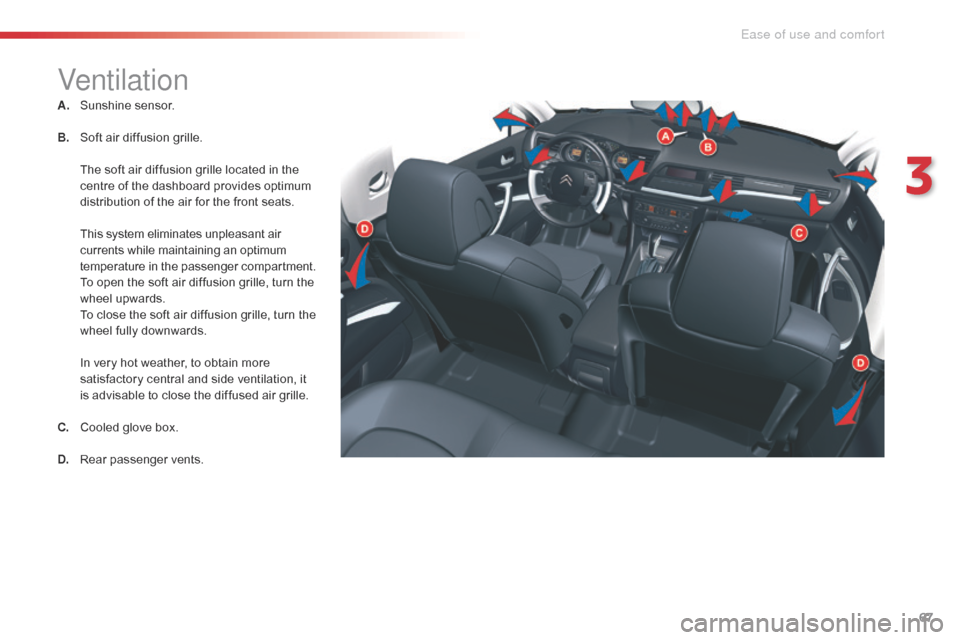
Ventilation
A. Sunshine sensor.
B.
S
oft air diffusion grille.
T
he soft air diffusion grille located in the
centre of the dashboard provides optimum
distribution of the air for the front seats.
T
his system eliminates unpleasant air
currents while maintaining an optimum
temperature in the passenger compartment.
T
o open the soft air diffusion grille, turn the
wheel upwards.
T
o close the soft air diffusion grille, turn the
wheel fully downwards.
I
n very hot weather, to obtain more
satisfactory central and side ventilation, it
is advisable to close the diffused air grille.
C.
C
ooled glove box.
D.
R
ear passenger vents.
3
Ease of use and comfort
Page 70 of 344

68
C5_en_Chap03_ergo-et-confort_ed01-2014
We recommend use of the automatic regulation
of the air conditioning.
It permits automatic and optimised control
of all of the following functions: air flow,
temperature in the passenger compartment
and air distribution, by means of various
sensors (ambient temperature, sunshine).
This eliminates any need for you to change
your settings other than the temperature value
displayed.
F Take care not to cover the sunshine sensor A .
If you select the automatic mode
(by pressing the "AUTO" control) and leave
all of the vents open, optimum comfort will be
maintained and humidity and condensation will
be removed regardless of the exterior climatic
conditions.
The temperature in the passenger compartment
can only be lower than the ambient temperature
if the air conditioning is on.
In order to be effective, the air conditioning must
be used with the windows closed. If the vehicle
has been parked in the sun for a long period
and the interior temperature is very high, first
ventilate the passenger compartment with the
windows open for a few minutes, then close the
windows.
Heating, ventilation and air conditioning recommendations
To keep the air conditioning system in
good working order it is essential that it is
operated at least once a month.
The air conditioning uses engine power
during its operation. As a result, the fuel
consumption of the vehicle increases.
In certain cases of particularly arduous use
(e.g. towing the maximum load on a steep
gradient in high temperatures), switching off
the air conditioning saves engine power and
improves the towing capacity.
Air inlet
Check that the exterior grille for the air inlet,
at the bottom of the windscreen, is clean and
free of dead leaves, snow, etc.
When washing the vehicle using a high
pressure nozzle, avoid spraying at the air
inlet. Maximum comfort is obtained by means of
a good distribution of air in the passenger
compartment, both in the front and in the rear.
To obtain a uniform distribution of air, take
care not to block the exterior air intake grille
located at the base of the windscreen, the
vents, the air outlets under the front seats and
the air extractor located behind the flaps in
the boot.
The front and rear vents are fitted with
thumbwheels to adjust the air flow and
direction. We recommend that you leave all of
the vents open.
Dust filter / Odour filter
(active carbon)
There is a filter for excluding odours and
dust.
This filter must be changed in line with the
vehicle's servicing schedule. (Refer to the
maintenance and warranty guide).
Air conditioning
Air circulation
Ease of use and comfort
Page 93 of 344
91
C5_en_Chap03_ergo-et-confort_ed01-2014
Boot fittings (Saloon)
1. Boot floor (spare wheel storage).2. B oot lamp.
3. L ocation for 6 CD changer.
Luggage securing rings
F Use the 4 securing rings on the boot floor to secure your luggage.
For safety reasons in the event of sharp
braking, you are advised to place heavy objects
as far for ward in the boot as possible.
3
Ease of use and comfort
Page 104 of 344
148
C5_en_Chap05_visibilite_ed01-2014
Directional lighting
without cornering lightingwith cornering lighting
"Cornering lighting" function
Activation
This function is activated:
- w hen the direction indicator is activated,
-
f
rom a certain angle of rotation of the
steering wheel.
Deactivation
This function is deactivated:
- b elow a certain angle of rotation of the
steering wheel,
-
w
hen stationary or at very low speed,
-
w
hen reverse gear is engaged,
-
w
hen the directional headlamps are
switched off.
With dipped or main beams, this function
provides additional lighting for the inside of a
bend, when the vehicle speed is below 25 mph
(approx 40 km/h).
This lighting is most useful when travelling at
low and medium speed (urban driving, winding
road, intersections, parking manoeuvres...).
Visibility
Page 110 of 344

96
C5_en_Chap04_conduite_ed01-2014
A few driving recommendations
Driving on flooded
roads
We strongly advise against driving on flooded
roads, as this could cause serious damage
to the engine or gearbox, as well as to the
electrical systems of your vehicle. Observe the driving regulations at all times and
remain vigilant whatever the traffic conditions.
Pay close attention to the traffic and keep your
hands on the wheel so that you are ready to
react at any time to any eventuality.
On a long journey, a break every two hours is
strongly recommended.
In difficult weather, drive smoothly, anticipate
the need to brake and increase the distance
from other vehicles.
Important!
Never drive with the parking brake
applied - Risk of overheating and
damage to the braking system!
Do not park or run the engine when
stationary in areas where inflammable
substances and materials (dry grass,
dead leaves...) might come into contact
with the hot exhaust system - Risk
of fire!
Never leave a vehicle unsupervised
with the engine running. If you have
to leave your vehicle with the engine
running, apply the parking brake
and put the gearbox into neutral or
position
N or P, depending on the type
of gearbox.
If you are obliged to drive through water:
-
c
heck that the depth of water does not
exceed 15 cm, taking account of waves
that might be generated by other users,
-
d
eactivate the Stop & Start system,
-
d
rive as slowly as possible without stalling.
In all cases, do not exceed 6 mph
(10 km/h),
-
d
o not stop and do not switch off the
engine.
On leaving the flooded road, as soon as
circumstances allow, make several light brake
applications to dry the brake discs and pads.
If in doubt on the state of your vehicle, contact
a CITROËN dealer or a qualified workshop.
Driving