2015 Citroen C4 PICASSO belt
[x] Cancel search: beltPage 172 of 420

170
The change from one level of alert to the next takes place if the driving
c
onditions do not change (speed
u
nchanged, no change of lane...)
Severe
weather conditions (very heavy
r
ain, accumulation of snow in front
o
f the radar) may inter fere with the
o
peration of the system, resulting in
t
he display of the message "System
inactive: Reduced visibility ".
The
s
ystem remains unavailable until the
m
essage
d
isappears.
If
the speed of your vehicle is too high
w
hen approaching another vehicle, the
f
irst level of alert may not be displayed:
t
he level 2 alert may be displayed
d
i r e c t l y.
On
the other hand, the level 1 alert
i
s never displayed with the triggering
t
hreshold 3 (close).
Alerts
According to the collision risk detected by the system and the alert threshold chosen, three
l
evels of alert can be triggered.
Level 1 :
visual alert only (orange)
i
ndicating that the vehicle in front is
v
ery close. The message "Vehicle
close "
is displayed.
Level 2 :
visual (red) and audible
a
lerts indicating that a collision is
i
mminent. The message "Brake! " is
displayed.
This
level of alert is based on the inter-vehicle
t
ime between your vehicle and the one in front.
This
level of alert is based on a time before
c
ollision. It takes account of the vehicle
d
ynamics, the speed of your vehicle and
t
he speed of the vehicle in front, the driving
c
onditions, the situation with your vehicle
(
cornering, pedals pressed, etc.) to trigger the
a
lert at the right moment. Level 3
: an increase in t
he tension of the driver's
s
eat belt, to hold the driver
a
gainst the backrest of their
sea
t.
The
3
rd level of alert is not triggered or i
s
interrupted in the event of an impact
b
etween the two vehicles.
The increase in the tension of the
driver's
seat belt is intended only as an
a
lert:
it
does not in any circumstances
a
ssure
the function of driver safety.
The
triggering of this alert does not act
o
n
the
safety functions provided by the
s
eat
belts.
Driving
Page 174 of 420
172
Lane departure warning system
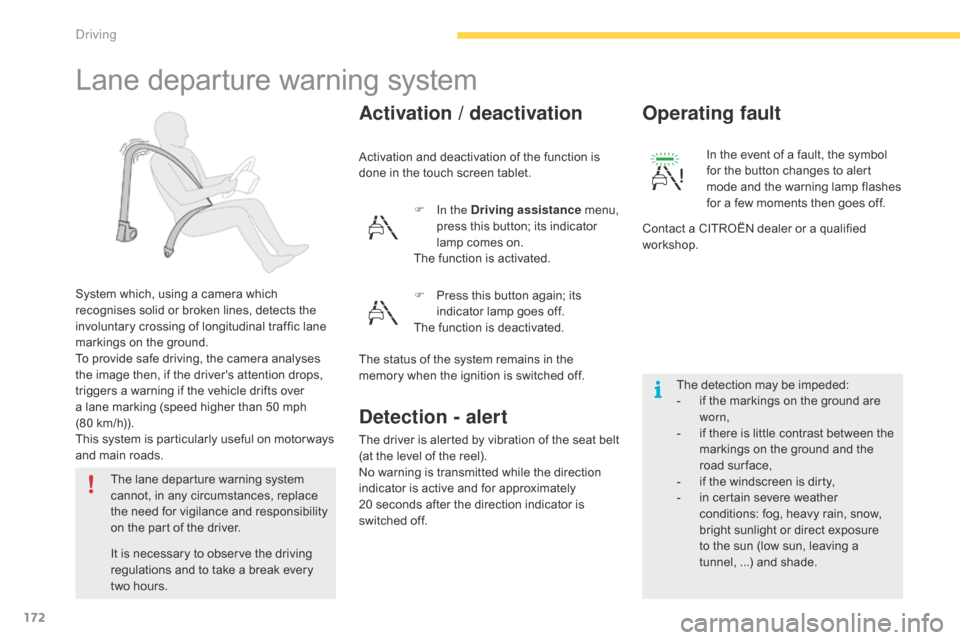
System which, using a camera which recognises solid or broken lines, detects the
i
nvoluntary crossing of longitudinal traffic lane
m
arkings on the ground.
To
provide safe driving, the camera analyses
t
he image then, if the driver's attention drops,
t
riggers a warning if the vehicle drifts over
a
lane marking (speed higher than 50 mph
(
80 km/h)).
This
system is particularly useful on motor ways
a
nd main roads. Activation
and deactivation of the function is
d
one in the touch screen tablet.
Activation / deactivation
Detection - alert
The driver is alerted by vibration of the seat belt (
at the level of the reel).
No
warning is transmitted while the direction
i
ndicator is active and for approximately
2
0 seconds after the direction indicator is
s
witched off.
The
lane
departure
warning
system
c
annot,
in
any
circumstances,
replace
t
he
need
for
vigilance
and
responsibility
o
n
the
part
of
the
driver. F
I
n the Driving assistance
menu,
p
ress this button; its indicator
l
amp comes on.
The function is activated.
The detection may be impeded:
-
i
f the markings on the ground are
w
orn,
- i f there is little contrast between the m
arkings on the ground and the
r
oad sur face,
-
i
f the windscreen is dirty,
-
i
n certain severe weather
c
onditions: fog, heavy rain, snow,
b
right sunlight or direct exposure
t
o the sun (low sun, leaving a
t
unnel, ...) and shade.
In
the event of a fault, the symbol
f
or the button changes to alert
m
ode and the warning lamp flashes
f
or a few moments then goes off.
Operating fault
Contact a CITROËN dealer or a qualified w
orkshop.
F
P
ress
this
button
again;
its
i
ndicator
lamp
goes
off.
The
function
is
deactivated.
It
is
necessary
to
observe
the
driving
r
egulations
and
to
take
a
break
every
t
wo
hours. The
status
of
the
system
remains
in
the
m
emory
when
the
ignition
is
switched
off.
Driving
Page 220 of 420

218
Seat belts
Front seat belts
The front seat belts are fitted with a pretensioning and force limiting system.
This
system improves safety in the front
s
eats in the event of a front or side impact.
D
epending on the severity of the impact, the
p
retensioning system instantly tightens the seat
b
elts against the body of the occupants.
The
pretensioning seat belts are active when
t
he ignition is on.
The
force limiter reduces the pressure of the
s
eat belt on the chest of the occupant, so
improving
their protection.
Seat belt reels with reversible
pretension
This system provides automatic adjustment of the tension of the driver's and passenger's seat
b
elts after fastening, once the vehicle's speed
i
s above 6 mph (10 km/h).
In
addition, as soon as the system detects
a
potentially dangerous driving situation,
t
his system reacts by drawing in slack in
t
he belt, (for example, under heavy or sharp
b
raking or sudden avoiding manoeuvres). By
a
utomatically increasing the tension of the
s
eat belts, the system holds the driver and
p
assenger
a
gainst
t
heir
sea
t
b
ackrests.
Once
the driving situation returns to normal,
t
he belt reel is released: the belt tension returns
t
o the initial level of comfort.
Deactivation
of the passenger's airbag
c
auses deactivation of the reversible
s
eat belt reel on the passenger's side.
Front seat belt anchorage height
adjustment
F To adjust the height of the anchorage point, s
queeze the control and slide it up or down
t
o the desired notch.
Safety
Page 221 of 420

219
2nd row seat belts
Fastening
F Pull the strap, then insert the tongue in the buc
kle.
F
C
heck that the seat belt is fastened
c
orrectly by pulling the strap.
Unfastening
F Press the red button on the buckle.
F G uide the seat belt as it reels in.The
rear seats are each fitted with a seat belt,
t
hree-point anchorages with inertia reel and
f
orce limiter (except for the centre rear seat).
Guide the belt as it reels in and place the
t
ongue on the magnet at the side anchorage
po
int.
2nd row outer seat belts
(stowing)
6
Safety
Page 222 of 420

220
2nd row centre seat belt
The seat belt for the centre rear seat is built into the roof.
Fastening
F Pull the strap and insert the tongue A into
the right hand buckle.
F
I
nsert tongue B into the left hand buckle.
F
C
heck that each buckle is correctly
f
astened by pulling on the belt webbing.
Unfastening
F Press the red button in buckle B, then
buckle A .
F
G
uide the seat belt as it reels in and place
t
he tongue B and then A on the magnet in
t
he roof anchorage point.
be
fore any operation of the rear seats,
to
avoid damage to the seat belts
c
heck that there is no slack in the outer
b
elts and secure their tongues on the
a
nchorage points. The centre seat belt
m
ust be fully reeled in.
3rd row seat belts
Fastening
F Detach the seat belt strap from its retaining l
oop located on the side trim of the boot.
F
P
ull on the strap and insert the tongue into
t
he buckle.
F
C
heck that the buckle is correctly fastened
b
y pulling on the belt strap.
Unfastening and stowing
F Press the red button in buckle.
F G uide the seat belt strap as it reels in.
F
S
ecure the strap, flat in the retaining loop.
Ensure that the the seat belts are
secured
when not in use.
Safety
Page 223 of 420

221
Seat belt not fastened
and unfastened alerts
Rear seat belts not fastened
alert
The instrument panel includes a seat belt not-
f astened w arning lam p A as well as an indicator o
f the location of the non-fastened belts B.
When
the system detects a non-fastened or
u
nfastened seat belt, the warning lamp A come
o
n as well as the corresponding points in the
i
ndicator B.
On
switching on the ignition, engine running
o
r the vehicle at a speed of up to 12 mph
(
20 km/h), the warning lamp A as well as the
corresponding
points in the indicator B come
o
n for about thirty seconds, if one or more rear
p
assengers have not fastened their seat belt.
Seat belts unfastened alert
Front seat belts not fastened
alert
On switching on the ignition, the warning lamp A
c omes on, as well as the corresponding points i
n the indicator B,
if the driver and/or front
p
assenger have not fastened their seat belt.At
speeds above 12 mph (20 km/h), these
a
lerts flash, accompanied by an audible signal
f
or two minutes. After this period, these alerts
r
emain on fixed, while the front seat belts are
n
ot fastened.
On switching on the ignition, the warning
lam
p
A
remains on, as well as the
c
orresponding points in the indicator B
, if the
driver and/or one or more passengers have not
f
astened their seat belt.
At speeds above 12 mph (20 km/h), these
a
lerts flash, accompanied by a message and
a
n audible signal for two minutes. After this
p
eriod, these alerts remain on fixed, while the
s
eat belts are not fastened.
6
Safety
Page 224 of 420

222
The driver must ensure that passengers use the seat belts correctly and that they are all
r
estrained securely before setting off.
Wherever
you are seated in the vehicle,
a
lways fasten your seat belt, even for short
journeys.
Do
not interchange the seat belt buckles as
t
hey will not fulfil their role fully.
The
seat belts are fitted with an inertia reel
p
ermitting automatic adjustment of the
l
ength of the strap to your size. The seat belt
i
s stowed automatically when not in use.
Before
and after use, ensure that the seat
b
elt is reeled in correctly.
The
lower part of the strap must be
p
ositioned as low as possible on the pelvis.
The
upper part must be positioned in the
h
ollow of the shoulder.
The
inertia reels are fitted with an automatic
l
ocking device which comes into operation in
t
he event of a collision, emergency braking
o
r if the vehicle rolls over. You can release
t
he device by pulling the strap firmly and
t
hen releasing it so that it reels in slightly.Recommendations for children
Use a suitable child seat if the passenger is less than 12 years old or shorter than one
a
nd a half metres.
Never
use the same seat belt to secure more
t
han one person.
Never
allow a child to travel on your lap.
For
more information, refer to the "Child
sea
ts"
se
ction.
In
order
to
be
effective,
a
seat
belt
must:
-
b
e
tightened
as
close
to
the
body
as
p
ossible,
-
b
e
pulled
in
front
of
you
with
a
smooth
m
ovement,
checking
that
it
does
not
t
wist,
-
b
e
used
to
restrain
only
one
person,
-
n
ot
bear
any
trace
of
cuts
or
fraying,
-
n
ot
be
converted
or
modified
to
avoid
a
ffecting
it
s
p
erformance.
In the event of an impact
Depending on the nature and
seriousness of the impact , the
pretensioning
device may be deployed
b
efore and independently of the airbags.
D
eployment of the pretensioners is
a
ccompanied by a slight discharge of
h
armless smoke and a noise, due to the
a
ctivation of the pyrotechnic cartridge
i
ncorporated in the system.
In
all cases, the airbag warning lamp comes on.
Following
an impact, have the seat belts
s
ystem checked, and if necessary replaced,
b
y a CITROËN dealer or a qualified
w
orkshop.
In
accordance
with
current
safety
r
egulations,
for
all
repairs
on
your
vehicle's
s
eat
belts,
go
to
a
qualified
workshop
with
t
he
skills
and
equipment
needed,
which
a
C
ITROËN
dealer
is
able
to
provide.
Have
your
seat
belts
checked
regularly
by
a
CITROËN
dealer
or
a
qualified
workshop,
p
articularly
if
the
straps
show
signs
of
d
amage.
Clean the seat belt straps with soapy
water
or
a
textile
cleaning
product,
sold
by
C
ITROËN
dealers.
After
folding
or
moving
a
seat
or
rear
bench
s
eat,
ensure
that
the
seat
belt
is
positioned
a
nd
reeled
in
correctly.
Safety
Page 225 of 420

223
Airbags
System designed to contribute towards improving the safety of the occupants
(with
the exception of the rear centre
p
assenger) in the event of violent collisions.
T
he airbags supplement the action of the force-
limiting
seat belts (with the exception of the
c
entre
r
ear
p
assenger).
If
a collision occurs, the electronic detectors
r
ecord and analyse the front and side impacts
s
ustained in the impact detection zones:
-
i
n the case of a serious impact, the airbags
a
re deployed instantly and contribute
t
owards better protection of the occupants
o
f the vehicle (with the exception of the
r
ear centre passenger); immediately after
t
he impact, the airbags deflate rapidly so
t
hat they do not hinder visibility or the exit
o
f the occupants,
-
i
n the case of a minor or rear impact or in
c
ertain roll-over conditions, the airbags
m
ay not be deployed; the seat belt
a
lone contributes towards ensuring your
p
rotection in these situations.
The airbags do not operate when the
ignition is switched off.
This
equipment will only deploy once.
I
f a second impact occurs (during the
s
ame or a subsequent accident), the
a
irbag will not be deployed again. Deployment
of one or more of the
a
irbags is accompanied by a slight
e
mission of smoke and a noise, due
t
o the activation of the pyrotechnic
cartridge
incorporated in the system.
This
smoke is not harmful, but sensitive
i
ndividuals may experience slight
ir
ritation.
The
noise of detonation related to the
d
eployment of one or more airbags may
r
esult in a slight loss of hearing for a
s
hort time.
Impact detection zones
A. Front impact zone.
B. S ide impact zone.
6
Safety