Page 140 of 401

138
System which automatically maintains the
speed of the vehicle at the value programmed
by the driver, without any action on the
accelerator pedal.The controls of this system are grouped
together on stalk A.
1.
C
ruise control mode selection thumb
wheel.
2.
V
alue decrease button.
3.
V
alue increase button.
4.
C
ruise control off/resume button.Steering mounted controlsDisplays in the instrument panel
The programmed information is grouped
together in the instrument panel screen.
5.
C
ruise control off/resume indication.
6.
C
ruise control mode selection indication.
7.
P
rogrammed speed value.
The cruise control cannot, in any circumstances,
replace the need to respect speed limits, nor can it
replace the need for vigilance on the part of the driver.
Cruise control
The cruise control is switched on manually: it
requires a minimum vehicle speed of 25 mph
(40 km/h), as well as the engagement of:
-
f
ourth gear on a manual gearbox,
-
s
econd gear on a or automatic or electronic
gearbox, in sequential mode,
-
position A on an electronic gearbox or
position D on an automatic gearbox.
The cruise control is switched off manually
or by pressing the brake or clutch pedal or on
triggering of the trajectory control systems for
safety reasons.
It is possible to exceed the programmed speed
temporarily by pressing the accelerator pedal.
To return to the programmed speed, simply
release the accelerator pedal.
Switching off the ignition cancels any
programmed speed value.
driving
Page 141 of 401
139
Programming
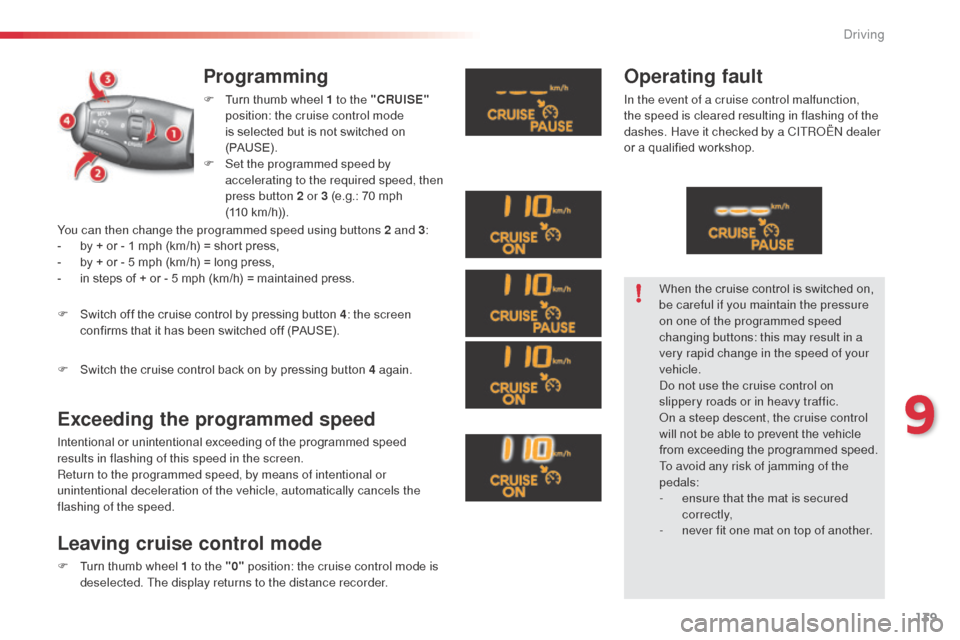
F Turn thumb wheel 1 to the "CRUISE"
position: the cruise control mode
is selected but is not switched on
(PAUS E).
F
S
et the programmed speed by
accelerating to the required speed, then
press button 2 or 3 (e.g.: 70 mph
(110 km/h)).
Exceeding the programmed speed
Intentional or unintentional exceeding of the programmed speed
results in flashing of this speed in the screen.
Return to the programmed speed, by means of intentional or
unintentional deceleration of the vehicle, automatically cancels the
flashing of the speed.
Leaving cruise control mode
F Turn thumb wheel 1 to the "0" position: the cruise control mode is
deselected. The display returns to the distance recorder.
F
S
witch off the cruise control by pressing button 4
: the screen
confirms that it has been switched off (PAUSE).
F
S
witch the cruise control back on by pressing button 4 again.
Operating fault
In the event of a cruise control malfunction,
the speed is cleared resulting in flashing of the
dashes. Have it checked by a CITR
oËn
dealer
or a qualified workshop.
When the cruise control is switched on,
be careful if you maintain the pressure
on one of the programmed speed
changing buttons: this may result in a
very rapid change in the speed of your
vehicle.
do n
ot use the cruise control on
slippery roads or in heavy traffic.
on a s
teep descent, the cruise control
will not be able to prevent the vehicle
from exceeding the programmed speed.
To avoid any risk of jamming of the
pedals:
-
e
nsure that the mat is secured
c o r r e c t l y,
-
n
ever fit one mat on top of another.
You can then change the programmed speed using buttons 2 and 3
:
-
b
y + or - 1 mph (km/h) = short press,
-
b
y + or - 5 mph (km/h) = long press,
-
i
n steps of + or - 5 mph (km/h) = maintained press.
9
Driving
Page 166 of 401
164
never store bottles of adbl ue® in your
vehicle.
a
d
blu
e
® freezes at about -11°C and
deteriorates above 25°C. It is recommended
that bottles be stored in a cool area and
protected from direct sunlight.
Under these conditions, the additive can be
kept for at least a year.
If the additive has frozen, it can be used once it
has completely thawed out.
Recommendations on storage
before topping-up, ensure that the vehicle is
parked on a flat and level sur face.
In wintry conditions, ensure that the
temperature of the vehicle is above -11°C.
Other wise, by freezing, the AdBlue
® cannot
be poured into its tank. Park your vehicle in a
warmer area for a few hours to allow the top-up
to be carried out.
Procedure
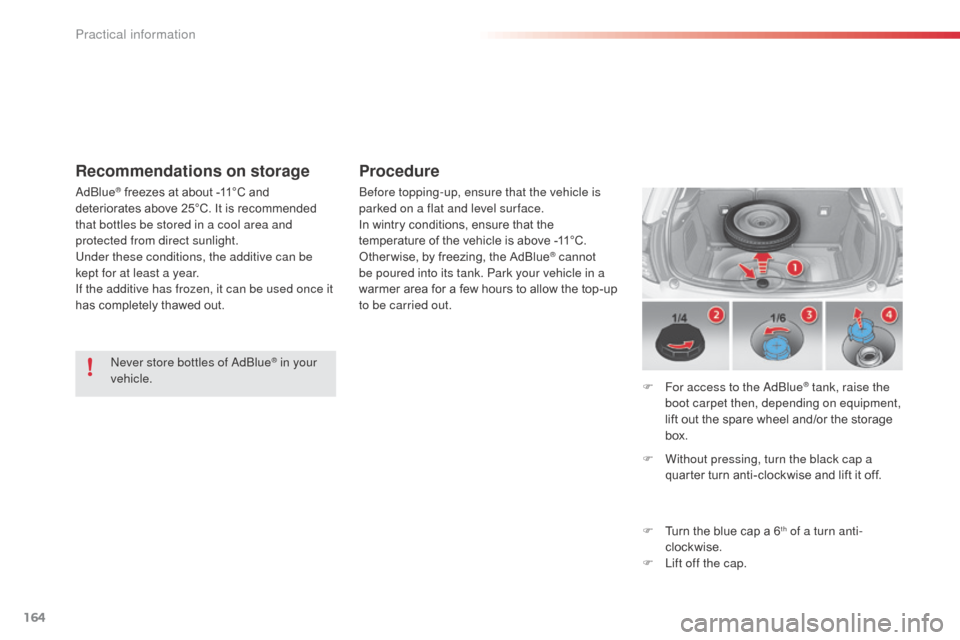
F For access to the adbl ue® tank, raise the
boot carpet then, depending on equipment,
lift out the spare wheel and/or the storage
box.
F
W
ithout pressing, turn the black cap a
quarter turn anti-clockwise and lift it off.
F
T
urn the blue cap a 6
th of a turn anti-
clockwise.
F
L
ift off the cap.
Practical information
Page 167 of 401

165
F obtain a bottle of adbl ue®. after first
checking the use-by date, read carefully
the instructions on use on the label before
pouring the contents of the bottle into your
vehicle's
a
d
blu
e
® tank.
Important : if your vehicle's
a
d
blu
e
® tank is completely empty -
w
hich is confirmed by the alert
messages and the impossibility of
starting the engine, you must add at
least 3.8 litres (so two 1.89 litre bottles). If any additive is split or splashed, wash
immediately with cold water or wipe with
a damp cloth.
If the additive has crystallised, clean it
off using a sponge and hot water.
Important: in the event of a top-
up after a breakdown because of
a lack of additive
, you must wait
around 5 minutes before switching
on the ignition, without opening the
driver's door, locking the vehicle or
introducing the key into the ignition
switch .
Switch on the ignition, then, after
10 seconds, start the engine.
ne
ver dispose of a
dbl
ue
® additive
bottles in the household waste. Place
them in a special container provided
this purpose or take them to your dealer.
F
A
fter emptying the bottle, wipe away any
spillage around the tank filler using a damp
cloth.
F
R
efit the blue cap to the tank and turn it a
6th of a turn clockwise, to its stop.
F
R
efit the black cap and turn it a quarter of
a turn clockwise without pressing. Ensure
that the indicator on the cap lines up with
the indicator on the support.
F
d
e
pending on equipment, return the spare
wheel and/or the storage box to the bottom
of the boot.
F
R
efit the boot carpet and close the tailgate.
11
Practical information
Page 168 of 401
166
Temporary puncture repair kit
Composition of the kit
1. 12 V compressor, with integral pressure gauge.
2.
S
ealant cartridge, with integral hose.
3.
Spe
ed limit sticker.
Access to the kit
This kit is installed in the storage box, under the
boot floor.
The speed limit sticker must be secured
to the interior of the vehicle in the
driver's field of vision, to remind you
that a wheel is in temporary use.
Complete system consisting of a compressor
and a sealant cartridge which permits
temporary repair
of a tyre so that you can
drive to the nearest garage.
It is designed to repair most punctures which
could affect the tyre, located on the tyre tread
or shoulder.
Do not exceed a speed of 50 mph
(80 km/h) when driving with a tyre
repaired using this type of kit.
The vehicle's electric system allows the
connection of a compressor for long
enough to inflate a tyre after a puncture
repair or for inflating a small inflatable
accessory.
Practical information
Page 173 of 401

171
Changing a wheel
The tools are stowed in the boot under the
f l o o r.
To gain access to them:
F
o
pen the boot,
F
r
aise the floor,
F
r
emove the polystyrene storage box,
F
u
nclip and remove the box containing the
tools.
Access to the tools
Procedure for changing a faulty wheel for the spare wheel using the tools provided with the vehicle.
List of tools
1. Wheelbrace. F
or removing the wheel trim and removal of
the wheel fixing bolts.
2.
J
ack with integral handle.
F
or raising of the vehicle.
3.
"bo
lt cover" tool.
F
or removing the bolt protectors (covers)
on alloy wheels.
4.
S
ocket for the security wheel bolts (located
in the glove box).
F
or adapting the wheelbrace to the special
"security" wheel bolts (if your vehicle has
them).
al
l of these tools are specific to your
vehicle.
d
o n
ot use them for other
purposes.
ne
ver use a jack other than the one
listed by the manufacturer. If the vehicle
does not have one, contact a CITR
oËn
dealer or a qualified workshop to obtain
a jack intended for the the vehicle.
11
Practical information
Page 174 of 401
172
Wheel with trim
When removing the wheel, first
detach the trim using the wheelbrace 1
pulling at the valve passage hole.
When refitting the wheel , refit the
trim starting by placing its cut-out at the
valve and press around its edge with
the palm of your hand.
Access to the spare wheel
The spare wheel is installed in the boot under
t h e f l o o r.
According to country, the spare wheel may be
steel or of the "space-saver" type.
To gain access to it, refer to the paragraph
"
ac
cess to the tools" on the previous page.
Fitting the steel or "space-
saver" type spare wheel
If your vehicle is fitted with alloy wheels,
it is normal to notice, when tightening
the bolts on fitting, that the washers do
not come into contact with the steel or
"space-saver" type spare wheel. The
wheel is secured by the conical contact
of each bolt.
Practical information
Page 175 of 401
173
Taking out the wheel
F Unscrew the yellow central bolt.
F R aise the spare wheel towards you from
the rear.
F
T
ake the wheel out of the boot.
Putting the wheel back in place
F Put the wheel back in its housing.
F U nscrew the yellow central bolt by a few
turns then put it in place in the centre of the
wheel.
F
T
ighten fully until the central bolt clicks to
retain the wheel correctly. F
P ut the box back in place in the centre of
the wheel and clip it.
F
P
ut the polystyrene storage box back in
place.
F
R
efit the boot floor carpet by lightly folding
it in two (refer to the "Boot fittings" section).
On vehicles equipped with a "space-
saver" type spare wheel, the punctured
wheel cannot be stowed in place of the
"space-saver" wheel.
11
Practical information


