Page 6 of 271
4
C1_en_Chap00b_vue-ensemble_ed01-2015
Exterior
102
81 91
33
Electronic key: Keyless
Entry and Starting
This system allows the locking, unlocking and
starting the vehicle by keeping the key on your
person and in the recognition zone.
Stop & Start
This system puts the engine temporarily
into standby during stops in the traffic (red
lights, traffic jams, etc...). The engine restarts
automatically as soon as you want to move
off. The Stop & Start system reduces fuel
consumption, exhaust emissions and the noise
level when stationary.
Under-inflation detection
This system automatically checks the tyre
pressures when driving and alerts you in the
event of an under-inflated tyre.
Active City Brake
The aim of this system is to avoid a frontal
collision or reduce the speed of impact if the
driver fails to react or reacts too late.
Lane departure warning
system
This system gives a warning if you inadvertently
cross a longitudinal road marking. 108
Over view
Page 11 of 271

9
C1_en_Chap00c_eco-conduite_ed01-2015
Limit the causes of excess consumption
Spread loads throughout the vehicle; place the heaviest items in the
bottom of the boot, as close as possible to the rear seats.
Limit the loads carried in the vehicle and reduce wind resistance
(roof bars, roof rack...). Use a roof box in preference.
Remove roof bars and roof racks after use.
At the end of winter, remove snow tyres and refit your summer tyres.
Observe the recommendations on
maintenance
Check the tyre pressures regularly, when cold, referring to the label in
the door aperture, driver's side.
Carry out this check in particular:
-
b
efore a long journey,
-
a
t each change of season,
-
a
fter a long period out of use.
Don't forget the spare wheel and the tyres on any trailer or caravan.
Have your vehicle serviced regularly (engine oil, oil filter, air filter,
passenger compartment filter...) and observe the schedule of
operations recommended in the maintenance and warranty guide.
When refuelling, do not continue after the third cut-off of the nozzle to
avoid any over flow.
At the wheel of your new vehicle, it is only after the first 1 800 miles
(3
000 kilometres) that you will see the fuel consumption settle down to
a consistent average.
.
Eco-driving
Page 20 of 271
18
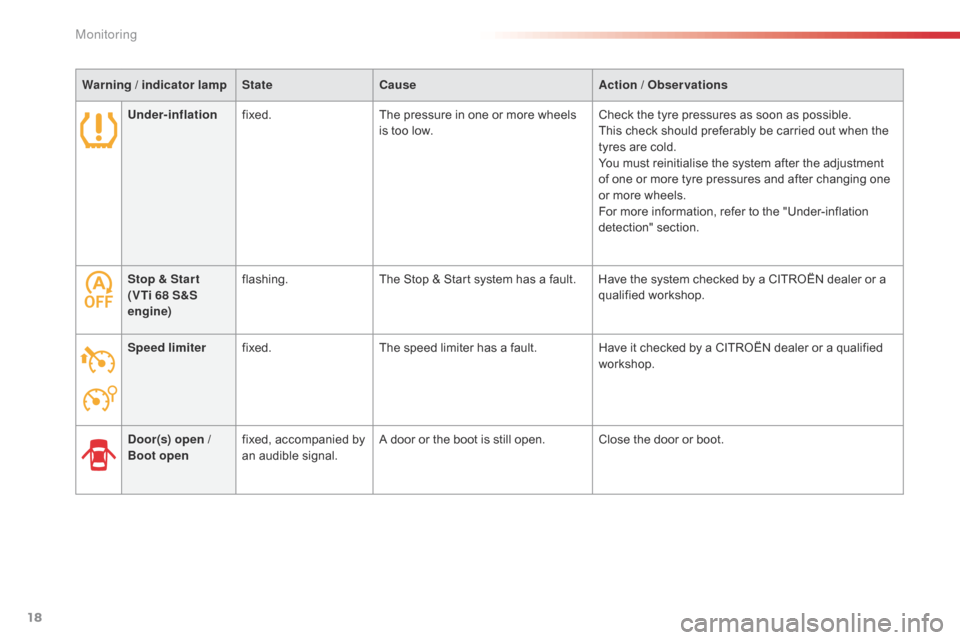
Stop & Star t
(VTi 68 S&S
engine)flashing.
The Stop & Start system has a fault. Have the system checked by a CITROËN dealer or a
qualified workshop.
Speed limiter fixed. The speed limiter has a fault. Have it checked by a CITROËN dealer or a qualified
workshop.
Door(s) open
/
Boot open fixed, accompanied by
an audible signal. A door or the boot is still open. Close the door or boot.
Warning
/ indicator lamp
State Cause Action
/ Observations
Under-inflation fixed. The pressure in one or more wheels
is too low. Check the tyre pressures as soon as possible.
This check should preferably be carried out when the
tyres are cold.
You must reinitialise the system after the adjustment
of one or more tyre pressures and after changing one
or more wheels.
For more information, refer to the "Under-inflation
detection" section.
Monitoring
Page 104 of 271

102
C1_en_Chap07_securite_ed01-2015
Under-inflation detection
The system monitors the pressures in the four
tyres, once the vehicle is moving.
It compares the information given by the four
wheel speed sensors with reference values,
which must be reinitialised ever y time the
tyre pressures are adjusted or a wheel
changed.
The system triggers an alert as soon as it
detects a drop in the inflation pressure of one
or more tyres. The under-inflation detection system
does not replace the need for vigilance
on the part of the driver.
This system does not avoid the need to
check the tyre pressures (including the
spare wheel) every month as well as
before a long journey.
Driving with under-inflated tyres impairs
road holding, extends braking distances
and causes premature tyre wear,
particularly under arduous condition
(high loading, high speed, long journey).
System which automatically checks the pressures of the tyres while driving.
Hazard warning
lamps
Visual warning by means of the direction
indicators to alert other road users to a vehicle
breakdown, towing or accident.
F
P
ress this button, the direction indicators
flash.
They can operate with the ignition off.
Safety
Page 105 of 271

103
C1_en_Chap07_securite_ed01-2015
Under-inflation alert
This is given by fixed illumination of
this warning lamp, accompanied by
an audible signal.
F
R
educe speed immediately, avoid
excessive steering movements and sudden
braking.
F
S
top the vehicle as soon as it is safe to do
so.
The loss of pressure detected does not
always cause visible bulging of the tyre.
Do not satisfy yourself with just a visual
check.
F
I
f you have a compressor (such as the one
in the temporary puncture repair kit) check
the pressures of the four tyres when cold.
I
f it is not possible to carry out this check
straight away, drive carefully at reduced
speed.
or
F
I
n the event of a puncture, use the
temporary puncture repair kit or the spare
wheel (depending on equipment).
The alert is maintained until the system
is reinitialised.
Reinitialisation
Before reinitialising the system, ensure
that the pressures of the four tyres are
correct for the use of the vehicle and in
line with the recommendations on the
tyre pressure label.
The under-inflation detection system
does not give a warning if a pressure is
incorrect at the time of reinitialisation.
It is necessary to reinitialise the system every
time one or more tyre pressure is adjusted, and
after changing one or more wheels.
A label attached to the middle pillar, driver's
side, gives a reminder of this.
The inflation pressures defined for
your vehicle can be found on the tyre
pressure label.
See the "Identification markings"
section.
Tyre pressures should be checked
when the tyres are "cold" (vehicle
stopped for 1 hour or after a journey of
less than 6 miles (10 km) at moderate
speeds).
Other wise (when hot), add 0.3 bar to
the pressures shown on the label. Driving with under-inflated tyres
increases fuel consumption.
7
Safety
Page 106 of 271

104
C1_en_Chap07_securite_ed01-2015
Reinitialisation of the system is done with the
ignition on (ignition switch in the " ON" position
or " ON" mode) and the vehicle stationary.
F
O
pen the glove box.
F
P
ress the reinitialisation button.
The new pressure settings registered
are considered to be reference values by
the
system. F
T
his warning lamp flashes
3
times in the instrument panel
when the reinitialisation is done.
F
W
ait a few minutes before switching off
the ignition (ignition switch in the " ACC" or
" LOCK " position, or " OFF" mode).
Operating fault
The flashing and then fixed illumination
of the under-inflation warning lamp
indicates a fault with the system.
In this case, under-inflation monitoring of the
tyres is no longer assured.
Have the system checked by a CITROËN
dealer or a qualified workshop.
Before doing anything to the system,
the pressures of the four tyres must be
checked and the system reinitialised.
The under-inflation alert can only be
considered reliable if reinitialisation of
the system is done with the the four tyre
pressures correctly set.Snow chains
The system does not have to be
reinitialised after fitting or removing
snow chains.
Safety
Page 143 of 271
141
C1_en_Chap09_info-pratiques_ed01-2015
F Place the switch in the "O" position.
F R emove the kit.
F
D
rive immediately for approximately
three miles (five kilometres), at reduced
speed (between 15 and 35 mph (20 and
60
km/h)), to plug the puncture.
F
S
top to check the repair and the tyre
pressure using the kit.
Checking / adjusting tyre pressures
F Check that the compressor switch is at the "O " position.
F
U
ncoil fully the electric cable, stowed under
the compressor.
F
C
onnect the compressor's plug to the
vehicle's 12 V socket.
F
S
witch on the ignition.
You can also use the compressor, without
injecting sealant, to check and if necessary
adjust the tyre pressures.
F
R
emove the valve cap from the tyre and
place it in a clean area.
F
U
ncoil the pipe stowed under the
compressor.
F
S
crew the pipe onto the valve and tighten
f i r m l y.
9
Practical information
Page 146 of 271

144
C1_en_Chap09_info-pratiques_ed01-2015
Access to the spare wheel
and tools
Tools provided
The following tools are installed in a carrier,
located in the centre of the spare wheel:
1.
Wheelbrace
2.
J
ack with handle
3.
R
emovable towing eye.
Refer to the "Towing the vehicle" section.
Tyre pressures
These are indicated on the label affixed to the
middle pillar of the left door, driver's side.
Refer to the "Identification markings" section. All of these tools are specific to your
vehicle and can vary according to
equipment. Do not use them for any
other purposes.
Never go underneath a vehicle
supported only by a jack (use an axle
stand).
Never use a jack other than the one
listed by the manufacturer. If your
vehicle does not have one, contact
a CITROËN dealer or a qualified
workshop to obtain the correct jack for
your vehicle.
Depending on version, the spare wheel and
tools are stowed in the boot under the floor.
F
R
emove the boot carpet.
F
R
emove the tool carrier.
F
S
lacken the central wheel retaining bolt.
F
R
emove the wheel.
Practical information