Page 652 of 726
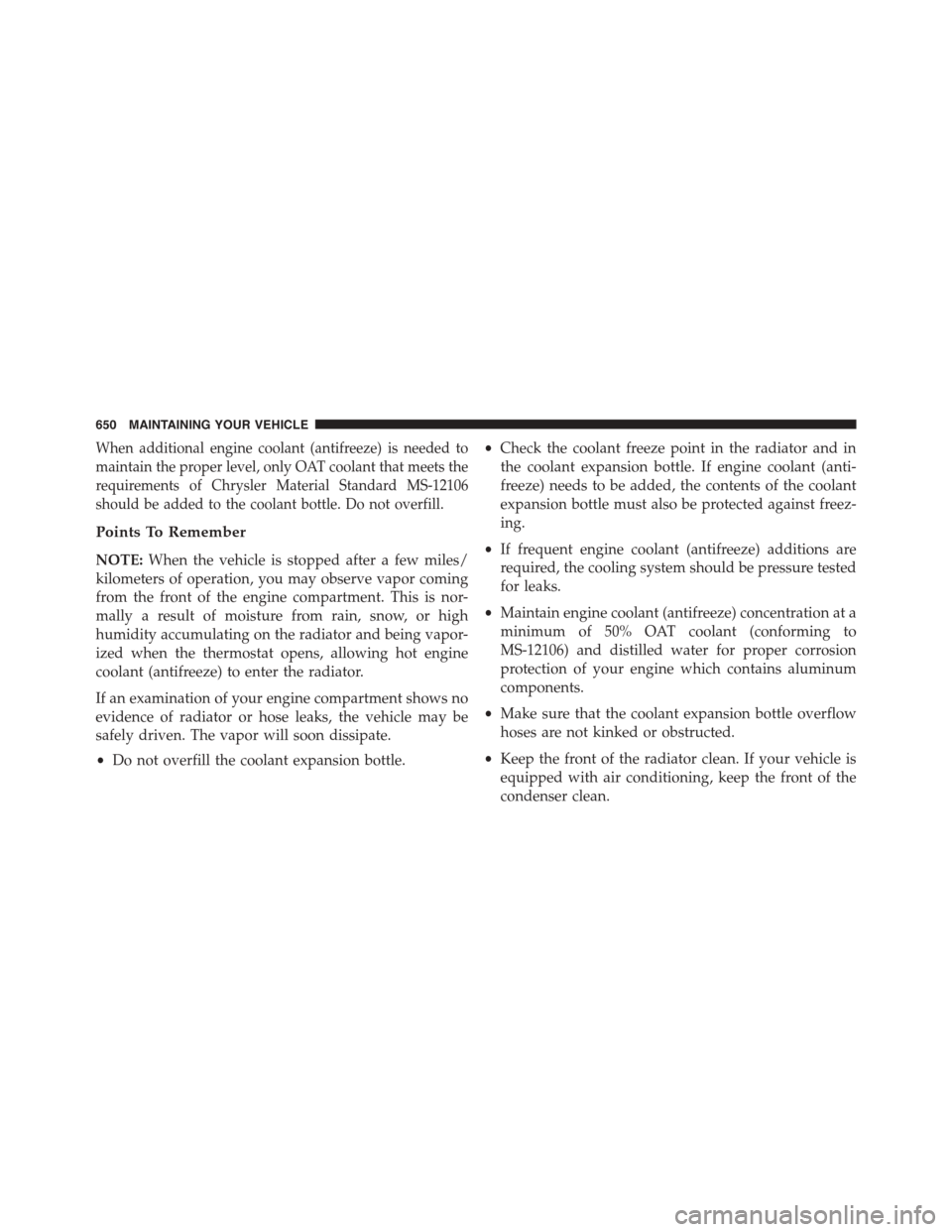
When additional engine coolant (antifreeze) is needed to
maintain the proper level, only OAT coolant that meets the
requirements of Chrysler Material Standard MS-12106
should be added to the coolant bottle. Do not overfill.
Points To Remember
NOTE:When the vehicle is stopped after a few miles/
kilometers of operation, you may observe vapor coming
from the front of the engine compartment. This is nor-
mally a result of moisture from rain, snow, or high
humidity accumulating on the radiator and being vapor-
ized when the thermostat opens, allowing hot engine
coolant (antifreeze) to enter the radiator.
If an examination of your engine compartment shows no
evidence of radiator or hose leaks, the vehicle may be
safely driven. The vapor will soon dissipate.
•Do not overfill the coolant expansion bottle.
•Check the coolant freeze point in the radiator and in
the coolant expansion bottle. If engine coolant (anti-
freeze) needs to be added, the contents of the coolant
expansion bottle must also be protected against freez-
ing.
•If frequent engine coolant (antifreeze) additions are
required, the cooling system should be pressure tested
for leaks.
•Maintain engine coolant (antifreeze) concentration at a
minimum of 50% OAT coolant (conforming to
MS-12106) and distilled water for proper corrosion
protection of your engine which contains aluminum
components.
•Make sure that the coolant expansion bottle overflow
hoses are not kinked or obstructed.
•Keep the front of the radiator clean. If your vehicle is
equipped with air conditioning, keep the front of the
condenser clean.
650 MAINTAINING YOUR VEHICLE
Page 653 of 726
•Do not change the thermostat for Summer or Winter
operation. If replacement is ever necessary, install
ONLY the correct type thermostat. Other designs may
result in unsatisfactory engine coolant (antifreeze)
performance, poor gas mileage, and increased emis-
sions.
Brake System
In order to assure brake system performance, all brake
system components should be inspected periodically.
Refer to the “Maintenance Schedule” for the proper
maintenance intervals.
WARNING!
Riding the brakes can lead to brake failure and
possibly a collision. Driving with your foot resting or
riding on the brake pedal can result in abnormally
(Continued)
WARNING!(Continued)
high brake temperatures, excessive lining wear, and
possible brake damage. You would not have your full
braking capacity in an emergency.
Master Cylinder — Brake Fluid Level Check
The fluid level in the master cylinder should be checked
when performing underhood services, or immediately if
the “Brake System Warning Light” indicates system
failure.
Clean the top of the master cylinder area before removing
the cap. Add fluid to bring the level up to the top of the
“FULL” mark on the side of the master cylinder reservoir.
Overfilling of fluid is not recommended because it may
cause leaking in the system.
Add enough fluid to bring the level up to the require-
ments described on the brake fluid reservoir. With disc
7
MAINTAINING YOUR VEHICLE 651
Page 680 of 726
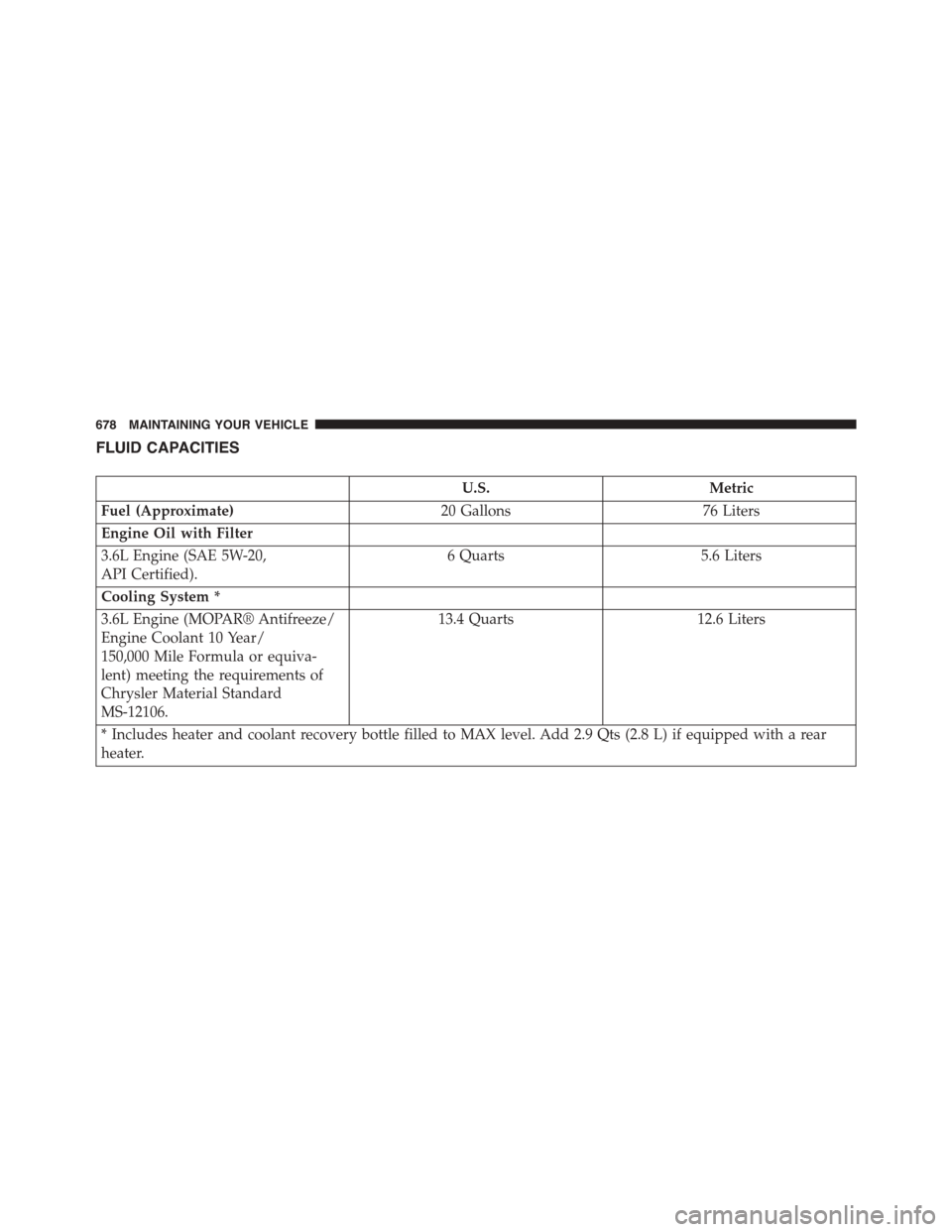
FLUID CAPACITIES
U.S.Metric
Fuel (Approximate)20 Gallons76 Liters
Engine Oil with Filter
3.6L Engine (SAE 5W-20,
API Certified).
6 Quarts5.6 Liters
Cooling System *
3.6L Engine (MOPAR® Antifreeze/
Engine Coolant 10 Year/
150,000 Mile Formula or equiva-
lent) meeting the requirements of
Chrysler Material Standard
MS-12106.
13.4 Quarts12.6 Liters
* Includes heater and coolant recovery bottle filled to MAX level. Add 2.9 Qts (2.8 L) if equipped with a rear
heater.
678 MAINTAINING YOUR VEHICLE
Page 681 of 726
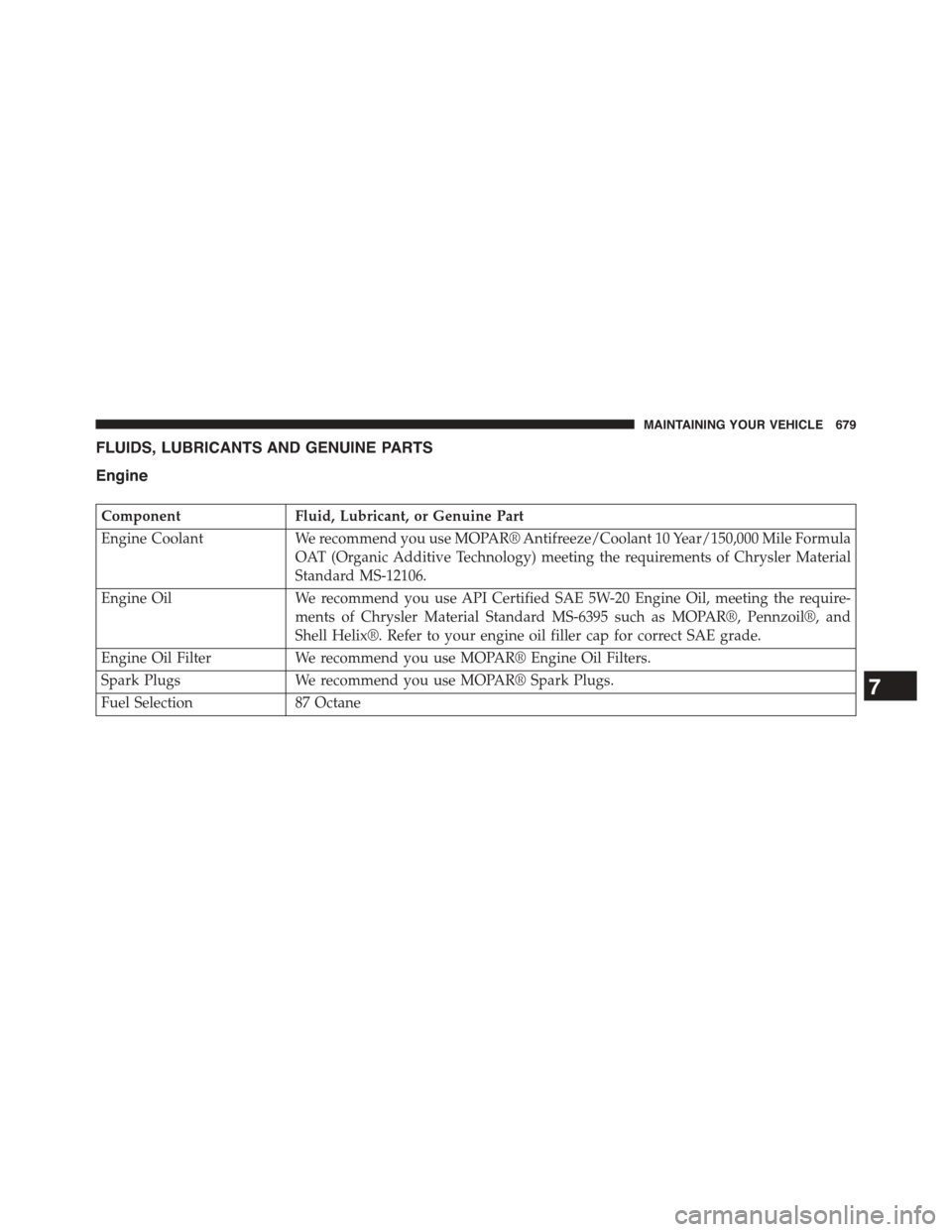
FLUIDS, LUBRICANTS AND GENUINE PARTS
Engine
ComponentFluid, Lubricant, or Genuine Part
Engine CoolantWe recommend you use MOPAR® Antifreeze/Coolant 10 Year/150,000 Mile Formula
OAT (Organic Additive Technology) meeting the requirements of Chrysler Material
Standard MS-12106.
Engine OilWe recommend you use API Certified SAE 5W-20 Engine Oil, meeting the require-
ments of Chrysler Material Standard MS-6395 such as MOPAR®, Pennzoil®, and
Shell Helix®. Refer to your engine oil filler cap for correct SAE grade.
Engine Oil FilterWe recommend you use MOPAR® Engine Oil Filters.
Spark PlugsWe recommend you use MOPAR® Spark Plugs.
Fuel Selection87 Octane7
MAINTAINING YOUR VEHICLE 679
Page 682 of 726
CAUTION!
•Mixing of engine coolant (antifreeze) other than
specified Organic Additive Technology (OAT) en-
gine coolant (antifreeze), may result in engine
damage and may decrease corrosion protection.
Organic Additive Technology (OAT) engine cool-
ant is different and should not be mixed with
Hybrid Organic Additive Technology (HOAT) en-
gine coolant (antifreeze) or any “globally compat-
ible” coolant (antifreeze). If a non-OAT engine
coolant (antifreeze) is introduced into the cooling
system in an emergency, the cooling system will
need to be drained, flushed, and refilled with fresh
OAT coolant (conforming to MS-12106), by an
authorized dealer as soon as possible.
(Continued)
CAUTION!(Continued)
•Do not use water alone or alcohol-based engine
coolant (antifreeze) products. Do not use additional
rust inhibitors or antirust products, as they may not
be compatible with the radiator engine coolant and
may plug the radiator.
•This vehicle has not been designed for use with
propylene glycol-based engine coolant (antifreeze).
Use of propylene glycol-based engine coolant (an-
tifreeze) is not recommended.
680 MAINTAINING YOUR VEHICLE
Page 687 of 726
•Check tire pressure and look for unusual wear or
damage. Rotate tires at the first sign of irregular wear,
even if it occurs before the oil indicator system turns on.
•Check the fluid levels of the coolant reservoir, brake
master cylinder, and power steering and fill as needed.
•Check function of all interior and exterior lights.
Required Maintenance Intervals.
Refer to the maintenance schedules on the following
page for the required maintenance intervals.
At Every Oil Change Interval As Indicated By Oil Change Indicator System:
•Change oil and filter.
•Rotate the tires.Rotate at the first sign of irregular wear, even if it occurs before the oil indicator system
turns on.
•Inspect battery and clean and tighten terminals as required.
•Inspect brake pads, shoes, rotors, drums, hoses and park brake.
•Inspect engine cooling system protection and hoses.
•Inspect exhaust system.
•Inspect engine air cleaner if using in dusty or off-road conditions.
8
MAINTENANCE
SCHEDULES
MAINTENANCE SCHEDULES 685
Page 689 of 726
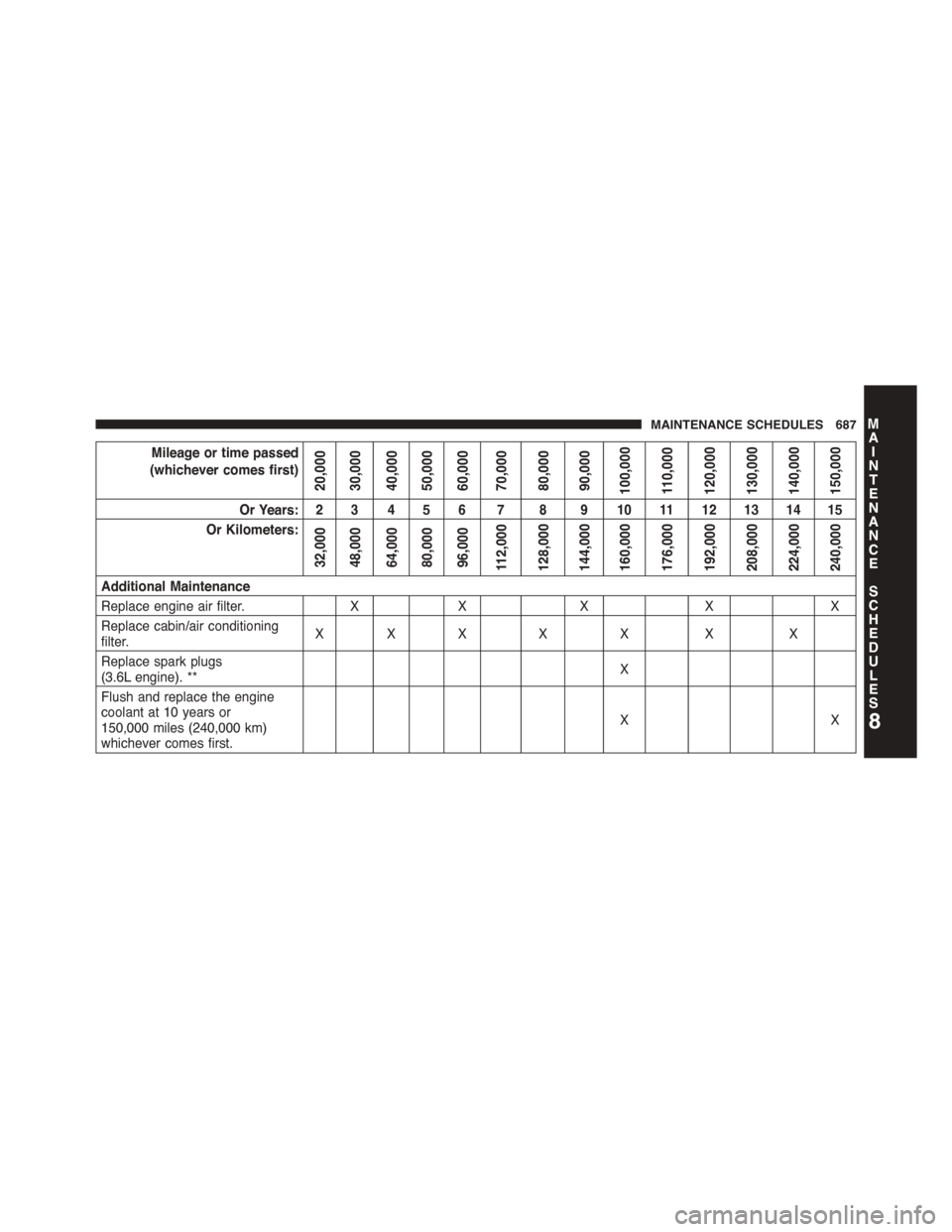
Mileage or time passed
(whichever comes first)
20,00030,00040,00050,00060,00070,00080,00090,000100,000110,000120,000130,000140,000150,000
Or Years: 2 3 4 5 6 7 8 9 10 11 12 13 14 15
Or Kilometers:
32,00048,00064,00080,00096,000112,000128,000144,000160,000176,000192,000208,000224,000240,000
Additional Maintenance
Replace engine air filter.XXXXX
Replace cabin/air conditioningfilter.XXX X X X X
Replace spark plugs(3.6L engine). **X
Flush and replace the enginecoolant at 10 years or150,000 miles (240,000 km)whichever comes first.
XX8
MAINTENANCE
SCHEDULES
MAINTENANCE SCHEDULES 687
Page 704 of 726
About Your Brakes........................503
Adding Engine Coolant (Antifreeze)............647
Adding Fuel.............................560
Adding Washer Fluid......................643
Additives, Fuel...........................554
Adjustable Pedals.........................246
Air bag . . . . . . . . . . . . . . . . . . . . . . . . . . . . . . . . .86
Air Bag
Advance Front Air Bag....................87
Air Bag Components.....................86
Air bag Operation.......................89
Air Bag Warning Light....................98
Enhanced Accident Response................97
Event Data Recorder (EDR)................100
Front Air Bag . . . . . . . . . . . . . . . . . . . . . . . . . . .86
If A Deployment Occurs...................96
Knee Impact Bolsters.....................90
Maintaining Your Air Bag System............100
Side Air Bags...........................91
Air bag Deployment........................86
Air bag Light.............................98
Air bag Maintenance.......................100
Air Cleaner, Engine (Engine Air Cleaner Filter) . . . .635
Air Conditioner Maintenance.................640
Air Conditioning..........................450
Air Conditioning Controls...................450
Air Conditioning Filter.....................470
Air Conditioning, Operating Tips..............469
Air Conditioning, Rear Zone.................455
Air Conditioning Refrigerant.................640
Air Conditioning System....................450
Air Conditioning System, Zone Control..........450
Air Pressure, Tires.........................529
Alarm
Arm The System........................18
Disarm The System.......................19
Tamper Alert...........................20
Alarm Light.............................331
702 INDEX