Page 145 of 180

FREEING A STUCK VEHICLE
If your vehicle becomes stuck in mud, sand or snow, it can often be moved using a rocking motion.
Tu r n t h e s t e e r i n g w h e e l r i g h t a n d l e f t t o c l e a r t h e a r e a a r o u n d t h e f r o n t w h e e l s . T h e n , s h i f t b a c k
and forth between REVERSE and DRIVE, while gently pushing the accelerator. Use the least
amount of accelerator pedal pressure that will maintain the rocking motion, without spinning the
wheels or racing the engine.
NOTE:
•ShiftsbetweenDRIVEandREVERSEcanonlybeachievedatwheelspeedsof5mph(8
km/h) or less. Whenever the transmission remains in NEUTRAL for more than 2 seconds, you
must push the brake pedal to engage DRIVE or REVERSE.
•Pushthe“ESCOff”switch,toplacetheElectronicStabilityControl(ESC)systemin“Partial
Off ” mode, before rocking the vehicle. Once the vehicle has been freed, push the “ESC Off ”
switch again to restore "ESC On" mode.
CAUTION!
•When“rocking”astuckvehiclebyshiftingbetweenREVERSEandDRIVE,donotspin
the wheels faster than 15 mph (24 km/h), or drivetrain damage may result.
•Revvingtheengineorspinningthewheelstoofastmayleadtotransmissionoverheating
and failure. It can also damage the tires. Do not spin the wheels above 30 mph (48 km/h)
while in gear (no transmission shifting occurring).
WARNING!
Fast spinning tires can be dangerous. Forces generated by excessive wheel speeds may cause
tire damage or failure. A tire could explode and injure someone. Do not spin your vehicle's
wheels faster than 30 mph (48 km/h) when you are stuck. Do not let anyone near a spinning
wheel, no matter what the speed.
WHAT TO DO IN EMERGENCIES
143
Page 148 of 180
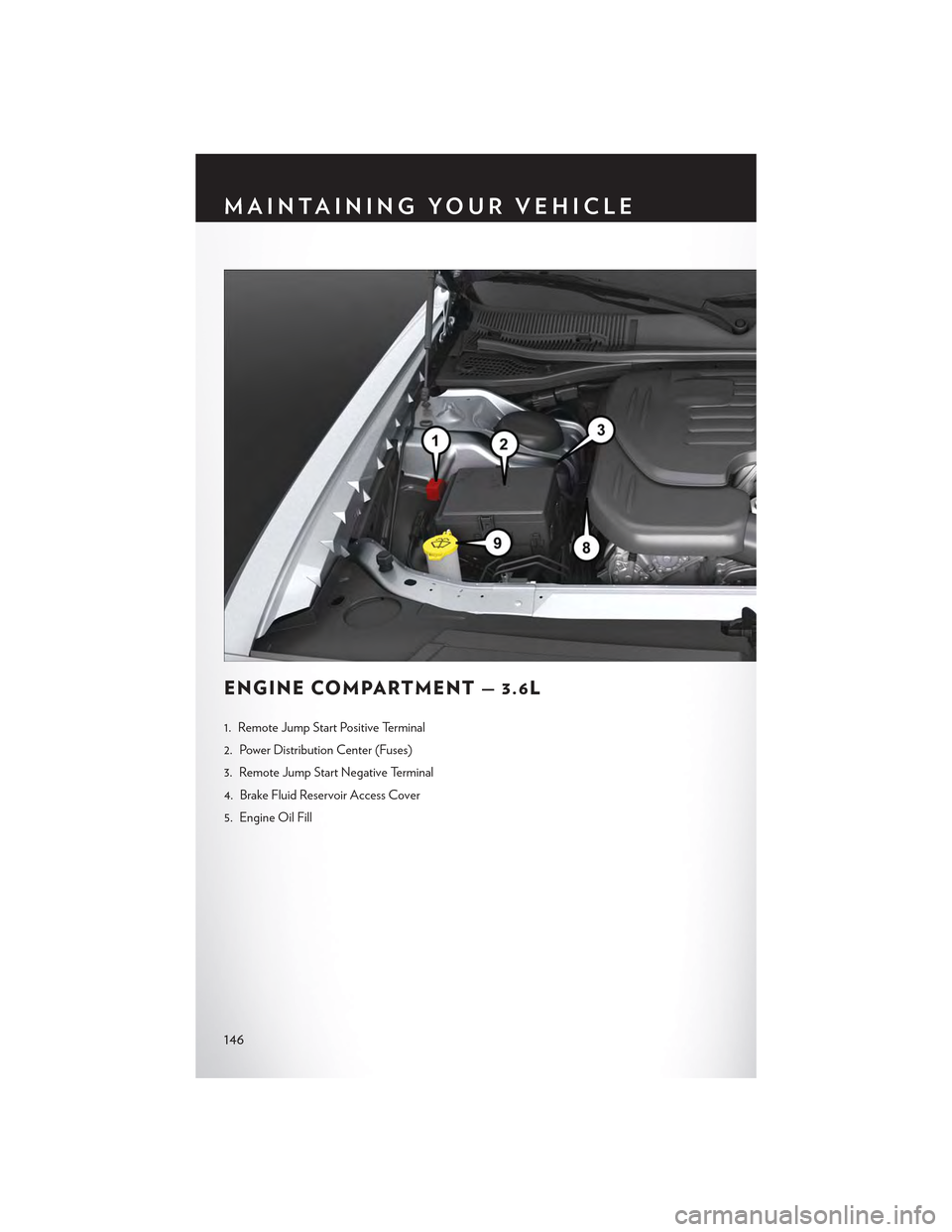
ENGINE COMPARTMENT — 3.6L
1. Remote Jump Start Positive Terminal
2. Power Distribution Center (Fuses)
3. Remote Jump Start Negative Terminal
4. Brake Fluid Reservoir Access Cover
5. Engine Oil Fill
MAINTAINING YOUR VEHICLE
146
Page 150 of 180
ENGINE COMPARTMENT — 5.7L
1. Remote Jump Start Positive Terminal
2. Power Distribution Center (Fuses)
3. Remote Jump Start Negative Terminal
4. Brake Fluid Reservoir Access Cover
5. Engine Oil Fill
MAINTAINING YOUR VEHICLE
148
Page 153 of 180

CAUTION!
•Mixingofenginecoolant(antifreeze)otherthanspecifiedOrganicAdditiveTechnology
(OAT) engine coolant (antifreeze), may result in engine damage and may decrease
corrosion protection. Organic Additive Technology (OAT) engine coolant is different
and should not be mixed with Hybrid Organic Additive Technology (HOAT) engine
coolant (antifreeze) or any “globally compatible” coolant (antifreeze). If a non-OAT
engine coolant (antifreeze) is introduced into the cooling system in an emergency, the
cooling system will need to be drained, flushed, and refilled with fresh OAT coolant
(conforming to MS.90032), by an authorized dealer as soon as possible.
•Donotusewateraloneoralcohol-basedenginecoolant(antifreeze)products.Donotuse
additional rust inhibitors or antirust products, as they may not be compatible with the
radiator engine coolant and may plug the radiator.
•Thisvehiclehasnotbeendesignedforusewithpropyleneglycol-basedenginecoolant
(antifreeze). Use of propylene glycol-based engine coolant (antifreeze) is not recom-
mended.
E-85 FLEXIBLE FUEL — (3.6L ENGINE ONLY )
Refer to your Owner's Manual on the DVD for further details.
CAUTION!
Only vehicles with the E-85 fuel filler door label or a yellow gas cap can operate on E-85.
Chassis
ComponentFluid, Lubricant, Or Genuine Part
Automatic Transmission – 8-Speed Transmis-sionUse only MOPAR® ZF 8&9 Speed ATF™ Auto-matic Transmission Fluid, or equivalent. Failureto use the correct fluid may affect the functionor performance of your transmission.
Brake Master CylinderWe r e c o m m e n d y o u u s e M O PA R ® D OT 3 a n dSAE J1703. If DOT 3 brake fluid is not avail-able, then DOT 4 is acceptable.
Front AxleWe r e c o m m e n d y o u u s e M O PA R ® S y n t h e t i cGear Lubricant SAE 75W90 (API GL-5).
Rear AxleWe r e c o m m e n d y o u u s e M O PA R ® O D S y n -thetic Gear Lubricant SAE 75W85 (API GL-5).
Tr a n s f e r C a s eWe r e c o m m e n d y o u u s e M O PA R ® Tr a n s f e rCase Lubricant for BorgWarner 44–40.
MAINTAINING YOUR VEHICLE
151
Page 154 of 180
MAINTENANCE PROCEDURES
For information on the maintenance procedures for your vehicle, please refer to “Maintenance
Procedures” in “Maintaining Your Vehicle” in your Owner’s Manual or applicable supplement on
the DVD for further details.
MAINTENANCE SCHEDULE
Yo u r v e h i c l e i s e q u i p p e d w i t h a n a u t o m a t i c o i l c h a n g e i n d i c a t o r s y s t e m . T h e o i l c h a n g e i n d i c a t o r
system will remind you that it is time to take your vehicle in for scheduled maintenance.
Based on engine operation conditions, the oil change indicator message will illuminate. This
means that service is required for your vehicle. Operating conditions such as frequent short-trips,
trailer tow, extremely hot or cold ambient temperatures, and E85 fuel usage will influence when
the “Change Oil” or “Oil Change Required” message is displayed. Severe Operating Conditions
can cause the change oil message to illuminate as early as 3,500 miles (5,600 km) since last reset.
Have your vehicle serviced as soon as possible, within the next 500 miles (805 km).
The “Oil Change Required” message will be displayed in the DID and a single chime will sound,
indicating that an oil change is necessary.
Your authorized dealer will reset the oil change indicator message after completing the scheduled
oil change. If a scheduled oil change is performed by someone other than your authorized dealer,
the message can be reset by referring to the steps described under “Instrument Cluster Warning
Lights” in “What To Do In Emergencies” in this guide or “Driver Information Dispay (DID)” in
“Understanding Your Instrument Panel” in your Owners Manual on the DVD for further infor-
mation.
NOTE:
Under no circumstances should oil change intervals exceed 10,000 miles (16,000 km) or twelve
months, whichever comes first.
Severe Duty All Models
Change Engine Oil at 4,000 miles (6,500 km) if the vehicle is operated in a dusty and off road
environment. This type of vehicle use is considered Severe Duty
Once A Month Or Before A Long Trip:
•Checkengineoillevel
•Checkwindshieldwasherfluidlevel
• Check tire pressure and look for unusual wear or damage. Rotate tires at the first sign of
irregular wear, even if it occurs before your next scheduled service.
•Checkthefluidlevelsofthecoolantreservoir,brakemastercylinder,andpowersteering(if
equipped) and fill as needed.
• Check function of all interior and exterior lights
MAINTAINING YOUR VEHICLE
152
Page 155 of 180
Required Maintenance Intervals.
Refer to the maintenance schedules on the following page for the required maintenance
intervals.
At Every Oil Change Interval As Indicated By Oil Change Indicator System:
• Change oil and filter
• Rotate the tires.Rotate at the first sign of irregular wear, even if it occurs before your nextscheduled service
•Inspectbatteryandcleanandtightenterminalsasrequired
•Inspectbrakepads,shoes,rotors,drums,hosesandparkbrake
•Inspectenginecoolingsystemprotectionandhoses
•Inspectexhaustsystem
•Inspectengineaircleanerifusingindustyoroff-roadconditions
MAINTAINING YOUR VEHICLE
153
Page 156 of 180

Maintenance Chart
Mileage or time passed (whichever comes first)
20,000
30,000
40,000
50,000
60,000
70,000
80,000
90,000
100,000
110,000
120,000
130,000
140,000
150,000
Or Years: 2 3 4 5 6 7 8 9 10 11 12 13 14 15
Or Kilometers:
32,000
48,000
64,000
80,000
96,000
112,000
128,000
144,000
160,000
176,000
192,000
208,000
224,000
240,000
Additional InspectionsInspect the CV joints. X X X X XInspect front suspension, tie rod ends, boot seals, and replace if neces-sary.
XXX X X X X
Inspect the rear axle fluid. Inspect the front axle fluid (All Wheel DriveOnly).
XX X X
Inspect the brake linings, replace as necessary.
XXX
X
X
X
X
Adjust park brake on vehicles equipped with four wheel disc brakes. X X X
X
X
X
X
Inspect transfer case fluid (All Wheel Drive Only).
X
X
X
Additional MaintenanceReplace engine air filter.
X
X
X
X
X
Replace cabin/air conditioning filter.
XXX
X
X
X
X
Replace spark plugs.**
X
Flush and replace the engine coolant at 10 years or 150,000 miles(240,000 km) whichever comes first.
XX
MAINTAINING YOUR VEHICLE
154
Page 160 of 180

Cavity Cartridge Fuse Mini-FuseDescription
22 40 Amp Green /20 Amp Blue –Police
–Engine Cooling Pump (6.2L Super-charged) / Police Bat Feed#3–IfEquipped
23 20 Amp Blue–Police Bat Feed # 1 – If Equipped
24 20 Amp Blue–Police Bat Feed#3–IfEquipped
28––Fuse – Spare
29–15 Amp Blue Transmission Control Module (LA/LDPolice)
30––Fuse – Spare
31–25 Amp ClearEngine Module
32––Fuse – Spare
33––Fuse – Spare
34–25 Amp ClearPowertrain #1
35–20 Amp YellowPowertrain #2
36–10 Amp RedAnti-Lock Brake Module
37–10 Amp Red Engine Controller/Rad Fan Relays – IfEquipped
38–10 Amp RedAirbag Module
39–10 Amp Red Power Steering Module/AC Clutch Re-lay
48–10 Amp Red AWD Module/Front Axle Disconnect(LX) / Adaptive Cruise (LA) – IfEquipped
49––Fuse – Spare
50––Fuse – Spare
51–20 Amp YellowVacuum Pump
52–5AmpTan AdaptiveCruise(LD/LX)–IfEquipped
53––Fuse – Spare
Rear Power Distribution Center (Fuses)
There is also a power distribution center located in the trunk under the spare tire access panel.
This center contains fuses and relays.
CAUTION!
•Wheninstallingthepowerdistributioncentercover,itisimportanttoensurethecoveris
properly positioned and fully latched. Failure to do so may allow water to get into the
power distribution center and possibly result in an electrical system failure.
• When replacing a blown fuse, it is important to use only a fuse having the correct
amperage rating. The use of a fuse with a rating other than indicated may result in a
dangerous electrical system overload. If a properly rated fuse continues to blow, it
indicates a problem in the circuit that must be corrected.
MAINTAINING YOUR VEHICLE
158