Page 469 of 574

Rear-Wheel Drive (RWD) Models
The manufacturer recommends towing your vehicle with
all four wheels OFF the ground using a flatbed.
If flatbed equipment is not available, and the transmis-
sion is operable, this vehicle may be flat towed (with all
four wheels on the ground) under the following condi-
tions:
•The transmission must be in NEUTRAL.
•The towing speed must not exceed 30 mph (48 km/h).
•The towing distance must not exceed 30 miles (48 km).
If the transmission is not operable, or the vehicle must be
towed faster than 30 mph (48 km/h) or farther than 30
miles (48 km), then the only acceptable method of towing
is with a flatbed truck.
CAUTION!
Towing this vehicle in violation of the above require-
ments can cause severe transmission damage. Dam-
age from improper towing is not covered under the
New Vehicle Limited Warranty.
Without The Key Fob
Special care must be taken when the vehicle is towed
with the ignition in the LOCK/OFF position. The only
approved method of towing without the Key Fob is with
a flatbed truck. Proper towing equipment is necessary to
prevent damage to the vehicle.
6
WHAT TO DO IN EMERGENCIES 467
Page 476 of 574

For states that require an Inspection and Mainte-
nance (I/M), this check verifies the “Malfunction
Indicator Light (MIL)” is functioning and is not
on when the engine is running, and that the OBD II
system is ready for testing.
Normally, the OBD II system will be ready. The OBD II
system maynotbe ready if your vehicle was recently
serviced, recently had a dead battery or a battery replace-
ment. If the OBD II system should be determined not
ready for the I/M test, your vehicle may fail the test.
Your vehicle has a simple ignition actuated test, which
you can use prior to going to the test station. To check if
your vehicle’s OBD II system is ready, you must do the
following:
1. Cycle the ignition switch to the ON position, but do
not crank or start the engine.
NOTE:If you crank or start the engine, you will have to
start this test over.
2. As soon as you cycle the ignition switch to the ON
position, you will see the Malfunction Indicator Light
(MIL) symbol come on as part of a normal bulb check.
3. Approximately 15 seconds later, one of two things will
happen:
•The MIL will flash for about 10 seconds and then
return to being fully illuminated until you turn OFF
the ignition or start the engine. This means that your
vehicle’s OBD II system isnot readyand you should
notproceed to the I/M station.
•The MIL will not flash at all and will remain fully
illuminated until you place the ignition in the off
position or start the engine. This means that your
vehicle’s OBD II system isreadyand you can proceed
to the I/M station.
474 MAINTAINING YOUR VEHICLE
Page 492 of 574

NOTE:Intentional tampering with emissions control
systems can result in civil penalties being assessed
against you.
In unusual situations involving grossly malfunctioning
engine operation, a scorching odor may suggest severe
and abnormal catalyst overheating. If this occurs, stop
the vehicle, turn off the engine and allow it to cool.
Service, including a tune-up to manufacturer’s specifica-
tions, should be obtained immediately.
To minimize the possibility of catalytic converter dam-
age:
•Do not shut off the engine or interrupt the ignition,
when the transmission is in gear and the vehicle is in
motion.
•Do not try to start the engine by pushing or towing the
vehicle.
•Do not idle the engine with any spark plug wires
disconnected or removed, such as when diagnostic
testing, or for prolonged periods during very rough
idle or malfunctioning operating conditions.
Cooling System
WARNING!
•When working near the radiator cooling fan, dis-
connect the fan motor lead or cycle the ignition
switch to the LOCK position. The fan is tempera-
ture controlled and can start at any time the igni-
tion switch is in the ON position.
•You or others can be badly burned by hot engine
coolant (antifreeze) or steam from your radiator. If
you see or hear steam coming from under the hood,
do not open the hood until the radiator has had
time to cool. Never try to open a cooling system
pressure cap when the radiator is hot.
490 MAINTAINING YOUR VEHICLE
Page 510 of 574

WARNING!(Continued)
not disassemble or modify the system. Seat belt
assemblies must be replaced after a collision if they
have been damaged (i.e., bent retractor, torn web-
bing, etc.).
Cleaning The Center Console Cupholders
Clean with a damp cloth or towel using a mild detergent
with the cupholder in the center console.
NOTE:The cupholder cannot be removed.
FUSES
WARNING!
•When replacing a blown fuse, always use an ap-
propriate replacement fuse with the same amp
(Continued)
WARNING!(Continued)
rating as the original fuse. Never replace a fuse
with another fuse of higher amp rating. Never
replace a blown fuse with metal wires or any other
material. Failure to use proper fuses may result in
serious personal injury, fire and/or property dam-
age.
•Before replacing a fuse, make sure that the ignition
is off and that all the other services are switched off
and/or disengaged.
•If the replaced fuse blows again, contact an autho-
rized dealer.
•If a general protection fuse for safety systems (air
bag system, braking system), power unit systems
(engine system, gearbox system) or steering system
blows, contact an authorized dealer.
508 MAINTAINING YOUR VEHICLE
Page 512 of 574
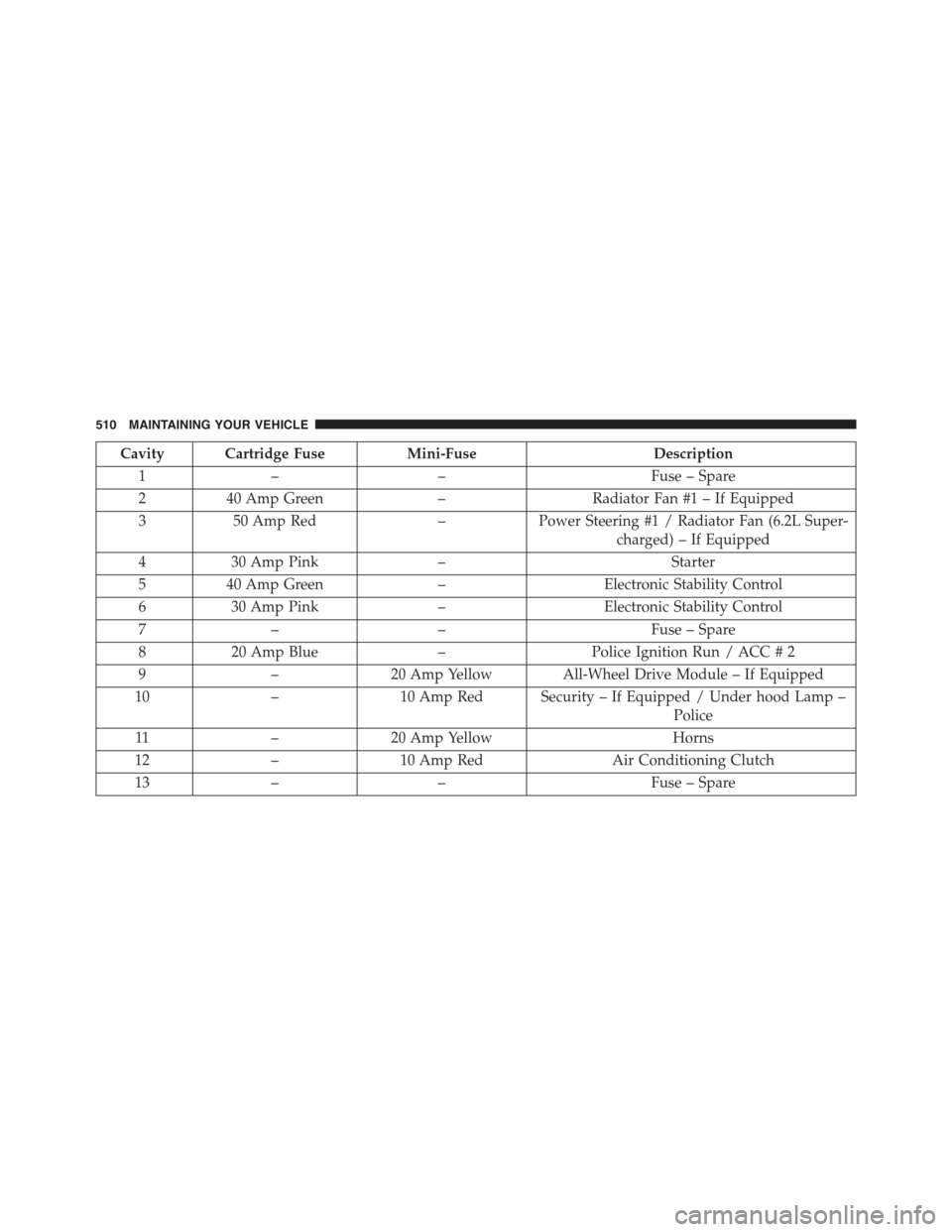
Cavity Cartridge FuseMini-FuseDescription
1––Fuse – Spare
240 Amp Green–Radiator Fan #1 – If Equipped
350 Amp Red–Power Steering #1 / Radiator Fan (6.2L Super-
charged) – If Equipped
430 Amp Pink–Starter
540 Amp Green–Electronic Stability Control
630 Amp Pink–Electronic Stability Control
7––Fuse – Spare
820 Amp Blue–Police Ignition Run / ACC # 2
9–20 Amp Yellow All-Wheel Drive Module – If Equipped
10–10 Amp Red Security – If Equipped / Under hood Lamp –
Police
11–20 Amp YellowHorns
12–10 Amp RedAir Conditioning Clutch
13––Fuse – Spare
510 MAINTAINING YOUR VEHICLE
Page 519 of 574
CavityCartridge FuseMini-FuseDescription
27—25 Amp ClearAmplifier – If Equipped
31—25 Amp Breaker Power Seats
32—15 Amp BlueHVAC Module/Cluster
33—15 Amp BlueIgnition Switch/RF hub
Module/Steering Column
Lock-LX If Equipped
34—10 Amp RedSteering Column Module/
Clock/Spare – Police
35—5 Amp TanBattery Sensor
36—15 Amp BlueElectronic Exhaust Valve – If
Equipped
37—20 Amp YellowRadio
38—15 Amp Blue – LD/LX
20 Amp Yellow – LA
Console Power Outlet/Console
Media Hub (LD/LX)
Power Outlet Inside Arm Rest/
Console Media Hub (LA)
7
MAINTAINING YOUR VEHICLE 517
Page 525 of 574
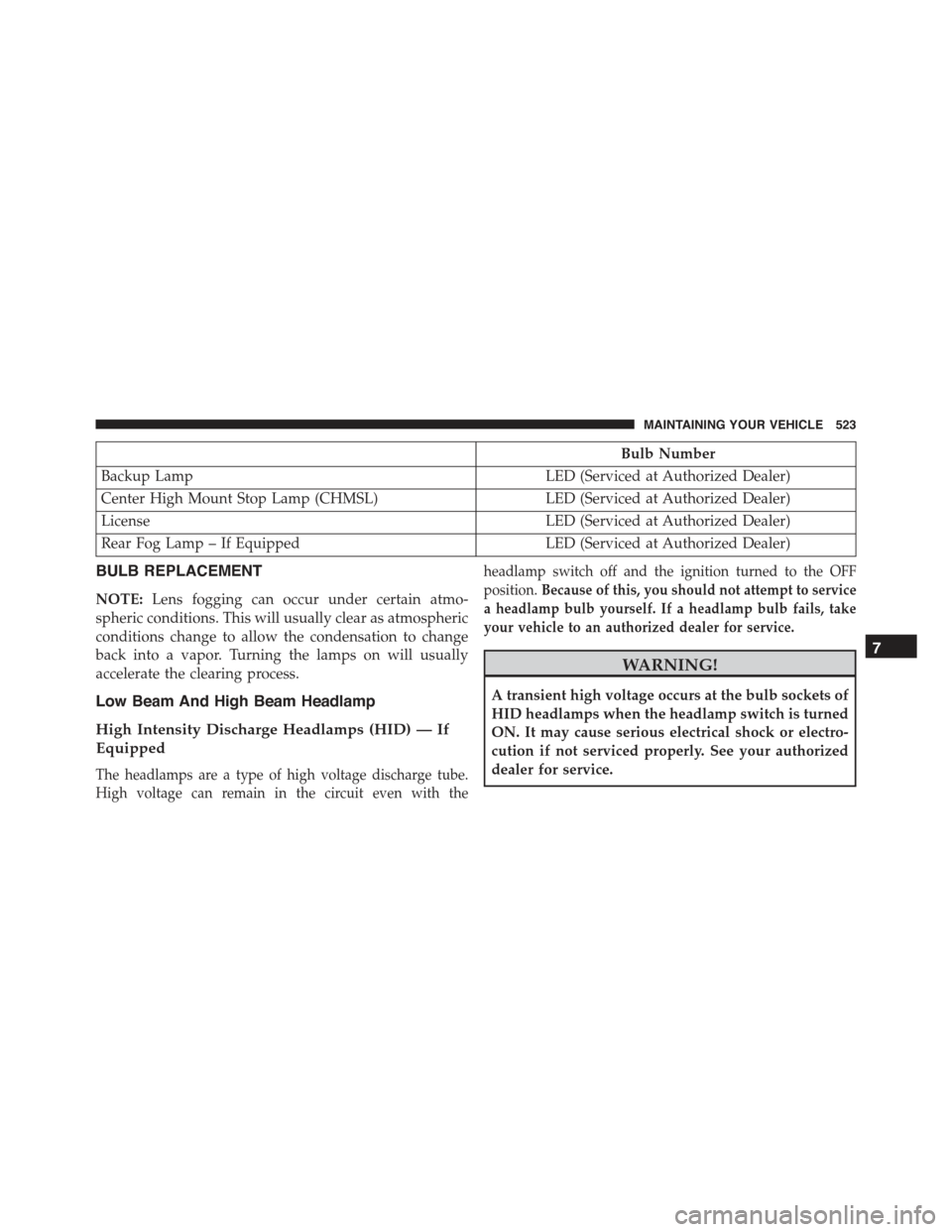
Bulb Number
Backup LampLED (Serviced at Authorized Dealer)
Center High Mount Stop Lamp (CHMSL)LED (Serviced at Authorized Dealer)
LicenseLED (Serviced at Authorized Dealer)
Rear Fog Lamp – If EquippedLED (Serviced at Authorized Dealer)
BULB REPLACEMENT
NOTE:Lens fogging can occur under certain atmo-
spheric conditions. This will usually clear as atmospheric
conditions change to allow the condensation to change
back into a vapor. Turning the lamps on will usually
accelerate the clearing process.
Low Beam And High Beam Headlamp
High Intensity Discharge Headlamps (HID) — If
Equipped
The headlamps are a type of high voltage discharge tube.
High voltage can remain in the circuit even with the
headlamp switch off and the ignition turned to the OFF
position.Because of this, you should not attempt to service
a headlamp bulb yourself. If a headlamp bulb fails, take
your vehicle to an authorized dealer for service.
WARNING!
A transient high voltage occurs at the bulb sockets of
HID headlamps when the headlamp switch is turned
ON. It may cause serious electrical shock or electro-
cution if not serviced properly. See your authorized
dealer for service.
7
MAINTAINING YOUR VEHICLE 523
Page 560 of 574

GVWR.................................425
Hazard
Driving Through Flowing, Rising, Or Shallow
Standing Water.........................357
Hazard Warning Flasher....................442
Headlights..............................523
Automatic............................146
Cleaning.............................506
Delay................................147
High Beam/Low Beam Select Switch.........152
Lights On Reminder.....................150
On With Wipers........................146
Passing..............................152
Switch...............................145
Time Delay............................147
Washers..............................487
Headlight Washers........................487
Head Restraints..........................134
Head Rests..............................134
Heated Mirrors...........................115
Heated Seats.............................131
Heater, Engine Block.......................342
High Beam/Low Beam Select (Dimmer) Switch . . . .152
Hill Start Assist...........................371
Hitches
Trailer Towing.........................430
Holder, Coin.............................249
Hood Release............................144
Ignition
Key . . . . . . . . . . . . . . . . . . . . . . . . . . . . . . . . . .11
Illuminated Entry..........................19
Immobilizer (Sentry Key)....................14
Inside Rearview Mirror.....................106
Instrument Cluster........................263
Instrument Panel And Controls...............261
Instrument Panel Lens Cleaning...............507
558 INDEX