Page 448 of 698

�FUEL REQUIREMENTS ..................531
▫ Reformulated Gasoline .................531
▫ Gasoline/Oxygenate Blends ..............532
▫ E-85 Usage In Non-Flex Fuel Vehicles .......532
▫ MMT In Gasoline .....................533
▫ Materials Added To Fuel ................533
▫ Fuel System Cautions ...................534
▫ Carbon Monoxide Warnings .............535
� FLEXIBLE FUEL — IF EQUIPPED ...........535
▫ E-85 General Information ...............535
▫ Ethanol Fuel (E-85) ....................537
▫ Fuel Requirements ....................537 ▫
Selection Of Engine Oil For Flexible Fuel Vehicles
(E-85) And Gasoline Vehicles .............538
▫ Starting ........................... .538
▫ Cruising Range ...................... .538
▫ Replacement Parts ....................539
▫ Maintenance ....................... .539
� ADDING FUEL ....................... .539
▫ Loose Fuel Filler Cap Message ............542
� VEHICLE LOADING ....................542
▫ Certification Label ....................542
� TRAILER TOWING .....................544
� RECREATIONAL TOWING (BEHIND
MOTORHOME, ETC.) ...................545
446 STARTING AND OPERATING
Page 589 of 698
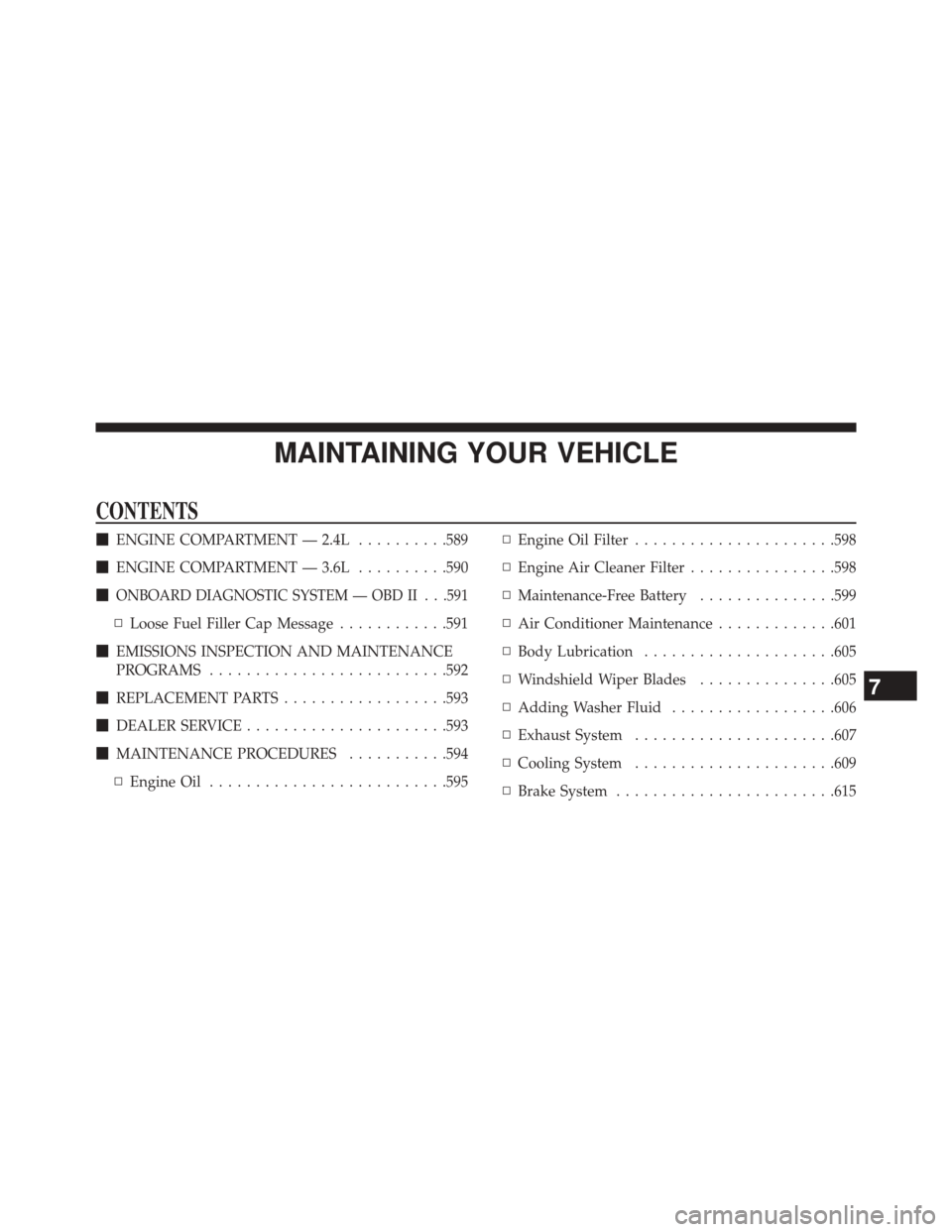
MAINTAINING YOUR VEHICLE
CONTENTS
�ENGINE COMPARTMENT — 2.4L ..........589
� ENGINE COMPARTMENT — 3.6L ..........590
�
ONBOARD DIAGNOSTIC SYSTEM — OBD II . . .591
▫ Loose Fuel Filler Cap Message ............591
� EMISSIONS INSPECTION AND MAINTENANCE
PROGRAMS ......................... .592
� REPLACEMENT PARTS ..................593
� DEALER SERVICE ..................... .593
� MAINTENANCE PROCEDURES ...........594
▫ Engine Oil ......................... .595▫
Engine Oil Filter ..................... .598
▫ Engine Air Cleaner Filter ................598
▫ Maintenance-Free Battery ...............599
▫ Air Conditioner Maintenance .............601
▫ Body Lubrication .....................605
▫ Windshield Wiper Blades ...............605
▫ Adding Washer Fluid ..................606
▫ Exhaust System ..................... .607
▫ Cooling System ..................... .609
▫ Brake System ....................... .615
7
Page 597 of 698

CAUTION!(Continued)
•Your vehicle has been built with improved fluids
that protect the performance and durability of your
vehicle and also allow extended maintenance inter-
vals. Do not use chemical flushes in these compo-
nents as the chemicals can damage your engine,
transmission or air conditioning. Such damage is
not covered by the New Vehicle Limited Warranty.
If a flush is needed because of component malfunc-
tion, use only the specified fluid for the flushing
procedure.
Engine Oil
Checking Oil Level
To assure proper engine lubrication, the engine oil must
be maintained at the correct level. Check the oil level at regular intervals, such as every fuel stop. The best time to
check the engine oil level is about five minutes after a
fully warmed up engine is shut off.
Checking the oil while the vehicle is on level ground will
improve the accuracy of the oil level readings. Always
maintain the oil level within the SAFE zone on the
dipstick. Adding 1 quart (0.9 L) of oil when the reading is
at the bottom of the SAFE zone will result in a reading at
the top of the safe zone on these engines.
CAUTION!
Overfilling or underfilling the crankcase will cause
aeration or loss of oil pressure. This could damage
your engine.7
MAINTAINING YOUR VEHICLE 595
Page 608 of 698

Operation of the wipers on dry glass for long periods
may cause deterioration of the wiper blades. Always use
washer fluid when using the wipers to remove salt or dirt
from a dry windshield.
Avoid using the wiper blades to remove frost or ice from
the windshield. Keep the blade rubber out of contact with
petroleum products such as engine oil, gasoline, etc.
NOTE:Life expectancy of wiper blades varies depend-
ing on geographical area and frequency of use. Poor
performance of blades may be present with chattering,
marks, water lines or wet spots. If any of these conditions
are present, clean the wiper blades or replace as neces-
sary.
Adding Washer Fluid
The fluid reservoir is located in the front of the engine
compartment. Be sure to check the fluid level in the
reservoir at regular intervals. Fill the reservoir with windshield washer solvent (not radiator antifreeze) and
operate the system for a few seconds to flush out the
residual water.
When refilling the washer fluid reservoir, take some
washer fluid and apply it to a cloth or towel and wipe
clean the wiper blades, this will help blade performance.
To prevent freeze-up of your windshield washer system
in cold weather, select a solution or mixture that meets or
exceeds the temperature range of your climate. This
rating information can be found on most washer fluid
containers.
WARNING!
Commercially available windshield washer solvents
are flammable. They could ignite and burn you. Care
must be exercised when filling or working around
the washer solution.
606 MAINTAINING YOUR VEHICLE