2015 CHEVROLET CRUZE fuel filter
[x] Cancel search: fuel filterPage 218 of 417
Black plate (27,1)Chevrolet Cruze Owner Manual (GMNA-Localizing-U.S./Canada-7707493) -
2015 - crc - 11/24/14
Driving and Operating 9-27
If the vehicle continues to be driven
with the DPF warning message on,
and the exhaust filter is not cleaned
as required, the malfunction
indicator lamp and the ENGINE
POWER IS REDUCED message
will come on and dealer service is
necessary. SeeMalfunction
Indicator Lamp on page 5-14 and
Engine Power Messages on
page 5-29.
{Warning
During DPF self cleaning or
during extended idling in P (Park),
the exhaust system and exhaust
gases are very hot. Things that
burn could touch hot exhaust
parts under the vehicle and ignite.
You or others could be burned.
Do not park, or idle for an
extended period of time, near or
over papers, leaves, dry grass,
or other things that can burn.
Keep the exhaust area clear of
(Continued)
Warning (Continued)
material that could ignite or burn.
SeeParking over Things That
Burn on page 9-25 for more
information.
Diesel Exhaust Fluid
{Warning
Diesel Exhaust Fluid (DEF) is
corrosive. Do not allow it to come
in contact with your skin, eyes,
or the finished surfaces of the
vehicle. If exposed, it may cause
skin and eye irritation. Wear skin
and eye protection when
handling. Inhalation may cause
irritation to the upper respiratory
tract. Store in a cool,
well-ventilated area. For more
safety and storage information,
see the label of the Diesel
Exhaust Fluid container. DEF is used with diesel engines to
reduce the amount of regulated
emissions produced. The fluid level
in the DEF tank must be maintained
for the vehicle to run correctly. The
capacity of the DEF tank is 18.5 L
(4.9 gal).
It is normal to hear the DEF system
purge fluid back into the tank after
the vehicle is shut off.
Locating Diesel Exhaust Fluid
DEF can be purchased at a
Chevrolet dealer. It can also be
purchased at authorized vehicle
dealerships. Additionally, some
diesel fueling stations or retailers
may have DEF for purchase. For
vehicles with an active OnStar
subscription, OnStar can help to
locate a DEF retailer. See
Customer
Assistance Offices on page 13-3 for
phone numbers to assist in
contacting a GM dealer. See
Recommended Fluids and
Lubricants on page 11-12.
Page 247 of 417
Black plate (56,1)Chevrolet Cruze Owner Manual (GMNA-Localizing-U.S./Canada-7707493) -
2015 - crc - 11/24/14
9-56 Driving and Operating
We neither encourage nor
discourage the use of biodiesel
blends for vehicles. As a renewable
fuel, biodiesel provides some
environmental benefits. However,
biodiesel has unique properties and
needs to be handled differently than
diesel fuel. Its use presents
additional risks and may not be
appropriate in all situations. Certain
vehicle operating modes increase
these risks and should be avoided.
Read further to determine if your
driving habits are compatible with
the use of biodiesel..Biodiesel fuel quality degrades
with time and exposure to high
temperature much more quickly
than conventional diesel fuel.
More frequent refueling provides
the best opportunity to have a
supply of fresh fuel.
Owners who have very low fuel
usage or who have vehicles
stored for extended periods of
time should avoid the use of
biodiesel. Storage at hot ambient
temperatures will accelerate
biodiesel degradation.
When vehicles will be stored for
extended periods of time
(greater than one month), they
should be run out of biodiesel to
below one-quarter tank, refueled
with conventional Ultra Low
Sulfur Diesel fuel, and driven
several miles before storage..Biodiesel gels sooner than
conventional diesel fuel at cold
temperature, and biodiesel fuel
requires proper blending for
winter time operation.
Fuels improperly blended for
cold temperature operation may
result in restricted fuel filters and
degraded vehicle performance.
Your vehicle is equipped with a
fuel heating system to provide a
level of protection against filter
plugging from gelling (waxing) of
conventional diesel fuel and
biodiesel blends. However, the
system will not prevent all cases
of plugged filters if the operating
temperature is far below the
temperature at which gelling or
waxing of the fuel occurs (cloud
point).
Use of biodiesel blends greater
than B5 (5% blend) should be
avoided in cold temperatures.
Page 248 of 417
Black plate (57,1)Chevrolet Cruze Owner Manual (GMNA-Localizing-U.S./Canada-7707493) -
2015 - crc - 11/24/14
Driving and Operating 9-57
.Vehicles operated for extended
periods of time on conventional
diesel fuel and then switched to
biodiesel blends may experience
premature fuel filter clogging and
require more frequent fuel filter
service.
With long-term use of
conventional diesel fuel, gum
and varnish may be deposited
within the tank and fuel system.
These deposits, while not
problematic with the use of
conventional diesel fuel, may
become loosened with a sudden
switch to biodiesel blends and
cause fuel filter plugging.
.Use of biodiesel blends will
degrade the performance of your
vehicle’s water separator.
Biodiesel reduces the
effectiveness of the vehicle’s
water separator, and in the event
of water contamination of the
fuel, increases the risk of
damage to the fuel system.
Refueling
Diesel fuel can foam when you fill
the tank. This can cause the
automatic pump nozzle to shut off,
even though the tank is not full.
If this happens, wait for the foaming
to stop, and then try filling the tank
more slowly. See Filling the Tank on
page 9-60.
{Warning
Heat coming from the engine can
cause the fuel to expand and
force the fuel out of the tank.
If something ignites the fuel, a fire
could start. To help avoid this, fill
the tank slowly and only until the
nozzle shuts off. Do not top it off.
Clean up any spilled fuel. Accidental Refueling with
Gasoline
{Caution
If the vehicle is accidentally
refueled with gasoline, do not
continue driving the vehicle
except to get to a location where
it can be stopped safely. Driving
the vehicle will damage the fuel
system. Have the vehicle towed
to a qualified technician to have
the gasoline removed from the
tank, preferably until the fuel
gauge reads near E (Empty).
Refuel with Ultra Low Sulfur
Diesel fuel.
Page 250 of 417
Black plate (59,1)Chevrolet Cruze Owner Manual (GMNA-Localizing-U.S./Canada-7707493) -
2015 - crc - 11/24/14
Driving and Operating 9-59
Refueling
Diesel fuel can foam when filling the
tank. This can cause the automatic
pump nozzle to shut off, even if the
tank is not full. If this happens, wait
for the foaming to stop, and then fill
the tank more slowly. SeeFilling the
Tank on page 9-60.
{Warning
Heat coming from the engine can
cause the fuel to expand and
force the fuel out of the tank.
If something ignites the fuel, a fire
could start. To help avoid this, fill
the tank slowly and only until the
nozzle shuts off. Do not top it off.
Clean up any spilled fuel. Accidental Refueling with
Gasoline
{Caution
If the vehicle is accidentally
refueled with gasoline, do not
continue driving the vehicle
except to get to a location where
it can be stopped safely. Driving
the vehicle will damage the fuel
system. Have the vehicle towed
to a qualified technician to have
the gasoline removed from the
tank, preferably until the fuel
gauge reads near E (Empty).
Refuel with Ultra Low Sulfur
Diesel fuel.
Cold Weather Operation
(Diesel)
Follow the instructions under
Fuel
for Diesel Engines on page 9-53.
{Caution
Using any fuel not approved for
this vehicle can cause engine
damage and would not be
covered by the vehicle warranty.
See “What Fuel to Use" for the
proper fuel.
In cold weather, the fuel filter could
become clogged by wax naturally
present in the fuel. To unclog it,
move the vehicle to a warm garage
area and allow the filter to warm up
to between 0°C (32°F) and 10°C
(50°F). You will not need to replace
the filter. Additional information on
the fuel filter follows.
Use of biodiesel blends greater than
B5 (5% blend) should be avoided in
cold temperatures.
Page 251 of 417
Black plate (60,1)Chevrolet Cruze Owner Manual (GMNA-Localizing-U.S./Canada-7707493) -
2015 - crc - 11/24/14
9-60 Driving and Operating
Water in Fuel (Diesel)
The fuel filter assembly has a
sensor to determine if there is water
in the fuel. If there is water in the
fuel, a WATER IN FUEL CONTACT
SERVICE message will display. See
Fuel System Messages on
page 5-29. The water will need to
be drained. See your dealer.
Running Out of Fuel
(Diesel)
Running out of diesel fuel requires
priming after fuel is added.
With engine switched off, turn
ignition key to ON, wait
approximately 15 seconds, and turn
key to LOCK to perform priming
operation. Perform this operation
three times or more while the
engine is switched off, to avoid air
entering the fuel line.
Filling the Tank
{Warning
Fuel vapors and fuel fires burn
violently and can cause injury or
death.
.To help avoid injuries to you
and others, read and follow
all the instructions on the fuel
pump island.
.Turn off the engine when
refueling.
.Keep sparks, flames, and
smoking materials away
from fuel.
.Do not leave the fuel pump
unattended.
.Do not reenter the vehicle
while pumping fuel.
.Keep children away from the
fuel pump and never let
children pump fuel.(Continued)
Warning (Continued)
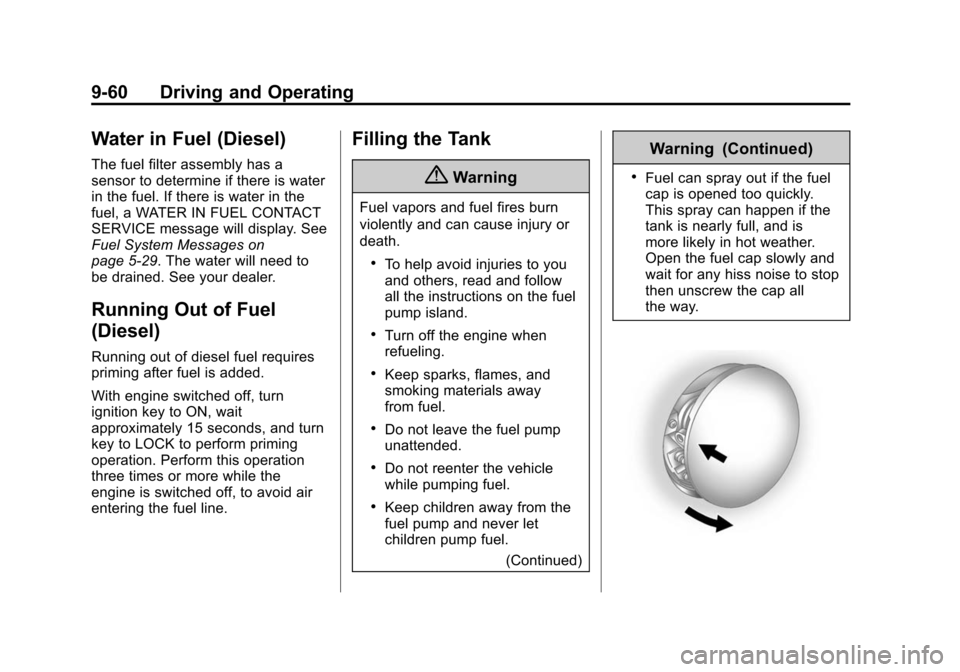
.Fuel can spray out if the fuel
cap is opened too quickly.
This spray can happen if the
tank is nearly full, and is
more likely in hot weather.
Open the fuel cap slowly and
wait for any hiss noise to stop
then unscrew the cap all
the way.
Page 270 of 417
Black plate (11,1)Chevrolet Cruze Owner Manual (GMNA-Localizing-U.S./Canada-7707493) -
2015 - crc - 11/24/14
Vehicle Care 10-11
1.Engine Air Cleaner/Filter on
page 10-17.
2. Engine Cooling Fan (Out of View). See Cooling System on
page 10-19.
3. Remote Negative (-) Grounding Point. See Jump Starting on
page 10-82.
4. Engine Oil Dipstick. See “Checking Engine Oil” under
Engine Oil on page 10-11.
5. Engine Oil Fill Cap. See “When
to Add Engine Oil” underEngine
Oil on page 10-11.
6. Brake Fluid Reservoir. See “Brake Fluid” underBrakes on
page 10-26.
7. Battery on page 10-28.
8. Engine Coolant Surge Tank and Pressure Cap. See Cooling
System on page 10-19.
9. Remote Positive (+) Terminal. See Jump Starting on
page 10-82. 10. Windshield Washer Fluid
Reservoir. See “Adding Washer
Fluid” under Washer Fluid on
page 10-25.
11. Engine Compartment Fuse
Block on page 10-38.
Engine Oil
To ensure proper engine
performance and long life, careful
attention must be paid to engine oil.
Following these simple, but
important steps will help protect
your investment:
.Always use engine oil approved
to the proper specification and of
the proper viscosity grade. See
“Selecting the Right Engine Oil”
in this section.
.Check the engine oil level
regularly and maintain the
proper oil level. See “Checking
Engine Oil” and“When to Add
Engine Oil” in this section.
.Change the engine oil at the
appropriate time. See Engine Oil
Life System on page 10-15.
.Always dispose of engine oil
properly. See “What to Do with
Used Oil” in this section.
Checking Engine Oil
It is a good idea to check the engine
oil level at each fuel fill. In order to
get an accurate reading, the vehicle
must be on level ground. The
engine oil dipstick handle is a loop.
SeeEngine Compartment Overview
on page 10-6 for the location of the
engine oil dipstick.
Obtaining an accurate oil level
reading is essential:
1. If the engine has been running recently, turn off the engine and
allow several minutes for the oil
to drain back into the oil pan.
Checking the oil level too soon
after engine shutoff will not
provide an accurate oil level
reading.
Page 359 of 417
Black plate (2,1)Chevrolet Cruze Owner Manual (GMNA-Localizing-U.S./Canada-7707493) -
2015 - crc - 11/24/14
11-2 Service and Maintenance
Because of the way people use
vehicles, maintenance needs vary.
There may need to be more
frequent checks and services. The
Additional Required Services -
Normal are for vehicles that:
.Carry passengers and cargo
within recommended limits on
the Tire and Loading Information
label. SeeVehicle Load Limits
on page 9-9.
.Are driven on reasonable road
surfaces within legal driving
limits.
.Use the recommended fuel. See
Fuel (Gasoline) on page 9-51.
Refer to the information in the
Maintenance Schedule Additional
Required Services - Normal chart.
The Additional Required Services -
Severe are for vehicles that are:
.Mainly driven in heavy city traffic
in hot weather.
.Mainly driven in hilly or
mountainous terrain.
.Frequently towing a trailer.
.Used for high speed or
competitive driving.
.Used for taxi, police, or delivery
service.
Refer to the information in the
Maintenance Schedule Additional
Required Services - Severe chart.
{Warning
Performing maintenance work can
be dangerous and can cause
serious injury. Perform
maintenance work only if the
required information, proper tools,
and equipment are available.
If they are not, see your dealer to
have a trained technician do the
work. See Doing Your Own
Service Work on page 10-4.
Maintenance
Schedule
Owner Checks and Services
At Each Fuel Stop
.Check the engine oil level. See
Engine Oil on page 10-11.
Once a Month
.Check the tire inflation
pressures. See Tire Pressure on
page 10-51.
.Inspect the tires for wear. See
Tire Inspection on page 10-57.
.Check the windshield washer
fluid level. See Washer Fluid on
page 10-25.
Engine Oil Change
When the CHANGE ENGINE OIL
SOON DIC message displays, have
the engine oil and filter changed
within the next 1 000 km/600 mi.
If driven under the best conditions,
the engine oil life system may not
indicate the need for vehicle service
Page 360 of 417
Black plate (3,1)Chevrolet Cruze Owner Manual (GMNA-Localizing-U.S./Canada-7707493) -
2015 - crc - 11/24/14
Service and Maintenance 11-3
for up to a year. The engine oil and
filter must be changed at least once
a year and the oil life system must
be reset. Your trained dealer
technician can perform this work.
If the engine oil life system is reset
accidentally, service the vehicle
within 5 000 km/3,000 mi since the
last service. Reset the oil life
system when the oil is changed.
SeeEngine Oil Life System on
page 10-15.
On vehicles with diesel engines, it is
recommended to drain the diesel
fuel filter of water when the oil is
changed or when the WATER IN
FUEL CONTACT SERVICE
message displays.
Tire Rotation and Required
Services Every 12 000 km/
7,500 mi
Rotate the tires, if recommended for
the vehicle, and perform the
following services. See Tire
Rotation on page 10-57.
.Check engine oil level and oil
life percentage. If needed,
change engine oil and filter, and
reset oil life system. See Engine
Oil on page 10-11 andEngine
Oil Life System on page 10-15.
.Check engine coolant level. See
Engine Coolant on page 10-20.
.Check windshield washer fluid
level. See Washer Fluid on
page 10-25.
.Visually inspect windshield wiper
blades for wear, cracking,
or contamination. See Exterior
Care on page 10-88. Replace
worn or damaged wiper blades.
See Wiper Blade Replacement
on page 10-31.
.Check tire inflation pressures.
See Tire Pressure on
page 10-51.
.Inspect tire wear. See Tire
Inspection on page 10-57.
.Visually check for fluid leaks.
.Inspect engine air cleaner filter.
See Engine Air Cleaner/Filter on
page 10-17.
.Inspect brake system. See
Exterior Care on page 10-88.
.Visually inspect steering,
suspension, and chassis
components for damaged, loose,
or missing parts or signs of
wear. See Exterior Care on
page 10-88.
.Check restraint system
components. See Safety System
Check on page 3-14.
.Visually inspect fuel system for
damage or leaks.
.Visually inspect exhaust system
and nearby heat shields for
loose or damaged parts.
.Lubricate body components. See
Exterior Care on page 10-88.
.Check starter switch. See Starter
Switch Check on page 10-29.