Page 269 of 401
Black plate (6,1)Cadillac CTS Owner Manual (GMNA-Localizing-U.S./Canada/Mexico-
7707478) - 2015 - crc - 10/1/14
10-6 Vehicle Care
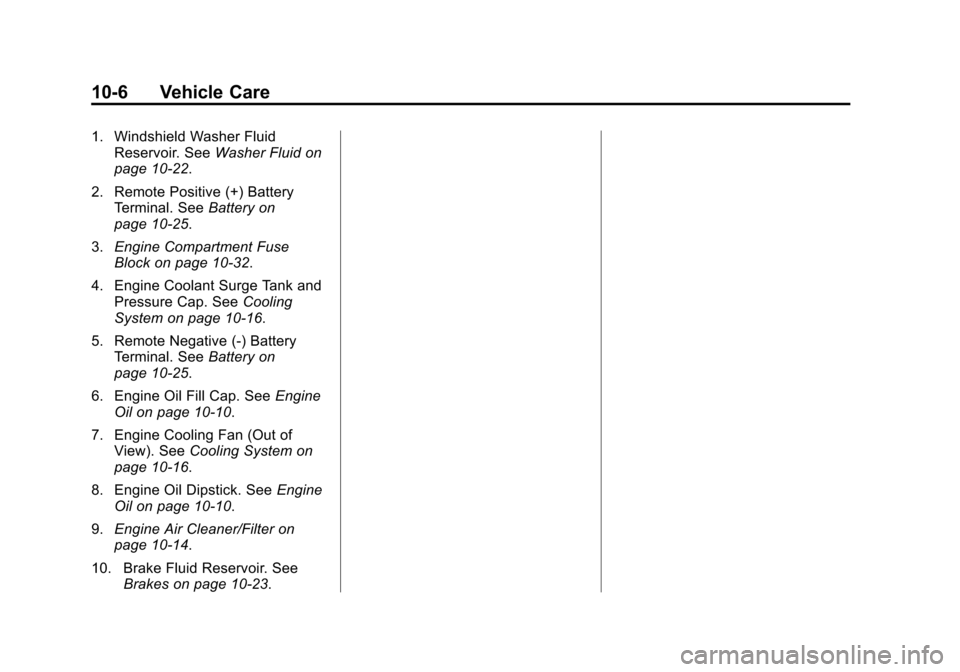
1. Windshield Washer FluidReservoir. See Washer Fluid on
page 10-22.
2. Remote Positive (+) Battery Terminal. See Battery on
page 10-25.
3. Engine Compartment Fuse
Block on page 10-32.
4. Engine Coolant Surge Tank and Pressure Cap. See Cooling
System on page 10-16.
5. Remote Negative (-) Battery Terminal. See Battery on
page 10-25.
6. Engine Oil Fill Cap. See Engine
Oil on page 10-10.
7. Engine Cooling Fan (Out of View). See Cooling System on
page 10-16.
8. Engine Oil Dipstick. See Engine
Oil on page 10-10.
9. Engine Air Cleaner/Filter on
page 10-14.
10. Brake Fluid Reservoir. See Brakes on page 10-23.
Page 271 of 401
Black plate (8,1)Cadillac CTS Owner Manual (GMNA-Localizing-U.S./Canada/Mexico-
7707478) - 2015 - crc - 10/1/14
10-8 Vehicle Care
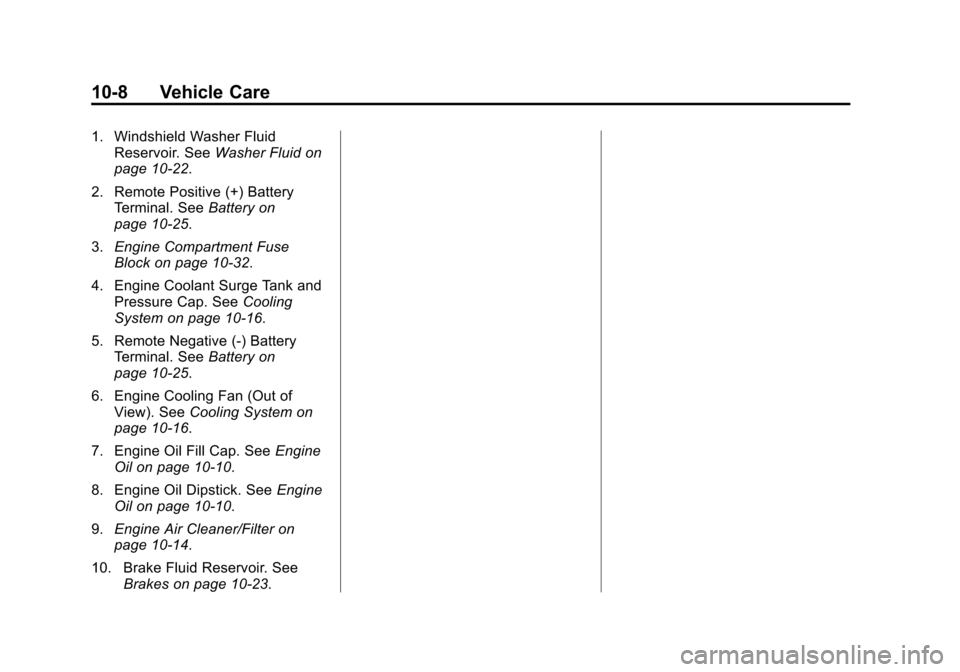
1. Windshield Washer FluidReservoir. See Washer Fluid on
page 10-22.
2. Remote Positive (+) Battery Terminal. See Battery on
page 10-25.
3. Engine Compartment Fuse
Block on page 10-32.
4. Engine Coolant Surge Tank and Pressure Cap. See Cooling
System on page 10-16.
5. Remote Negative (-) Battery Terminal. See Battery on
page 10-25.
6. Engine Cooling Fan (Out of View). See Cooling System on
page 10-16.
7. Engine Oil Fill Cap. See Engine
Oil on page 10-10.
8. Engine Oil Dipstick. See Engine
Oil on page 10-10.
9. Engine Air Cleaner/Filter on
page 10-14.
10. Brake Fluid Reservoir. See Brakes on page 10-23.
Page 273 of 401

Black plate (10,1)Cadillac CTS Owner Manual (GMNA-Localizing-U.S./Canada/Mexico-
7707478) - 2015 - crc - 10/1/14
10-10 Vehicle Care
1. Windshield Washer FluidReservoir. See Washer Fluid on
page 10-22.
2. Remote Positive (+) Battery Terminal. See Battery on
page 10-25.
3. Engine Compartment Fuse
Block on page 10-32.
4. Engine Coolant Surge Tank and Pressure Cap. See Cooling
System on page 10-16.
5. Remote Negative (-) Battery Terminal. See Battery on
page 10-25.
6. Engine Cooling Fan (Out of View). See Cooling System on
page 10-16.
7. Engine Oil Fill Cap. See Engine
Oil on page 10-10.
8. Engine Oil Dipstick. See Engine
Oil on page 10-10.
9. Engine Air Cleaner/Filter on
page 10-14.
10. Brake Fluid Reservoir. See Brakes on page 10-23.Engine Oil
To ensure proper engine
performance and long life, careful
attention must be paid to engine oil.
Following these simple, but
important steps will help protect
your investment:
.Always use engine oil approved
to the proper specification and of
the proper viscosity grade. See
“Selecting the Right Engine Oil”
in this section.
.Check the engine oil level
regularly and maintain the
proper oil level. See “Checking
Engine Oil” and“When to Add
Engine Oil” in this section.
.Change the engine oil at the
appropriate time. See Engine Oil
Life System on page 10-12.
.Always dispose of engine oil
properly. See “What to Do with
Used Oil” in this section.
Checking Engine Oil
It is a good idea to check the engine
oil level at each fuel fill. In order to
get an accurate reading, the vehicle
must be on level ground. The
engine oil dipstick handle is a loop.
SeeEngine Compartment Overview
on page 10-5 for the location of the
engine oil dipstick.
1. If the engine has been running recently, turn off the engine and
allow several minutes for the oil
to drain back into the oil pan.
Checking the oil level too soon
after engine shutoff will not
provide an accurate oil level
reading.
{Warning
The engine oil dipstick handle
may be hot; it could burn you.
Use a towel or glove to touch the
dipstick handle.
Page 288 of 401

Black plate (25,1)Cadillac CTS Owner Manual (GMNA-Localizing-U.S./Canada/Mexico-
7707478) - 2015 - crc - 10/1/14
Vehicle Care 10-25
{Warning
With the wrong kind of fluid in the
brake hydraulic system, the
brakes might not work well. This
could cause a crash. Always use
the proper brake fluid.
{Caution
.Using the wrong fluid can
badly damage brake
hydraulic system parts. For
example, just a few drops of
mineral-based oil, such as
engine oil, in the brake
hydraulic system can damage
brake hydraulic system parts
so badly that they will have to
be replaced. Do not let
someone put in the wrong
kind of fluid.(Continued)
Caution (Continued)
.If brake fluid is spilled on the
vehicle's painted surfaces,
the paint finish can be
damaged. Be careful not to
spill brake fluid on the
vehicle. If you do, wash it off
immediately.
Battery
The original equipment battery is
maintenance free. Do not remove
the cap and do not add fluid.
The battery is in the trunk, behind
the trim panel, on the driver side of
the vehicle. Refer to the
replacement number shown on the
original battery label when a new
battery is needed.
{Warning
Battery posts, terminals, and
related accessories contain lead
and lead compounds, chemicals
known to the State of California to
cause cancer and reproductive
harm. Wash hands after handling.
After a power loss, such as
disconnecting the battery or
removing the maxi fuses in the
power distribution fuse block, the
following steps must be performed
to calibrate the electronic throttle
control. If this is not done, the
engine will not run properly.
1. Turn the ignition on but do not start the engine.
2. Leave the ignition on for at least three minutes so that the
electronic throttle control will
cycle and relearn its home
position.
3. Turn the ignition off.
Page 289 of 401

Black plate (26,1)Cadillac CTS Owner Manual (GMNA-Localizing-U.S./Canada/Mexico-
7707478) - 2015 - crc - 10/1/14
10-26 Vehicle Care
4. Start and run the engine for atleast 30 seconds.
Vehicle Storage
{Warning
Batteries have acid that can burn
you and gas that can explode.
You can be badly hurt if you are
not careful. See Jump Starting on
page 10-65 for tips on working
around a battery without
getting hurt.
Infrequent Usage: Remove the
black, negative (−) cable from the
battery to keep the battery from
running down.
Extended Storage: Remove the
black, negative (−) cable from the
battery or use a battery trickle
charger.
All-Wheel Drive
If the vehicle is equipped with
All-Wheel-Drive (AWD), this is an
additional system that needs
lubrication.
Transfer Case
When to Check Lubricant
It is not necessary to regularly
check the transfer case fluid unless
a leak is suspected or an unusual
noise is heard. A fluid loss could
indicate a problem. Have it
inspected and repaired. How to Check Lubricant
1. Fill Plug
Page 302 of 401
Black plate (39,1)Cadillac CTS Owner Manual (GMNA-Localizing-U.S./Canada/Mexico-
7707478) - 2015 - crc - 10/1/14
Vehicle Care 10-39
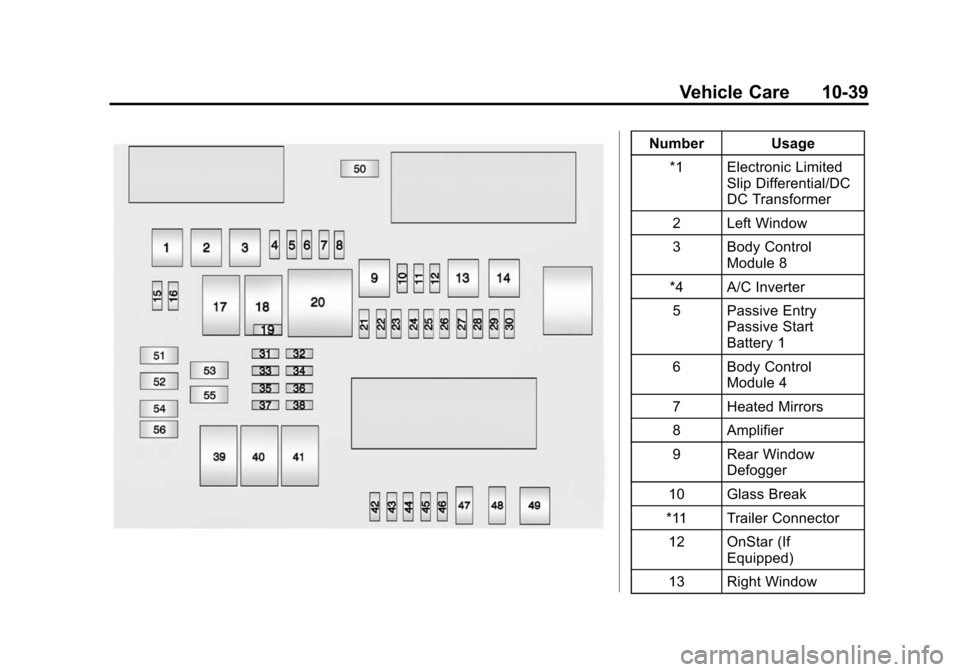
Number Usage*1 Electronic Limited Slip Differential/DC
DC Transformer
2 Left Window
3 Body Control Module 8
*4 A/C Inverter 5 Passive Entry Passive Start
Battery 1
6 Body Control Module 4
7 Heated Mirrors
8 Amplifier
9 Rear Window Defogger
10 Glass Break
*11 Trailer Connector 12 OnStar (If Equipped)
13 Right Window
Page 303 of 401

Black plate (40,1)Cadillac CTS Owner Manual (GMNA-Localizing-U.S./Canada/Mexico-
7707478) - 2015 - crc - 10/1/14
10-40 Vehicle Care
Number Usage14 Electric Parking Brake
15 Not Used
16 Trunk Release
*17 Run Relay
*18 Logistics Relay
*19 Logistics Fuse
20 Rear Window Defogger Relay
21 Mirror Window Module
22 Pedestrian Protection
23 Canister Vent
24 Body Control Module 2
*25 Rear Vision Camera
*26 Front Ventilated Seats
*27 SBZA/LDW/EOCM Number Usage
*28 Trailer/Sunshade
*29 Rear Heated Seats
*30 Semi-Active Damping System
*31 Transfer Case Control Module/
Electronic Limited
Slip Differential
32 Theft Module/ Universal Garage
Door Opener/Rain
Sensor
*33 UPA
*34 Radio/DVD
35 Spare
*36 Trailer
37 Fuel Pump/Fuel System Control
Module
38 Not Used
39 Not Used Number Usage
40 Not Used
41 Not Used
*42 Memory Seat Module
43 Body Control Module 3
44 Not Used
45 Battery Regulated Voltage Control
46 Engine Control Module Battery
47 Not Used
48 Not Used
*49 Trailer Module 50 Door Lock Security
51 Rear Closure Release
52 Not Used
53 Not Used
54 Door Lock Security
Page 328 of 401

Black plate (65,1)Cadillac CTS Owner Manual (GMNA-Localizing-U.S./Canada/Mexico-
7707478) - 2015 - crc - 10/1/14
Vehicle Care 10-65
The vehicle has no spare tire, no
tire changing equipment, and no
place to store a tire.
If the vehicle has run-flat tires, there
is no need to stop on the side of the
road to change a flat tire. See
Run-Flat Tires on page 10-43.Jump Starting
For more information about the
vehicle battery, seeBattery on
page 10-25.
If the battery has run down, try to
use another vehicle and some
jumper cables to start your vehicle.
Be sure to use the following steps to
do it safely.
{Warning
Batteries can hurt you. They can
be dangerous because:
.They contain acid that can
burn you.
.They contain gas that can
explode or ignite.
.They contain enough
electricity to burn you.
If you do not follow these steps
exactly, some or all of these
things can hurt you.
{Caution
Ignoring these steps could result
in costly damage to the vehicle
that would not be covered by the
vehicle warranty. Trying to start
the vehicle by pushing or pulling it
will not work, and it could damage
the vehicle.
1. Good Battery Positive Terminal
2. Good Battery Negative Terminal