2015 BMW I8 weight
[x] Cancel search: weightPage 4 of 224
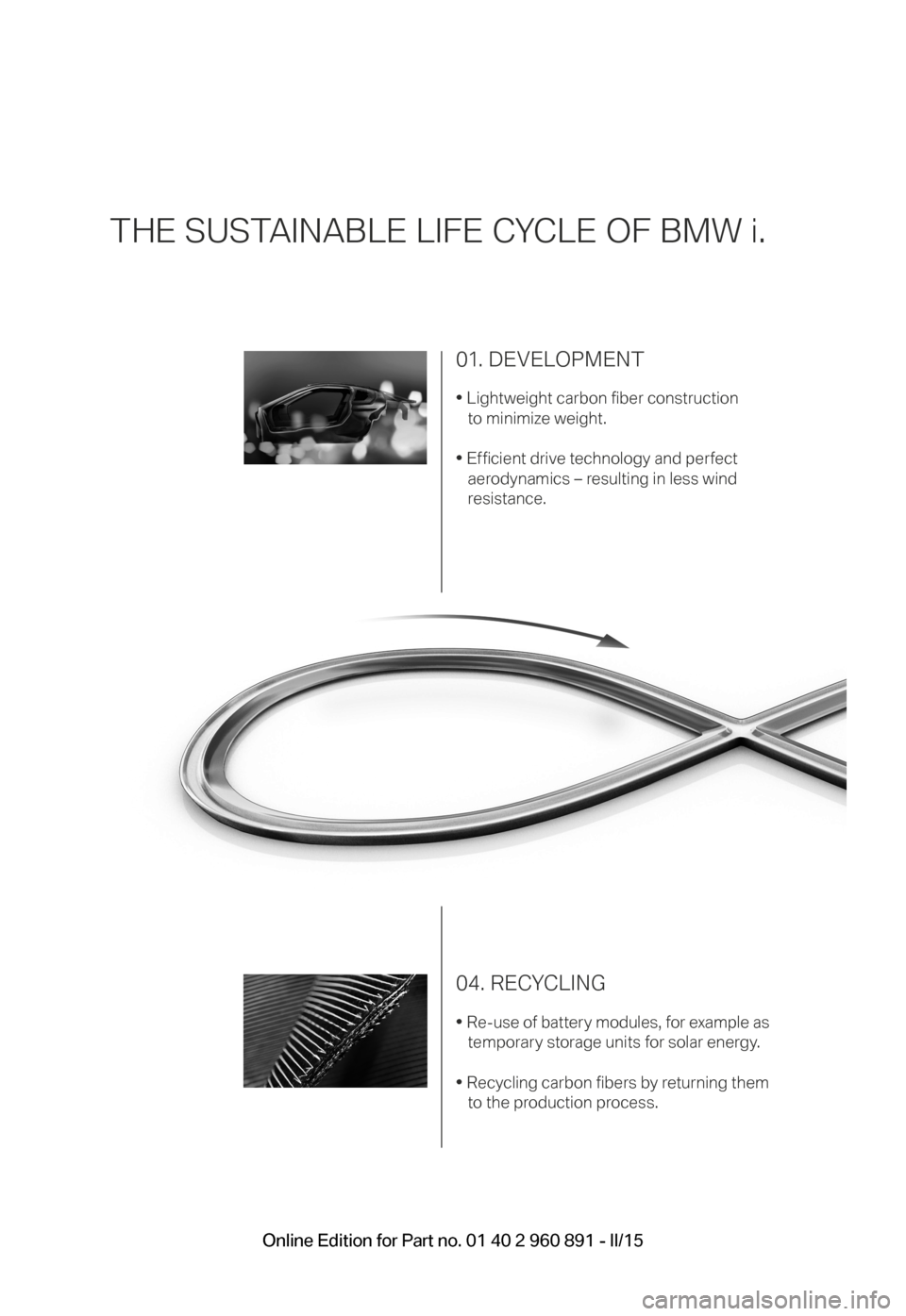
THE SUSTAINABLE LIFE CYCLE OF BMW i.
01. DEVELOPMENT
• Lightweight carbon fi ber construction to minimize weight.
• Effi cient drive technology and perfect aerodynamics – resulting in less wind resistance.
04. RECYCLING
• Re-use of batter y modules, for example as temporar y storage units for solar energy.
• Recycling carbon fi bers by returning them to the production process.
BMW_i8_Bedienungseinleger_210x138mm_US.indd 215.01.14 17:53 Online Edition for Part no. 01 40 2 960 891 - II/15
Page 6 of 224

FOR OVER THREE QUARTERS OF A
CENTURY, THE BASIC IDEA BEHIND THE
CAR WAS LEFT UNTOUCHED.
Until now. BMW i has launched a groundbreaking sports car with a
wide range of technological innovations – the BMW i8. The innovative
BMW eDrive technology effectively combines an electric motor with
a BMW TwinPower Turbo engine (hybrid electric vehicle). The result
is a breathtaking plug-in hybrid sports car with the fuel consumption
and emissions of a compact vehicle.
The weight of the BMW i8 is a result of the Life module – the passen-
ger cell made of light and extremely robust carbon fiber. It substantially
reduces the weight of the vehicle and has a significant impact on the
design of the BMW i8. The principle of intelligent lightweight design has
also been applied to all other components of the BMW i8. Moreover,
streamflow aerodynamics reduce drag and energy consumption.
With its dynamic proportions and sporty, progressive design, the BMW i8
embodies lightness – as well as efficiency and sheer driving pleasure.
The development process itself is the first of many innovations. In order
to ensure that the BMW i8 is a truly sustainable product, measurable
targets were defined at the design phase and throughout the entire life
cycle of the vehicle, from the extraction of raw materials, production
and use to recycling and the end of product life. The deliberate use of
recycled and environmentally friendly materials in production guarantees
holistic sustainability throughout the entire value chain.
For more information, visit www.bmw-i.com.
01. DEVELOPMENT
BMW_i8_Bedienungseinleger_210x138mm_US.indd 415.01.14 17:53 Online Edition for Part no. 01 40 2 960 891 - II/15
Page 73 of 224
Transporting children safelyVehicle features and optionsThis chapter describes all standard, country-
specific and optional features offered with the
series. It also describes features that are not
necessarily available in your car, e. g., due tothe selected options or country versions. This
also applies to safety-related functions and
systems. The respectively applicable country
provisions must be observed when using the
respective features and systems.
The right place for children
Note
Children in the vehicle
Do not leave children unattended in the
vehicle; otherwise, they could endanger them‐
selves and other persons, e.g., by opening the
doors.◀
Children should always be in the rear Accident research shows that the safest place
for children is in the back seat.
Transporting children in the rear
Only transport children younger than
13 years of age or shorter than 5 ft/150 cm in
the rear in child restraint systems provided in
accordance with the age, weight and size of
the child; otherwise, there is an increased risk
of injury in an accident.
Children 13 years of age or older must wear a
safety belt as soon as a suitable child restraint
system can no longer be used due to their age,
weight and size.◀
Children on the front passenger seat
Should it ever be necessary to use a child re‐
straint system in the front passenger seat,
make sure that the front, knee and side airbags
on the front passenger side are deactivated.
Automatic deactivation of front-seat passen‐
ger airbags, refer to page 98.Note
Deactivating the front-seat passenger
airbags
If a child restraint system is used in the front
passenger seat, deactivate the front-seat pas‐
senger airbags; otherwise, there is an in‐
creased risk of injury to the child when the air‐
bags are activated, even with a child restraint
system.◀
Installing child restraint
systems
Hints Manufacturer's information for child re‐straint systems
To select, mount and use child restraint sys‐
tems, observe the information provided by the
system manufacturer; otherwise, the protec‐
tive effect can be lost.◀
Ensuring the stability of the child seat
When installing child restraint systems,
make sure that the child seat is securely fas‐
tened to the backrest of the seat. Angle and
headrest of the backrest might need to be ad‐
justed or possibly be removed. Make sure that
all backrests are securely locked. Otherwise
the stability of the child seat can be affected,
and there is an increased risk of injury becauseSeite 57Transporting children safelyControls57
Online Edition for Part no. 01 40 2 960 891 - II/15
Page 75 of 224
erwise, the level of protection may be re‐
duced.◀
Mounts for the lower LATCH anchors The lower anchors may be used to attach the
CRS to the vehicle seat up to a combined child
and CRS weight of 65 lb/30 kg when the child
is restrained by the internal harnesses.
Note Properly engage the lower LATCH an‐
chors
Make sure that the lower LATCH anchors have
properly engaged and that the child restraint
system is resting snugly against the backrest; otherwise, the degree of protection may be re‐duced.◀
Position The corresponding symbol shows the
mounts for the lower LATCH anchors.
Seats equipped with lower anchors are
marked with a pair, 2, of LATCH sym‐
bols. It is not recommended to use the
inner lower anchors of standard outer
LATCH positions to fasten a child restraint
system on the middle seat. Use the vehicle
seat belt instead for the middle seat.
Before installing LATCH child
restraint systems
Pull the belt away from the area of the child re‐
straint system.
Assembly of LATCH child restraint
systems1.Mount the child restraint system; refer to
the user's manual of the system.2.Ensure that both LATCH anchors are prop‐
erly connected.Child restraint fixing system with a
tether strap
Mounting points The respective symbol shows the an‐
chor for the upper retaining strap.
Seats with an upper Top Tether are
marked with this symbol. It can be found on
the rear seat backrest or the rear window shelf.
Note Mounting eyelets
Use the mounting eyes only for the up‐
per retaining strap to secure child restraint
systems; otherwise, the mounting eyes could
be damaged.◀
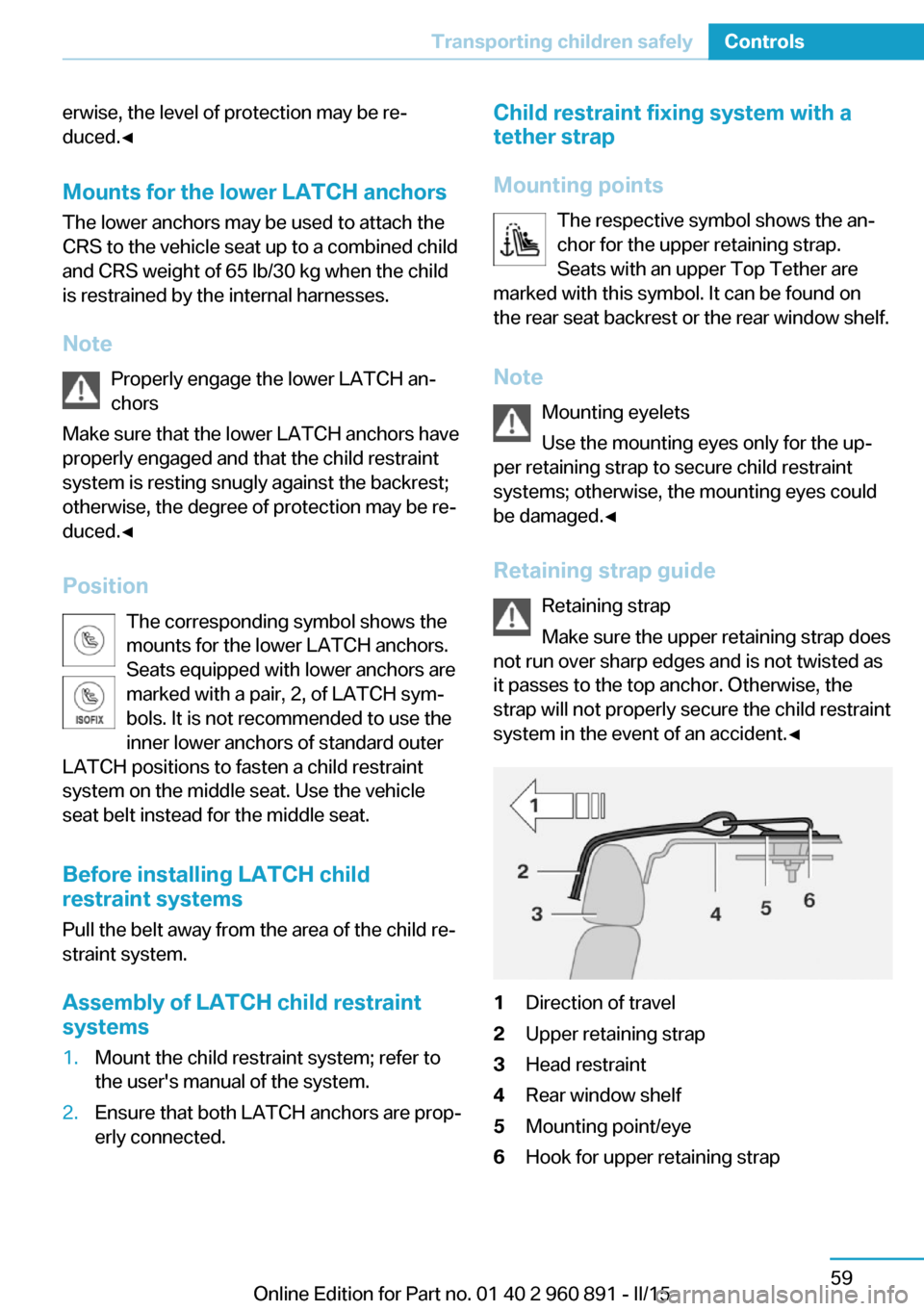
Retaining strap guide Retaining strap
Make sure the upper retaining strap does
not run over sharp edges and is not twisted as
it passes to the top anchor. Otherwise, the
strap will not properly secure the child restraint
system in the event of an accident.◀1Direction of travel2Upper retaining strap3Head restraint4Rear window shelf5Mounting point/eye6Hook for upper retaining strapSeite 59Transporting children safelyControls59
Online Edition for Part no. 01 40 2 960 891 - II/15
Page 158 of 224
LoadingVehicle features and options
This chapter describes all standard, country-
specific and optional features offered with the
series. It also describes features that are not
necessarily available in your car, e. g., due to
the selected options or country versions. This
also applies to safety-related functions and
systems. The respectively applicable country
provisions must be observed when using the
respective features and systems.
Hints Overloading the vehicle
To avoid exceeding the approved ca‐
pacity of the tires, never overload the vehicle.
Overloading can lead to overheating and in‐
creases the rate at which damage develops in‐
side the tires. This could result in a sudden
loss of tire inflation pressure.◀
No fluids in the cargo area
Make sure that fluids do not leak into the
cargo area; otherwise, the vehicle may be dam‐
aged.◀
Heavy and hard objects
Do not stow any heavy and hard objects
in the car's interior without securing them; oth‐
erwise, they may present a danger to occu‐
pants, e.g., during braking and evasive maneu‐
vers.◀
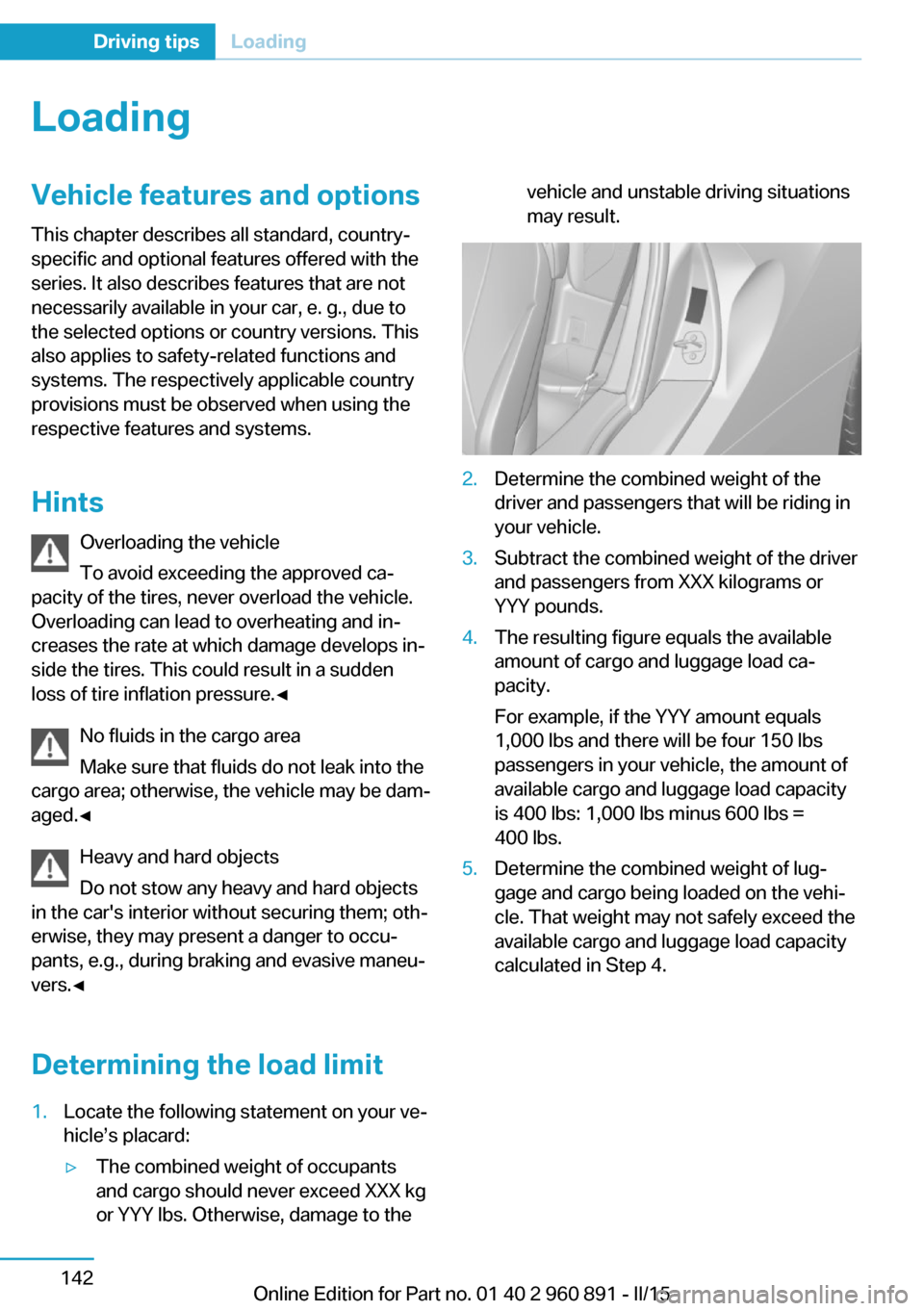
Determining the load limit1.Locate the following statement on your ve‐
hicle’s placard:▷The combined weight of occupants
and cargo should never exceed XXX kg
or YYY lbs. Otherwise, damage to thevehicle and unstable driving situations
may result.2.Determine the combined weight of the
driver and passengers that will be riding in
your vehicle.3.Subtract the combined weight of the driver
and passengers from XXX kilograms or
YYY pounds.4.The resulting figure equals the available
amount of cargo and luggage load ca‐
pacity.
For example, if the YYY amount equals
1,000 lbs and there will be four 150 lbs
passengers in your vehicle, the amount of
available cargo and luggage load capacity
is 400 lbs: 1,000 lbs minus 600 lbs =
400 lbs.5.Determine the combined weight of lug‐
gage and cargo being loaded on the vehi‐
cle. That weight may not safely exceed the
available cargo and luggage load capacity
calculated in Step 4.Seite 142Driving tipsLoading142
Online Edition for Part no. 01 40 2 960 891 - II/15
Page 159 of 224
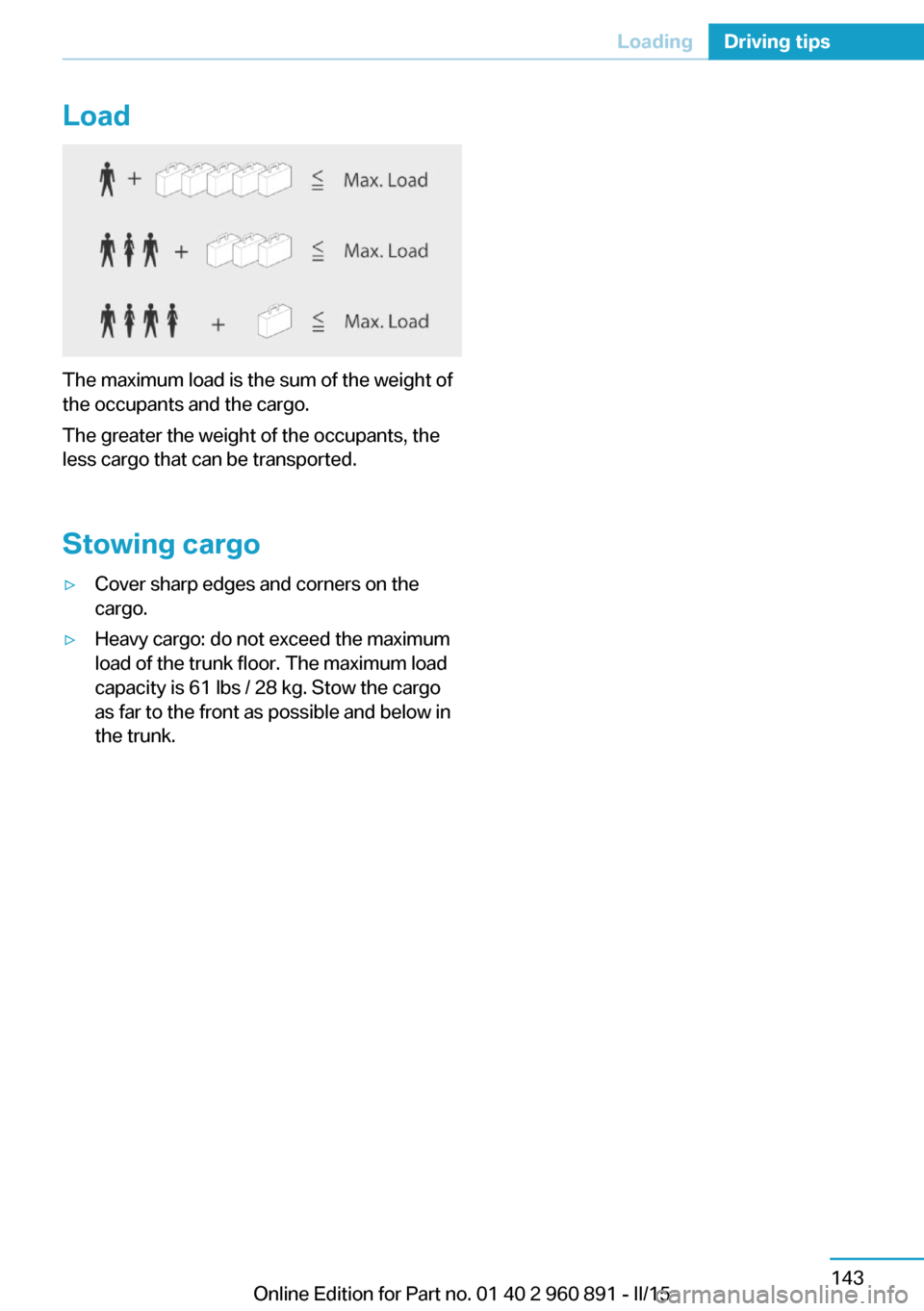
Load
The maximum load is the sum of the weight of
the occupants and the cargo.
The greater the weight of the occupants, the
less cargo that can be transported.
Stowing cargo
▷Cover sharp edges and corners on the
cargo.▷Heavy cargo: do not exceed the maximum
load of the trunk floor. The maximum load
capacity is 61 lbs / 28 kg. Stow the cargo
as far to the front as possible and below in
the trunk.Seite 143LoadingDriving tips143
Online Edition for Part no. 01 40 2 960 891 - II/15
Page 160 of 224

Increase rangeGeneral informationThe vehicle contains comprehensive technolo‐
gies for reducing the energy consumption and
for maximizing the range.
The range depends on a number of different
factors.
The implementation of certain measures, driv‐
ing style and regular maintenance can increase
range and thereby also reduce the environ‐
mental impact.
Remove unnecessary cargo
Additional weight increases fuel consumption.
Remove attached parts
following use
Attached parts on the vehicle impair the aero‐
dynamics and increase the energy consump‐
tion.
Closing the windows
Open windows increase air resistance and
therefore lead to greater fuel consumption.
Tires General information Tires can affect energy consumption in various
ways, for instance energy consumption can be
influenced by tire size.Check the tire inflation pressure
regularly
Check and, if needed, correct the tire inflationpressure at least twice a month and before
starting on a long trip.
Low tire inflation pressure increases rolling re‐
sistance and thus raises energy consumption
and tire wear.
Standing air conditioning Run advance climate control, refer to
page 127, in the vehicle during charging if pos‐
sible before driving off.
Heating and cooling operations are very en‐
ergy intensive and substantially reduce the
electric range.
Look well ahead when
driving
Avoid unnecessary acceleration and braking.
By maintaining a suitable distance to the vehi‐
cle driving ahead of you.
Driving smoothly and proactively reduces fuel
consumption.
Longer braking procedures result in more effi‐
cient charging of the high-voltage battery via
energy recovery from braking.
Use coasting
When approaching a red light, take your foot
off the accelerator and let the vehicle coast to
a halt.Seite 144Driving tipsIncrease range144
Online Edition for Part no. 01 40 2 960 891 - II/15
Page 211 of 224

Weights
BMW i8Approved gross vehicle weightlbs/kg4,090/1,855Loadlbs/kg620/281Approved front axle loadlbs/kg1,975/896Approved rear axle loadlbs/kg2,195/996Cargo area capacitycu ft/l4.7/154
Capacities
US gal/litersFuel tank, approx.11.1/42Seite 195Technical dataReference195
Online Edition for Part no. 01 40 2 960 891 - II/15