2015 AUDI TT ROADSTER engine
[x] Cancel search: enginePage 174 of 244

172 Checking and filling
Checking the engine coolant level
The engine coolant level can be checked with
a quick glance.
F ig. 132 Eng ine compartme nt: cover on the coo lant
expansion tank
Before you check anything in the engine com
partment,
a lway s read and he ed a ll WARN
ING S o .A in Working in the engine compart
ment on page 164.
., Park your vehicle on a level surface.
., Switch the ign ition
off .
., Read the coolant level at the coolant expan
sion tank
opage 166, fig . 128. With a cold
engi ne, it must be above the "min" mark.
With a hot engine, it can be a l ittle above
the indicated range.
The location of the coolant expans ion tank
can be seen in the engine compartment illus
tration
o page 166.
To obtain an accurate read ing, the eng ine
must be sw itched
off.
The expans ion tank in your vehicle is equipped
with an electric coolant level sensor.
When the coolant level is too low, the warning
light in the Auto-Check System
opage 17will
illum inate until you add coolant and the level
has been restored to normal. Even thoug h
there is an electric coolant level sensor, we
still recommend you check the coolant leve l
from time to t ime.
Coolant lo ss
Coolant loss may indicate a leak in the cooling
system. In the event of coolant loss, the cool
ing system should be inspected immediately by your authorized Audi dea
ler .
It is not
enough merely to add coo lant .
In a
seal ed system, losses can occu r on ly if
the boi ling po int o f the coo lan t is exceeded as
a res ult of overheating.
(D Note
Do n ot add any type o f radiator leak se al
ant to your veh icle's engine coo lant. Add
i ng radiator repa ir fl uid may adverse ly af
fect the functio n and performance of you r
cooling system and could result in damage
not cove red by your New Veh icle l imited
Warranty.
Adding coolant
Be very careful when adding engine coolant.
Before you check anyth ing in the engine com
partment,
a lways read and heed all WARN
INGS o .A in Working in the engine compart
ment on page 164.
Req uirement: There m ust be a res idual
amount of coo lant in the expansio n tank
o (D .
., Tur n off the engi ne .
., le t t he eng ine cool down.
., Place a thick rag ove r the coolant expansion
tank
o page 172, fig. 132 and carefully
twist the cap counter-clockwise o _A .
., Add coolant m ixed in the correct ratio
o page 171, Coolant up to the MAX mark
ing.
.. Make sure that the flu id level remains sta-
b le. Add more coo lant if necessary.
., Twi st the cap o n aga in
tightly.
Replacement engine coo lant must conform to
exact spec ificat ions
o page 171, Coolant .
We recommend using only coolant addit ive
Gl2++, Gl3 or in an emergency Gl2+. Do
not
use a different add itive . In an emergency use
plain water until you can get the co rrect addi
t ive and can resto re the correct ratio. This
sho uld be done as soon as poss ib le.
Page 175 of 244

If you have lost a consi derable amount of
coolant, then you should add co ld antifreeze
and cold water only when the engine is co ld .
Always use
new engine coolant when refi lling.
D o not fi ll coolant above the "MAX " mark . Ex
cess coolant will be forced out th rough the
p ress ure rel ief valve in the cap when the en
g ine becomes hot .
A WARNING ,_________
- The cooling system is under press ure and
can get very hot . Reduce the risk of
sca ld ing from hot coo lant by following
these steps.
- Tur n
off the eng ine and a llow itto cool
down.
- P rotect your face, hands and arms from
escap ing f lu id a nd steam by cover ing
the cap wi th a la rge, thick rag.
- Turn the cap slow ly and very ca refully
in a cou nte r-clockw ise d irect ion while
a pply ing ligh t, downw ard p ress ure on
the to p of the cap.
- T o avo id being burned, do no t sp ill an
tifreeze or coolan t on the exhaust sys
tem or hot engine parts . U nder certa in
conditions, the ethylene glyco l in en
gine coolant can catc h fire .
- Antifreeze is poisonous . Always store an
tifreeze in its original container and we ll
o ut o f the reach of children.
- If you drain the coolant , it must be
caught and safely stored in a proper con
tainer clearly marked "poison".
@ Note
- Do not add coolant if the expansion tank
i s empty . Ai r could enter the cooling sys
tem and damage the engine. If this is
the case, do not continue driving. Seek professional assistance.
- Coolant po llutes the env ironment and
could cause a n engine fire. Excess coo l
ant wi ll be f orced out through the pres
su re re lief valve in the cap when the en
gine becomes hot.
Checkin g and fillin g 173
- If, in an eme rgency, on ly wate r can be
added, the co rrect ratio between water
and antifreeze ¢
page 171 must be re
stored as soon as possible.
@) For the sake of the environment
Drained coolant sho uld not be reused. A l
ways d ispose of used coolant while observ
i ng a ll environmental regulations.
, Radiator fan
The radiator fan switches on automatically by
itself .
The electric radiator fan is controlled by ther
moswitches that switch on and
off depending
on coo lant and eng ine compartment tempera
tures.
An a uxiliary electric radiato r fan* sw itches on
and
off depending on coolant temperature
and othe r vehicle ope rat ion conditions .
After yo u switch the eng ine off, the aux iliary
f an can continu e running for up to 10 m inut es
- even with the ignition off. It can even switch
on again later by itself¢ & , if
- t he temperatu re of the engine coo lant rises
due to the hea t build -up from the engine in
the engine compa rtment, or
- the engine compa rtment heats up because
the vehicle is parked in intense sunlig ht.
A WARNING ~
- To reduce the risk of persona l in ju ry nev-
er touch the radiator fan .
- The a uxiliary electric fan is tempe rat ure
contro lled and can switch on suddenly
even when the engine is not running.
- The a uxiliary radiator fa n sw itches on a u
tomatically when the engine coo lant
reaches a certai n temperature and will
continue to ru n until the coo lant temper
ature drops. •
•
Page 176 of 244

17 4 Che cking and filling
Brake fluid
Checking brake fluid level
Fig . 133 Engine compa rtment: cove r on the brake fluid
reservo ir
Before you check anything in the engine com
partment,
a lw ays read and h eed all WA RN
ING S ¢&. in Working in the engine compart
ment on page 164.
,.. Read the brake fluid level from the brake
fluid reservoir¢
page 166, fig . 128. T he
brake flu id leve l must be between the "MIN"
and "MAX" markings.
The brake flu id rese rvo ir is located behind the
rear part ition of the eng ine compartment o n
the left side ¢
page 166.
The fluid level may drop slightly after some
time due to the automatic adjustment of the b rake pads . This is not cause for alarm.
If the brake fluid level falls
considerably be
low the "MIN" mark, the brake warning/indi
cator light (U.S. models: . , Canadian mod
e ls: . ) w ill come on
¢page 14. Do not con
tinue to operate the vehicle. The comp lete
brake system shou ld be thoroughly checked
by an authorized A udi dealer or other quali
fied facility and the cause corrected.
If the
brake fluid level is too low, the brake warn ing/
indicator light w ill illuminate. Contact an au
thor ized Audi dealer
imm ediatel y.
Changing brake fluid
Have the brake fluid changed by an experi
enced technician .
Brake fluid absorbs moisture from the air. If
the water content in the brake fluid is too high, corrosion in the brake system may result
after a period of time . The boiling point of the
brake flu id will also decrease conside rably and
decrease braking pe rformance.
Therefore, the brake fluid must be changed
eve ry two y ears. Always use new brake flu id
which conforms to Federal Motor Veh icle
Standard "F MVSS 116 DOT 4".
The brake fluid reservoir can be diff icult to
reach, therefore, we recommend that you
have the brake fluid changed by your author
ized
Audi dealer . Your dealer has the correct
tools, the right brake fl uid and the know -how
to do this for you.
A WARNING
- Brake fluid is poisonous . It must be stor
ed only in the closed original container
out of the reach of children!
- Brake failure can resu lt from o ld or inap
propriate brake flu id. Observe these pre
cautions:
- Use only brake f luid that meets SA E
specifica tion
J 1 7 03 and conforms to
Federa l Moto r Ve hicl e Standard 1 16.
Always check with yo ur authorized Aud i
dealer to make sure yo u are using the
correct brake fluid. The correct type of brake f lu id is also ind icated on the
brake flu id reservoir.
- The brake fluid must be new. Heavy use
of the brakes can cause a vapor lock if
the brake fluid is left in the system too
l ong. This can seriously affect the effi
c iency of the brakes as well as your
safety. This cou ld resu lt in an accident.
(D Note
Brake fluid will damage the paint of your
vehicle .
Page 179 of 244

-Do not interchange the positive and neg
ative cables .
- When working on the battery , be sure
not to short-circuit the terminals with
tools or other metal objects. This would cause the battery to heat up very quickly,
which could lead to damage or explosion and personal injury.
- When a battery is charged, it produces
hydrogen gas which is explosive and
could cause personal injury .
- Always keep the battery well out of the reach of children .
- Before work is done on the electrical sys
tem, disconnect the negative ground ca
ble .
- Before performing any work on the elec
trical system , switch off the engine and
ignition as well as any electrical equip
ment. The negative cable on the battery
must be disconnected. If you are just go
ing to replace a light bulb, then it is
enough to switch off the lights.
- Before disconnecting the battery , switch
off the anti-theft alarm system! Other
wise you will set off the alarm.
- When disconnecting the battery, first
disconnect the negative cable and then
the positive cable.
- Before reconnecting the battery, make
sure all electrical consumers are switch
ed off. Reconnect the positive cable first
and then the negative cable. Never inter
change the cables - this could start a fire!
- Never charge a fro zen or a thawed-out
battery. It could explode! If a battery has
frozen, then it must be replaced. A dis
charged battery can freeze over at 32 °F
(0 °C) .
-Make sure the vent hose is always attach
ed to the opening on the side of the bat
tery.
- Never use batteries which are damaged.
Danger of explosion! Always replace a
damaged battery.
Checking and filling 177
A WARNING
California Proposition 65 Warning:
- Battery posts, terminals and related ac cessories contain lead and lead com
pounds, chemicals known to the State of
California to cause cancer and reproduc
tive problems . Wash hands after han
dling.
Q) Note
- Do not disconnect the vehicle battery
when the ignition is switched on or when
the engine is running, otherwise , you will
damage electronic components in the
electrical system.
- If your vehicle is going to stand for a
long period of time without being driven,
protect the battery from "freezing", oth
erwise it will be damaged and will then
have to be replaced.
Checking the battery acid level on magic
eye batteries*
The battery acid level in the battery can be
checked through the clear inspection window .
Fig. 134 Lugg age compar tme nt: Battery w ith mag ic
e ye .
On top of the battery, there is a round "win
dow". This window (magic eye) changes color
as the battery charge and acid level change.
.,. Read and heed all WARNINGS
~.&_ in
Working on the battery on page 176
.. Read the acid level from the window on the
battery ~
fig. 134. Ill>-
Page 180 of 244

178 Checking and filling
Ai r bubbles in the window can cause an inac
curate reading. Carefully tap on the side of
the w indow.
- If the window is gr ee n, the battery ac id leve l
is correct.
- If the window has no c olo r or is brigh t yel
low ,
the battery acid leve l is too low . Have
the battery tested by your authorized A udi
dealer or a qualified workshop .
- If the window is
black , then the batte ry is
insufficiently charged. Recharge the battery
as soon as possible ¢
page 178.
@ Note
Do not overfill the battery, otherwise bat
tery acid will overflow through the vent
opening. This can damage the paint and
cause corros ion.
Charging of battery
Starting the engine requires a well charged
battery.
• Alw ay s rea d and heed all WARNING S be
low ¢
A and ¢ A in Working on the bat
tery on page 176.
• Switch off the ignit ion and all electrical con
sumers.
• Make sure the area is well vent ilated when
you charge the battery .
• Connect charger cables.
ALW AYS conn ect
c harg er cab les POSITIVE
G) to POSITIVE
G) ; NEGATIVE Qto NEGATIVE Q.
• Switch on the charger .
•T urnoff the charger ¢,& .
• Disconnect the charger cables.
• Connect both battery cables to the battery if
necessary-
first plus, then m inus.
When charging at
low voltages (e.g . with a
tri ckle char ger), the battery cables do not
have to be d isconnected first. Before charging
at
high voltages, i.e. "fa st charg ing ", you
must disconnect both cables. In e ither case,
follow the instruct ions from the manufacturer
of the charger. Fastcharging a battery is
dangerou
s ¢.&. in
Working on the battery on page 176 .
It re
quires special charging equipment and the
knowledge to go with it. We recommend hav
ing your battery fast charged only by a quali
fied workshop .
A d ischarged battery can
freeze at tempera
tures of only
32 °F (0 °C). Allow a frozen bat
tery to thaw completely before attempting to
charge it¢,&.. However, we recommend not
us ing a thawed battery aga in because the bat
tery casing can be cracked due to ice fo rma
t ion and can leak battery acid.
Do not open the battery caps when charging
the battery .
A WARNING ,..__ -
Charging a battery can be dangerous.
- Never charge a frozen battery . It may ex
p lode because of gas trapped in the ice .
Allow a frozen battery to thaw out first.
- Do not reuse batteries wh ich were fro
zen. The battery hous ing may have
cracked and weakened when the battery
fro ze.
- Cha rge t he battery in a well venti lated
area. Keep away from open flame or elec
tr ica l spar k. Do not smo ke. Hyd rogen gas
genera ted by the battery is explos ive .
- To reduce the danger of explosion, never
connect or d isconnect charger cab les
while the charger is operating.
- Fast charging a ba ttery is dange rous and
should only be at tempted by a compe
tent technician with the proper equip
ment.
- Battery acid tha t may sp ill dur ing cha rg
ing should be washed off with a solution
of warm water and baking soda to neu
tralize the ac id.
(D Note
Neve r use a fast charger as a booster to
start the engine. This wi ll seriously dam
age sensit ive e lectronic components, such
as contro l units, re lays, radio, etc., as well
as the battery charger.
Page 181 of 244

@ Tips
The vehicle battery must not be charged
with a standard small charger that plugs
into the cigarette lighter or out let.
Windshield/headlight
washer container
F ig . 135 Fen der, left: c over on th e win ds hield and
h ead lig ht· washe r fl uid reservoi r
The washer flu id container is marked with the
symbol
Q on its cap Qpage 166, fig. 128 .
• Before you check anyth ing in the engine
compartment,
always r ea d and h eed all
WARNING S Q .&. in Working in the engine
compartment on page 164 .
• Lift the filler cap tongue to add washer flu
id. You can fill the container to the top.
• Press the cap back onto the filler neck after
filling the containe r.
You can f ind the rese rvoir
ca paci ty in the tab le
in
~ page 223.
Clean water should be used when fill ing up . If
possib le, use soft water to prevent sca ling on
the washer jets. Always add a glass cleaner solu tion (with fros t protection in the w inter) .
(D Note
-Do not mix engine coolant antifreeze or
any other addi tives to fill up the wind
s hi eld washer reservo ir.
- Do not use glass cleane rs contain ing
paint solvent; you r isk damaging the
pain t.
Checkin g and fillin g 179
Page 187 of 244
Tires an d wheel s 185
you have stored. The system does not
recognize the load condition of your vehicle.
The effectiveness of the ti re pressu re monitor
ing sys tem w ill be impaired if you store no r
mal load pressures but then operate the vehi
cle at its maximum load¢,&.
See the illustration¢
fig. 136 for the location
of the label on dr iver's side B-pillar (color of
the actual labe l and exact location on the ve
hicle wi ll vary slig htly) .
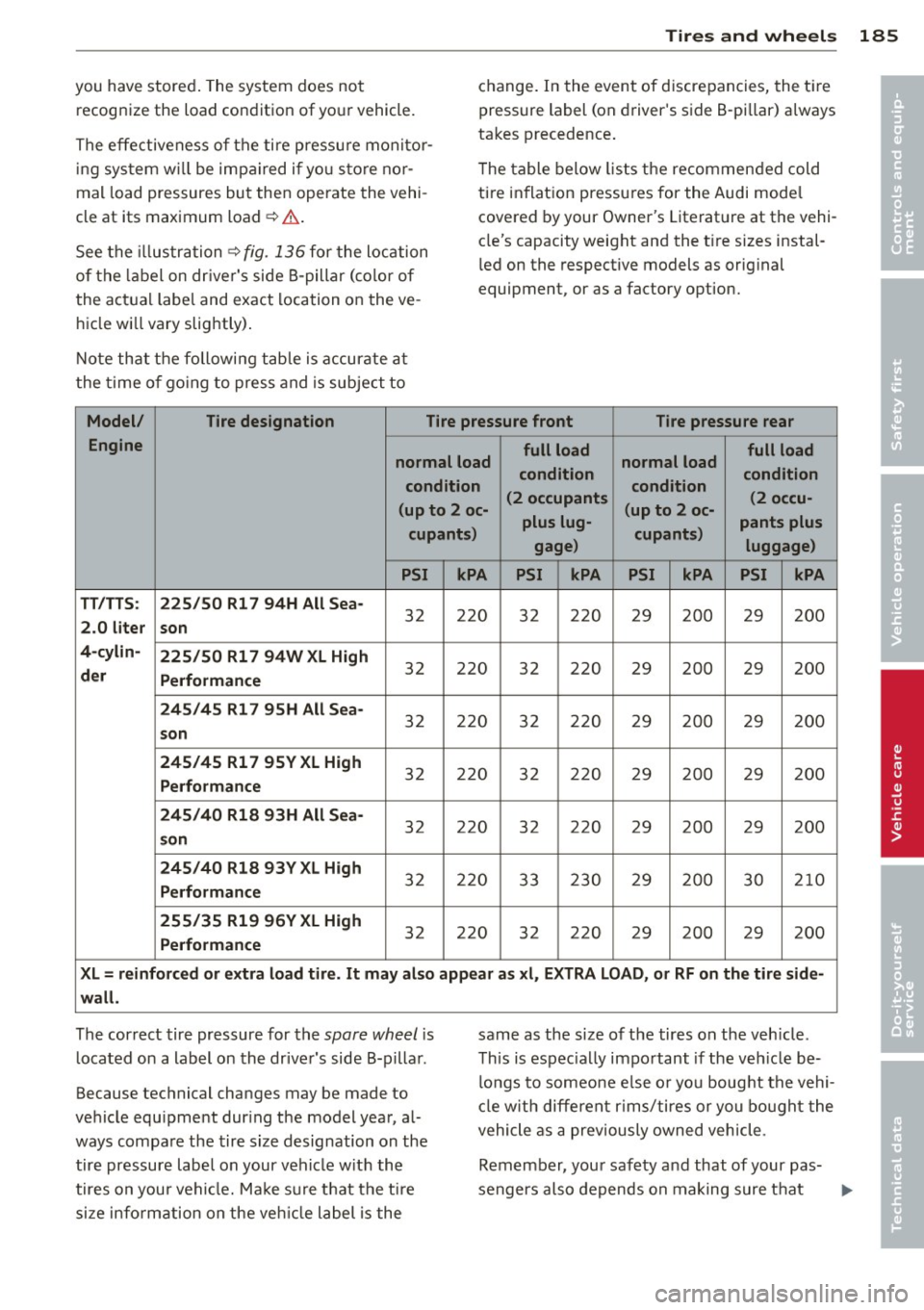
Note that the fo llowing tab le is accurate at
the t ime o f go ing to press and is subject to change. In the
event of discrepancies, the ti re
pressure label (on driver's side B-pi llar) always
takes precedence .
T he table below lists the recommended cold
ti re inflation pressures for the Audi mode l
covered by your Owner's Literature at the vehi
cle's capacity weight and the t ire sizes instal
led on the respective models as orig inal
equipment, or as a factory option.
Model/ Tire designation Tire pressure front Tire pre ssure rear
Engine full load full load
normal load condition normal load
condition
condition
(2 occupants condition
(2 occu-
( upto 2 oc-
plus lug- (
up to 2 oc-
pants plus
cupants) gage ) cupants)
luggage)
PSI kPA PSI kPA PSI kPA PSI kPA
TT /TI S: 225 /50 Rl 7 94H All Sea -
32 220 32 220 29 200 29 200 2.0 liter son
4-cyl in-
225/50 Rl 7 94W XL Hi gh
d er
Perf or man ce
32 220 32 220 29 200 29 200
24 5/ 45 Rl 7 95 H All S ea-
32 220 32 220 29 200 29 200 son
245 /45 R1 7 95YX L High
32 220 32 220 29 200 29 200 Performance
245 /40 R18 93H All S ea-
32 220 32 220 29 200 29 200 son
2 45 /40 R18 93Y XL High
32 220 33 230 29 200 30 210 Perf or mance
255 /35 R19 96 Y XL High
32 220 32 220 29 200 29 200
Perfo rmance
X L= r einf orced or extra lo ad tire. It ma y al so app ear a s xl, EX TR A LO AD, or RF on the tir e side-
wa ll.
The correct tire pressure for the spare wheel is
located on a label on the driver's side B-pillar.
Because technical changes may be made to
vehicle equ ipment during the model year, al
ways compare the tire size designation on the
tire pressure label on your vehicle w ith the
tires on your vehicle. Ma ke sure that the tire
size information on the veh icle label is the same
as the size of the tires on the veh icle.
Th is is espec ially important if the veh icle be
longs to someone else o r you boug ht the vehi
cle w ith diffe rent rims/tires or you bought the
vehicle as a prev iously owned vehicle.
Remember, your safety and that of your pas-
sengers also depends on making sure that
IJll,
•
•
Page 206 of 244
204 What do I do now ?
What do I do now?
Trunk escape handle
In case of an emergency, the rear lid can be
opened from the inside using the trunk es
cape handle.
Fig. 1 46 Luggage compartment: Trunk escape handle
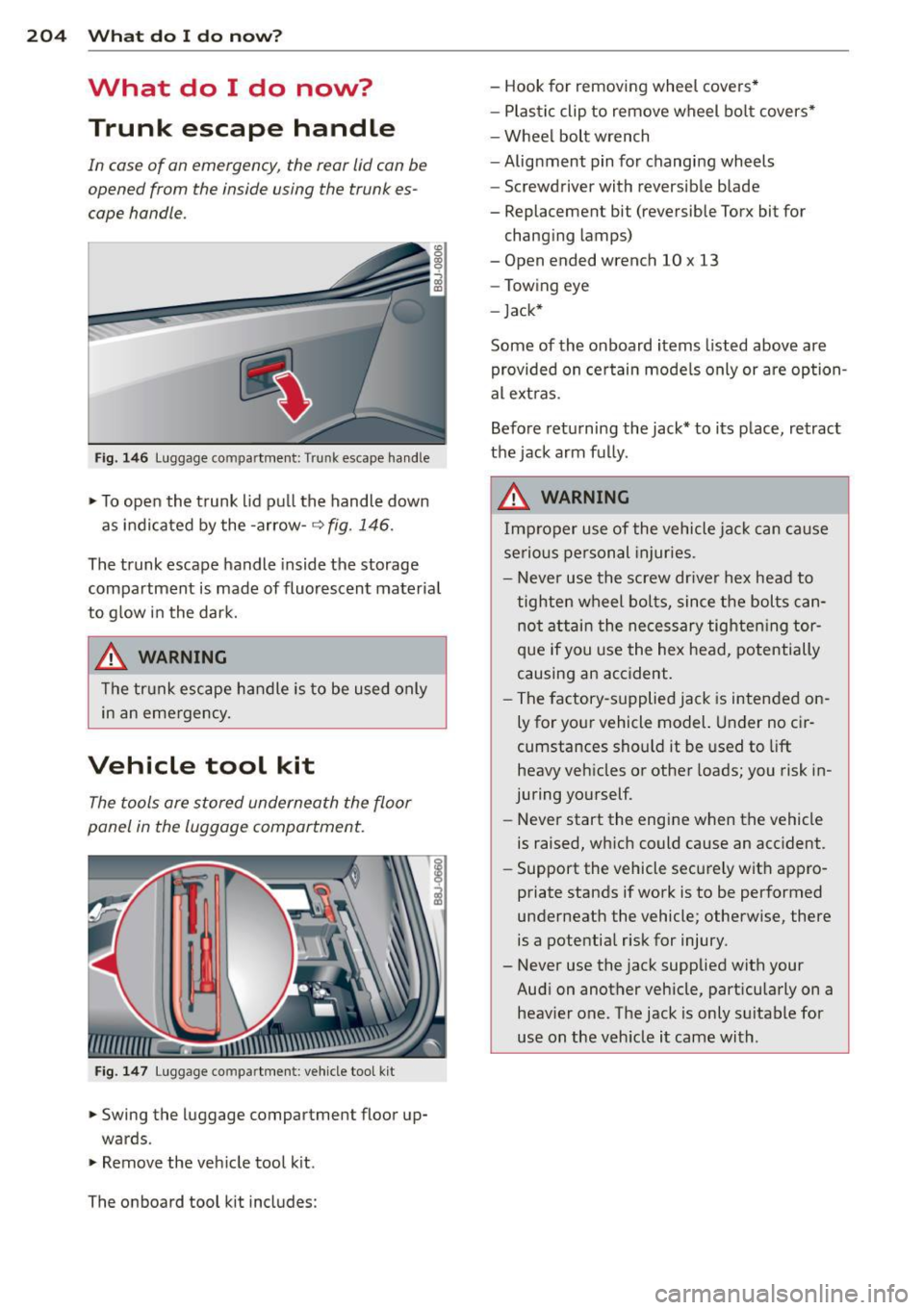
... To open the trunk lid pu ll the handle down
as indicated by the -arrow-~
fig. 146.
The trunk escape handle inside the storage
compartment is made of fluorescent materia l
to g low in the dark.
A WARNING
The trunk escape handle is to be used only
in an emergency.
Vehicle tool kit
The tools are stored underneath the floor
panel in the luggage compartment.
Fig. 1 47 Luggage co mpa rtment : veh icle too l kit
... Swing the luggage compartment floor up
wards .
... Remove the veh icle tool k it.
The on board tool kit includes: -
Hook for removing wheel covers *
- Plastic clip to remove wheel bo lt covers•
- Wheel bolt wrench
-Alignment pin for changing wheels
- Screwdriver with reversible blade
- Replacement bit (reversible Torx bit for
chang ing lamps)
- Open ended wrench 10 x 13
- Towing eye
- Jack*
Some of the on board items listed above are
provided on certain mode ls only or are option
al ext ras.
Before returning the jack* to its place, retract
the jack arm fully .
A WARNING
Im proper use of the vehicle jac k can cause
serious personal injuries .
- Never use the screw driver hex head to tighten wheel bo lts, since the bolts can
not attain the ne cessary tighten ing tor
que if you use the hex head, potentially
causing an accident.
- The factory-supplied jack is intended on ly for your vehicle model. Under no cir
cumstances should it be used to lift
heavy vehicles or other loads; you risk in
juring yourself.
- Never start the engine when the vehicle
is raised, wh ich could cause an acc ident.
- Support the vehicle secure ly wit h appro
priate stands if work is to be performed
underneath the vehicle; otherwise, there
is a potential risk for injury.
- Never use the jack supplied with your
Audi on another vehicle, part icularly on a
heavier one. The jack is only su itable for
use on the veh icle it came with .