2015 AUDI S8 seat adjustment
[x] Cancel search: seat adjustmentPage 181 of 312

as possible before installing the child
restraint.
- Always make sure that nothing pre
vents the front passenger's seat from
be ing moved to the rearmost position
in its fore and aft adjustment range.
- Always make sure that the backrest is
in the upr ight position.
- Always buck le the child safety seat firmly
in place even if a child is not sitting in it.
A loose ch ild safety seat can fly around
dur ing a sudden stop or in a col lision .
- Always read and heed all WARNINGS
whenever using a child restrained in ave
hicle is being used
c::> page 143, Safety
belts,
c::> page 151, Airbag system and
c::> page 17 4, Child Safety.
A WARNING
T o reduce t he ris k of serious injury, make
sure that the
PASSENGER AIR BAG OFF
light comes on and stays on whenever a
child rest raint is installed on the front pas
senger seat and the ignition is switc hed
on.
- Take the child restraint off t he fro nt pas
senger seat and install it properly at one
of the rear seat positions if the
PASSEN ·
GER AIR BAG OFF
light does not stay on.
- Have the airbag system inspected by
your authorized Aud i dealer immediate
ly.
Secure unused safety belts on the rear
seat
F ig. 175 Schematic overv iew: keep un used safety belts
away from children in child safety seats.@-oute r rear
safety belt,
@ -center rear safety belt
Child S afety 1 79
If a child safety seat is used on the rea r bench,
especially with LATCH universal lower ancho
rages, the unused safety belts
must be se
cured so that the child in the child restraint
cannot reach them
c::> &.
-Guide the safety belt webbing behind the
head restra int of the ad jacent seat
c::> fig. 175. When doing so, do not engage
the switchable locking retractor! You shou ld
not hear a "click ing" sound when wind ing up
the safety belt .
- Let the belt retractor wind up the safety belt
webbing.
A WARNING
A child in a chi ld safety seat installed with
the LA TCH lower anc horages or with the
standa rd safety be lt or a child in a booster
se at o n the rea r seat co uld play with un
used rear seat safety belts and become en
tang led . This cou ld cause the chi ld ser ious
personal injury and even death.
-A lways secure unused rear seat sa fe ty
be lts out of reach of children in child
seats such as by proper ly rout ing them
around the head restraint of the seat
where the ch ild restraint is installed.
- Never activate the switchable locking re
tracto r when routing the safety belts
around the head restraints.
- Never let anyone s it at the center rear
seating position if the center rear safety
be lt has been routed around a rear head
restra int .
Page 187 of 312

,....,
N ,....,
N
0 J:
'SI: ,...., \!) 1.1'1 ,...., 1.1'1 ,....,
-Forward-facing child safety seats or in
fant carriers installed on the front pas
senger's seat may interfere with the de ployment of the airbag and cause serious
injury to the child.
- It is safer to install a forward-facing
child safety seat on the rear seat .
- Always read and heed all WARNINGS
whenever using a child restrained in ave
hicle is being used
c:::;,page 174. Special
precautions apply when installing a child
safety seat on the front passenger seat
c:::;, page 153, Child restraints on the front
seat -some important things to know.
A WARNING
-
Always take special precautions if you
must install a forward or rearward-facing
child restraint on the front passenger's
seat in exceptional situations:
- Whenever a forward or rearward-facing
child restraint is installed on the front
passenger seat, the
PASSENGER AIR
BAG OFF light must come on and stay on
whenever the ignition is switched on.
- If the
PASSENGER AIR BAG OFF light
does not come on and stay on, perform
the checks described
c> page 161, Moni
toring the Advanced Airbag System .
-Take the child restraint off the front pas
senger seat and install it properly at one
of the rear seat positions if the
PASSEN
GER AIR BAG OFF
light does not stay on
whenever the ignition is switched on.
- Improper installation of child restraints
can reduce their effectiveness or even
prevent them from providing any protec
tion.
- An improperly installed child restraint
can interfere with the airbag as it de
ploys and seriously injure or even kill the
child.
- Always carefully follow the manufactur
er's instructions provided with the child
safety seat or carrier.
- Never place additional items on the seat
that can increase the total weight regis-
Child Safety 185
tered by the weight-sensing mat and can
cause injury in a crash.
A WARNING
Forward-facing child restraints:
- Always make sure the forward-facing
seat has been designed and certified by
its manufacturer for use on a front seat
with a passenger front and side airbag.
- Never put the forward -facing child re
straint up, against or
very near the in
strument panel.
- Always
move the passenger seat into its
rearmost position in the seat 's fore and
aft adjustment range, as far away from
the airbag as possible before installing
the forward-facing child restraint . The
backrest must be adjusted to an upright
position.
- Make sure that the
PASSENGER AIR BAG
OFF
light comes on and stays on all the
time whenever the ignition is switched
on.
A WARNING ...==-
Rearward-facing child restraints:
-A child in a rearward-facing child safety
seat installed on the front passenger
seat will be seriously injured and can be
killed if the front airbag inflates -
even
with an Advanced Airbag System.
- The inflating airbag will hit the child
safety seat or infant carrier with great
force and will smash the child safety seat
and child against the backrest, center
armrest, door or roof .
- Always be especially careful if you must
install a rearward facing child safety seat
on the front passenger seat in exception
al circumstances .
- A tight tether strap on a rearward-facing
child restraint attached to the front pas
senger seat can put too much pressure
on the weight-mat in the seat and regis
ter a heavier weight in the Advanced Air
bag System. The heavier weight regis
tered can make the system work as •
•
Page 193 of 312

-Always read and heed the important in
formation and WARNINGS about child
safety and the installation of child re
straint systems
c:> page 174, Child Safe
ty.
(D Note
On vehicles with power adjustable rear
seats* some criteria must be observed
when attaching the child restraint using the
LATCH system:
- To attach the child restraint securely, the
seat must be moved to the farthest rear
position, the seat height set to the low
est position and the head restraint must be adjusted to the vertical position
¢ page 61.
-If a child safety seat is attached to one of
the rear seats, this seat must not be ad
justed using the power controls under
any circumstances. The
Entry assistance
for this seat must also be deactivated in
the MMI ¢
page 64. The child safety seat
as well as the rear seat can be damaged by the adjustment process.
Tether anchors and tether straps
Fig. 186 Tether an cho rs: reces s fl ap s b ehin d th e re ar
seatbacks
The tether anchors for the two* /three rear
seating positions are located in recesses in the
rear window shelf ¢
fig. 186. Vehicles with
two rear seating positions* are equipped with two tether anchors .
A tether is a straight orV-shaped strap that
attaches the top part of a child restraint to
special anchorage points in the vehicle.
Child Safety 191
The purpose of the tether is to reduce the for
ward movement of the child restraint in a
crash, in order to help reduce the risk of head
injury that could be caused by striking the ve
hicle interior .
Forward facing child restra ints manufactured
after September 1, 1999, are required by U.S.
federal regulations to comply with new child
head movement performance requirements.
These new performance requirements make a
tether necessary on most new child safety
seats .
.&_ WARNING
Improper installation of child restraints
will increase the risk of injury and death in
a crash.
- Always follow the instructions provided
by the manufacturer of the child re
straint you intend to install in your Audi.
- Improper use of child restraint anchors
(including tether anchors) can lead to in
jury in a collision . The anchors are de
signed to withstand only those loads im
posed by correctly fitted child restraints .
- Never mount two child restraint systems
on one LATCH lower anchor point.
- Never attach two child restraint systems to one tether strap or tether anchorage.
- Never attach a tether strap to a tie-down
hook in the luggage compartment.
- Never use child restraint tether ancho
rages to secure safety belts or other
kinds of occupant restraints.
- Never secure or attach any luggage or
other items to the LATCH lower ancho rages or to the tether anchors .
- If a tether or other strap is used to at
tach a child restraint to the front passen ger seat, make sure that it is not so
tight, that it causes the weight -sensing
mat to measure more weight than is ac
tually on the seat .
- The heavier weight registered can make
the Advanced Airbag System work as
though an adult were on the seat and de -
ploy the Advanced Airbag when it must ..,
Page 205 of 312

.... N .... N
0 J:
'SI: .... \!) 1.1'1
.... 1.1'1 ....
temperature. This determines the current
state of charge and the power of the battery.
Idling current management
Idling current management reduces energy
consumpt ion while the vehicle is stand ing.
With the ignition switched off, it contro ls the
energy supply to the various e lectrica l compo
nents . Data from battery diagnosis is consid
ered.
D epending on the battery's state of charge,
individua l consumers are gradua lly turned off
to prevent excessive discharge of the battery
and thus maintain starting capability.
Dynamic energy management
While the veh icle is being driven, dynamic en
ergy management dist ributes the energy gen
erated according to the needs of the individu
a l components . It reg ulates consumption, so
that more electrical energy is not being used
than is being generated and ensures an opti
mal state of charge for the battery.
- But even energy management cannot
negate the limits of physics. Consider
that the power and life of a battery are
limited.
- If starting ab ility is threatened, the indi
cator light (•) appears
c> page 16, Cl
Battery .
What you should know
The highest priority is given to maintaining
starting capability .
The battery is severely taxed in short-distance
driving, in city traffic and during the cold time
of year. Abundant electrical energy is re
qu ired, but only a little is generated. It is also
cr itica l if the engine is not running and electri
cal components are turned on. In th is in
stance energy is being consumed but none is
be ing generated .
Intelligent technology 203
It is in precisely these situations that you will
notice energy management active ly regu lat
ing the distribution of energy.
Vehicle stands for an extended period
If you do not drive your vehicle over a period
of several days or weeks, e lectrica l compo
nents are gradually cut back or switched off.
This reduces energy consumption and main
tains starting capability over a longer period.
Some of the convenience functions may not
operate, such as the interior lights or the
power seat adjustment. The convenience
functions will be available again when you
switch on the ignition and start the eng ine.
With the engine turned off
If you listen to the radio, for example, with
the engine turned off or use other MMI func
tions, the battery is being discharged.
If starting capability is jeopardi zed due to en
ergy consumption , the following warning ap
pears in the MM I display:
Please start the engine soon or the system
will be turned off.
The warning indicates that the system will be
turned off automatically after 3 minutes. If
you w ish to continue using the functions, you
have to start the engine.
With the engine running
Although electrical energy is generated when
the vehicle is being driven, the battery can be
come discharged . This happens mostly when
li ttle energy is being generated and a great
deal consumed and the battery's state of
charge is not optimal.
T o b ring the energy ba lance back into equili
brium , consumers wh ich requ ire espe cially
large amounts of energy are temporarily cut
back or switched off . Heating systems in par
ticular require a great deal of energy. If you
notice, for examp le, that the heated seats* or
the heated rear window are not heating, they
have been temporarily cut back or switched .,.
•
•
Page 281 of 312
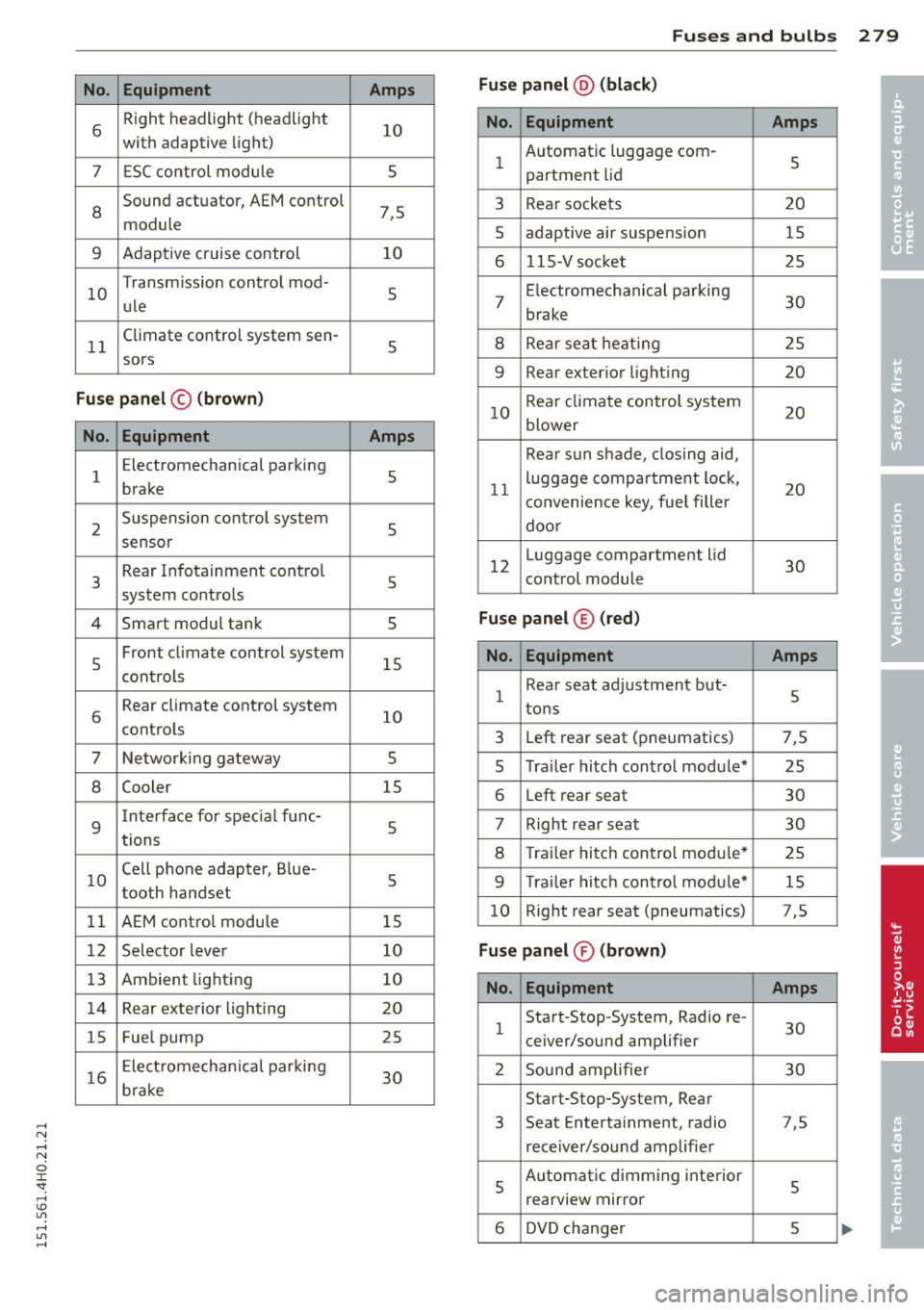
.... N .... N
0 J:
'SI: .... \!) 1.1'1
.... 1.1'1 ,....,
No. Equ ipment
6 R
ight headlight (headlight
with adaptive light)
7 ESC control module
8
Sound actuator, AEM control
module
9 Adaptive cruise control
10 Transmiss
ion control mod-
ule
11 Climate control
system sen-
sors
Fu se pan el© (bro w n)
No. Equipment
1 E
lectromechanical parking
brake
2 Suspension control system
sensor
3 Rear
Infotainment control
system controls
4 Smart modul tank
5 Front
climate control system
contro ls
6 Rear climate control
system
controls
7 Networking gateway
8 Cooler
9
I nterface for specia l func-
tions
10 Cell phone
adapter, Blue-
tooth handset
11 AEM control modu le
1 2 Selector lever
13 Ambient lighting
14 Rear exterior lighting
15 Fuel
pump
16 Electromechanical parking
brake
Amps
10
5
7,5 10
5
5
Amps
5
5
5
5
15
10
s
15
s
5
15
10
10
20
25
30
Fu ses and bulb s 2 79
Fus e pan el@ (bla ck)
•
No. Equipment Amps •
1 Automatic luggage com
-
5
partment lid
3 Rear sockets 20
5 adaptive air suspension
15
6 115-Vsocket 25
7 E
lectromechanical parking
30
brake
8 Rear seat heating 25
9 Rear exterior lighting
20
10 Rear climate control system
20
blower
Rear sun shade, closing aid,
11 luggage
compartment lock,
20
convenience key, fue l filler
door
12 Luggage compartment
lid
30
control module
Fuse panel ® (red)
No. Equipm ent Amps
1 Rear
seat adjustment but-
tons 5
3 Left rear seat (pneumatics) 7,5
5 Tra
iler hitch control module* 25
6 Left rear seat 30
7 Right rear seat 30
8 Trailer hitch contro l modu le*
25
9 Tra ile r hitc h control modu le* 15
10 Right rear
seat (pneumatics) 7,5
Fuse pan el® (brown )
No. Equipment Amps
1 Start-Stop-System,
Radio re-
30
ceiver/sound amplifier
2 Sound amplifie r 30
Start-Stop-System, Rear
3 Seat
Entertainment, radio 7,5
receiver/sound amplifier
5
Automatic dimming interior 5
rearview mirror
6 DVD changer 5
Page 302 of 312

300 Index
Front airbags
Description .... . ...... ... .. .. .... .
155
Howtheywork . ... .... ... .. .. .... . 160
Fr onta l co llisions and the laws of physics 144
Front passenger seat adjustment ... .. .. 64
Front seats . . . . . . . . . . . . . . . . . . . . . . . . . 58
Adjusting . .... . ...... ... .. .. .... . 135
Child restraints in the front seat ..... . 153
Fue l
Additives .... .. .. ..... ... .. .. .... .
220
Blended gasoline . ..... ... .. .. .... . 220
Current consumptio n . . . . . . . . . . . . . . . . 25
Economy messages (efficiency program) 26
Fuel filler flap emergency release .... . 224
Fuel filler neck ........... .. .. .. .. . 222
Fuel gauge . . . . . . . . . . . . . . . . . . . . . . . . 11
Gasoline ..................... ... . 220
Gasoline additives . ........... .. .. . 221
Low fue l level symbo l . . . . . . . . . . . . . . . 21
Octane rating .......... .. .. .. .. .. . 220
Recommendation . ..... ... .. .. .... . 220
Refue lling . .... .. ..... ... .. .. .... . 223
Reserve .... ... .. ..... ... .. .. .... .. 11
Tank capacity . . . . . . . . . . . . . . . . . 11,288
Fu ses
Assignment . .. .. ..... ... .. .. .... .
276
Rep lacing . .. .. .. ..... ... .. .. .... . 276
G
Garage door opener (Homel in k) .. .. .. . 131
Garment hooks ................. ..... 75
Gas discharge lamps ... ... .. .. .. .. .. . 280
Gauges
Eng ine coolan t temperature .. .. .. ....
10
Fue l gauge . . . . . . . . . . . . . . . . . . . . . . . . 11
Speedometer . . . . . . . . . . . . . . . . . . . . . . 26
Tachometer . . . . . . . . . . . . . . . . . . . . . . . 11
Trip odometer . . . . . . . . . . . . . . . . . . . . . 26
General illustration . . . . . . . . . . . . . . . . . . . 8
Generator ..................... .....
16
Glossary of t ire and loading termino logy 246
Glove compartment (cooled) ........... 75
Glow plug system
Indicator light . . . . . . . . . . . . . . . . . . . . .
20
Gross Vehicle Weight Rating (GVWR) .. . 287
H
Head -up Display . . . . . . . . . . . . . . . . . . . . . 28
Head lights
Cleaning .. .. .. .. .. ........ ...... .
215
Cleaning system . . . . . . . . . . . . . . . . . . . . 53
De fec tive . . . . . . . . . . . . . . . . . . . . . . . . . 22
Head light range control . . . . . . . . . 22 , 46
High beam assist .... .. ..... ... .. .. . 49
Washer reservoir ... ... ..... ... .. .. 244
Head restrai nts . . . . . . . . . . . . . . . . . 65, 13 7
Adjusting . .. .. .. ............. .. .. 13 7
Heated exter ior mirro rs . . . . . . . . . . . . . . . . . . . .
55
rear w indow . . . . . . . . . . . . . . . . . . . . . . . 80
sea ts . .. .. .. .. .. .. ............. .. . 80
windshield washer sp ray no zzles . . . . . . 53
Heating ...... .. .. .. ... ....... ... .. . 78
Heavy clothing and safety be lts . ... .. .. 146
Hig h beam .. .... .. ............. ..... 48
Hig h voltage warning label ........... 287
Hill descent contro l .. .... .... ... .. .. 117
Homelink universal remote control .... 131
Hood (re lease lever) . .... ..... ... .. .. 228
Hor n ............................... 8
How are child restraint system anchors re-
lated to chi ld safety .......... .......
187
How many airbags does my vehicle have? 158
How often should I che ck my tire pres-
s ur es? . .. .. .. .. .. ............... ..
2 52
How safety belt pretens ioners work .. .. 149
Hydrop laning ..... ... .. ..... ... .. .. 256
I
Ig nition
Indica tor lights .. .. .... .... ... .. .. .
17
Switching on/off .... .. ..... .... . .. . 83
Immobilize r .. .. .. ............. .. .. . 26
Important t hings to do before driving .. 133
Improperly worn safety belts . . . . . . . . . . 149
Ind icator lights
Dynam ic steer ing ................. .
201
also refer to Warning/indicator lights . . 11
Infant seats .... .. ............. .... 180
Installing child safety seats
Safety be lts . . . . . . . . . . . . . . . . . . . . . .
184
Page 305 of 312

,....,
N ,....,
N
0 J:
'SI: ,...., \!) ..,.,
,...., ..,., ,....,
Settings ... .. ........... .. .. .. .... 34
Unlocking and locking vehicle ... .. .. .. 35
Pow er seat adjustment
Front seats . . . . . . . . . . . . . . . . . . . . . . . . S9
Rear seats . . . . . . . . . . . . . . . . . . . . . . . . . 61
Power steering
refer to Electromechanical power assist 201
Power windows ............ .... .. .... 41
malfunction ............. .... .. .. .. 42
Pregnant women
Special considerations when wearing a
safety belt . . . . . . . . . . . . . . . . . . . . . . . 148
pre sense .. .. .. ........... .. .. .. .. . 194
Preventative passenger protection . . . . . 194
Programming the Hom elink universa l re-
mote control ................. ... ... 131
Proper occupant seating positions .. .. . 134
Proper safety belt position ... .. .. .. .. . 147
Proper seating position
Front passenger ................... 135
Occupants .. ................. .. ... 134
Rear passengers .......... .. .. .. ... 136
Protecting 216
Q
quattro
refer to All Wheel Drive ............. 202
Question What happens to unbelted occupants? 144
Why safety belts? ............... .. 143
R
Radiator fan ... ........... .. .. .. ... 238
Radio clock .. .. .............. ... .... 27
Rain/light sensor Headlights .............. .... .. .... 46
I ntermittent (windshield wipers) . . . . . . 53
Sensor defective . . . . . . . . . . . . . . . . . . . . 22
RangeffuelleveO .................... 25
Reading lights . ............... ... .... 50
Rear fog lights ............ .... .. .. .. 46
Rear lid
Escape handle
Rear light 266
Defective .. ............. .... .. .... 22
Index 303
Rear seats
Adjusting individual seats ......... .. . 61
Entry assistance . ... .............. .. 64
Front passenger seat adjustment . . . . . . 64
Reclining rear seat .................. 63
Rear view mirror ... .. .............. .. 56
Rear window heating . ................ 80
Recircu lation mode (automatic climate
control) . . . . . . . . . . . . . . . . . . . . . . . . . . . . 79
Reclining rear seat ... .............. .. 63
Recuperat ion .. .. .. .. . .. ... .... .... .. 25
Refuelling ... ... .. .. ............... 223
Remote control Garage door opener (HomeLink) ...... 131
Massage function . . . . . . . . . . . . . . . . . . . 64
Unlock ing and locking .............. . 35
Remote luggage compartment lid release 37
Repair manuals .. ................... 290
Repairs Airbag system ..... .............. . 164
Replacing Fuses ......... .. ................. 276
Light bulbs .. .. .. .... ........... .. 280
Tires and wheels ... .............. . 257
Windshield wiper blades ............ . 54
Reporting Safety Defects ............. 141
Request to warm engine by driving Warning/indicator lights ........ .. .. . 21
Reset button . . . . . . . . . . . . . . . . . . . . . . . . 26
Retractor . . . . . . . . . . . . . . . . . . . . . . . . . . 146
Reverse . . . . . . . . . . . . . . . . . . . . . . . . . . . 114
Rims Cl eaning ...... .... ............... 215
Roof rack . . . . . . . . . . . . . . . . . . . . . . . . . . . 72
Loading ........................... 73
Roof weight . .. .. .... ........... .. . 73
s
SAFE ................... ........... 26
Safe driving habits ... .............. . 133
Safety belt pos ition . . . . . . . . . . . . . . . . . 14 7
Safety belts worn by pregnant women . 148
Safety belt pretensioner . . . . . . . . . . . . . . 149
Serv ice and disposal ... ... .... ..... 150
Safety belt pretensioners Pre sense . . . . . . . . . . . . . . . . . . . . . . . . 194
•
•
Page 306 of 312

304 Index
Safety belts . . . . . . . . . . . . . . . . . . . . . . . . 146
Adjusting . ................. ..... . 148
C leaning ... ................ ..... . 217
Danger to passengers who do not wear a
safety belt . . . . . . . . . . . . . . . . . . . . . . . 144
Fastening .. ................ ... ... 146
Improperly worn ......... .. .. .. .. . 149
Not worn . . . . . . . . . . . . . . . . . . . . . . . . 144
Safety belt position ..... .. .. .. .. .. . 147
Safety instructions . . . . . . . . . . . . . . . . . 146
Securing child safety seats .......... 184
Specia l considerations for pregnant
women .... ................ ..... . 148
Unfastening ............... .. .... . 148
Warning/indicator light ...... .. .... . 143
Warning light .. ............ .. .... .. 17
WhyYOU MUSTwearthem ..... .. ... 143
Worn properly . . . . . . . . . . . . . . . . . . . . 145
Safety belt tensioner drive select .............. .. .. .... . 108
Safety belt warn ing ligh t .. .. .. .. .. .. . 143
Safety compliance st icker ....... .. .. . 287
Safety equipment .................. . 133
Safety features for occupant restraint and
p ro tection ... .. . .......... .. .. .. .. . 133
Safety guidelines Seat adjustment . . . . . . . . . . . . . . . . . . . . 58
Safety instructions Engine compartment ...... .. .. .. .. . 228
for side curtain airbags .... .. .. .... . 173
for using child safety seats ....... .. . 177
for using safety belts ....... ..... .. . 146
Monitoring the Advanced Airbag Sys-
tem ... .. ... ............ .. .. .. .. . 164
Safety systems Warning/ indicator lights ... .. .. .. .. . . 18
Saving fue l
Cylinder on demand System . ... .. .. .. 25
Efficiency program . . . . . . . . . . . . . . . . . . 26
Recuperation . . . . . . . . . . . . . . . . . . . . . . 25
Seat adjustment Controls (front seats) . . . . . . . . . . . . . . . . 59
Controls (rear seats) ................ 61
Driver's seat . . . . . . . . . . . . . . . . . . . . . . . 58
Front passenger's seat . . . . . . . . . . . . . . . 59
Front seats . . . . . . . . . . . . . . . . . . . . . . . . 58
H ead restraints . . . . . . . . . . . . . . . 65 , 137 Reclining
rear seat ............. ..... 62
Safety guidelines ................. .. 58
Seat belts
Why YOU MUST wear them ...... .. .. 143
Seat covers Cleaning ...... .. .. ... ........... . 217
Seat heating/ventilation .............. 80
Seating position Driver .. .. .. .. .. .. ........... .. .. 134
Front passenger .. ............. .... 135
How to adjust the front seats ........ 135
Incorrect seat position .............. 13 7
Occupants ..... ................... 134
Rear passengers .. ............. .... 136
Seat memory . . . . . . . . . . . . . . . . . . . . . . . 66
Seats Comfort seat side view .............. 67
Seat symme try ... ............. .... . 67
Seats (number) .. .. ............. .... 143
Selective catalytic reduction
refer to Ad Blue ... ................ . 225
Selective unlock feature . . . . . . . . . . . . . . . 34
Selector lever ..... ............. .... 114
Service and disposal
Safety belt pretensioner . . . . . . . . . . . . 150
Serv ice interval display ................ 27
Service position
refer to Windshield wipers ...... .. .. . 54
Shift paddles . . . . . . . . . . . . . . . . . . . . . . . 117
Sh ip (transport ing your vehicle) .. .. .. .. 285
Shutting down vehicle ........... .. .. 207
Side airbags Description .... ... .............. .. 168
How they work . . . . . . . . . . . . . . . . . . . . 170
Side assist ...... .. .. ........ ...... . 104
Activating and deactivating ........ .. 106
Adjusting the brightness .......... .. 106
Cleaning the sensors ........... .... 215
Sensor range .... ................ . 105
Side curtain airbags ................ . 171
Description .... .. ............. .... 171
How they work ... ............. .... 172
Safety instructions ... .......... .. .. 173
Side marker lights . .................. 46
Ski sack
refer to Pass -through with ski sack .. .. . 71