2015 AUDI S6 ECU
[x] Cancel search: ECUPage 207 of 314

M N
0 <.J 'SI: ,...., \!) ..,.,
,...., ..,., ,....,
Trailer towing Driving with a trailer
General information
Your Audi was designed primarily for passen
ger transportation .
If you plan to tow a tra iler, p lease remember
that the addit ional load will affect durab ility,
economy and performance .
Trailer towing not on ly places more stress on
the vehicle, it also calls for more concentra
tion from the driver.
F or this reason, a lways fo llow the operating
and driving instructions provided and use
common sense.
(D Note
If you are going to tow a trai le r, you must
ac tivate the trailer operation mode
c::> page 205, Operating instructions.
Technical requirements
Trailer hitch
Use a weig ht-carrying hitch conforming to the
gross trailer we ight. The hitch must be suita
b le for your veh icle and trailer and must be
mounted secure ly on t he ve hicle's chassis at a
technically sound location . Use only a trail er
hi tch w ith a removab le ball moun t. A lways
check wi th t he tra ile r hi tch man ufactur er to
make sure that you are using the cor rect
h itch.
Do not us e a bumper hitch.
The hitc h m ust be installed in such a way that
i t does not interfe re with the impac t-absorb
i ng bumper syst em. No mod ificat ions should
b e made to the vehi cle e xhaus t and br ake sys
tems . From t ime to time, check th at a ll hitc h
mo unt ing bo lts rem ain securely fas tened.
When you are not towing a trail er, remove the
tra ile r hi tch ball moun t. T h is prevents the
hi tch from causing damage sho uld your ve hi
cle be str uck from behind~ .& .
Trailer towin g 205
Trailer brakes
If your trailer is equippe d wi th a bra king sys
tem, check to be s ure that i t conforms to all
regulations .
T he trailer hyd ra u lic bra ke sys tem mus t not be
d irec tly connec ted to the vehicle's hydraulic
brake system .
Safety chains
Always use safety chains be tween your ve hicle
and t he tra ile r.
Trailer lights
Trai ler lights must meet all reg ulations. Be
su re to c heck with your Audi dea ler for correct
wir ing, switches and relays .
Mirrors
If you a re unable to see the traffic behind you
u sing the regula r outside mirrors, then you
must insta ll extended mir rors. It is important
t h at you
always have clea r vis io n to the rear.
_&. WARNING
-
Afte r removi ng the t railer hitch , do no t
stor e it in yo ur v ehicl e. In case of sudden
b raki ng, the hi tch co ul d fly forwar d and in
j ur e you o r yo ur pass enge rs.
Operating instructions
Maximum trailer weight
A tra ile r fo r you r vehi cle is l imited to a typi cal
cla ss 1 o r class 2 tr ailer.
Trailer load distribution
Be sure the load in the tra ile r is held secure ly
in place to p revent it from shift ing fo rward,
ba ckward or sideways.
Never allow a passenger to ride in a trailer
c::> .& in Driving instructions on page 207 .
Eng ine cooling sy stem
Towing a t railer ma kes the engine wor k hard
er . It is impo rtant that the cooling system's
performance is up to the additional load.
•
•
Page 225 of 314

M N
0 <.J 'SI: ,...., \!) 1.1'1 ,...., 1.1'1 ,....,
-Always disconnect the battery.
- Never smoke or work near heaters or open flames. Fluids in the engine com
partment could start a fire.
- Keep an approved fire extinguisher im
mediately available.
- To avoid electrical shock and personal in
jury while the engine is running or being
started, never touch :
- Ignition cables
- Other components of the high voltage
electronic ignition system.
- If you must perform a check or repair
with the engine running:
- First, fully apply the parking brake,
move selector lever to P (Park).
- Always use extreme caution to prevent
clothing, jewelry, or long hair from get
ting caught in the radiator fan, V-belts
or other moving parts, or from contact ing hot parts. Tie back hair before
starting, and do not wear clothing that
will hang or droop into the engine.
- Minimize exposure to emission and
chemical ha zards c:::> & .
A WARNING
California Proposition 65 Warning:
- Engine exhaust, some of its constituents,
and certain vehicle components contain
or emit chemicals known to the State of
California to cause cancer and birth de
fects and reproductive harm. In addition ,
certain fluids contained in vehicles and
certain products of component wear con
tain or emit chemicals known to the
State of California to cause cancer and
birth defects or other reproductive harm .
Checking and filling 223
-Battery posts, terminals and related ac
cessories contain lead and lead com
pounds, chemicals known to the State of
California to cause cancer and reproduc
tive harms. Wash hands after handling.
(D Note
When adding fluids, always make sure that
they are poured into the proper container
or filler opening, otherwise serious dam
age to vehicle systems will occur.
(® For the sake of the environment
To detect leaks in time, inspect the vehicle
floor pan from underneath regularly . If
you see spots from oil or other vehicle flu ids, have your vehicle inspected by an au
thorized Audi dealer.
Closing the engine hood
.,. Pull the hood down until the pressure from
the struts is reduced.
.,. Let the hood
drop down and latch in place.
Do not try to push it shut; it may fail to en
gage
c:::> ,A .
A WARNING
-
A hood that is not completely latched
could fly up and block your view while driv
ing .
- When you close the engine hood, check it
to make sure the safety catch has proper ly engaged. The hood should be flush
with the surrounding vehicle body parts.
- If you notice while driving that the hood
is not secured properly , stop at once and
close it. •
•
Page 254 of 314

252 Tires and wheels
-Always inflate tires to the
recommended and correct
tire pressure before driving
off .
-Driving with underinflated tires bend more, letting
them get too hot resulting
in tread separation, sudden
tire failure and loss of con
trol.
-Excessive speed and/over loading can cause heat
build-up, sudden tire failure
and loss of control.
-If the tire pressure is too low or too high, the tires
will wear prematurely and the vehicle will not handle
well.
- If the tire is not flat and you
do not have to change a
wheel immediately, drive at
reduced speed to the near
est service station to check
the tire pressure and add air
as required.
@ Note
Driving without valve stem
caps can cause damage to
the tire valves. To prevent
this, always make sure that
factory installed valve stem caps on all
wheels are secure
ly mounted on the valve.
@) For the sake of the environment
Underinflated tires will also
increase the fuel consump
tion.
Tires and vehicle load limits
There are limits to the amount of load or weight that any vehi
cle and any tire can carry. Ave
hicle that is overloaded will not
handle well and is more diffi
cult to stop. Overloading can not only lead to loss of vehicle
control, but can also damage
important parts of the vehicle
and can lead to sudden tire fail
ure, including a blowout and
sudden deflation that can cause
the vehicle to crash.
Your safety and that of your
passengers also depends on
making sure that load limits are
not exceeded. Vehicle load in
cludes everybody and every
thing in and on the vehicle.
These load limits are technical
ly referred to as the vehicle's
Gross Vehicle Weight Rating
("GVWR "). .,..
Page 268 of 314

26 6 T ire s and whee ls
Wheel bolts
Wheel bolts must always be tightened to the
correct torque .
The design of wheel bolts is matched to the
factory installed rims. If different rims are fit
ted, the correct wheel bolts with the right
length and correctly shaped bolt heads must
be used. This ensures that wheels are fitted
secure ly and that the brake system functions
correctly .
In ce rtain circumstances, you may not use
wheel bolts from a different vehicle -even if it
is the same mode l
~page 294.
_& WARNING
Improperly tig htened o r maintained whee l
bolts can become loose ca using loss of
contro l, a co llision and serious persona l in
jury.
- Always keep the wheel bolts and the
threads in the wheel hubs clean so the
wheel bolts can turn easily and be prop
erly t ightened.
- Never grease or oil the wheel bo lts and
the threads in the wheel hubs. They can
become loose while driving if greased or
oiled, even if tightened to the specif ied
torque.
- Only use wheel bolts that belong to the
rim being installed.
- Never use different wheels bolts on your
vehicle.
-Always maintain the correct tighten ing
torque for the wheel bolts to reduce the
risk of a wheel loss. If the tightening tor
que of the wheel bolts is too low, they
can loosen and come out when the veh i
cle is moving. If the tightening torque is
too high, the whee l bolts and threads
can be damaged and the wheel can be
come loose.
@ Note
The spec ified torq ue fo r the wheel bo lts is
90 ft lb (120 Nm) w ith a toleran ce of± 7,4
ft lb(± 10 Nm). Torque wheel bo lts diago- nally
. After changing a whee l, the torque
must be checked as soon as possible with a
torque wrench -preferably by an author
i zed Audi dealer or qualified workshop.
Low aspect ratio tires
Your Audi is factory-equ ipped w ith low aspect
r atio tires . These tires have been tho roughly
tested and been se lected specifically for your
model for their superb perfo rmance, road fee l
and hand ling under a variety of d riving cond i
tions . As k your au thor ized A udi dealer for
more de tails .
T he low aspect ratio of these t ires is ind icated
by a numera l of
55 or less in the tire's s ize
designation. The nume ra l represen ts the ra tio
of the tire's sidewall height in relation to its
tread width expressed in percentage . Conven
tiona l tires have a he ight/width ratio of 60 or
more.
The performance of low- aspect-r atio tires is
p ar ticu la rly s ens iti ve to improper infl ation
p re ss ure. I t is th erefore im portant th at low
as pect ratio tires are inflated to the specified
pressure and that the inflation pressu re is
r e gularl y che cked and mainta ined. Tir e pre s
su res should be ch ecked at least onc e a
month and alwa ys bef ore a long trip
~ page 249, Checking tire pressure.
What you can do to a void tire and rim
damage
Low aspect ratio tires can be damaged more
easily by impact w it h potholes, curbs, gull ies
o r r idges on the road, pa rticularly if the tire is
u nderinfla ted .
In order to minimize the occurrence of impact
damage to the tires of you r vehicle, we recom
mend that you observe the follow ing p recau
tions:
- Always ma inta in recommended inflation
pressures. Check your tire pressure eve ry
2,000 miles (3,000 km) and add air if neces
sary .
- Dr ive carefully on roads with potholes, deep
gullies o r ridges. The impact from dr iv ing ..,.
Page 273 of 314

Vehicle tool kit
Vehicle tool kit and jack
The vehicle tool kit is located in the luggage
compartment under the cargo floor cover.
Fi g. 204 Luggage compa rtme nt: cargo floor cover
folded upward/spare tire
Fig. 205 Trunk lid: Vehicle too l kit
.. Lift the cargo floor by the plastic handle
c:> fig . 204.
.. Hook the handle into the luggage compart
ment weather strip .
.. Turn the handwheel counter-clockwise
c:> fig. 204 and remove the spare tire to
reach the vehicle too l kit.
.,. Unhook the ca rgo floor before clos ing the
rear lid.
The onboard tool kit includes:
- Hooks to remove the wheel covers*
- Plastic hook to remove wheel bolt covers*
- Wheel bolt wrench
- Alignment pin for changing wheels
- Screwdriver w ith reversible blade
- T owing eye
~ -Jack
0
~ Before storing the jack, make sure it is wound rl
:5: back down as far as it will go.
rl l/1 rl
What do I d o now ? 271
A WARNING
Im proper use of the vehicle jack can cause
serious personal injur ies.
- Never use the screw driver hex head to
tighten wheel bolts, since the bolts can
not attain the necessary tighten ing tor
que if you use the hex head, potentially
causing an accident.
- The factory-supplied jack is intended on
ly for yo ur vehicle model. Under no c ir
cumstances should it be used to lift heavy veh icles or other loads; you risk in
ju ring yo urself.
- Never start the engine when the vehicle
is raised, wh ich could cause an acc ident.
- Support the vehicle securely with appro
priate stands if work is to be performed
underneath the vehicle; otherwise, there
is a potentia l risk for injury.
- Never use the jack supplied wit h your
Audi on another vehicle, particularly on a
heavier one. The jack is only s uitable for
use on the vehicle it came with.
(D Tips
- Some of the onboard items listed above
are provided on certain models only or
are optional ext ras .
- Before yo u can raise your vehicle using
the jack, you must activate the jacking
mode
c:!) page 2 75 .
Space-saving spare tire (compact spare
tire )
The spare tire/wheel is located in the luggage
compartment under the cargo floor cover. It
is intended for short-term use only.
Ta king out the spare tire
.. Lift the cargo floor by the p lastic handle
<=) page 271, fig . 204 .
.. Hook the handle into the luggage compart
ment weather strip.
.. Turn the large screw
¢ page 271, fig. 204
counter -clockwise .
.,. Take out the spa re tire .
Page 278 of 314

276 What do I do now?
-On hard, slippery surface (such as tiles)
use a rubber mat or similar to prevent
the jack from slipping.
- To help prevent injury to yourself and
your passengers:
- Do not raise the vehicle until you a re
sure the jack is securely engaged.
- Passengers must not remain in the ve
hicle when it is jacked up.
- Make sure that passengers wait in a
safe place away from the vehicle and
well away from the road and traffic.
- Make sure jack position is correct , ad
just as necessary and then continue to raise the jack.
- Changes in temperature or load can af
fect the height of the vehicle.
(D Note
Do not lift the vehicle by the sill. Position
the vehicle jack only at the designated lift
ing points on the sill. Otherwise, your vehi
cle will be damaged.
(D Tips
The vehicle jack mode* switches off auto matically at speeds above 6 mph (10 km/
h).
Removing and installing the sill cover
Applies to vehicles: with sill
Fig . 211 Sill: remov ing t he cover
.. Pull the cover down to remove it¢ fig . 211.
.,. To install the cover again , insert it into the
retainers and then swing it upward until it
clicks into place. The cover must be flush
with the sill.
(D Tips
Some models may also have a cover for the
rear vehicle lift point.
Taking the wheel off /installing the spare
Follow these instructions st ep-by-step for
changing the wheel.
Fig. 212 Changing a wheel: using the screwdrive r han
dle (w it h th e blade re m oved) to turn the bolt s
Fig. 213 Changing a wheel: alignment p in ins ide t he
top hole
After you have loosened all wheel bolts and
raised the vehicle off the ground, remove and
replace the wheel as follows:
Removing the wheel
.. Use the hexagonal socket in the screwdriv
er handle
to completely remove the top
most wheel bolt and set it aside on a
clean
surface ¢ fig. 212 .
.,. Screw the threaded end of the alignment
pin
from the tool kit hand-tight into the
empty bolt hole
¢ fig . 213 .
.,. Then remove the other wheel bolts as de
scribed above .
.. Take off the wheel leaving the alignment pin
in the bolt hole
¢(D . Ill>
Page 280 of 314

278 What do I do no w?
-Repl ace th e flat tire with a n ew one and
h av e it in sta ll ed on you r ve hicle a s soo n a s
possible. Remount the wheel co ve r.
Until then, drive with extr a ca re a nd at re
du ced spee ds.
A WARNING
-
- If you are going to equip your vehicle
with t ires or rims wh ich d iffer from those
wh ich were factory installed, then be
sure to read the informat ion
c::> page 257,
New tires and replacing tires and
wheels.
- Always make sure the damaged wheel or
even a flat tire and the jack and tool kit
are properly secured in the luggage com
partment and are not loose in the pas
senger compartment.
- In an accident or sudden maneuver they
cou ld fly forward, inju ring anyone in the
vehicle.
- Always store damaged wheel, jac k and
tools secure ly in the luggage compart
ment. Otherw i5e, in an acc ident or 5ud
den maneuver they cou ld fly forward,
causing injury to passengers in the vehi
cle .
Page 287 of 314
M N
0 I.J "". rl I.O
"' rl
"' rl
-When connecting jumper cables, make
sure that they cannot get caught in any
moving parts in the eng ine compart
ment .
- Before you check anything in the engine
compartment, always read and heed all
WARNINGS
¢ page 222.
(D Note
Improper hook-up of jumper cables can r u
in the generator.
- Always connect POSITIVE( +) to POSI
TIVE(+), and NEGATIVE(-) to NEGATIVE
( - ) gro und post of the battery manager
control unit .
- Check that all screw plugs on the battery
cells a re screwed in firmly . If not, tighten
pl ugs p rior to connecting clamp on nega
tive battery term inal.
- Please note that the procedure f or con
nect ing a jump er cable as desc ribed
above appl ies spec ifically to the case of
you r vehi cle be ing jump started. When
you are giv ing a jump star t to an othe r ve
hi cle, do
not connec t the negat ive (-) ca
ble to the negat ive (-) terminal on the
discharged battery@¢fig.
219. In
stead, securely connect the negative( -)
cable to e ithe r a solid metal component
that is firmly bolted to the engine block
or to the e ng ine block itse lf. If the bat
te ry tha t is being charged does not vent
to the outside, escaping batte ry gas
could igni te and exp lode!
Emergency towing
with commercial tow truck
General hints
Your Audi requires special handling for tow
tng.
The follow ing information is to be used by
commercia l tow tr uck operators who know
h ow to ope rate thei r equipme nt safe ly.
Emergenc y situ ation s 285
-Ne ver tow your Audi. Towing will cause
damage to the engine and tran smission.
- Never wrap the safety chain s or w inch ca
ble s around the brake lines.
- To prevent unnece ssary damage , your Audi
must be transported with a flat bed tru ck.
- To load the vehicle on to the fl at bed , use
the towing loop found in the vehicle tools
a nd attach to the front or rear anchora ge
¢ page 285 and ¢ page 286 .
_& WARNING
A vehicle being towed is not safe for pas
sengers. Never allow anyo ne to ride in a
vehicle be ing towed, for any reason.
Front towing loop
Only install the front towing loop when it is
needed.
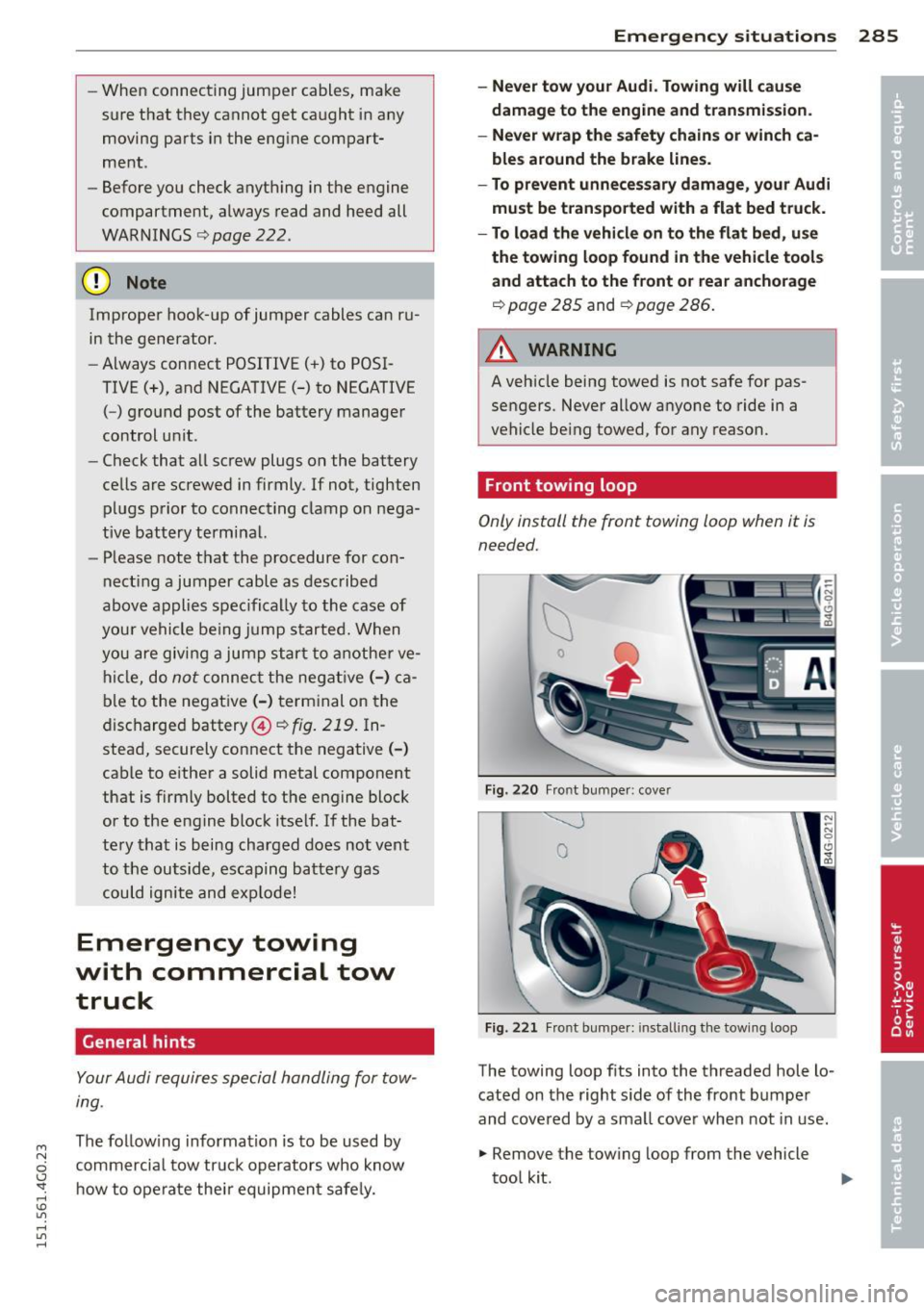
Fig. 22 0 Front bu mpe r: cove r
Fig. 22 1 Front bu mpe r: in stall ing t he tow ing loop
-
The towing loop fits into the threaded hole lo
cated on the right s ide of the front bumpe r
and cove red by a sma ll cover when not in use.
.. Remove the tow ing loop from the vehicle
too l kit .