2015 AUDI S3 SEDAN wheel
[x] Cancel search: wheelPage 228 of 282
Tires and wheels
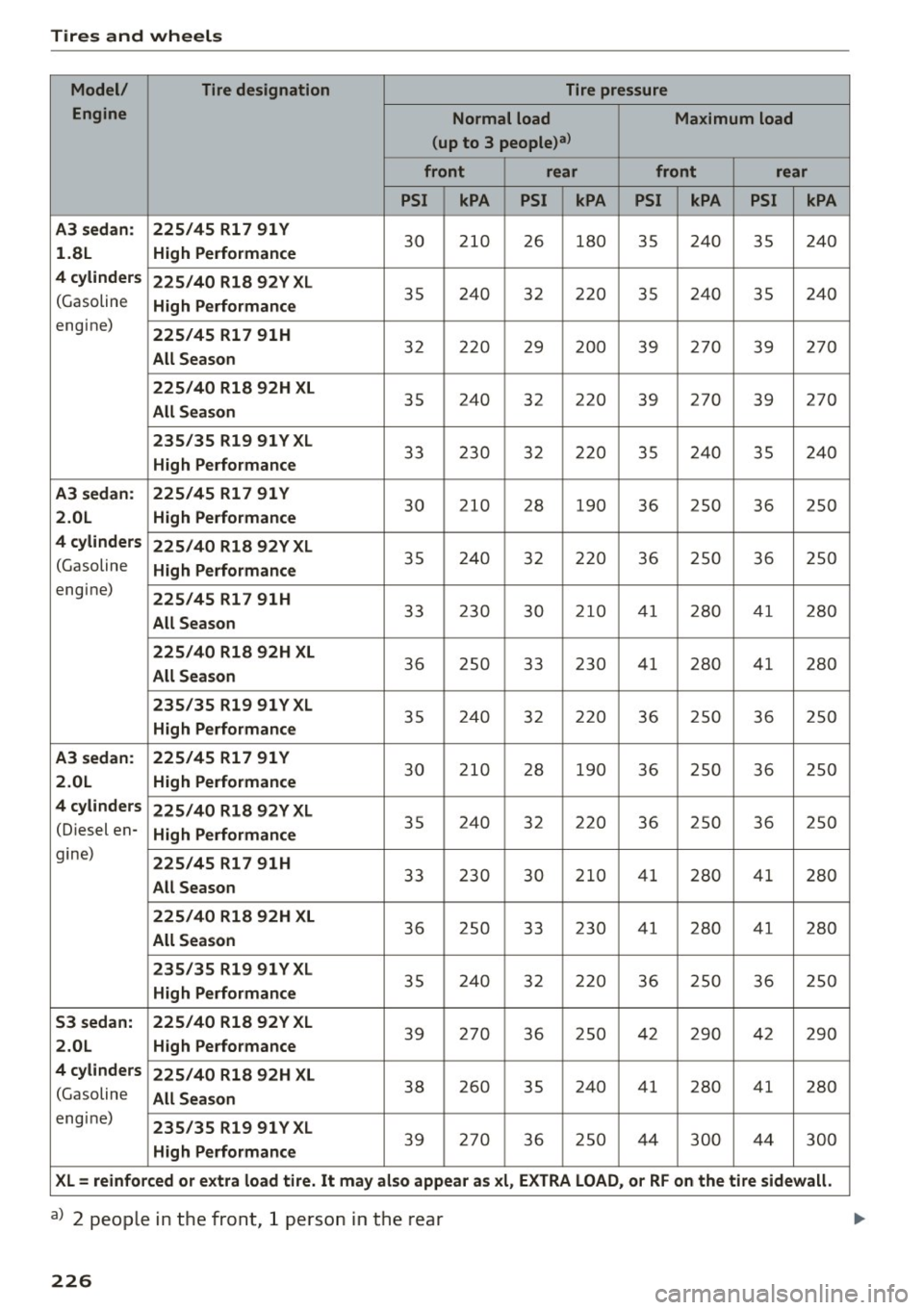
Model/ Tire designation Tire pressure
Engine Normal load Maximum load
(up to
3 people)a>
front rear front rear
PSI kPA
PSI kPA PSI kPA PSI kPA
A3 sedan: 225/45 Rl 7 91 Y
30 210 26 1 80 3 5 2
4 0
35 2
4 0
l.BL High Performance
4 cylinders 225/40 Rl8 92Y XL
35 240 32 220 35 240 35 240
(Ga so lin e
High Performance
en gine )
225/45 Rl7 91H
32 220 29 200 39 270 39 270
All Season
225/40 Rl8 92H XL
35 2
40
32 22 0 39 27
0
39 2
70
All Season
235/35 Rl9 91 Y XL 33 230 32 220 35 240 35 240
High Performance
A3 sedan: 225/45 Rl7 91Y
30 21
0 28 190
36 2
50
36 2
50
2.0L High Performance
4 cylinders 225/40 Rl8 92Y XL
35 240
32 220 36 250 36 2 50
(G asolin e
High Performance
e n gine)
225/45 Rl 7 91H
33 230 30 210 41 280 41 280
All Season
225/40 R18 92H XL
36 250 33 2 30 41 28 0 4
1
28 0
All Season
235/35 Rl9 91YXL
35 240 32 220 36 250 36 250
High Performance
A3 sedan: 225/45 Rl7 91Y
30 210 28 190
36 2
50 3 6 250
2.0L High Performance
4 cylinders 225/40 Rl8 92Y XL
35 24
0
32 22 0 36 250 36 250
(D ie se l en -
High Performance
gi ne)
225/45 Rl 7 91H
33 230 30 210 41 280 41 280
All Season
225/40 Rl8 92H XL
36 25
0
33 23
0 41 2 80 41 2 80
All Season
235/35 Rl9 91 Y XL
35 240 32 220 36 250 36 250
High Performance
53 sedan: 225/40 Rl8 92Y XL
39 270 36 250 42 290 42 290
2.0L High Performance
4 cylinders 225/40 Rl8 92H XL
38 260 35 24
0 4 1
28 0 4
1
280
(G asolin e
All Season
e n gine)
235/35 Rl9 91YXL
39 270 36 250 44 300 44 300
High Performance
XL= reinforced or extra load tire. It may also appear as xl, EXTRA LOAD, or RF on the tire sidewall.
a) 2 people in the front, 1 person in the rear
226
Page 229 of 282
.&_ WARNING
Please note the important safe
ty precautions regarding tire pressure ¢
page 224 and load
limits¢
page 227.
Tires and vehicle load limits
There are limits to the amount of load or weight that any vehicle
and any tire can carry . A vehicle
that is overloaded will not handle
well and is more difficult to stop .
Overloading can not only lead to
loss of vehicle control, but can al
so damage important parts of the
vehicle and can lead to sudden
tire failure, including a blowout
and sudden deflation that can
cause the vehicle to crash.
Your safety and that of your pas
sengers also depends on making
sure that load limits are not ex ceeded. Vehicle load includes ev
erybody and everything in and on
the vehicle. These load limits are
technically referred to as the vehi cle's
Gro ss Vehicle We ight Rating
("GVWR").
The "GVWR" includes the weight of the basic vehicle, all factory in
stalled accessories, a full tank of
fuel, oil, coolant and other fluids
Tires and wheels
plus maximum load . The maxi
mum load includes the number of
passengers that the vehicle is in
tended to carry ("seating capac i
ty") with an assumed weight of
150 lbs . (68 kg) for each passen
ger at a designated seating posi
tion and the total weight of any luggage in the vehicle . If you tow
a trailer, the weight of the trailer
hitch and the tongue weight of
the loaded trailer must be includ ed as part of the vehicle load.
The
Gross Ax le Weight Rating
("GAWR") is the maximum load
that can be applied at each of the
vehicle's two ax les.
T he fact that there is an upper
limit to your vehicle's Gross Vehi
cle Weight Rating means that the
total weight of whatever is being
carried in the vehic le (inc luding
the weight of a trai ler hitch and
the tongue weight of the loaded
trailer) is limited. The more pas
sengers in the vehicle or passen
gers who are heavier than the
standard we ights assumed mean
that less weight can be carried as luggage.
The Gross Vehicle Weight Rating
and the Gross Axle Weight Rating .,..
227
Page 230 of 282
Tires and wheels
are listed on the safety compli
ance sticker label located on the
driver's side B-pillar
¢ page 224,
fig. 170 .
& WAR NING
-
Overloading a vehicle can cause
loss of vehicle control, a crash
or other acc ident, serious per
sonal injury, and even death.
-Carrying more weight than your vehicle was designed to carry will prevent the vehicle
from handling properly and in crease the risk of the loss of
vehicle control.
-The brakes on a vehicle that
has been overloaded may not
be able to stop the vehicle
within a safe distance .
-Tires on a vehicle that has been overloaded can fail sud
denly, including a blowout and
sudden deflation, causing loss of control and a crash.
-Always make sure that the to tal load being transported -
inc luding the weight of a trail
er hitch and the tongue
weight of a loaded trailer -
does not make the vehicle
heavier than the vehicle's
Gross Vehicle Weight Rating.
228
Determining correct load
limit
Use the example below to calcu
late the total weight of the pas
sengers and luggage or other
things that you plan to transport so that you can make sure that
your vehicle will not be overload
ed.
Step s for Determining Correct
Load Limit
1. Locate the statement "THE
COMBINED WE IGHT OF OCCU
PANTS AND CARGO SHOULD
NEVER EXCEED XXX KG OR XXX
L BS"on your vehicle's placard
(tire inflation pressure label)
¢ page 224, fig . 170 .
2. Determine the combined
weight of the drive r and pas
sengers that will be riding in
your vehic le.
3. Subtract the combined weight of the driver and passengers
from "XXX" kilograms or "XXX"
pounds shown on the sticker
¢ page 224, fig . 170 .
4. The resulting figure equals the
available amount of cargo and luggage load capacity . For ex
ample, if the
"XXX" amount
equals 1400 lbs . and there will ...
Page 231 of 282

M N
0 > co ,...., \!) 1.1'1
1.1'1
1.1'1
,....,
be five 150 lbs. passengers in
your vehicle, the amount of
available cargo and luggage load capacity is 650 lbs.
(1400-750 (5
X 150) = 650
lbs.)
5. Determine the combined weight of luggage and cargo
being loaded on the vehicle.
That weight may not safely
ex
ceed the available cargo and
luggage load capacity calculat
ed in Step 4.
6. If your vehicle will be towing a trailer, load from your trailer
will be transferred to your vehi
cle. Consult this manual to de
termine how this reduces the available cargo and luggage
load capacity of your vehicle.
.,.Check the tire sidewall
(c> page 214, fig. 168) to deter
mine the designated load rating
for a specific tire.
Wheel bolts and rims
Wheel bolts
Wheel bolts must be clean and loosen/tighten
easily.
Rims
Rims with a bolted rim ring* or with bolted wheel
covers* consis t of mul tiple pieces. These compo
nents were bolted together using special bolts
and a special procedure . You must not repair or
disassemble them
Q ,& .
Tires and wheels
A WARNING
Wheel bolts that are tightened or repaired in
correctly can become loose and result in loss
of vehicle control, which increases the risk of
an accident . For the correct tightening specifi
cation, refer to~
page 242, A~er changing a
wheel.
- Always keep the wheel bolts and the threads
in the wheel hub clean and free of grease.
- Only use wheel bolts that fit the rim.
-Always have damaged rims repaired by an
authorized Audi dealer or authorized Audi
Service Facility. Never repair or disassemble
rims yourself, because this increases the risk
of an accident.
Winter tires
Winter tires significantly improve the vehicle's
handling when driving in winter conditions. Be
cause of their construction (width, compound,
tread pattern), summer tires provide less traction on ice and snow.
.. Use winter tires on all four wheels.
.. Only use winter tires that are approved for your
vehicle .
.. Please note that the maximum permitted
speed may be lower with winter tires
Q _& . An
authorized Audi dealer or authorized Audi Serv
ice Facility can inform you about the maximum
permitted speed for your tires.
.. Check the tire pressure after installing wheels
Qpage 224.
The effectiveness of winter tires is reduced great
ly when the tread is worn down to a depth of
0.157 inch (4 mm). The characteristics of winter
tires also decrease greatly as the tire ages, re
gardless of the remaining tread.
A WARNING
-Never drive faster than the maximum per
mitted speed for your tires. This could cause
the tires to heat up too much. This increases
the risk of an accident because it can cause
the tire to burst.
229
Page 232 of 282
Tires and wheel s
-Always adapt your driving to the road and
traff ic conditions. Dr ive carefully and red uce
yo ur speed on icy or slippery roads. Even
winter tires can lose tract io n on black ice .
@ For the sake of the environment
Reinstall summer tires at the appropriate
time, because they provide better handling
when roads are free of snow a nd ice. Summer
tires cause less road noise, tire wear and fuel
consumptio n.
(D Tips
You can also use all season tires instead of
w inte r tires. Please note that in some coun
t ries w here winter tires are requ ired, on ly win
t er tire s wi th the .& symbol may be pe rm it
t ed.
Snow chains
Snow chains improve traction in the snow .
.,. Only install snow chains on the front wheels.
Th is applies also to veh icles with all wheel
drive* .
.,. Ch eck and correct the seating of th e snow
c h ains if necessa ry afte r dri ving a few feet. Fo l
l ow the ins tructions from the manuf acturer.
.,. Note t he max imum permit ted speed w hen driv
ing with snow chains . Do not exceed 30 mph
(SO km/h).
Snow chains not only improve the
driving in win
ter road conditions, but a lso t he
braking .
Use of s now chai ns is o nly pe rm itted with certa in
r im/t ire comb ina tion s due to techn ica l reason s.
Chec k w ith an au thori zed A udi d ealer or au tho r
ized A udi Service Facility to see if yo u may use
snow cha ins.
Use
fine -mesh snow chain s. They mus t not add
mo re th an 0 .5 3 inch ( 13.S mm) in height, in clu d
ing the chain lock.
You must remove the chai ns when dr iv ing on
roads tha t are
free of snow. W hen r oads are free
of snow, snow chains can imp air handling an d
230
'
damage the tires, and the chains wi ll quick ly be
dest royed.
A WARNING
Using incorrect snow chains o r insta lling snow
cha ins incor rectly can res ult in loss of veh icle
c o ntrol, which increases the risk of an acc i
dent.
(D Note
- Snow chains can damage the rims/wheel
cove rs* if the c hains come into direct c on
tact with them. Remove the wheel covers*
first . Use coa ted snow cha ins.
Low aspect ratio tires
Your A udi is fac to ry-eq uipped w ith low aspect ra
t io t ires. These t ires have been thoroug hly tes ted
a nd been sele cted specifi ca lly f or your mode l for
the ir su perb pe rformance, r oad fee l and h andlin g
u nder a var iety of dr iv ing con ditions. As k your au
t h orized Aud i dea le r fo r more details .
The low aspe ct ratio of these tires is ind icated by
a n umer al of
55 or less in the t ire's s ize design a
tion . The nume ral represents the ratio of the
ti re's si dewall height in relatio n to its tread width
expressed i n pe rcentage. Conventional tires have
a height/width rat io o f 60 o r more .
The performance of low-aspect-ratio tire s is par
ticularly sensitive to imprope r inflation pres
sure. It is therefore important that low aspect ratio tires are inflated to the specified pressure
and that the inflation pressure is regularly
checked and maintained. Tire pressures should be checked at least once a month and always
b efor e a long trip
Q page 224 .
What you can do to avoid tire and rim
damage
Low aspect rat io tires can be damaged mo re eas i
l y by impact w ith potho les, c urbs , g ull ies o r
r idges on t he road, pa rti cularly if th e tire is un
der i nflated.
Page 233 of 282
M N
0 > co ,...., \!) 1.1'1
1.1'1
1.1'1
,....,
In o rder to m inim ize the occu rrence o f impac t
damage to the t ires of your vehicle, we recom
mend that you observe the following precau
tions :
- Always maintain recommended in flat ion p res
s ur es . Check yo ur tire p ress ure every 2,000
miles (3,000 km) and add air if necessary.
- Drive carefu lly on roa ds with potholes, deep
gul lies or ridges. The impact from driving
th ro ugh or over such obstacles can damage
your tires. Impact with a curb may also cause damage to your tires.
- After any impact, immediately inspect your
tires or have them inspected by the nearest a u
thorized Aud i dea ler . Replace a damaged tire as
soon as poss ible .
- Inspect your t ires every 2,000 miles (3 ,000 km)
for damage and wear. Damage is not always
easy to see. Damage can lead to loss of a ir and
underinflation, which cou ld eventually cause
t ir e fa il ur e.
If yo u be lieve that a ti re may h ave
been d amaged, rep lace the tire as soon as pos
s ible.
= T hese tires m ay we ar m ore q uic kly than ot hers.
- Please a lso remember that, wh ile thes e tir es
deliver respons ive handling, t hey may ride less
c o m fort ably and m ake more noise t han other
cho ices .
Reduced performance in winter/cold season
conditions
All t ires are des igned for cert ain purposes. The
l ow aspec t ratio, u ltra high per formance tires
originally insta lled on yo ur vehicle a re intended
for maximum dry and wet road perfo rmance an d
h andling. They are not suitable for cold, snowy or
icy weather cond it ions . If you drive under those
circumstances , you should equip your vehicle
w ith a ll-season or winter tires , which offer better
traction under those cond itions . We suggest you
use the re commended snow o r a ll-s eason t ires
specified fo r you r vehicle , or the ir eq uivalent.
Refe r to ¢
page 229 for mo re deta iled informa
tion regard ing winter tires .
Uniform tire quality grading
- Tread wear
Tires and wheels
- Traction AA A B C
- Temper ature A BC
Quali ty g rades can be found where applicab le on
t h e tire side wa ll between tread shoulder a nd
max imum sec tion wid th
~ page 214, fig . 168.
For example: Tread wear 200 , Traction AA, Tem
perature
A.
All passenger car t ires must conform to Federa l
Safety Requirements in addition to these grades.
Tread wear
T he tread wear g rade is a comparative rating
based on the wear rate of the t ire when tested
u nder contro lled c onditions on a specified gov
ernment test course.
F or example, a tire gra ded 15 0 wo uld wear one
and one half (1 1/2) times as we ll on the govern
ment course as a t ire g raded 100.
T he re lative per forman ce of tires depends upon
t h e actual cond itions of thei r use, however, and
may depart significantly from the norm due to
variations in driv ing habits, service p ract ices and
differences in road c haracteristics and climate.
Traction
T he traction gra des, from highest to lowest, are
AA , A , Ban d
C. Those g rades represent t he tire's
ability to stop on wet pavement as meas ured un
der contro lled conditions on specified govern
ment test s urfaces of asphalt a nd c oncrete . A tire
marked C may have poor traction performance
~ A .
Temperature
The temperature grades are A (the highest), B,
and C, representing the t ire's resistance to the
generation of heat a nd its ability to diss ipate
heat when tested u nder cont ro lled conditions on
a spec ified indoor labora to ry test wheel.
Sustained h igh temperature can cause the mate
ria l of the tire to degenerate and reduce ti re life,
and excess ive temperature can lead to s udden
t ir e fail ure¢ ,&. . .,,.
231
Page 234 of 282

Tires and wheels
The grade C corresponds to a level of perform
ance which all passenger car tires must meet un
der the Federal Motor Vehicle Safety Standard No.
109 . Grades Band A represent higher levels
of pe rformance on the laboratory test wheel than
the minimum required by law .
A WARNING
The traction grade assigned to this tire is
based on straight-ahead braking traction
tests, and does not include acceleration, cor
nering, hydroplaning or peak traction charac
teristics.
A WARNING
The temperature grade for this tire is estab
lished for a tire that is properly inflated and
not overloaded. Excessive speed, underinfla
tion, or excessive loading, either separate ly or
in combination, can cause heat buildup and
possible tire failure.
A WARNING
Temperature grades apply to tires that are properly inflated and not over or underinflat
ed .
Tire pressure monitoring
system
CD General notes
Applies to veh icles: w ith tire pressure monitoring system
Each tire, including the spare (if provided),
should be checked monthly when cold and inflat
ed to the inflation pressure recommended by the
vehicle manufacturer on the vehicle placard or
tire inflation pressure label.
(If your vehicle has
tires of a different size than the size indicated on
the vehicle placard or tire inflation pressure la
bel, you should determine the proper tire infla
tion pressure for those tires).
As an added safety feature, your vehicle has been
equipped with a tire pressure monitoring system
(TPMS) that illuminates a low tire pressure tell
tale when one or more of your tires is significant
ly under-inflated. Accordingly, when the low tire
pressure telltale illuminates, you should stop and
232
check your tires as soon as possible, and inflate
them to the proper pressure . Driving on a signifi
cantly under-inflated tire causes the tire to over
heat and can lead to tire failure. Under-inflation
also reduces fuel efficiency and tire tread life,
and may affect the vehicle's handling and stop
ping ability .
Please note that the TPMS is not a substitute for
proper tire maintenance, and it is the driver's re
sponsibility to maintain correct tire pressure, even if under-inflation has not reached the level
to trigger illumination of the TPMS low tire pres
sure telltale.
Your vehicle has also been equipped with a TPMS malfunction indicator to indicate when the sys
tem is not operating properly. The TPMS mal
function indicator is combined with the low t ire
pressure tel ltale. When the system detects a
malfunction, the telltale will flash for approxi
mately one minute and then remain continuously
illuminated. This sequence will continue upon
subsequent vehicle start -ups as long as the ma l
function exists .
When the malfunction indicator is illuminated,
the system may not be able to detect or signal low tire pressure as intended. TPMS malfunctions
may occur for a variety of reasons, including the
installation of replacement or alternate tires or
wheels on the vehicle that prevent the TPMS
from functioning properly. Always check the
TPMS malfunction telltale after replacing one or
more t ires or wheels on your vehicle to ensure
that the replacement or alternate tires and
wheels allow the TPMS to continue to function
properly .
Page 235 of 282
....,
N
0 > co
rl I.O
"'
"'
"'
rl
If the Tire Pressure Monitoring System
indicator appears
Applies to vehicles: with t ire p ressure monitoring syste m
The tire pressure indicator in the instrument
cluster informs you if the tire pressure is too low
or if there is a system malfunction.
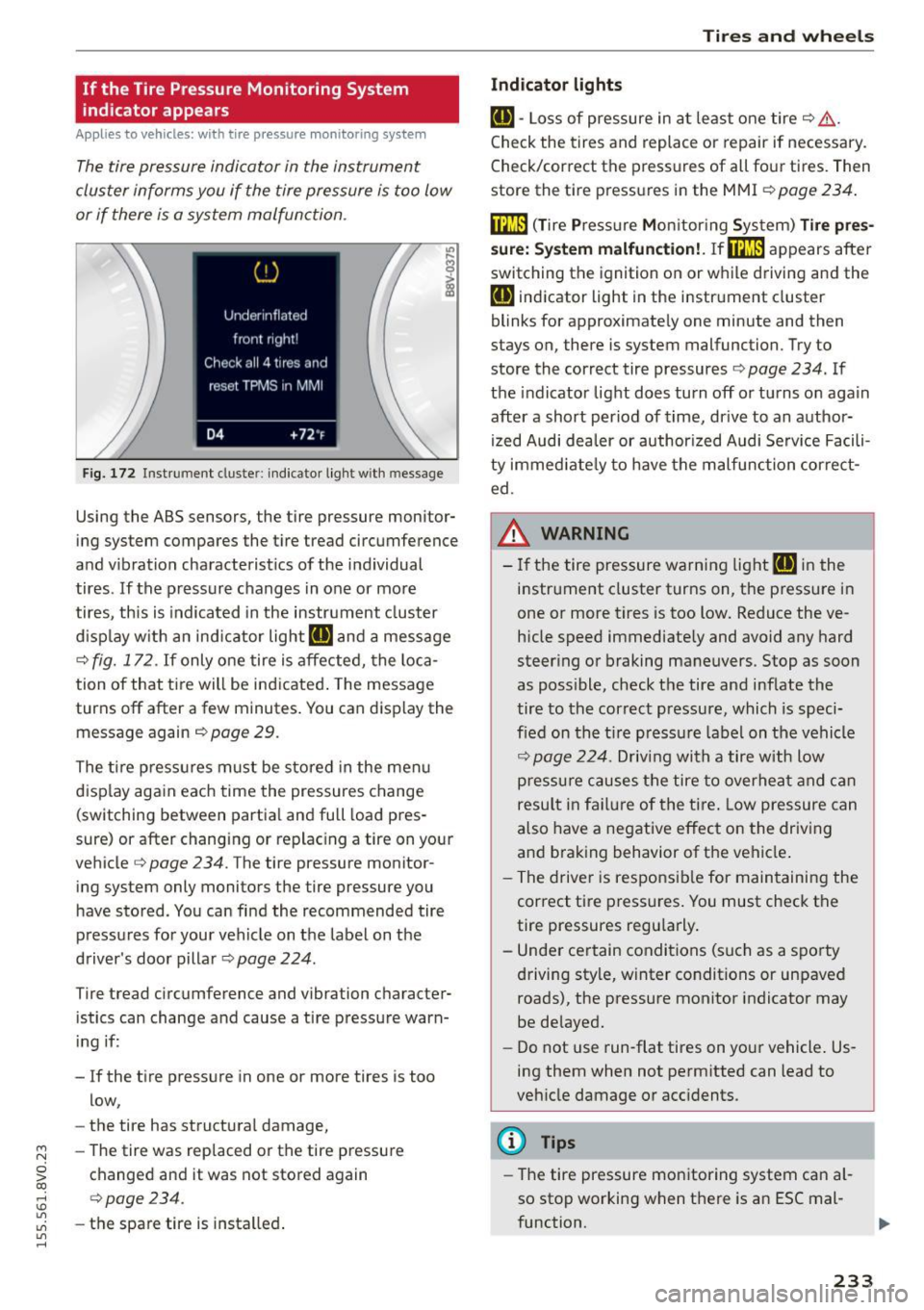
F ig. 172 Instrument cluster: in dicator light w ith message
Using the ABS sensors, the tire pressure monitor
ing system compares the tire tread circumference
and v ibration characterist ics of the ind ividual
tires.
If the pressure changes in one or mo re
tires, th is is indicated in the instrument cluster
d isp lay w ith an ind icator light
RE and a message
¢
fig. 172. If only o ne tire is affected, the loca
tion of that ti re will be indicated . The message
turns off after a few minutes . You can display the
message again
r::;,page 29.
The tire p ressu res m ust be stored in the menu
disp lay aga in each time the pressures change
(switching between partia l and full load pres
sure) or after changing or replac ing a tire on your
ve hicle¢
page 234. The tire pressure monitor
ing system only monitors the tire pressure you
have stored. You can find the recommended tire
pressures for your vehicle on the label on the
driver's door pillar¢
page 224.
Tire tread circumference and vibration character
istics can change and cause a tire pressure warn
in g if:
- If the tire pressure in one or more tires is too
low,
- the tire has structural damage,
- The tire was replaced or the tire pressure
changed and it was not stored again
¢ page 234.
-the spare tire is insta lled .
Tires and wheels
Indicator lights
RE -Loss of pressure in a t least one tire ¢ ,&.
Check the tires and replace or repair if necessary.
Check/correct the pressures of all four t ires. Then
store the tire p ressu res in the MMI ¢
page 234.
film (T ire Pressure Mon itor ing Sys tem) Tire pres
s ure: Sy stem malfunction!. If@m
appears after
switching the ignition on or while driving and the
RE ind icator light in the instr ument cluster
blinks for approximate ly one minute and then
stays on, there is system malfunction. Try to
store the correct tire pressures ¢
page 234. If
the indicator light does turn off or turns on aga in
after a short period of time, dr ive to an author
i zed Audi dea ler or author ized Audi Serv ice Facili
ty immed iate ly to have the malfunction corre ct
ed.
,&. WARNING
- If the tire pressure warning light RE in the
i n str ument cluster turns on, the pressure in
one or more tires is too low . Reduce the ve
h icle speed immediate ly and avoid any hard
steer ing or braking maneuvers. Stop as soon
as poss ible, check the tire and inf late the
tire to the correct pressure, which is speci
fied on the t ire p ress ure label on the vehicle
r::;, page 224. Driv ing with a tire with Low
p ressu re causes the tire to overhea t and c an
resul t in fa il ur e of the tire . Low pressure can
a lso have a negative effect on the driving
and b rak ing behavior of t he vehicle .
- T he drive r is respons ib le for main taining the
correct ti re press ures . You must check the
tire pressures regu larly .
- Under certain conditions (such as a sporty
driving style, winter conditions or unpaved
roads), the pressure monitor indicator may
be de layed.
- Do not use run-flat tires on yo ur vehicle . Us
ing them when not permitted can lead to
veh icle damage or acc idents.
(D Tips
- The tire pressure monitoring system can al
so stop working when t here is an ESC mal-
function. ..,.
233