2015 AUDI S3 tow
[x] Cancel search: towPage 173 of 310

M N
0 > co ,...., \!) 1.1'1
M 1.1'1 ,....,
-Always install rear-facing child safety
seats on the rear seat.
- If you must install a rearward facing
child safety seat on the front passenger
seat in exceptional circumstances and
the
PASSENGER AIR BAG OFF light does
not come on and stay on, immediately
install the rear-facing child safety seat in
a rear seating position and have the air
bag system inspected immediately by
your Audi dealer.
_& WARNING
- Forward-facing child safety seats instal
led on the front passenger's seat may in
terfere with the deployment of the air
bag and cause serious injury to the child.
- If exceptional circumstances require the
use of a forward-facing child restraint on
the front passenger's seat, the child's
safety and well-being require the follow ing special precautions to be taken:
- Always make sure that the forward-fac
ing seat has been designed and certi
fied by its manufacturer for use on a
front passenger seat with a front and
side airbag.
- Always carefully follow the manufac
turer's instructions provided with the
child seat or infant carrier.
- Never install a child restraint without a
properly attached top tether strap if
the child restraint manufacturer's in
structions require the top tether strap
to be used.
- Never put the forward-facing child re
straint up against or very near the in
strument panel.
- Always set the safety belt upper an
chorage to the adjustment position
that permits proper installation in ac
cordance with the child restraint manu
facturer's instructions.
- Always move the passenger seat into its rearmost position in the seat's fore
and aft adjustment range, as far away
from the airbag as possible before in-
Child Safety 1 71
stalling the child restraint. The back
rest must be adjusted to an upright po
sition.
- Always make sure that nothing pre
vents the front passenger's seat from
being moved to the rearmost position
in its fore and aft adjustment range.
- Never place objects on the seat (such
as a laptop, CO player, electronic games device, power inverter or seat
heater for child seats) . These may in
fluence the electrical capacitance
measured by the capacitive passenger
detection system and can also fly
around in an accident and cause serious personal injury.
- Never place or use any electrical device
(such as a laptop, CO player, electronic
games device, power inverter or seat
heater for child seats) on the front pas
senger seat if the device is connected
to the 12-volt socket or the cigarette lighter socket.
- If a seat heater has been retrofitted or
otherwise added to the front passen ger seat, never install any child re
straint system on this seat.
- Make sure that there are no wet objects (such as a wet towel) and no water or
other liquids on the front passenger
seat cushion .
- Always make sure that the
PASSENGER
AIR BAG OFF
light comes on and stays
on all the time whenever the ignition is
switched on.
- If the PASSENGER AIR BAG OFF light
does not come on and stay on, immedi
ately install the rearward-facing child
safety seat in a rear seating position
and have the airbag system inspected by your authorized Audi dealer.
- Always buckle the child seat firmly in
place even if a child is not sitting in it.
A loose child seat can fly around during
a sudden stop or in a collision.
- Always read and heed all WARNINGS
whenever using a child restraint in ave-
hicle
¢ page 135, Safety belts, ..,
•
•
•
Page 177 of 310

Child Safety 175
-The child and the passenger can also heater for child seats) on the front pas-
injure each other in an accident . senger seat if the device is connected
- Never install rear-facing child safety to the 12-volt socket or the cigarette
seats or infant carriers on the front pas- lighter
socket.
senger seat. A child will be seriously in- -If a seat heater has been retrofitted or
jured and can be killed when the passen- otherwise added to the front passen-
ger airbag inflates - even with an Ad -ger seat, never install any child re-
•
vanced Airbag System. straint system on this seat.
•
-The inflating airbag will hit the child -Make sure that there are no wet objects
safety seat or infant carrier with great (such as a wet towel) and no water or
force and will smash the child safety seat other liquids on the front passenger
and child against the backrest, center seat cushion.
armrest, door or roof. -Never place objects on the seat (such
- Always install rear-facing child safety as a laptop, CD player, electronic
seats or infant carriers on the rear seat. games device, power inverter or seat
- Forward-facing child safety seats instal- heater for child seats). These may
in-
led on the front passenger's seat can in- fluence the electrical capacitance
terfere with the airbag when it inflates measured by the capacitive passenger
and cause serious injury to the child. Al- detection system and can also fly
ways install forward-facing child safety around in an accident and cause serious
seats on the rear seat. personal injury.
- If exceptional circumstances require the -
Always buckle the child safety seat firmly
use of a forward-facing child restraint on in place even if a child is not sitting
in it.
the front passenger's seat, the child's A loose child safety seat can fly around
safety and well-being require that the during a sudden stop or in a collision
.
following special precautions be taken: -Always read and heed all WARNINGS
- Make sure the forward-facing seat has whenever using a child restrained in ave-
been designed and certified by its man- hide is being used
c> page 135, Safety
ufacturer for
use on a front seat with a belts, ¢ page 144, Airbag system and
passenger front and side airbag.
¢ page 170, Child Safety .
-Always carefully follow the manufac-
A WARNING turer's instructions provided with the
child safety seat or carrier. To reduce the risk of serious injury, make
- Always move the front passenger seat
sure that the
PASSENGER AIR BAG OFF
into the rearmost position of the pas-
light comes on and stays on whenever a
senger seat's fore and aft adjustment child restraint is installed on the front pas-
range, and as far away from the airbag senger seat and the ignition is switched
as possible before installing the child on.
restraint. - Take the child restraint off the front pas-
- Always make sure that nothing pre-
senger seat and install it properly at one
vents the front passenger's seat from of the rear seat positions if the
PASS EN-
being moved to the rearmost position GER AIR BAG OFF light does not stay on.
in its fore and aft adjustment range .
-Have the airbag system inspected by
- Always make sure that the backrest is
your authorized Audi dealer immediate-
M • N in the upright position. ly. 0 > - Never place or use any electrical device co ,....,
(such as a laptop, CD player, electronic \!) 1.1"1
M
games device, power inverter or seat 1.1"1 ,....,
Page 179 of 310
....,
N
0 > co
rl I.O
"' ....,
"' rl
It is a very dangerous place for an infant or a
la rger child in a rearward-facing seat.
A WARNING
Not using a child safety seat, using the
wrong child safety seat or improperly in stalling a child restraint increases the risk
of serious personal injury and death in a
crash.
- Never install rear-facing child safety
seats or infant carriers on the front pas
senger seat -even with an Advanced Air
bag System. A child will be seriously in
jured and can be killed when the inflat
ing airbag hits the child safety seat or in
fant carrier with great force and smashes
the child safety seat and child against
the backrest, center armrest, door or
roof
c::> page 146, Child restraints on the
front seat -some important things to
know.
- Always install rear-facing child safety
seats or infant carriers on the rear seat.
- Never install a rear-facing child restraint in the forward-facing direction. Such re
straints are designed for the special
needs of infants and very small children
and cannot protect them properly if the
seat is forward-facing .
-If you must install a rearward facing
child safety seat on the front passenger
seat because of exceptional circumstan
ces and the
PASSENGER AIR BAG OFF
light does not come on and stay on, im
mediately install the rear-facing child
safety seat in a rear seating position and have the airbag system inspected by your
Audi dealer.
- Never place or use any electrical device
(such as a laptop, CD player, electronic
games device, power inverter or seat
heater for child seats) on the front pas
senger seat if the device is connected to
the 12-volt socket or the cigarette light
er socket .
- If a seat heater has been retrofitted or
otherwise added to the front passenger
Child Safety 177
seat, never install any child restraint sys
tem on this seat.
- Make sure that there are no wet objects
(such as a wet towel) and no water or
other liquids on the front passenger seat
cushion.
- Never place objects on the seat (such as
a laptop, CD player, electronic games de
vice, power inverter or seat heater for
child seats). These may influence the
electrical capacitance measured by the
capacitive passenger detection system
and can also fly around in an accident
and cause serious personal injury.
- Always read and heed all WARNINGS
whenever using a child restrained in ave
hicle is being used
c::> page 135, Safety
belts,
c::> page 144, Airbag system and
c::> page 170, Important things to know.
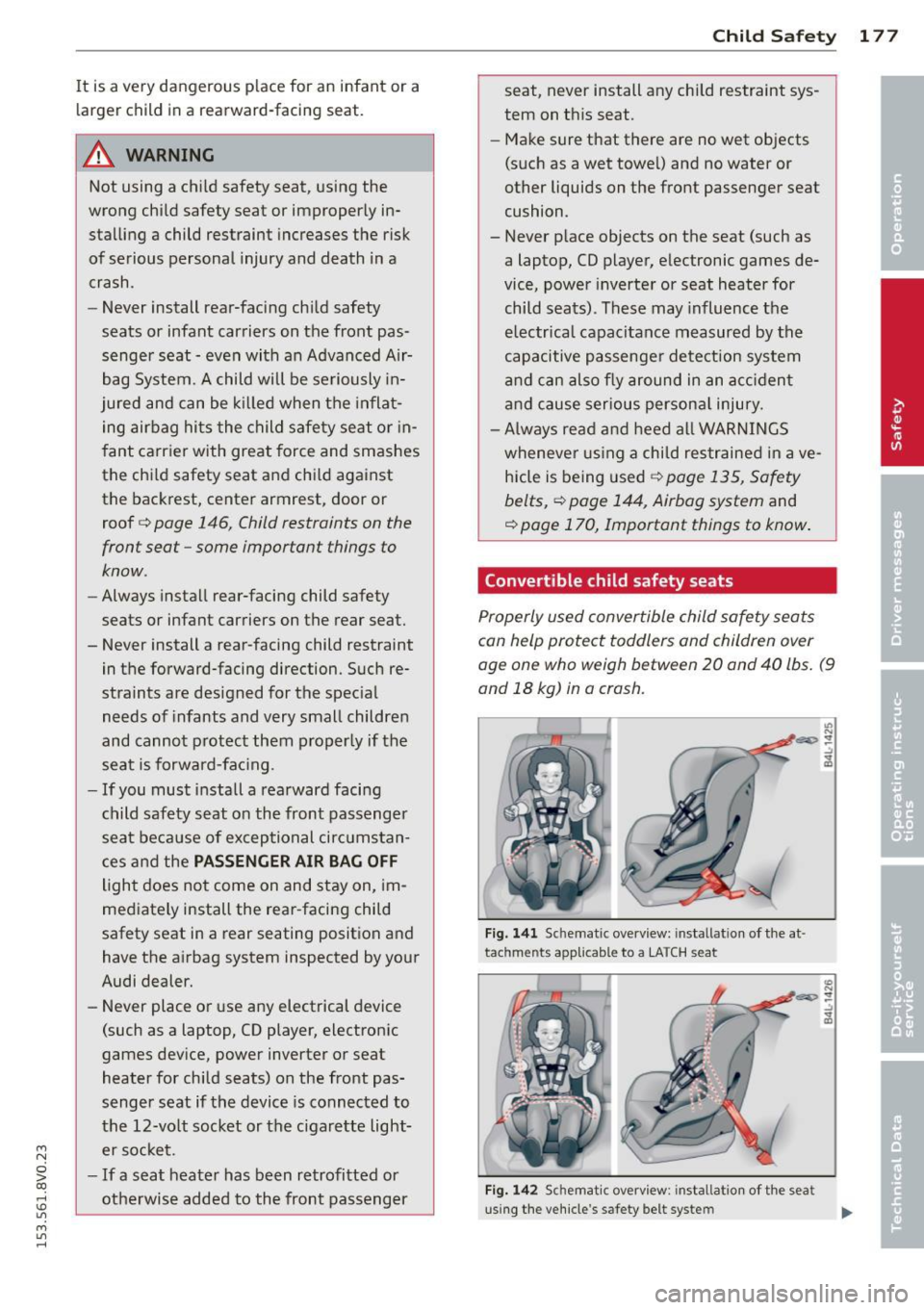
Convertible child safety seats
Properly used convertible child safety seats
can help protect toddlers and children over
age one who weigh between 20 and 40 lbs. (9
and 18 kg) in a crash.
Fig. 141 Schematic overview: installat ion of the at
tachments applicable to a LATCH seat
Fig. 142 Schematic overview: installation of the seat
using the vehicle 's safety be lt system
I),,
Page 181 of 310

....,
N
ci > co
rl I.O
"' ....,
"' rl
-Always follow the manufacturer's in
structions provided with the child safety
seat or infant carrier.
- Always move the front passenger seat in
to the rearmost position of the passen
ger seat's fore and aft adjustment range,
and as far away from the airbag as possi
ble before installing the child restraint.
- Always make sure that nothing prevents
the front passenger's seat from being
moved to the rearmost position in its
fore and aft adjustment range.
- Always make sure the backrest is in an
upright position .
- Never place or use any electrical device (such as a laptop, CD player, electronic
games device, power inverter or seat
heater for child seats) on the front pas
senger seat if the device is connected to
the 12-volt socket or the cigarette light er socket.
-If a seat heater has been retrofitted or
otherwise added to the front passenger
seat, never install any child restraint sys
tem on this seat.
- Make sure that there are no wet objects
(such as a wet towel) and no water or
other liquids on the front passenger seat
cushion.
- Never place objects on the seat (such as
a laptop, CD player, electronic games de
vice , power inverter or seat heate r for
child seats). These may influence the
electrical capacitance measured by the
capacitive passenger detection system
and can also fly around in an accident
and cause serious personal injury.
- Make sure that the
PASSENGER AIR BAG
OFF
light comes on and stays on all the
time whenever the ignition is switched
on.
- If the
PASSENGER AIR BAG OFF light
does not come on and stay on, immedi
ately install the forward-facing child seat
at a seating position on the rear seat and
have the airbag system inspected by your
authorized Audi dealer . Child Safety 1 79
- Ta ke the child restraint off the front pas
senger seat and install it properly at one
of the rear seat positions if the
PASSEN
GER AIR BAG OFF
light does not stay on
whenever the ignition is switched on.
Booster seats and safety belts
Properly used booster seats can help protect
children weighing between about 40 lbs . and
80 lbs. (18 kg and 36 kg) who are less than 4
ft. 9 in. tall. 9 in . (57 inches/1 .45 meters)
tall .
Fig. 143 Rear seat: ch ild prope rly restraine d in a bo os
ter seat
The vehicle's safety belts alone will not fit
most children until they are at least 4 ft . 9 in .
(57 inches/1.45 meters) tall and weigh about
80 lbs. (36 kg). Booster seats raise these chil
dren up so that the safety belt will pass prop
erly over the stronger parts of their bodies and the safety belt can help protect them in a
crash.
.. Do not use the convertible locking retractor
when using the vehicle's safety belt to re
strain a child on a booster seat .
.. The shoulde r belt must lie as close to the
center of the child's collar bone as possible
and must lie flat and snug on the upper
body. It mus t never lie across the throat or
neck . The lap belt must lie across the pelvis
and never across the stomach or abdomen .
Make sure the belt lies flat and snug. Pull on
the belt to tighten if necessary .
.. If you must transport an older child in a
booster seat on the front passenger seat, .._
Page 186 of 310

184 Child Saf ety
Deactivating the convertible locking
retractor
The convertible locking retractor for child re
straints will be deactivated automatically when the belt is wound all the way back into the retractor .
.,. Press the red button on the safe ty belt buck
le. The be lt tongue w ill pop out of the buck
le .
.. Guide the safety be lt all the way back into
its stowed position .
A lways le t the safety bel t retract comp lete ly
into its stowed posit ion . The sa fety belt can
now be used as an ordinary safety belt with
out the convert ib le locking ret ractor for chi ld
restra ints.
If the convertible locking retracto r shou ld be
activated inadvertently, the safety belt m ust
be unfastened and guided comp letely back in
to its stowed pos ition to deactivate th is fea
ture. If the convertib le locki ng retractor is not
deactivated, the safety be lt will gradually be
come tighter a nd u ncomfo rtable to wea r.
A WARNING
Imprope rly insta lled child saf ety seats in
crease t he risk of ser ious personal inju ry
a n d death in a collision .
- Never unfaste n the safety belt to deacti
vate the convert ible lo cking re tr actor fo r
ch ild rest rain ts while the veh icle is mov
ing. You would not be res trained and
cou ld be seriously injured in an accident.
- Always re ad and heed all WARN INGS
whenever using a child rest rained in ave
hicle is being used
¢page 170. Special
precautions apply when installing a ch ild
safety seat on the front passenge r seat
¢ page 146, Child restraints on the front
seat -some important things to know.
LATCH Lower
anchorages and tethers
for children
Child Restraint System anchors and how
are they related to child safety
T o p rov ide a simple r and more practicable way
to a ttach the child restra int on t he vehi cle
sea t, Federal regulat ions re quire spe cial lowe r
anchorages in vehicles and devices on new
c h ild restraints to attach to the vehicle ancho
rages.
T he comb inat io n of th e tether anc horages and
the lowe r anchorages is now genera lly c alled
t h e
LATCH system fo r "Lower Anchorages and
T ethers for Child ren."
F o rward-f ac ing ch ild res trai nts ma nufacture d
after September 1, 1999, are req uired by U .S .
f ede ra l regu lations to comply with new child
head movement performance req uirements.
These new performance req uirements make a
tether necessary on most new child seats.
Installing a child restraint that requires a top
tethe r without one can seriously impair the
performance of the c hild restra int and its abil
ity to protect the child in a coll is ion. Insta lling
a chi ld restrai nt that requires a top tether
without the top tether may be a violat ion of
state law.
Child rest raint manufacturers offer LATCH
lower anchorages on their child seats w ith
hook-on or push-on connectors attached to
adjustable straps .
In add ition to the LATCH lower anchorages,
t h ese chi ld restraint systems usually require
t h e use of tethe r straps to he lp keep the ch ild
rest raint fi rmly in place.
A WARNING
-Imp roper installat ion of ch ild restra ints
will i ncrease the r is k of injury a nd dea th i n
a cr ash.
-
Page 194 of 310

192 Smart T echnol ogy
Corro sion
Leaving the vehicle parked for long periods o f
time, low mi leage and avoiding heavy braking
can contribute to corrosion on the brake ro
tors and di rty brake pads.
I f you usually avoid heavy brak ing or if there is
corrosion present, occasiona l heavy braking at
high speeds is recommended to clean the
brake rotors and pads¢,& .
Brake system malfunction
if you notice that the brake pedal t ravel has
suddenly gotten larger, then a brake circuit
may have failed. Drive to your authorized Audi
dealer or qualified repair facility immediately
to hav e the problem corrected . On the way
there, drive with reduced speed and keep in
mind that a long braking distance and in
creased pressure on the brake pedal will be
necessary .
Lo w brake fluid level
When the brake fluid level is low, ma lfunc
tions in the brake system may occur. The
brake fluid level is electronically mon itored.
B rake bo ost er
The brake booster amplifies the pressure you
apply to the brake pedal. It only works when
the engine is running.
A WARNING ,~ ·
- You should only perform braking maneu
vers to clean the brakes when the road
condit ions perm it. Never put others on
the road at risk -never forget the risk of
acc idents!
- On steep slopes, reduce the speed and
select a lower gea r or lowe r selector lev
er position. Drive as litt le as poss ible
w hil e pressing the bra ke peda l and avoid
putt ing you r left foot on the brake pedal
whi le driving . This could cause the brakes
to overheat and impair the efficiency of
the brakes .
- Do not let the brakes "grind" by always
keeping yo ur foot on the brake peda l. This can cause the brakes to overheat
in-
,
crease wear and increase braking dis
tance unnecessarily.
- Certain weather and operating condi
tions such as driving through water, driv
ing in heavy rain or driving after washing
your veh icle can impa ir the effectiveness
of the brakes . In the winter, ice may
bu ild up on the bra ke pads, rotors and
d rums. Che ck these components by b rak
ing caref ully. App lyi ng the br akes care
fu lly several times dries the brakes and
removes ice bui ld-up .
- The eff ic iency of the brakes can also be
impaired by driving for long stretches on roads covered with salt without using the
brakes. Yo u can remove salt deposits
from the brake rotors and pads by care
fully applying the brakes several times.
- If the front spoiler is damaged or you in
stall another spoiler, make sure the front
wheel brakes are ventilated properly.
Otherwise , the brake system could over
heat, wh ic h red uces their effectiveness .
- Failure of a brake circuit impa irs braking
performance, wh ic h increases bra king
d istance . Avoid driving the vehicle and
have it towed it to the nearest author
i z ed A udi dealer or au thorized Aud i Serv
ice Facility .
- Do not let your ve hicle roll w it h the en
g ine switched off unde r any circumstan
ces .
- If the b rake booste r is no t working, you
will have to press much harder on the b rake peda l to compensate for the lack
of the booster.
(D Note
- N ever le t the bra kes "rub" by pressing
t he pedal ligh tly when braking is not
really necessary . This causes the brakes
to overheat and increases braking dis
tance and causes wear .
- Before dr iv ing on a long stretch with
steep s lopes, reduce your speed and shift
to the next lower gear This makes use of
the engine brak ing effect and relieves .,.
Page 195 of 310

M N
0 > co ,...., \!) 1.1'1
M 1.1'1 ,....,
the brakes. If you need to brake addit ion
ally, bra ke in intervals and not continu
ously.
(D Tips
- If the brake boos ter is not wor king, you
must p ress the brake pedal with much
more force t hen no rma l.
- If yo u retrof it your vehicle with a front
s po ile r, wheel covers or similar items,
make sure that the air f low to the front
whee ls is not interrupted. Otherwise the
brake system can become too hot.
Electromechanical
steering
The elec tromechanical steering suppor ts the
driver's s teering movements .
Powe r stee ring adapts electronically based o n
the veh icle speed.
The vehicle still has full stee ring fu nctionality
if the powe r steering fails o r whe n the eng ine
i s stopped (towi ng). To s teer, yo u must app ly
m uc h mo re fo rce than usual.
Indicator lights and messages
• Do not drive vehicle: steering defective
If th is in dicator lig ht tu rns on and stays on
and this message appears, the power steering may have fa iled.
Do
not co ntin u e dr iving . See an autho rize d
Aud i dea ler o r autho rized Aud i Service Fac ility
for assistance.
• Do not drive vehicle: steering defective
There is a malf unct io n in the electro nic steer
in g lo ck. You canno t turn the ign ition on.
Do
not tow your vehicle beca use it ca nnot be
steered. See an autho rized Aud i dea le r or au
thor ized Audi Se rv ice Facility for ass istance.
Ei:-Y Steering malfunction : you can continue
driving
I f the indicator light turns on, the steering
wheel may be more difficult to move or more
Smart Technolog y 193
sensit ive tha n usua l. The stee ring wheel may
also be at a n angle when dr iv ing stra ight .
D rive slowly to you r auth ori zed Audi de aler o r
qualifie d wo rkshop to have the ma lf u ncti on
correc ted.
II Steering lock : sy stem fault! Pl ease con
tact Service
T he re is a malfunction in the elec tronic steer
ing lock .
D rive to an author ized Audi dealer or author
ized Audi Serv ice Facility immediately to have
the malfunc tion corrected.
A WARNING
Have the sys tem ma lf u nction co rrec ted as
soon as po ssible by an aut horiz ed Aud i
d e aler or au thoriz e d Au di Service Fa cili ty,
a s this incr eases the r is k of an acciden t.
(D Tips
If th e . or l~ij indi cator ligh t only s tays
o n for a short t ime , you may con tinue dr iv
i ng.
ALL wheel drive
(quattro)
App lies to vehicles: wi th all wheel drive
In all wheel drive, all four wheels are pow
ered.
General information
In all whee l dr ive, the dr iv ing power is divi ded
between all fo ur whee ls. Thi s happens auto
matically depending on yo ur driv ing behavior
as well as the current road conditions. Refer
to
¢ page 189, Electronic stabilization con
trol (ESC) .
The all wheel drive concept is designed for
high eng ine power. Your veh icle is except ion
a lly powerfu l and has excellent driving charac
te ristics both under normal driv ing cond itions
and on snow a nd ice. Always read and follow
safety precaut ions¢ .&.. ..,.
•
•
•
Page 200 of 310

198 Driving and the environment
Driving through water
on roads
Note the following to avoid vehicle damage
when driving through water, for example on
flooded roads:
- The water must not be any higher than the
bottom of the vehicle body.
- Do not drive faster than wa lking speed.
A WARNING
After driving through water or mud, the
braking effect can be reduced due to mois
ture on the brake discs and brake pads. A
few careful brake applications should dry off the brakes.
@) Note
Vehicle components such as the engine, transmiss ion, suspension or electrical sys
tem can be severely damaged by driving
through water.
- Determ ine the depth before driving
through water.
- Do not stop the vehicle, drive in reverse
or switch the engine off when driving
through water .
- Keep in mind that oncoming vehicles may create waves that raise the water
level and make it too deep for your vehi
cle to drive through safely.
- Avoid dr iving through salt water (corro
s ion).
Catalytic converter
App lies to vehicles: with gasoline engine
It is very important that your emission con
trol system (catalytic converter) is function
ing properly to ensure that your vehicle is run
ning in an environmentally sound manner.
> Always use lead-free gaso line r=;, page 210,
Fuel supply .
> Never run the tank down all the way to emp-
ty.
> Never put too much motor o il in your engine
r=;, page 223, Adding engine oil
The catalytic converter is an efficient "clean
up" device built into the exhaust system of
the vehicle . The cata lytic converter burns
many of the pollutants in the exhaust gas be
fore they are released into the atmosphere.
The exclusive use of unleaded fuel is critica lly
important for the life of the catalytic convert
er and proper functioning of the engine.
A WARNING
-
The temperature of the exhaust system is high, both when driv ing and after stopping
the eng ine .
- Never touch the exhaust tail pipes once
they have become hot . This could result
in burns.
- Do not park or operate the vehicle in
areas where the hot exhaust system may
come in contact with dry grass, brush,
fue l spill or other material wh ich can
cause a fire.
- Do not app ly additional undercoating or
rustproofing on or near the exhaust manifold, exhaust pipes, catalytic con
verter or heat shields . Dur ing driving, the
substance used for undercoating could
overheat and cause a fire.
(D Note
- Be aware that just one tank filling with
leaded fuel will already seriously de
grade the performance of the catalytic
converter.
- Do not exceed the correct engine oil level
r=;, page 223.
-Do not drive until the fuel tank becomes
completely empty. The engine could mis
fire . Unburned fuel could also get into
the exhaust system and this cou ld cause
the catalytic converter to overheat.
- Do not switch off the ignition while the
vehicle is moving.
- Do not continue to operate your vehicle
under these conditions, as otherwise fuel
IIJ,,