2015 AUDI S3 change wheel
[x] Cancel search: change wheelPage 267 of 310

M N
0 > co ,...., \!) 1.1"1
M 1.1"1 ,....,
reached the level to trigger illumination of the
TPMS low tire pressure telltale.
Your veh icle has also been equ ipped with a
TPMS malfunction indicato r to indica te when
the system is not operating properly . The
TPMS malfunction indicator is combined with
the low tire pressure tellta le . When the sys
tem detects a malfunct ion, the telltale will
flash for approximately one minute and then
remain cont inuous ly illuminated. This se
quence will continue upon subsequent vehicle
start-ups as long as the ma lfunction ex ists .
When the malfunct ion indicator is illuminat
ed, the system may not be able to detect or
sig nal low t ire pressure as intended . TPMS
malfunct ions may occur for a variety of rea
sons, including the installa tio n of replace
ment or a lternate tires or whee ls on the veh i
cle that prevent the TPMS from funct ion ing
properly. Always check the TPMS malfunction
tellta le after replacing one or more tires or
wheels on your veh icle to ensure that the re
placement or alternate tires and wheels allow
the
TPMS to continue to function properly.
If the Tire Pressure Monitoring System
indicator appears
Applies to vehicles: with tire pressure monito ring system
The tire pressure indicator in the instrument
cluster informs you if the tire pressure is too
low or if there is a system malfunction .
Fig . 173 In strum ent clus te r: indica tor l igh t w ith mes
sage
Using the ABS sensors, the tire pressure moni
toring system compares the t ire tread circum
ference and vibration characteristics of the in
d iv idual tires . If the pressure changes in one
Tire s an d wheel s 265
or more tires, this is indicated in the instru
ment cluster disp lay with an indicator light
ti] and a message c:::> fig . 17 3. If only one tire
is affected, the locat ion of that tire will be in
dicated. The message turns off after a few mi
nutes . You can d isplay the message aga in
c:::> page 2 9 .
The tire pressures must be stored in the menu
display again each time the pressures change
(sw itching between partial and full load pres
sure) or after chang ing or replacing a t ire on
your vehicle
c:::> page 266 . The t ire press ure
monitori ng system only monito rs the tire
pressure yo u have stored . Yo u can find the rec
ommended t ire press ures for your vehicle on
the labe l on the driver 's doo r pillar
c:::> page240 .
Tire t read circumference and vib rat ion charac
teristics can change and cause a tire pressu re
warning if :
- I f the tire pressure in one or mo re tires is
t oo low,
- the t ire has structural damage,
-The tire was replaced or the t ire p ressure
changed and it was not stored again
c:::> page 266 .
- The spare tire is installed .
Indicator light s
ti]-Loss of pressure in at least one tire c:::> &.
Check the tires and replace or repair if neces
sary. Check/correct the pressures of all four
tires . Then store the t ire pressures in the MMI
c:::> page 266 .
DI (T ire Pressure Monitoring System) T ir e
press ure: S ystem malfunct ion!. If Ill ap
pears afte r switching the ignition on or while
driv ing and the
ti] indicator l ight in the in
str ume nt cluster b links for app rox imately one
minute and then stays on , the re is system
malfunction. Try to s to re the co rrec t ti re pres
s u res
c:::> page 266. If the indicator ligh t does
turn off or tu rns on again after a short period
of time, drive to yo ur authorized Aud i dea ler
or qualified repa ir facility immed iate ly to have
the malfunction corrected. .,..
•
•
•
Page 268 of 310
![AUDI S3 2015 Owners Manual 266 Tire s and wheels
& WARNING
-If the tire pressure warning light ti] in
the instrument cluster turns on, the
pressure in one or more tires is too low.
Reduce the vehicle speed](/manual-img/6/57541/w960_57541-267.png "AUDI S3 2015 Owners Manual 266 Tire s and wheels
& WARNING
-If the tire pressure warning light ti] in
the instrument cluster turns on, the
pressure in one or more tires is too low.
Reduce the vehicle speed")
266 Tire s and wheels
& WARNING
-If the tire pressure warning light ti] in
the instrument cluster turns on, the
pressure in one or more tires is too low.
Reduce the vehicle speed immediately
and avoid any hard steering or braking
maneuvers . Stop as soon as possible,
check the t ire and inflate the tire to the
correct pressure, which is specified on
the tire pressu re label on the veh icle
¢ page 240. Driving with a t ire with low
pressure causes the tire to overheat and
can result in failure of the tire . Low pres
sure can a lso have a negative effect on
the driving and braking behavior of the
vehicle.
- The driver is responsible for maintaining
the correct tire pressures. You must
check the t ire pressures regularly.
- Under certain conditions (such as a spor
ty driving style, winter conditions or un
paved roads), the pressure monitor ind i
cator may be delayed .
- Ask your author ized dealer if run-flat
t ires may be used on your vehicle.
- The tire pressure monitoring system can
also stop work ing when there is an ESC
malfunction.
- Using snow chains may result in a system
malfunction.
- The tires with the identification "AO" or
"RO" ¢ page 254 have been matched
with your Audi tire pressure monitoring
system. We recommend that you use
these tires.
- The tire pressure monitoring system can
only mon itor the t ire pressure of the
driving tires . Check the tire pressure of
the spare wheel in the luggage compart ment so that if necessary it is ready for
us e.
-
Storing tire pressures
Applies to vehicles: wit h tire press ure mo nitor ing system
A change in tire pressure or a change in tires
must be stored in the system.
The tire pressure is stored in the MMI.
.. Make sure before storing that the tire pres
sures of a ll four tires meet the specified va l
ues and are adapted to the load. Otherwise
the system could malfunction
¢ page 240.
.. Switch on the ignition.
.. Select: the
I MENU I button >Car > Systems*
control button > Service & control > Tire
pressure monitor > Store tire pre ssure >
Yes, store now.
(D Tips
Do not store the tire pressures if snow
chains are installed. Otherwise the system
could malfunction.
Page 272 of 310

2 70 What do I do now ?
other warning devices to alert other
motorists.
- Make sure that passengers wait in a safe
place away from the vehicle and well
away from the road and traff ic.
- To help prevent the ve hicle from mov ing
sudden ly and possibly slipping off the
jack, always fully set the parking brake and block the whee l diago na lly opposite
the whee l being changed . When one
front whee l is lifted off the gro und, plac
ing the A utomat ic Transm iss ion in P
( P ark) will
no t prevent t he ve hicl e from
movin g.
- B efore yo u change a w heel, be su re the
gr ound is leve l and fir m.
If necess ary,
use a s turdy board under the j ack.
- Alw ay s store the vehicle tool ki t, the j ack
and the repl aced t ire i n the l ugg age com
partment
¢ page 131.
Changing a wheel
When you change a wheel, follow these
quence described below step-by -step and in
exactly that order.
1. Remove the decorative wheel cover* . Fo r
mo re details see also¢
page 2 70, Deco
rative wheel covers
or ¢ page 2 71 ,
Wheels with wheel bolt caps .
2. Loosen the wheel bolts r::!> page 271.
3 . Locate the proper mo unting point for the
jack and align the jack below that point
¢ page 272.
4 .
Raise the car w ith the jack ¢ page 2 72.
5. Remove the wheel with the flat tire and
then install
the spare ¢ page 2 73.
6. Tighten all wheel bo lt s li ghtly.
7 .
Lower the ve hicle w ith the jack.
8. Use the wheel bolt wrench and
firmly
t ig hten all whee l bolts <:!> page 271.
9. Replace the decorative wheel cove r* .
A WARNING
A lways read and follow all WARNINGS and
informati on
r::!> &. in Raising the vehicle on
page
2 72 a nd r:!> page 274 .
After changing a wheel
A wheel change is not complete without the
doing the following .
"'Always store the vehicle toot kit, the jack*
and the replaced tire in the luggage com
pa rtment
¢ page 131.
"' Check the tire pr essure on the spare whee l
immed iate ly afte r mounting i t.
"' As soon as poss ib le, have the
tight ening
torques
on all whee l bolts chec ked with a
torque wre nch . The correc t tig hten ing tor
que is 90 ft l b (120 Nm).
"' Have the flat tire
replaced as soon as possi
ble.
@ Tips
- If you not ice that the wheel bo lts are
corroded and difficult to turn while
chang ing a tire, t hey should be rep laced
before you check the tig htening to rque.
- Dr ive at reduced speed until you have the
t ightening torques checked.
- After changing a whee l, the t ire p ress ure
in all four tires must be chec ked/co rrect
ed and the tire p ress ure monito ring ind i
cator must be s to red in the MMI
r::!> page 266.
' Decorative wheel covers
Applies to vehicles: w ith decorative whee l covers
The decorative wheel covers mus t be removed
first to access the wheel bolts.
Fig. 1 79 Cha ngin g a w hee l: Re mov ing th e w heel cove r
Removing
"' Insert the hook (p rov ided with th e vehicle
t oo l ki t) in the ho le in the whee l hub cover . .,._
Page 274 of 310

272 What do I do now?
hold on to the car to keep your balance
and take care not to slip.
Raising the vehicle
Th e ve hicl e must b e lifted with the jack first
before the wheel can be removed.
Fig. 182 Sill p anels : m arkin gs
Fig. 183 Sill: positio ning t he veh icle jack
.. Engage the parking brake to prevent your
vehicle from rolling unintentionally.
.. Move the
selector lever to position P .
.. Find the marking (imprint) on the sill that is
nearest the wheel that will be changed
~ fig . 182. Behind the marking, there is a
lifting point on the sill for the vehicle jack.
.. Vehicles with a sill : Note the position of the
sill when positioning the vehicle jack
r::!) fig. 183.
.. Place the vehicle jack (vehicle tool kit) on a
firm surface. Use a flat , stable support if
necessary . On a slippery surface such as tile,
you should use a non-slip pad (such as a rub
ber mat)
¢ _& .
.. Turn the vehicle jack located under the lift
ing point on the sill to raise the jack until its
arm @Q
fig. 183 is located under the des
ignated plastic mount Q
.&., Q (D .
.. Align the jack so that its arm @ Q
fig. 183
engages in the designated lifting point in the door sill and
the movable base @ lies
flat on the ground. The base @ must be
ver
tical
under the lifting point@ .
.. Wind the jack up further until the flat tire
comes off the ground Q
.&_.
Position the vehicle jack only under the desig
nated lifting points on the sill
Qfig . 182.
There is exactly one location for each wheel.
The jack must not be positioned at any other location Q
,&q(j) _
An unstable surface under the jack can cause
the vehicle to slip off the jack. Always provide a firm base for the jack on the ground . If nec
essary place a sturdy board or similar support
under the jack . On
hard, slippery surfaces
(such as tiles) use a rubber mat or similar to
prevent the jack from slipping Q
,&.
_& WARNING
- You or your passengers could be injured
while changing a wheel if you do not fol
low these safety precautions:
- Position the vehicle jack only at the
designated lifting points and align the
jack. Otherwise, the vehicle jack could
slip and cause an injury if it does not
have sufficient hold on the vehicle .
- A soft or unstable surface under the
jack may cause the vehicle to slip off
the jack . Always provide a firm base for
the jack on the ground. If necessary,
use a sturdy board under the jack.
- On hard, slippery surface (such as tiles)
use a rubber mat or similar to prevent
the jack from slipping.
- Only raise your vehicle with the vehicle
jack provided by the factory. If you use
a vehicle jack for another vehicle, your
vehicle can slide and cause injury.
- Changes in temperature or load can af
fect the height of the vehicle .
- Never start the engine when the vehi
cle is raised, which could cause an acci-
dent.
~
Page 275 of 310

....,
N
0 > co
rl I.O
"' ....,
"' rl
-Support the vehicle securely with ap
propriate stands if work is to be per
formed underneath the vehicle;
otherw ise, there is a potential risk for
injury .
- To help prevent injury to yourself and
your passenge rs:
- Do not raise the vehicle until yo u are
sure the jack is secu rely engaged .
- Passenge rs must no t remai n in the ve
h icle when it is jacked up .
- Ma ke sure that passengers wait in a
safe place away from the vehicle and
well away from the road and traff ic.
- Make sure ja ck position is correct, ad
jus t as necessary and then conti nue to
raise the jack .
- Changes i n tem pera ture or load can af
fect the height of the vehi cle.
(D Note
Do not lift the vehi cle by the s ill. Pos ition
the vehicle jac k only at the designated lift
ing points o n the sill. Othe rwise, your vehi
cle will be damaged .
Taking the wheel off/installing the spare
Follow these instructions step-by-step for
changing the wheel.
F ig . 1 84 Chan gin g a w hee l: us ing t he sc rew driver han
dl e (w it h t he bla de removed) to t urn th e bolts
What do I d o now ? 273
Fig . 1 8 5 Changi ng a wheel : al ig nme nt p in in sid e th e
t op hole
After yo u have loosened all wheel bo lts and
raised the vehicle
off the ground, remove and
replace the wheel as follows :
Removing the wheel
.,. Use the he xag onal so cket in the scre wdriv
er handle
to comple tely remove the top
most whee l bolt and set it aside on a
clean
surface ¢ fig. 184.
.,. Screw the threaded end of the alignment
pin from the tool kit hand- tight into the
empty bolt hole
Q fig . 185.
.,. Then remove the other wheel bolts as de
scribed above .
.,. Take
off the whee l leaving the alignment pin
in the bo lt ho le
¢ (D .
Putting on the comp act spare wheel
.,. Lift the spare wheel and carefully slide it
over the alignment p in to g uide it in place
¢ (D .
.,. Use the hexagona l socket in the screwd river
h a ndle to screw in a nd tig hten all whee l
bolts
slightly .
.,. Remove the alignment pin and insert and
tighten the remaining whee l bolt slightly
like the rest .
.,. Turn the jack hand le counter-clockwise to
lower the veh icle until the jack is fully re
leased .
.,. Use the wheel bo lt wrench to tighten all
wheel bo lts firm ly
i=;, page 271. Tighten
them
c rosswise, from one bolt to the (ap
proximately) opposite one, to keep the
wheel cente red.
Page 276 of 310

274 What do I do no w?
When removing or installing the wheel,
the rim could hit the brake rotor and dam
age the rotor. Work carefully and have a
second person help you.
Never use the hexagonal socket in the han
dle of the screwdriver to loosen or t ighten
the wheel bolts.
- Pull the reversible b lade from the screw
driver before yo u use the hexagonal
socket in the handle to turn the whee l
bo lts.
- When mounting tires with
unid irectional
tread design
make sure the tread pat
tern is pointed the r ight way
¢page 274.
- The wheel bolts should be clea n and easy
to tu rn . Check for d irt and corrosion on
the mat ing su rfaces of both the whee l
and the h ub. Remove a ll dirt from these
su rfaces before remo unti ng the wheel.
Tires with unidirectional tread design
Tires with unidirectional tread design must be
mounted with their tread pattern p ointed in
the right direction.
Using a spare tire with a tread pattern
intended for use in a specific direction
When using a sp are tire w ith a tread pa tte rn
i nten ded for use in a specific direc tion, p lease
note t he following:
- T he direction of rotation is marked by an a r
row on the side of the tire.
- If the spare t ire has to be installed in the in
c orrec t direction, use the spa re tire only
tempor arily si nce the t ire will no t be able to
achieve its op timum performance character
istics with regard to aquaplaning, noise and
wear .
- We recommend tha t you pay particular a t
tention to this fact during wet weather and
that you adjust your speed to matc h road
condit ions. -
Replace the flat ti re with a new one and
have it insta lled on your vehicle as soo n as
possible to resto re the hand ling advantages
of a unidirectional tire.
Notes on wheel changing
Please read t he information ¢ page 254, New
tires and replacing tires and wheels
if you a re
going to use a spa re tire which is different
from the t ires on you r vehicle.
After you change a tire:
- Check the tire pre ssure on the spare imme
diately after installation .
- Have the wheel bolt tightening torque
c hecked with a torque wrench as soon as
possible by your author ized Audi dealer or
a qualified service stat ion.
- With steel and alloy wheel r ims, the wheel
bolts a re co rrectly tightened at a torque of
90 ft lb (120 Nm ).
- If you notice that the wheel bolts are cor
roded and difficult to turn while changing
a tire , they should be replaced before you
check the t ightening torque .
- Replace the flat tire w ith a new one and
have it installed on your vehicle as soon as
po ssible . Remount the wh eel cover.
Until then , dr ive with e xtra care and at re
duced speeds.
A WARNING
= -
- If you are going to equ ip your vehicle
with tires o r rims which differ from those
which were facto ry installed, then be
s ure to read the information¢
page 25 4,
New tires and repla cing tires and
wheels.
- Always m ake s ure the dam age d wheel o r
even a flat tire a nd the jack and tool ki t
are properly secu red in the luggage com
pa rtment and are not loose in the pas
senger compartment.
- In an accident or sudden maneuver they
could fly forwa rd, injuring anyone in the
veh icle.
Page 280 of 310

2 78 Fuses and bulbs
No . Equipment Ampere
Door/front passenger's side
F39 doors (for example, power 30
windows)
F40 Sockets 20
F41 Reversible front passenger·s
25
side safety belt tensioners
F42 Central locking components,
40
windshield washer system
F43 Headlights , light ing 30
F44 all wheel drive
15
F49 Starter, clutch sensor, head-
s light
relay coil
FS3 Rear window defogger
30
The power seats* are protected via
circuit
breakers
that automatically switch on after a
few seconds after the overload has been re
duced.
@ Tips
Note that the following table was accurate
at the time of print ing and is subject to
change.
Left engine compartment fuse
assignment
Fig. 189 Engine compartment : fuse assignment
No.
Fl
F2
F3
F4
F5
F6
F7
F8
F9
FlO
Fll
Fl2
Fl3
Fl5 Fl6
Fl7
Fl8 Fl9
F20 F22
F23
F24
F3 1
F32
Equipment Ampere
ESC control modu le 40
ESC cont rol module 40
Engine control module (gas-
15/30
oline/diesel)
Engine cooling, engine com-
ponents, auxiliary heater 5/10
coil relay (1+2), secondary
air injection pump relay
Engine components, tank 7.5/10/
system 15
Brake light sensor
5
Engine components, water 7.5/10/
pumps 15
Oxygen sensor 10/15
Engine components, ex-
haust door, glow t ime con-
5/10/20
trol module, SU LEV valve
Fuel injectors, fuel control
15/20
module
Auxiliary heater heating ele-
40
ment2
Auxi lia ry heater heating ele-
40
ment 3
Automatic transmission con- 15/30
trol module
Horn 15
Ignit ion coil 5/20
ESC contro l module, engine
7.5
control module
T ermina l 30 (reference volt-
5
age)
Windshield wipers 30
Horn 10
Terminal SO diagnosis 5
Starter 30
Auxiliary heater heat ing ele-
40
ment 1
Vacuum pump 15
LED headlights 5
Page 290 of 310
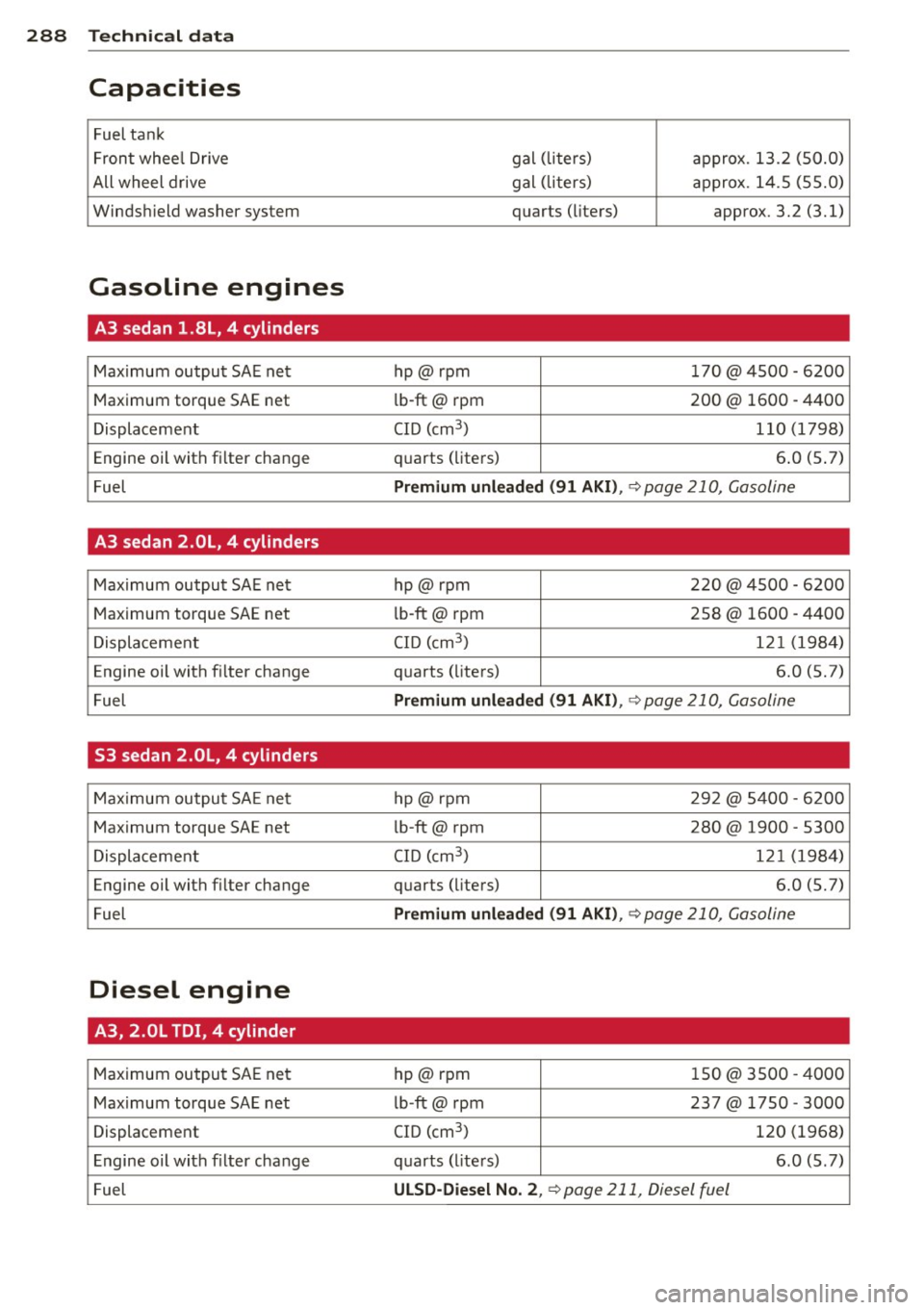
288 Technical data
Capacities
Fuel ta nk
Front whee l Drive gal (
liters)
approx. 13.2 (50.0)
All wheel drive gal (li
ters) approx. 14.5 (5 5.0)
Winds hield washer system quarts (lite rs) approx. 3.2 (3.1)
Gasoline engines
A3 sedan l.8L, 4 cylinders
Maximum output SA E ne t hp@rpm 170 @ 4500 - 6200
Ma ximum torque SAE net l
b-ft@ rpm 200@ 1600 - 4400
Displacement CID (cm
3
) 110 (1798)
Engine oil with filter change q
uarts ( lite rs) 6.0( 5.7)
Fuel
Premium unleaded (91 AKI) , ~ page 210, Gasoline
A3 sedan 2.0L, 4 cylinders
Max imum outpu t SA E net hp@rpm 220 @ 4500 - 6200
Maximum torque SAE net l
b-ft@ rpm 258@ 1600 - 4400
Displacement C
ID (cm
3
) 12 1 (198 4)
Engine oil with f ilter change quarts (li ters) 6.0(5.7)
Fuel
Premium unleaded (91 AKI) , ~page 210, Gasoline
S3 sedan 2 .0L, 4 cylinders
Max imu m outpu t SA E net hp@rpm 292 @ 5400 - 6200
Maximum torque SAE net lb-ft@ rpm 280@ 1900 - 5300
Displa cement CID
(cm
3
) 12 1 (198 4)
Engine oil with filter change quarts ( liters) 6.0(5.7)
F uel
Premium unleaded (91 AKI) , ~ page 210, Gasoline
Diesel engine
A3, 2.0L TOI , 4 cylinder
Maximum outpu t SA E net hp@rpm 1
50@ 3500 -4 000
Ma ximum torque SAE net lb-ft@ rpm 237@ 1750 -3000
Displacement CI
D (cm
3
) 12 0 (19 68)
E ngine oil with filter change q uarts (lite rs) 6.0(5
.7)
Fuel
ULSD-Diesel No. 2 , ¢ page 211, Diesel fuel