2015 AUDI S3 warning
[x] Cancel search: warningPage 188 of 310

186 Child Saf ety
attachment of child restraints specifically cer
tified for use with
LATCH low er anchorages.
Ch ild restra ints that are not equipped with the
lower anchorage attachments can still be in
stalled in comp liance with the child restrain t
manufacturer's instruct ions on using vehicle
safety belts .
A WARNING
Improper use of LATCH lower anchorages
can ca u se serio us pe rsonal inju ry i n an ac
c ident .
- Always ca refully fo llow the c hild re
st raints manuf acturer's inst ru cti ons for
proper ins tallat ion of the child rest rain t
and proper use of the lowe r anchorages
or safety be lts in your vehicle .
- Never secure or attach any l uggage or
other items to the
LATCH lower ancho
rages.
- Always read and heed the impor tant in
format ion about child restraints in this
chapter and WARNINGS
~ page 170 ,
Child Safety.
Installing a child restraint with LATCH
lower anchorages
App lies to vehicles: with Top Tether
Whenever you install a child restraint always
follow the child restrain t manufacturer's in
structions.
F ig . 14 7 Lower a nch orage s: p rope r m ou ntin g
Mounting
~ Make sure the seatback of the rear seat
bench is in the upr ight position and se curely
l atched in pl ace.
~ Attach both hook -on connectors with the
spring catch release on the child safety seat
onto the LA TCH lower anchorage so that the
connectors lock into place <=>
fig. 147.
~Pullon the connector attachments to make
sure they a re properly attached to the LATC H
lower ancho rage .
~ Pull straps tight fo llow ing the child r estraint
manufact urer's inst ruct io ns .
Releasing
~ Loose n the tension on the straps following
the child restra int manufacturer's instruc
tions .
~ Depress the spr ing catches to releas e the
anchorage hooks from the lowe r an chorag
es.
Remember: Use te ther straps to help keep the
c hi ld restra int fi rm ly in place.
A WARNING
I m proper use of the LATCH system can i n
crease the risk o f serious pe rsonal in jury
and death in a n accident.
- T hese an chors were deve lope d on ly for
chi ld safe ty seats using the " LA TC H" sys
tem .
- N ever at tach othe r ch ild safety sea ts,
be lts or o ther objects to these anchors .
- Always ma ke su re tha t you hear a click
when latch ing the seat in place . If you do
not hear a click t he seat is not secu re and
could
fly forwa rd and hit the inter ior of
the vehicle, or be e jected from the veh i
cle.
A WARNING
-Improper installat ion of child restra ints
will i ncrease the r isk of injury in an acci
dent.
- Always follow the chi ld restraint system
manufacturer's inst ruct ions for prope r
installa tion of the c hild restra int system
a nd p roper use of tether st raps as well as
the lower a nchorages or safety bel ts in
your veh icle.
~
Page 189 of 310

M N
0 > co
rl I.O
"' M
"' rl
-Always read and heed the important in
formation and WARNINGS about child
safety and the installation of child re
straint systems
c:> page 170, Child Safe
ty.
Tether anchors and tether straps
Fig . 14 8 Te th er ancho rs: re cess flap s be hind the re ar
sea tback s
The tether anchors for the rear seating posi
tions are located in recesses in the rear win
dow she lf
c:> fig. 148
A tether is a straight or V -sha ped strap that
attaches the top part of a child res traint to
specia l anchorage poi nts in the veh icle.
T he purpose of the tether is to reduce the for
ward movement of the c hild restra int in a
crash, in o rder to help reduce the r isk of head
i n jury that could be caused by striki ng the ve
hi cle inter io r.
Forward facing child restraints manufactured
after September 1, 1999 , are required by U .S .
federal regulations to comp ly with new c hild
h ead movement perform ance requirements.
These new per formance requ irements make a
tether necessary on most new child safety
seats.
A WARNING
Improper insta llation of chi ld restraints
w ill increase the risk of injury and death in
a crash.
- Always fo llow the instructions prov ided
by the manufacturer of the ch ild re
straint you intend to install in your Audi.
Child S afety 18 7
-Improper use of child restraint anchors
(including tether anchors) can lead to in
jury in a collision. The anchors are de· sig ned to withstand only those loads im
posed by correctly fitted child restrain ts .
- Never mount two child restra int systems
on one LATC H lowe r anchor point .
- Never attach two child restraint systems
to one tether st rap or tethe r anchorage .
- Never attach a tether strap to a t ie-down
ho ok in the luggage compartment.
- Never use child restraint tether ancho
rages to secure safety belts or other
kinds of occupant rest raints.
- Never secure or attach any luggage or
o ther items to the LATCH lower ancho
rages or to the tet her anchors.
- If you must install a rearward fac ing
child safety seat on the fro nt passenger
seat because of e xceptional c ircumstan
ces and t he
PASSENGER AIR BAG OFF
lig ht does not come o n and stay on, im
medi ately ins tall th e rear-fac ing ch ild
safety sea t in a rear se atin g position and
have the airbag system inspected by your
Au di dea le r.
Installing the upper tether strap on the
anchorage
F ig . 14 9 Tet her st ra p: prop er rou ting a nd m ou ntin g
Installing the tether strap
... Release or deploy the tet her st rap on the
child res traint accord ing to the child re
s tr aint manufacture r's ins tructions .
... Gu ide the upper tether strap
under th e rear
head restraint
c:> fig. 149 (ra ise the head re-
stra int if ne cessary) . "'
Page 190 of 310

188 Child Saf ety
• Tilt the recess flap up to expose the anchor
bracket.
• Attach the tether strap anchorage hook into
the opening of the tether anchorage.
• Pull on the tether strap hook so that the
spring catch of the hook engages.
• Tighten the tether strap firmly followi ng the
ch ild restra int manufacturer's inst ruct ions .
Releasing the tethe r strap
• Loosen the tens ion following the child re
stra int manufacturer's instructions.
• Depress the spring catc h on the hook and re
lease it from the anchorage.
(D Note
If you leave the child restraint with the
t ether strap firmly insta lled for several
days, this cou ld leave a mar k on the up
h olste ry on t he seat cush ion a nd ba ckrest
in the are a whe re the te ther s tra p w as in
s t alled. The uphols tery wo uld also be per
manently stretched around the tethe r
strap . This applies especially to leather
seats .
Using tether straps on rearward-facing
child restraints
Cur rently, few rear-facing child rest raint sys
tems come w ith a tethe r. Pl ease read and
h eed the child res traint system manufactur
e r's ins tructions ca ref ully to dete rm ine how to
p roperly insta ll the tethe r.
& WARNING
-
A child in a rea rward -facing child safety
seat insta lled on the front passenger seat
w ill be seriously injured and can be k illed if
the front a irbag inflates -
even wit h an Ad
vanced Airbag System.
- The inflating a irbag wi ll hit the child
safety seat or infant carrier wit h great
force and w ill smash the c hild safety seat
and child against the backrest, ce nte r
armr est, or door.
- If you must install a rearward faci ng
child safety seat on the front passenger seat because of exceptiona
l cir cumstan
ces and the
PASSENGER AIR BAG OFF
lig ht does not come on and stay on, im
mediately insta ll the rear-fac ing c hild
safety seat i n a rear seat ing position and
have th e air bag system i nsp ecte d by your
Aud i de aler.
Additional Information
Sources of information about child
restraints and their use
There are a number of sources of add itiona l
informat ion abo ut child rest ra int selection, in
sta llation and use:
NHTSA advises that the best child safety seat
is the one that fits your ch ild and fits in your
vehicle, and that yo u will use correct ly and
co nsist ently .
Try before yo u buy!
U.S National Highway Traffic Safet y Admin
istration
Tel.: 1-888-327-4236 (TIY: 1-800-424-9153)
www.nhtsa.gov
National SAFE KIDS Campa ign
Tel.: (202) 662-0600
www.safek ids.org
Safet y BeltSafe U.S.A
Tel.: (800) 745-SAFE (English)
Tel.: (800) 747-SANO (Spanish)
www.ca rseat.org
Transport Canada Information Centre
T el.: 1-800-333-0371 o r ca ll
1-613 -998 -8616 if you are in the Ottawa area
http://www.tc.gc.ca/eng/roadsafety/
men u.h tm
Audi Customer Relations
Tel.: (800) 822-2834
Page 192 of 310

190 Smart Technology
Steering r ecommendat ion
The ESC helps to stabilize the vehi cle by
changing the steering torque.
Select ive wh eel torqu e co ntrol
Select ive wheel torque control is used when
driving on curves . The front wheel on the in
side of the curve or both wheels on the inside
of the curve are braked selective ly as needed.
Th is a llows more precise driv ing in c urves.
Automatic post -collision braking system
The "Automatic post-collision braking system"
can he lp to reduce the risk of sliding and of
other coll is ions after an acc ident. If the airbag
control mod ule detects a collision above acer
tain vehicle speed, the vehicle is braked by the
ESC.
The vehicle does not brake automatically if:
- the driver presses the accelerator pedal , or
- the braking fo rce genera ted by the pressed
brake pedal is greater than the braking force
that would be initiated by the system, or
- the ESC, the brake system or the vehicle
electrical system are not functioning .
A WARNING ,.
- The ESC and its integrated systems can
not overcome the lim its posed by natural
physical laws. This is especia lly impor
tant on s lippery or wet roads. If the sys-
Switching on /off
terns begin acting to stabilize your vehi
cle, you should immediately a lter your
speed to match the road and traffic con
ditions . Do not let the increased safety
provided tempt you into taking r isks .
This could increase your risk of a co lli
sion .
- Please note the r isk of a coll is ion increas
es when driving fast, especially through
curves and o n slippe ry or wet roads, and
when dr iv ing too close to objects ahead.
The ESC and i ts integrated systems can
not a lways p revent collisions -there is
still a risk of accidents!
- Press the acce lerator pedal caref ully
when acce lerating on even, slippery sur
faces such as ice and snow. The drive wheels can spin even when these control
systems are installed and this can affect
driving stability and increase the risk of a
coll is io n.
(D Tips
- ABS and ASR only function correctly
when all four wheels are equ ipped w ith
identical t ires . Different t ire sizes can
lead to a reduction in engine power.
- You may hear noises when the systems
descr ibed are working .
- If the
DJ or [IJ indicator light appears,
there may be a malfunction¢
page 22.
E SC turns on automatically when you start the engine .
Fig. 1 50 Upper c ente r conso le : ESC but to n
The ESC is designed to funct ion in levels . De
pending on the level that is selected, the sta
bilization funct io n of the ESC is lim ited or
swit ched off . The amoun t of stabilization con
tro l will differ depending on t he level.
In the follow ing unusual situations it may
make sense to switch the ESC sport mode on
to allow the wheels to sp in:
- Rocking the vehicle to free it when it is stuck
- Driving in deep snow or on loose ground
ll>
Page 193 of 310
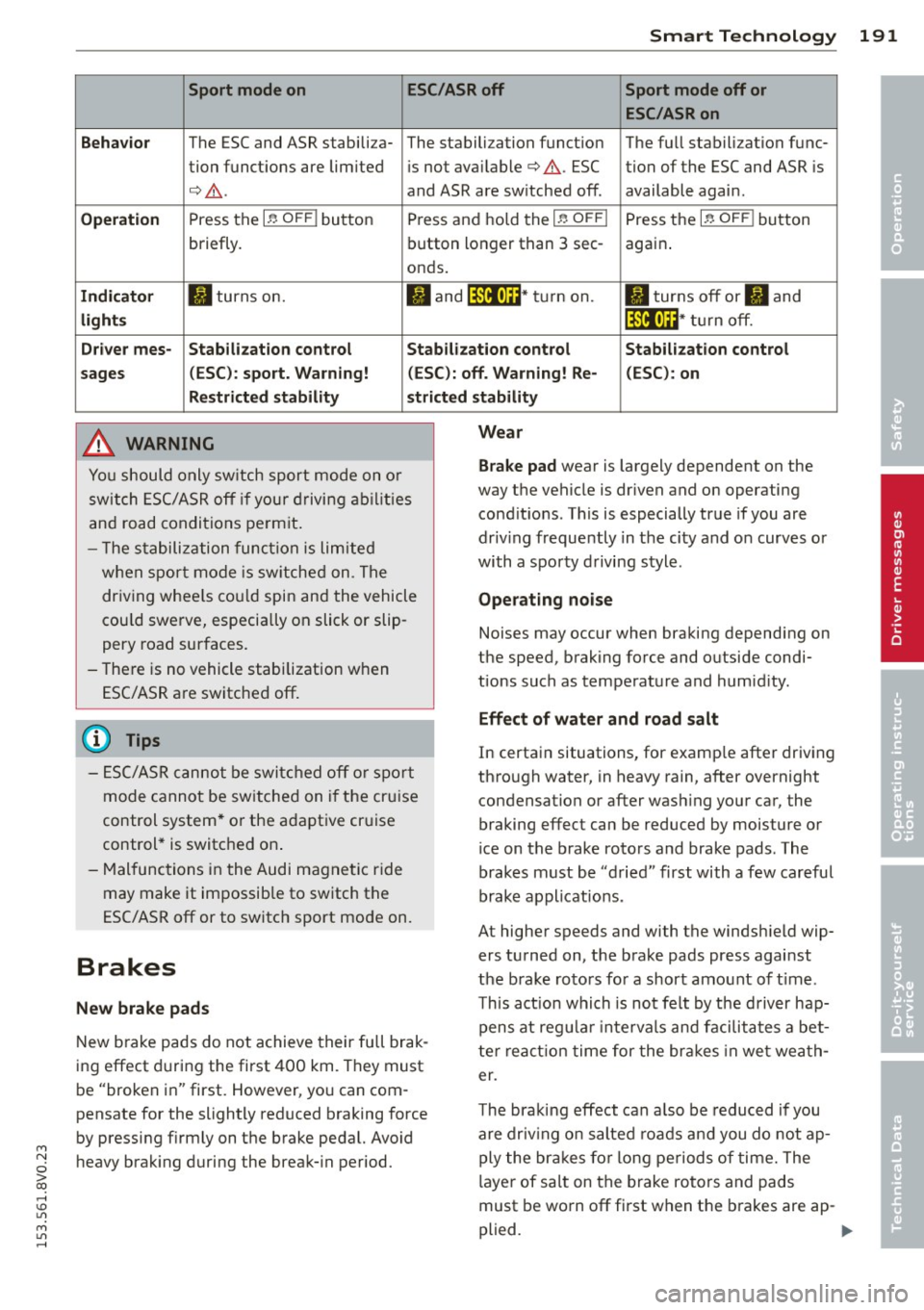
M N
0 > co ,...., \!) ..,.,
M ..,., ,....,
Smart Technology 191
Sport mode on ESC/ASR off Sport mode off or
ESC /ASR on
Behavior
The ESC and ASR stabili za- The sta lbili zation funct ion The fu ll stabili zation f unc-
tion func tions are lim ited is not available¢ .&,.. ESC tion of the ESC and ASR is
¢ .&,. .
and ASR are switched off . available again .
Operation P ress the I~ OFF I button Press and ho ld the I~ OFFI Press the I~ OFF I button
briefly. b
utton lo nger than 3 sec-
again.
onds.
Indi cator II turns on. II and jf'illt)H * tu rn on. II tur ns off or II and
light s jf 'ilftli~ * tur n off.
Driv er mes -Stab ilization control Stab ilization control Stabilization control
sages (ESC ): sport. Warning! (ESC ): off. Warning! Re- (ESC) : on
Restricted stability st ricted stability
_& WARNING
Yo u should o nly sw itch spor t mode on o r
switch ESC/ASR o ff if your driving abilities
and road condi tions pe rm it .
- T he s tabili zation func tion is limited
when sp ort mode is sw itche d on . T he
dr iving w hee ls co uld spin and the vehicle
cou ld swerve, especia lly on slick or slip
pery road surfaces.
- The re is no vehicle stabilization when
ESC/ASR a re switc hed off.
@ Tips
-
- ES C/ASR canno t be swi tched off or spor t
mode cannot be sw itche d on i f the cr uise
control system * or the a daptive cr uise
control * is switc hed on .
- Malfunc tions in the Audi mag net ic r ide
may make it impossib le to sw itch the
ESC/ASR off or to switch sport mode on.
Brakes
New brake pads
New b ra ke pads do not achieve their full brak
i n g effect d uring the first
4 00 km. They must
be "broken in" first. However, yo u can com
pensate for the slightly reduced braking force
by pressing firmly on the brake pedal. Avoid
heavy brak ing duri ng the break- in period.
Wear
Brake pad
wear is largely dependent on the
way the vehicle is driven and on operating
cond it ions . This is especially true if you are
driv ing frequently in the city and on curves or
with a sporty d riving style .
Operating noise
Noises may occur when bra king depending on
the speed, brak ing force and outs ide condi
tions such as temperature and humid ity.
Effect of water and road salt
In certa in situations, for examp le after driv ing
th ro ugh water, in heavy rain, after overnight
condensation or after was hing your car, the
braking effect can be reduced by mois ture or
ice on the brake rotors and brake pads . The
brakes must be "d ried" first with
a few car eful
brake applications .
At higher speeds and with the windsh ield wip
ers turned on, the brake pads press against
the b rake ro to rs fo r a shor t amo unt of t ime .
T h is act ion whi ch is not felt by the driver hap
pens at reg ular intervals and facilita tes a bet
t e r r ea ct ion time for the br ake s in we t wea th
er.
T he bra king effect can a lso be reduced if you
are driv ing o n salted roa ds an d you do not ap
ply the br akes fo r long peri ods of time. The
l aye r of sa lt on the brake rotors and pads
must be wo rn off first when the b rakes are ap -
plied. .,.
•
•
•
Page 194 of 310

192 Smart T echnol ogy
Corro sion
Leaving the vehicle parked for long periods o f
time, low mi leage and avoiding heavy braking
can contribute to corrosion on the brake ro
tors and di rty brake pads.
I f you usually avoid heavy brak ing or if there is
corrosion present, occasiona l heavy braking at
high speeds is recommended to clean the
brake rotors and pads¢,& .
Brake system malfunction
if you notice that the brake pedal t ravel has
suddenly gotten larger, then a brake circuit
may have failed. Drive to your authorized Audi
dealer or qualified repair facility immediately
to hav e the problem corrected . On the way
there, drive with reduced speed and keep in
mind that a long braking distance and in
creased pressure on the brake pedal will be
necessary .
Lo w brake fluid level
When the brake fluid level is low, ma lfunc
tions in the brake system may occur. The
brake fluid level is electronically mon itored.
B rake bo ost er
The brake booster amplifies the pressure you
apply to the brake pedal. It only works when
the engine is running.
A WARNING ,~ ·
- You should only perform braking maneu
vers to clean the brakes when the road
condit ions perm it. Never put others on
the road at risk -never forget the risk of
acc idents!
- On steep slopes, reduce the speed and
select a lower gea r or lowe r selector lev
er position. Drive as litt le as poss ible
w hil e pressing the bra ke peda l and avoid
putt ing you r left foot on the brake pedal
whi le driving . This could cause the brakes
to overheat and impair the efficiency of
the brakes .
- Do not let the brakes "grind" by always
keeping yo ur foot on the brake peda l. This can cause the brakes to overheat
in-
,
crease wear and increase braking dis
tance unnecessarily.
- Certain weather and operating condi
tions such as driving through water, driv
ing in heavy rain or driving after washing
your veh icle can impa ir the effectiveness
of the brakes . In the winter, ice may
bu ild up on the bra ke pads, rotors and
d rums. Che ck these components by b rak
ing caref ully. App lyi ng the br akes care
fu lly several times dries the brakes and
removes ice bui ld-up .
- The eff ic iency of the brakes can also be
impaired by driving for long stretches on roads covered with salt without using the
brakes. Yo u can remove salt deposits
from the brake rotors and pads by care
fully applying the brakes several times.
- If the front spoiler is damaged or you in
stall another spoiler, make sure the front
wheel brakes are ventilated properly.
Otherwise , the brake system could over
heat, wh ic h red uces their effectiveness .
- Failure of a brake circuit impa irs braking
performance, wh ic h increases bra king
d istance . Avoid driving the vehicle and
have it towed it to the nearest author
i z ed A udi dealer or au thorized Aud i Serv
ice Facility .
- Do not let your ve hicle roll w it h the en
g ine switched off unde r any circumstan
ces .
- If the b rake booste r is no t working, you
will have to press much harder on the b rake peda l to compensate for the lack
of the booster.
(D Note
- N ever le t the bra kes "rub" by pressing
t he pedal ligh tly when braking is not
really necessary . This causes the brakes
to overheat and increases braking dis
tance and causes wear .
- Before dr iv ing on a long stretch with
steep s lopes, reduce your speed and shift
to the next lower gear This makes use of
the engine brak ing effect and relieves .,.
Page 195 of 310

M N
0 > co ,...., \!) 1.1'1
M 1.1'1 ,....,
the brakes. If you need to brake addit ion
ally, bra ke in intervals and not continu
ously.
(D Tips
- If the brake boos ter is not wor king, you
must p ress the brake pedal with much
more force t hen no rma l.
- If yo u retrof it your vehicle with a front
s po ile r, wheel covers or similar items,
make sure that the air f low to the front
whee ls is not interrupted. Otherwise the
brake system can become too hot.
Electromechanical
steering
The elec tromechanical steering suppor ts the
driver's s teering movements .
Powe r stee ring adapts electronically based o n
the veh icle speed.
The vehicle still has full stee ring fu nctionality
if the powe r steering fails o r whe n the eng ine
i s stopped (towi ng). To s teer, yo u must app ly
m uc h mo re fo rce than usual.
Indicator lights and messages
• Do not drive vehicle: steering defective
If th is in dicator lig ht tu rns on and stays on
and this message appears, the power steering may have fa iled.
Do
not co ntin u e dr iving . See an autho rize d
Aud i dea ler o r autho rized Aud i Service Fac ility
for assistance.
• Do not drive vehicle: steering defective
There is a malf unct io n in the electro nic steer
in g lo ck. You canno t turn the ign ition on.
Do
not tow your vehicle beca use it ca nnot be
steered. See an autho rized Aud i dea le r or au
thor ized Audi Se rv ice Facility for ass istance.
Ei:-Y Steering malfunction : you can continue
driving
I f the indicator light turns on, the steering
wheel may be more difficult to move or more
Smart Technolog y 193
sensit ive tha n usua l. The stee ring wheel may
also be at a n angle when dr iv ing stra ight .
D rive slowly to you r auth ori zed Audi de aler o r
qualifie d wo rkshop to have the ma lf u ncti on
correc ted.
II Steering lock : sy stem fault! Pl ease con
tact Service
T he re is a malfunction in the elec tronic steer
ing lock .
D rive to an author ized Audi dealer or author
ized Audi Serv ice Facility immediately to have
the malfunc tion corrected.
A WARNING
Have the sys tem ma lf u nction co rrec ted as
soon as po ssible by an aut horiz ed Aud i
d e aler or au thoriz e d Au di Service Fa cili ty,
a s this incr eases the r is k of an acciden t.
(D Tips
If th e . or l~ij indi cator ligh t only s tays
o n for a short t ime , you may con tinue dr iv
i ng.
ALL wheel drive
(quattro)
App lies to vehicles: wi th all wheel drive
In all wheel drive, all four wheels are pow
ered.
General information
In all whee l dr ive, the dr iv ing power is divi ded
between all fo ur whee ls. Thi s happens auto
matically depending on yo ur driv ing behavior
as well as the current road conditions. Refer
to
¢ page 189, Electronic stabilization con
trol (ESC) .
The all wheel drive concept is designed for
high eng ine power. Your veh icle is except ion
a lly powerfu l and has excellent driving charac
te ristics both under normal driv ing cond itions
and on snow a nd ice. Always read and follow
safety precaut ions¢ .&.. ..,.
•
•
•
Page 196 of 310

194 Smart Technology
Winter tires By using all wheel drive, your vehicle has good
forward motion with standard tires in winter
cond itions. However, in winter we recommend
using winter or all season tires on
all four
wheels, because this will improve the braking
effect .
Snow chains
If there are snow chain laws, snow chains
must also be used on vehicles with all whee l
drive ¢
page 262, Snow chains .
Replacing tires
Fo r vehicles w ith all whee l dr ive , only wheels
with the same rolling circumference should be
used . Avoid whee ls with different tread
depths ¢
page 254.
Offroad vehicle?
Your Aud i is not an offroad vehicle -there is
not enough ground clearance. For this reason,
avoid difficult terrain. Refer to¢
page 287.
&_ WARNING
- Also, in vehicles with all whee l dr ive,
adapt yo ur driving style to the current
road and traffic conditions. Do not let
the increased safety provided tempt you
into taking risks.
- The braking ability of your vehicle is lim
ited to the traction of the wheels . In this
way, it is not different from a two wheel
dr ive vehicle. Do not be tempted to ac
celerate to a high speed when the road is
slippery this increases the risk of an acci
dent .
- Note that on wet streets, the front
wheels can "hydroplane" if driving at
speeds that are too high. Unlike front
wheel drive vehicles, the engine does not
rev higher suddenly when the vehicle be
gins hydroplan ing. For this reason, pay
attention to the road conditions regard
less of your speed.
Energy management
The starting ability is optimized
The energy management system manages
the electrical energy distribution and optimiz
es the availability of electrical energy for
starting the engine.
When a vehicle with a conventional energy
system is not driven for a long time , the bat
tery is drained by equ ipment (for example the
immobilizer). In certain circumstances, there
could may not be enough energy to start the
engine .
Your vehicle is equipped with an intel ligent
energy management system for d istr ibut ing
electricity. This s ignificantly improves the
sta rting ability and increases the battery life.
The energy management sy stem Is made up
of
battery diagnosis , idling current manage·
ment
and dynamic energy management .
Battery diagnosis
The battery d iagnosis determ ines the battery
charge leve l. The sensors determine the bat
tery voltage, the battery current, and the bat
tery temperature. The curren t cha rge leve l
and the performance of the battery are deter
mined based on this.
Idling current management
The idling current management decreases the
energy used wh ile parked. With the engine
switched off, it manages the energy distribu
tion to the different elect rical componen ts.
Date from battery diagnosis is taken into ac
count for this.
Depending on the battery charge level, elec
trical equip ment is switched off one item after
the o ther, to prevent the battery from drain
ing and to retain the starting ability.
Dynamic energy management
While driving, dynamic energy management
distributes the appropriate amount of energy
to the e lectr ica l equipment.
It controls the
battery charge level so that more energy is ..,.