2015 AUDI RS5 COUPE ABS
[x] Cancel search: ABSPage 124 of 254
Safety belts
Never rely on airbags a lone for protection . Even
when they deploy, airbags provide only additional
protection . A irbags are not supposed to deploy in
all kinds of accidents. Although your Audi is
equipped w ith airbags, all vehicle occupants, in
cluding the driver, must wear safety belts cor
rectly in orde r to min imize the risk of seve re in
jury o r death in a crash .
Remember too, that airbags will deploy only once
and that your safety be lts are a lways there to of
fer protection in t hose accidents in which airbags
are not supposed to deploy or when they have a l
ready deployed . Unbelted o ccupan ts can also be
thrown ou t of the vehicle where even mo re severe
or fata l injur ies can occur .
It is also important fo r the rea r passenge rs to
wear safety belts co rrectly. Unbe lted passenge rs
i n t he rear se ats endanger not only themselves
but also the driver and other passengers
~ fig . 125 . In a frontal coll ision they wi ll be
thrown forward violent ly, where they can hit and
in ju re the driver and/or front seat passenger.
Safety belts protect
People think it's possible to use the hands to
brace the body in a minor collision . It 's simply
not true!
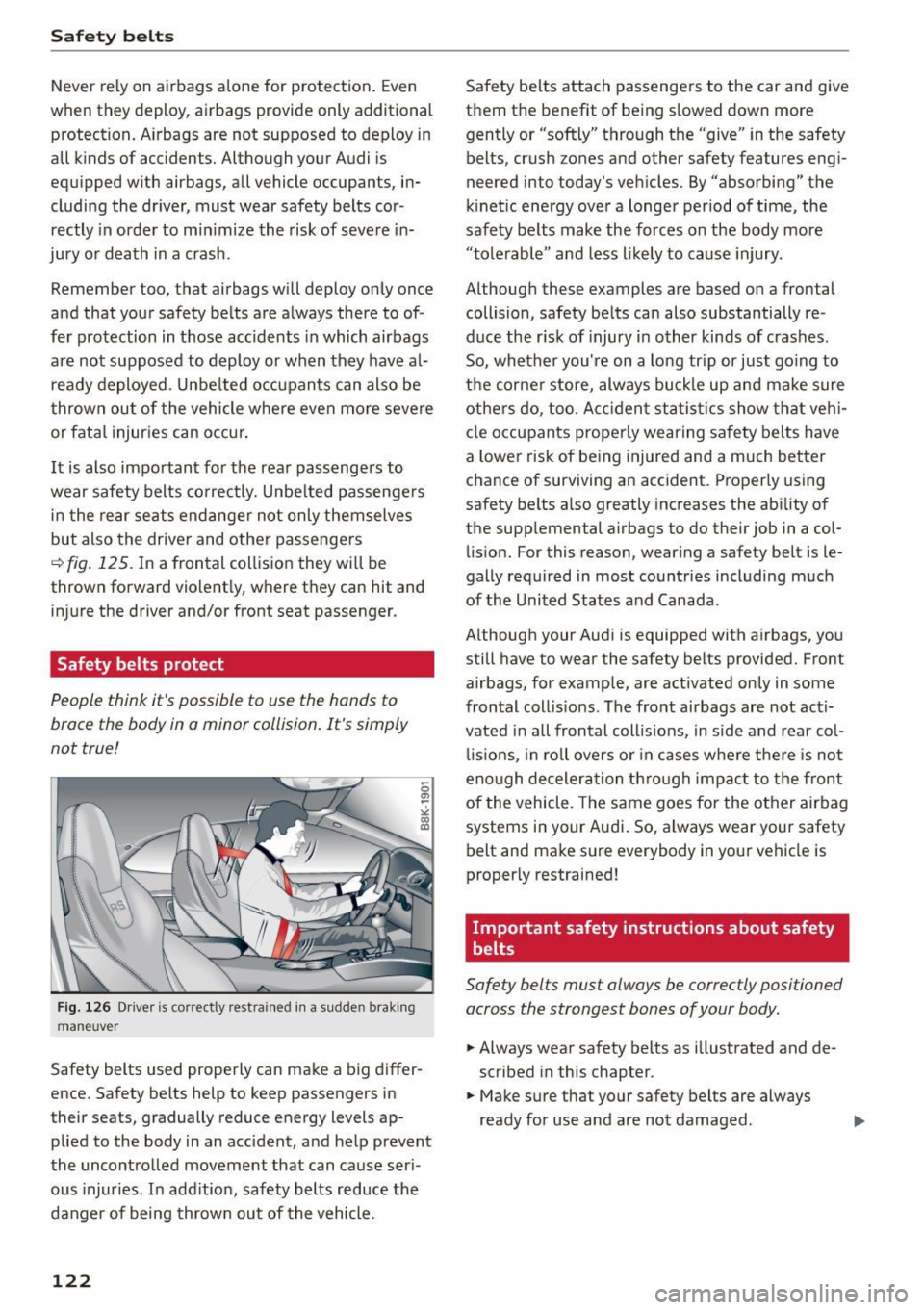
F ig . 12 6 Driver is correct ly rest ra ined i n a sudden b rak ing
m aneuver
Safety belts used properly can make a big differ
ence. Safety belts help to keep passengers in
their seats , gradually reduce energy levels ap
plied to the body in an accident, and he lp prevent
the uncont ro lled movement that can cause seri
ous injur ies. In add it ion, safety belts reduce the
danger of being throw n ou t of the vehicle.
122
Safety be lts attach passengers to the car and give
them the benefit of being s lowed down more
gently or "softly" through the "give" in the safety
belts, crush zones and other safety features eng i
neered into today's veh icles. By "absorbing" the
ki net ic ene rgy over a longer period of time, the
safety be lts make the forces on the body more
"tole rable" and less li kely to cause injury .
Although these examples are based o n a frontal
collision, safety be lts can also substantially re
duce the r isk o f injury in other kinds o f crashes.
So, whether you're on a long tr ip or just go ing to
t he cor ne r store, always bu ckle up and ma ke sure
o thers do, too. Ac ciden t sta tis tics show that ve hi
cle occupants properly wearing sa fe ty belts have
a lowe r risk of be ing injured and a much better
chance of surviving an accident. Pro perly using
safety belts a lso greatly increases the ab ility of
the supp lemental airbags to do their job in a col
li sion. For this reason, wear ing a safety be lt is le
gally required in most countries including much
of the United States and Canada .
Although your Audi is equipped with a irbags, you
still have to wear the safety belts provided. Front airbags, for example, are act ivated only in some
fron tal coll is io ns . The front airbags are not act i
vated in a ll frontal col lisions, in s ide and rear co l
li sio ns, in ro ll overs o r in cases whe re the re is not
eno ugh deceler ation th rough impac t to the front
of the vehicle . T he same goes for the other airbag
systems in your Audi. So, always wear your safety
belt and make sure everybody in your vehicle is
proper ly restrained!
Important safety instructions about safety
belts
Safety belts must always be correctly positioned
across the strongest bones of your body .
.,. Always wear safety belts as illustrated and de
scribed in this chapter .
.,. Make s ure that your safety belts are always
ready fo r use and are not damaged .
Page 134 of 254

Airb ag syst em
Front airbags
Description of front airbags
The airbag system can provide supplemental
protection to properly restrained front seat occu
pants .
Fig. 131 Location of driver airbag : in steering whee l
Fig. 132 Location of front passenger's airbag: in the instru
ment panel
Your vehicle is equ ipped with an "Advanced Air
bag System" in compliance with Un ited States
Federal Motor Vehicle Safety Standard
(FMVSS) 208 as applicab le at the time your veh i
cle was manufactured. The safety belts for the
seats have "pretensioners" that help to take s lack
out of the belt system . The pretensioners are also
activated by the electronic control unit for the
airbag system .
The front safety belts a lso have load limiters to
help reduce the forces applied to the body in a
crash.
The airbag for the driver is in the steer ing wheel
hub
¢ fig. 131 and the airbag for the front pas
senger is in the instrument panel¢
fig. 132. The
general location of the airbags is marked "AIR
BAG".
1 32
There is a lot you need to know about the airbags
in your vehicle . We urge you to read the detailed
i nformation about airbags, safety belts and child
safety in this and the other chapters that make
up the owner's literature. Please be sure to heed
the WARNINGS -they are extremely important
for your safety and the safety of your passengers, especially infants and small children .
,&_ WARNING -
Never rely on airbags alone for protection.
- Even when they deploy, airbags provide only supp lemental protection.
- Airbag work most effectively when used with properly worn safety belts .
- Therefore, always wear your safety be lts and
make sure that everybody in your vehicle is
properly restrained.
,&_ WARNING
A person on the front passenger seat, espe
cially infants and small ch ild ren, will rece ive
serious i nju ries and can even be killed by be
ing too close to the airbag when it inf lates .
- Although the Advanced Airbag System in your vehicle is designed to turn off the front passenger airbag if an infant or a sma ll child
is on the front passenger seat, nobody can
absolutely guarantee that deployment un
der these special condit ions is impossible in
all conceivable situations that may happen
during the useful life of your vehicle .
- The Advanced Airbag System can dep loy in
accordance with the "low risk" option under
the U .S. Federal Standard if a chi ld that is
heav ier than the typical one-year old child is
on the front passenger seat and the other
conditions for airbag deployment are met.
- Accident statistics have shown that ch ildren
are generally safer in the rear seat area than
in the front seating position .
- For their own safety, all children, especially
12 years and younger, sho uld a lways ride in
the back properly restrained for their age
and size .
-
Page 136 of 254

Airbag syste m
-a small adu lt or teenager is on the front pas
senger seat
- a passenger who is not sitting upright with
their back against a non -reclined backrest with
their feet on the vehicle floor in front of the
seat is on the front passenger seat.
I f the front passenger airbag deploys, the Federal
Standard req uires the airbag to meet the " low
risk" deployment criteria to help reduce the risk
of injury through interaction with the airbag .
"Low risk" deployment occurs in those crashes
that take place at lower decelerations as defined in the electron ic control unit.¢ page
138
Alw ays re member: Even though your vehicle is
equ ipped w ith Advanced Airbags, the safest place
for children is properly restrained on the back
seat . Please be sure to read the important infor
mat ion in the sections that follow and be sure to
heed a ll of the WARNINGS.
_& WARNING
To reduce the ris k of injury when an airbag in
fla tes, always wear safety belts proper ly.
- If you are unrestrained, leaning fo rward, s it
t ing s ideways or out of position in any way,
your risk of injury is much higher .
- You w ill also receive serious inju ries and
could even be killed if you are up against the
airbag or too close to it when it inflates -
even with an Advanced Airbag ¢ page
128.
_& WARNING
A child in a rearward-facing child safety seat
installed on the front passenger seat will be
ser iously injured and can be killed if the front
airbag inflates - even w ith an Advanced Airbag
System.
- Although the Advanced Airbag System in
your vehicle is designed to turn off the front
airbag when a rearward -facing child re
straint has been installed on the front pas
senger seat, nobody can absolutely guaran
tee that deployment is impossible in al l con
ceivable s ituations that may happen dur ing
the usef ul life o f your vehicle .
- The inflating a irbag w il l hit the child safety
seat or infant carrier wi th great force and
134
w ill smash the child safety seat and child
aga inst the backrest, center armrest, door,
or roof.
- Always install rearward-facing chi ld re
straints in the back seat.
- If you must insta ll a rearward fac ing ch ild
safety seat on the front passenger seat be
cause of exceptional circumstances and the
PAS SENGER AIR BAG OFF light does not
come on and stay on, immediately install
the rear-facing child safety seat in a rear
seating position and have the airbag system
inspected by your au thorized Aud i dealer .
_& WARNING
If, in exceptiona l circumstances, you must in
stall a forwa rd-facing child restra int on the
front passenger's seat:
- Always ma ke sure the forward-facing sea t
has been des igned and certif ied by its man
ufacturer for use on a front seat with a pas
senger front and s ide a irbag .
- Never p ut the fo rward-facing child restraint
up against or very near the instrument pan
el.
-Always move the passenger seat into its
rearmost position in the seat's fore and aft
ad justment range, as far away from the a ir
bag as poss ible, before insta lling the for
ward-facing child restraint. The backrest
must be adjusted to an upr ight position .
- Make sure that the
PASSENGER AIR BAG
OFF
li ght comes on and stays on all the time
whenever the ign it ion is switched on.
Advanced Airbag System components
The front passenger seat in your vehicle has a lot
of ve ry impo rtant parts of the Advanced A irbag
System in it. These pa rts include the we ight
sensing mat, senso rs, w iring, bracke ts, and more.
The function of the system in the front passenge r
seat is checked by the e lectronic control unit
when the ignition is on. The control unit mon itors
the Advanced Airbag System and turns the airbag i ndicator light on when a malfunct io n in the sys
tem components is detected. The function of the
a irbag indicator light is described in greate r
Page 144 of 254

Airb ag syst em
@ For the sake of the environment
Undep loyed airbag modu les and pretension
ers m ight be classified as Perchlorate Mater ia l
-special handling may apply, see
www.dtsc.ca.gov/hazardouswaste/perchlo rate. When the vehicle or parts of the re
straint system including a irbag modules safe
ty belts with pretensioners are scrapped, all
app licab le laws and regu lations must be ob
served. Your authori zed A udi dealer is fami lia r
w ith these requirements and we recommend
that you have yo ur dealer perform this service
for you.
Other things that can affect Advanced
Airbag performance
Changing the vehicle 's suspension system can
change the way that the Advanced A irbag System
pe rforms in a crash. For example, using t ire-rim
comb inat ions not approved by Audi, lowering the
ve hicl e, chang ing the stiffness of the suspension,
including the spr ings, suspension s truts, shock
absorbers etc . can change the forces that are
measured by the airbag sensors and sent to the
electronic control un it. Some suspension changes
can, for example, increase the force levels meas
ured by the sensors and make the airbag system
deploy in c rashes in which it wo uld not deploy if
the changes had not been made. Other ki nds of
changes may reduce the force levels measured by
the sensors and preve nt the airbag from deploy
i n g when i t should .
A WARNING
Changing the vehicle's s uspension including
use of unapproved ti re -rim comb inations can
change Advanced A irbag pe rformance and in
crease t he risk of serious persona l injury in a
crash.
- Never install suspension components that do not have the same performance charac
teristics as the components or iginally insta l
led on your veh icle.
- Never use tire-rim combinations that have
not been approved by Audi.
142
A WARNING
Items stored between t he safety be lt b uckle
and the center console can cause the sensors i n the buckle to send the wrong informat ion
to the electronic control module a nd prevent
the Adva nced Airbag System from wor king
properly.
- Always ma ke sure that nothing can interfere
w it h the safe ty belt bu ckles an d that they
are no t obstr ucted.
Knee airbags
Description of knee airbags
Applies to vehicles: with knee airbags
The knee airbag system can provide supplemen
tal protection to properly restrained front seat
occupants.
F ig. 135 Driver"s kn ee airbag
The driver knee airbag is i n the instrument panel
u nderneath the steer ing whee l~
fig. 135, the
k nee a irbag for the passenger is at abou t the
same height in the instrument pane l unde rneath
the g love compartment.
The knee air bag offers addi tional protec tion to
t h e d river 's and passenge r's knees and uppe r and
l ower thigh areas and supplements the protec
tion provided by the safety belts.
If t he front airbags dep loy, the knee a irbags also
deploy in fro ntal c ollisions when the dep loyment
th reshold stored in the control un it is me t
~ page 136, More important things to know
about front airbags.
In add it ion to their normal sa fe ty f unct io n, safe-
ty be lts he lp keep the driver or front passenger in ..,.
Page 160 of 254

Child safety
BAG OFF light does not stay on whenever
the ignition is switched on.
Booster seats and safety belts
Properly used booster seats can help protect
children weighing between about 40 lbs. and 80
lbs. (18 kg and 36 kg) who ore less than 4 ft .
9
in. (57 inches/1.45 meters) tall.
Fig . 14 5 Rear seat: ch ild p roperly restra ined in a booster
seat
The vehicle's safety belts alone will not fit most
children until they are at least 4
ft. 9 in . (57 in
ches/1.45 meters) tall and weigh about 80 lbs.
(36 kg) . Booster seats raise these c hildren up so
that the safety belt will pass properly over the
stronge r pa rts of their bod ies and the safety belt
can help protect them in a crash.
• Do not use the convertible locking retractor
when using the vehicle's safety belt to restrain
a chi ld on a booster seat .
• The shoulder be lt must lie as clo se to the cen
t er of the child's collar bone as poss ible and
must lie flat and sn ug on the upper body . It
must never lie across the throat or neck . The
lap belt must lie across the pelvis and never
across the stomach or abdomen . Make sure the
belt lies flat and snug. Pull on the belt to tight
en if necessary.
• Secu re unused safety belts on the rear seat
~ page 155.
Children up to about 40 lbs. (18 kg) are best pro
tected in child safety seats designed for their age
and weight . Experts say that the skeletal struc
ture, part icularly the pelvis, of these ch ildren is
not f ully deve loped, and they must not use the
158
vehicle safety be lts without a suitable child re
straint.
It i s usually best to put t hese chi ldren in appro
pr iate booste r seats . Be sure the boos ter seat
meets a ll applicab le safety standards.
Booster seats ra ise the sea ting pos ition of t he
ch ild an d repos ition bo th the lap and shoulder
parts o f the safety bel t so th at they pass across
the chi ld's body in the right places . The rout ing of
the be lt over the chi ld's body is very important
for t he chi ld's protection, whether or not a boos
ter seat is used. C hildren age 12 and under must
always ride in the rear seat.
Children who are at least 4
ft . 9 in . (57 inc hes/
1.45 meters) tall ca n generally use the vehicle's
three po int lap and shoulder be lts. Never use the
lap belt portion of the vehicle's safety belt alone
to rest rain any child, regardless of how b ig the
c hi ld is . A lways remember that ch ild ren do not
have the p ronounced pe lvic st ructure required for
the p roper func tion of lap belt port ion of the ve
h icle 's th ree po int lap and shoulder be lts. The
ch ild' s sa fety abso lutely requires tha t a lap belt
portion of the safety belt be fastened snug ly and
as low as possible around the pelvis . Never let
the lap be lt portion of the safety belt pass over
the child's stomach or abdomen.
In a crash, a irbags must inflate within a blink of
an eye and with considerable force . In order to do
i ts job, the airbag needs room to inflate so that it
will be there to protect the occ upant as the occu
pant moves forward into the airbag .
A ve hicle occupant who is out of pos ition and too
close to the a irbag gets in the way of an inflating
airbag. When an occupant is too close, he or she
will be struck vio lent ly and will receive serious or
possibly even fatal injury .
In order for the airbag to
offer protection, it is
important that all vehicle occupants, especially
any ch ildren, who must be in the front seat be
cause of exceptional circumstances, be prope rly
restrained and as far away from the airbag as
poss ible. By keep ing room betw een the ch ild 's ..,
Page 171 of 254

M N
0:: loo ,...., \!) 1.1"1
N 1.1"1 ,....,
shared, please see your contract with the
wireless telecommunications provider and the
"About Aud i connect" tab in your vehicle's
MMI*:
IMENU I button> Audi connect > About
Audi connect .
Electronic Stabilization
Control (ESC)
Description
ESC helps to improve road holding and vehicle
dynamics to help reduce the probability of skid
ding and loss of vehicle control. It works only
when the engine is running. ESC detects certain
d ifficu lt driving situations, including when the ve
hicle is beginn ing to spin (yaw) out of control and
helps you to get the vehicle back under control by
selectively braking the whee ls, and/or reducing
engine power and prov iding steer ing ass istance
to help hold the vehicle on the driver's intended
course. The indicator light
Bl in the instrument
cluster blinks when ESC is taking action to help
you control the veh icle.
ESC has limitations.
It is important to remember
that ESC cannot overcome the laws of physics. It
will not always be able to help out under all con
ditions you may come up against. For example, ESC may not always be able to help you master
situations where there is a sudden change in the
coefficient of frict ion of the road surface . Whe n
there is a section of dry road that is suddenly cov
ered with water, slush or snow, ESC cannot per
form the same way it wou ld on the dry surface. If
the vehicle hydroplanes (rides on a cushion of wa
ter instead of the road surface), ESC will not be
ab le to he lp you steer the vehicle because contact
with the pavement has been interrupted and the
vehicle cannot be braked or steered . During fast
cornering, particularly on winding roads, ESC
cannot always deal as effectively with difficult
driving situations than at lower speeds. Whe n
tow ing a trailer, ESC is not able to help you regain
con trol as it wou ld if you were no t towing a trail
er .
A lways adjust your speed and dr iving sty le to
road, traffic and weather conditions. ESC cannot
override the vehicle's physical limits, increase the
Smart Technology
available traction, or keep a vehicle on the road i f
road departure is a result of driver inattention.
Instead, ESC improves the possibility of keeping
the vehicle under control and on the road dur ing
extreme maneuvers by using the driver's steering
inputs to help keep the vehicle go ing in the in
tended direction. If you are traveling at a speed
that causes you to run off the road before ESC
can prov ide any assistance, you may not expe ri
ence the benefits of ESC.
ESC is switched on all the time . In certain situa
t ions when you need less traction, you can switch
off ASR by pressing the button
[ru ~ page 170,
fig. 152 or ~page 170, fig . 153. Be sure to
switch ASR on again when you no longer need
less traction.
T he following systems are integrated in the ESC:
Anti-lock braking system (ABS)
ABS prevents the wheels from locking up when braking. The vehicle can still be steered even dur
i ng hard braki ng. Apply steady pressure to the
brake pedal. Do not pump the pedal. A pulsing in
the brake pedal indicates that the system is he lp
ing you to brake the vehicle.
Brake assist system
The brake ass ist system can decrease braking dis
tance . It increases braking power when the driver
presses the brake peda l quickly in emergency sit
u at ions. You must press and hold the brake pedal
until t he situat ion is over. In vehicles with adap
tive cruise control*, the brake assist system is
more sensitive if the distance detected to the ve
hicle ahead is too sma ll.
Anti-slip regulation (ASR)
ASR red uces eng ine power when the drive wheels
begin to spin and adapts the force to the road
conditions. This makes it easier to start, acce le r
ate and drive up hills.
Electronic differential lock (EDL)
T he EDL brakes whee ls that are spinning and
transfers the drive power to the other wheels.
T his function is available up to about 60 mph
(100 km/h).
169
Page 172 of 254

Smart Technology
In extreme cases, EDL automatically switches off
to help keep the brake on the braked wheel from
overheating. EDL will switch on again automati
cally when conditions have returned to normal.
Steering recommendation
The ESC helps to stabilize the vehicle by changing
the steering torque.
I n vehicles with dynamic steering*, ESC also
he lps to stabilize the steering in critical situa
tions .
Selective wheel torque control
Select ive wheel torque control is used when driv
ing on c urves . The front wheel on the inside of
the curve or both whee ls on the inside of the
curve are braked selectively as needed. This al
lows more precise driving in curves . Th e applica
b le system may not activate when driving in wet
or snowy conditions .
A WARNING
- The ESC and its integrated systems cannot
overcome the laws of physics. This is espe
c ially important on slippery or wet roads. If
the systems beg in acting to stabilize your
vehicle, you should immediately change
your speed to match the road and traffic
Switching on/off
conditions . Do not let the increased safety
provided by these systems tempt you to
take risks. Doing so will increase the risk of a
loss of vehicle control, collision and serious
personal injuries.
- Always adapt your speed to road, traffic and
weather conditions. The risk of losing con
trol of the vehicle increases when dr iving
too fast, especially through curves and on
slippery or wet roads, and when driv ing too
close to vehicles up ahead. The ESC and its
integ rated systems cannot always prevent
collisio ns -there is sti ll a risk of accidents!
- Always accelerate with special care on even,
smooth surfaces such as those that are wet
or covered with ice and snow. The drive
wheels can spin even with these assistance
systems that cannot always help to reduce
the risk of loss of vehicle control.
@ Tips
-ABS and ASR only work correctly when all
four wheels are equ ipped w ith identical
t ires. Different tire s izes can lead to a reduc
t ion in engine power.
- You may hear noises when the systems de scribed are working.
ESC turns on automatically when you start the engine .
Fig. 152 Version A : lower center console,~ OFF button
The ESC is designed to function in levels. Depend
ing on the level that is selected, the stabilization
function of the ESC is limited or switched off. The
170
Fig. 153 Version B: upper center console,~ OFF butto n
amount of sta bilization control will differ de
pending on the level.
Page 175 of 254

brake rotors and brake pads. The brakes must be
dried first with a few carefu l brake applications .
At h igher speeds and with the w indshield w ipers
turned on, the brake pads press against the brake rotors for a sho rt amount of time. This occurs at
regular intervals without the driver noticing and
prov ides for better brake response time under
wet conditions.
The effectiveness of the brakes can be reduced
when the vehicle is driven on a salt-covered road
and the brakes are not used. Likew ise, you clean
off accumulated salt coating from brake discs
and pads with a few cautious applications of the
brake ¢,&. .
Due to their surface characteristics, ceram ic
brake rotors* absorb moisture in such conditions.
This can cause a temporary reduction in braking
force compared to dry brakes . You can compen
sate for this by press ing the brake pedal harder .
Corrosion
There may be a tendency for dirt to bui ld up on
the brake pads and corrosion to form on the discs
if the car is not driven regularly or only for short
trips with little use of the brakes .
If the brakes are not used frequently, or if corro
sion has formed on the discs, it is advisable to
clean off the pads and discs by brak ing firmly a
few t imes from a moderately high speed¢& .
Fa ul ts i n the brake sys te m
If you should notice a sudden increase in brake
pedal travel, then one of the two brake circuits
may have failed¢&.
Low brak e flu id l eve l
Malfunctions can occur in the brake system if the
brake fluid level is too low. The brake fluid leve l is
monitored e lectronically.
Brake boo ste r
The brake booster increases the pressure that you
genera te with the brake pedal.
It works only M
"" when the engine is running.¢ & 0:: l-oo ,...., \!) 1.1'1
N 1.1'1 ,....,
Smart T echno log y
Brake lining wear statu s
Brake lining wear may be checked by visual in
spection of the condition of the brake pads
thro ugh the openings in the wheel. If necessary,
the wheel may be removed for this inspection
¢ page 218, Replacing wheels .
A WARNING ...__
-New brake pads don't have the best stop
ping power and must be "broken-in" during
the initial 250 miles (400 kilometers) . The
break-in per iod can be cons iderably longer
for vehi cles w ith ceramic b rake rotors*. You
can compensate for this by p ress ing the
b rake peda l more fi rmly. This a lso applies
later when new pads are installed.
- You shou ld perform braking maneuvers for
the purpose of cleaning the brake system
only if road conditions permit. Other road
users must not be put at risk -you may
cause an accident!
-
- Before descend ing a steep grade, reduce
speed and sh ift transmission into a lower
gear or lower dr iving range. Do not ride the
brakes or hold the pedal down too long or
too often . This could cause the brakes to get
hot and dimin ish braking effic iency .
- Do not "ride the brakes" by rest ing your foot
on the pedal when you do not intend to
brake. This may cause the brakes to over
heat, premature wear and increased stop
p ing distance.
- Under certain cl imatic and operat ing condi
tions such as passing t hrough water, dr iv ing
in heavy rain or after washing the veh icle,
the effect iveness of the brakes can be re
duced . In winter, ice can accumulate on the
brake pads, linings, discs and drums . Care
fu lly apply brakes for a test. Brakes will dry
and ice coatings will be cleaned off after a
few careful brake applications.
- Driving for an extended period of time on salt-covered roads without using your
brakes can a lso affect braking efficiency.
Clean off accumulated salt coating from brake discs and pads with a few careful
brake applications.
173