2015 AUDI RS5 CABRIOLET oil
[x] Cancel search: oilPage 203 of 284

M N
er
u..
co ,...., \!) 1.1'1 ,...., 1.1'1 ,....,
Engine cooling system
Coolant
The engine coolant performs two functions: it
keeps the engine from overheating and it pro
tects the engine from freezing in the winter .
The cooling system is sealed and generally re
quires little attention.
T he cooling system has been filled at the fac
tory with a permanent coolant which does not need to be changed. The coolan t consists of a
mixture of specially conditioned water and the
manufacturer 's glycol-based coolant addi-
tive G13 antifreeze with ant icorros ion addi
tives (50% for USA models ; 60% for Ca nadian
models) . Th is mixture both assures the neces
sary frost protection and protects metal com
ponents in the engine's coo ling system from
corrosion and scaling. It a lso raises the boil
ing point of the coo lant.
D o not reduce the concentration o f the coo l
ant in the summer by adding plain water .
The
proportion of coolant additive mu st be at
least 50 % but not more than 60 %
to main
tain antifree ze protection and cooling efficien
cy. If the coolant frost protect ion is too low,
the coolant could freeze and damage the veh i
cle heating and eng ine cooling system .
For year-round driving, antifree ze is added at
the factory for temperatures down to:
- -31° F(-35°C)USA
- - 4 0 ° F ( -40 °C) Canada.
I f you must add coo lant, use a m ixture of wa
ter and coolant addit ive. Mixing the coolant
addi tive wi th disti lled wate r is recommended.
A WARNING
Be fore yo u check any thing in the engine
compartment, always read and heed all
WARNI NGS
~ .&. in Working in the engine
compartment on page 195.
(D Note
- Befo re win ter sets in, have the coolan t
checked to see if t he coolant ad dit ive in
-
Checkin g and fillin g 201
your vehicle is sufficient to meet the cli
mate conditions . This is especia lly impor
tant if you live in a region where the win
ter is extreme ly co ld. If necessary, in
c rease the p ropo rtion of coo lant add itive
to 60% .
- When adding coolant additive to your
cooling system, remember:
- We re commend using on ly coola nt ad
d itive G 12++ or G 13 for your veh icle .
T his coolan t ad di tive is availab le a t au
thor ized Audi dealers. Other types of
antifreeze can significantly reduce cor
rosion protection. The resulting corro
sion can cause a loss of coolant and se
rious engine damage .
- Do not add any type of rad iator leak seal
ant to your vehicle's engi ne coolant .
Add ing radiator repa ir flu id may adverse
ly affect the f unction and performance of
your cooling system and cou ld resu lt in
damage not covered by you r New Ve hicle
Li mited War ran ty.
•
•
Page 204 of 284
202 Checking and filling
Checking the engine coolant level and
adding coolant
Be very careful when adding engine coolant.
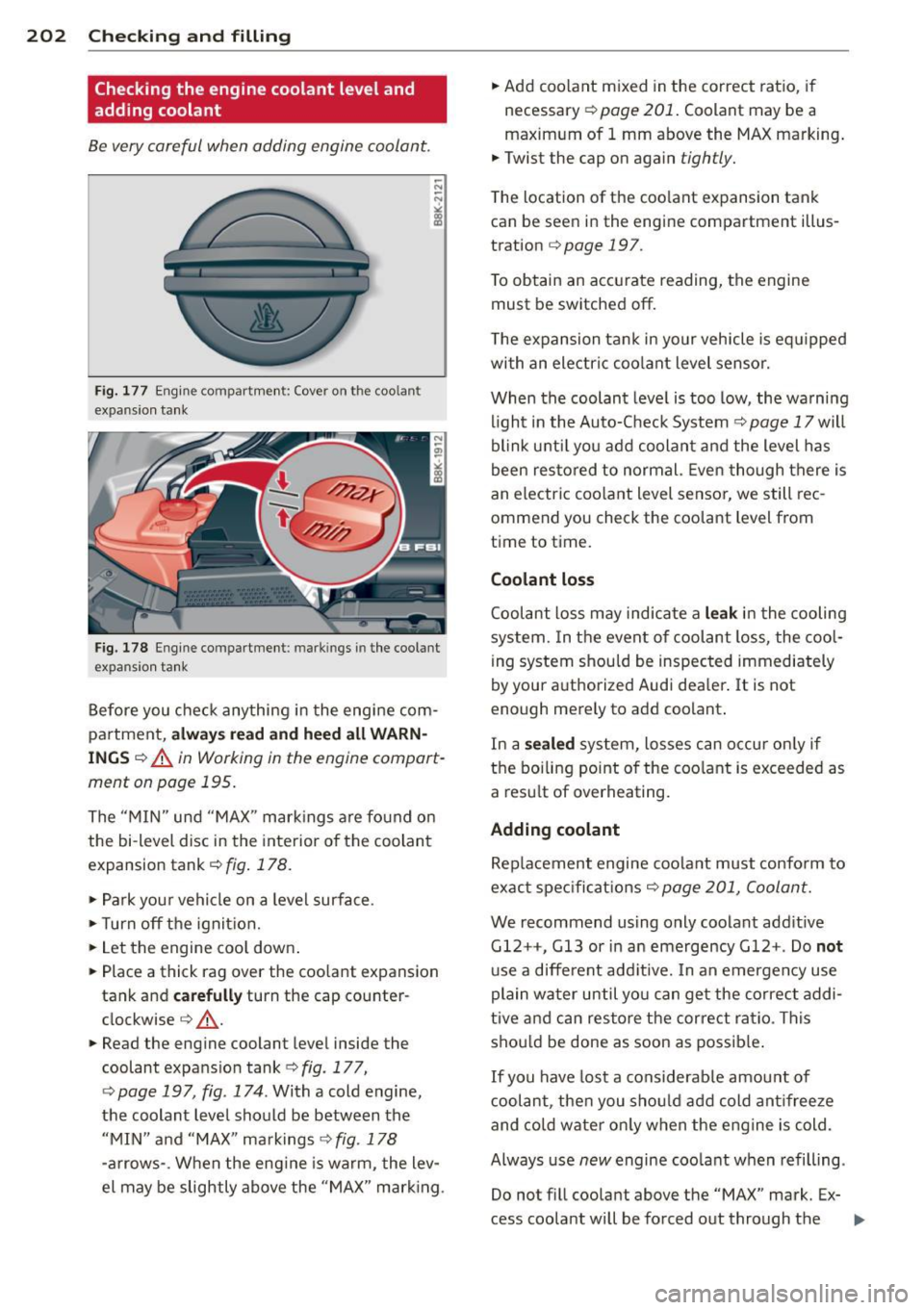
Fi g. 1 77 En g in e c ompart men t: C over on the coola nt
ex pan sion ta nk
Fig. 178 Engine co mpar tment : ma rkin gs in th e coolant
ex pan sio n ta nk
Before you che ck anything in the engi ne com
partment,
a lwa ys r ead and heed all WARN
INGS c> A in Working in the engine compart
ment on page
195.
The "M IN " und "MAX " mark ings a re found o n
the bi -level disc in the in terior of the coolant
expansion tank
¢ fig . 178.
.,. Pa rk you r vehi cle on a level sur face .
.,. Turn off t he igni tion.
.,. Let the engine coo l down .
.,. Place a thick rag over the coolant expansion
tank and
c a refully turn the cap cou nte r
clockwise
c> _&. .
.,. Read the eng ine coolant level inside the
coolant expans io n tank
c> fig . 177,
c>page 197 , fig. 174 . With a cold engine,
the coolant level sho uld be betwe en the
" M IN " and "MAX " ma rkings <=>
fig. 178
-arrows- . W he n t he eng ine is wa rm, the lev
el may be slightly
above the "MAX" marking . .,.
Add coo lant mixed in the correct rat io, if
necessary
c> page 201 . Coolant may be a
maxim um of 1 mm above the MAX marking .
.,. Twist the cap on again
tightly.
The location of the coo lant expansion tan k
can be seen i n the engine compartment illus
tration
c> page 197.
T o obtain an acc urate reading, the engine
must be sw itched off.
T he ex pan sion ta nk in your vehicle is eq uipped
with an ele ctric coo lant level senso r.
When the coolant level is too low , the wa rn ing
li ght in the Au to-Check System <=>
page 17 will
blink u nti l yo u ad d coolant and the level has
been restored to normal. Eve n t hough t here i s
an e lectri c coo lant level senso r, we still rec
ommend you check the coola nt level from
time to t ime.
Coolant loss
Coolant loss may indica te a leak in the cooling
system. In t he event o f coolant loss, the coo l
i ng system shou ld be inspected immediately
by your a uthorized Audi dea ler . It is not
eno ugh mere ly to add coolant.
In a
sealed sys tem, losses can occur on ly i f
the boili ng point o f the coo lant is exceeded as
a res ult of overheating.
Adding coolant
Rep la cement engine coo la nt must conform to
exact spe cificat ions
c> page 201, Cool ant .
We recommend using only coolant add it ive
Gl 2++ , Gl3 or in an emergency G 12 +. Do not
use a diffe rent add itive. In an emerge ncy use
plain w ater until yo u can get the correc t addi
tive a nd can res tore the cor rect ra tio. T hi s
sho uld be done as soon as possib le .
If you have lost a considerab le amou nt of
c oolant , the n you shoul d a dd cold an tifreeze
and co ld wate r on ly w hen the e ng ine is cold.
Always use
n ew engine coo lant w hen refilling .
Do not f ill coo la nt
above the "MA X" mark. Ex-
cess coolant will be forced o ut through the .,,_
Page 206 of 284

204 Checking and filling
Brake fluid
Checking brake fluid level
The brake fluid level can be checked with a
quick glance .
N N ~ N
" (X) (0
Fig. 179 Engine compartme nt: Cover on the brake flu ·
id reservo ir
Before you check anything in the engine com
partment,
a lwa ys re ad and heed all WARN·
ING S ¢.&._ in Working in the engine compart
ment on page 195 .
.. Read the brake fluid level from the brake
fluid reservoir
¢ fig . 179 , ¢page 197,
fig . 174.
The brake fluid level must be be
tween the "MIN" and
"MAX" markings.
The brake fluid reservoir is located at the rear
partition of the engine compartment on the
left side
¢ page 197.
The fluid level may drop slightly after some
time due to the automatic adjustment of the
brake pads. This is not cause for alarm.
If the brake fluid level falls
considerably be
low the "MIN" mark, the brake warning/indi
cator light (U.S. models:
11111 , Canadian
models :. ) will come on
¢page 15. Do not
continue to operate the vehicle. The complete brake system should be thoroughly checked
by an authorized Audi dealer or qualified
workshop and the cause corrected .
If the
brake fluid level is too low, the brake warn ing/
indicator light w ill illuminate. Contact an au
thorized Audi dealer
immedi atel y.
@ Tips
The brake fluid reservoir is located under
neath the cover.
Changing brake fluid
Have the brake fluid changed by an experi
enced technician .
Brake fluid absorbs moisture from the air. If
the water content in the brake fluid is too
high, corrosion in the brake system may result
after a period of time . The boiling point of the
brake flu id will also decrease conside rably and
decrease braking pe rformance.
Therefore, the brake fluid must be changed
every two year s. Always use new brake flu id
which conforms to Federal Motor Veh icle
Standard "F MVSS 116 DOT 4".
The brake fluid reservoir can be diff icult to
reach, therefore, we recommend that you
have the brake fluid changed by your author
ized
Audi d ealer . Your dealer has the correct
tools, the right brake fl uid and the know -how
to do this for you .
A WARNING
- Brake fluid is poisonous . It must be stor
ed only in the closed original container
out of the reach of children!
- Brake failure can resu lt from o ld or inap
propriate brake flu id. Observe these pre
cautions:
- Use only brake f luid that meets SA E
specifica tion
J 1 7 03 and conforms to
Federa l Moto r Ve hicle Standard 1 16.
Always check with yo ur authorized Aud i
dealer to make sure yo u are using the
correct brake fluid. The correct type of brake f lu id is also indicated on the
brake fluid reservoir.
- The brake fluid must be new. Heavy use
of the brakes can cause a vapor lock if
the brake fluid is left in the system too
l ong. This can seriously affect the effi
c iency of the brakes as well as your
safety. This cou ld resu lt in an accident.
(D Note
Brake fluid will damage the paint of your
vehicle .
Page 212 of 284

210 Tires an d whee ls
Tires and wheels
Tires
General notes
Tires may be the least appreci
ated and most abused parts of
a motor vehicle.
Ti res may be the least appreci
ated and most abused parts of
a motor vehicle. Tires are, how
ever, one of the most important
parts of a vehicle, particularly
considering the comparatively
small patch of r ubber on each
tire that assures that all-impor
tant contact between you, your
vehicle and the road.
Maintaining the co rrect tire
p ressure, making sure that your
vehicle and its tires do not have
to carry more we ight than they
can safe ly handle, avoiding
damage from road hazards and
regularly inspecting tires for
damage including cuts, s lashes
irregular wear and overall con
d ition are the most important
things that you can do to help
avoid sudden tire failure inc lud
ing tread separation and blow
outs.
Avoiding damage
If you have to drive over a curb
or similar obstacle, drive very
slowly and as close as possible
at a right angle to the curb.
Always keep chemicals includ
ing grease, oil, gasoline and
brake fluid off the tires.
Inspect the tires regularly for
damage (cuts, cracks or blis
ters, etc.). Remove any foreign
bodies embedded in the treads.
Storing tires
Mark tires when you remove
them to indicate the direction
of rotation. This ensures you to be able to mount them correct
ly when you reinstall them.
When removed, the wheels or
tires should be stored in a cool,
dry and preferably dark p lace.
Store tires in a vertical position if they are not mounted on
rims, in a horizontal position if
they are mounted on rims.
New tires
New tires have to be broken in
¢ &.
The tread depth of new tires
may vary, according to the type .,.
Page 215 of 284

M N
er
u..
co ,...., \!) 1.1'1 ,...., 1.1'1 ,....,
Bead
means the part of the tire that
is made of steel wires, wrapped
or reinforced by ply cords and
that is shaped to fit the rim.
Bead separation
means a breakdown of the bond
between components in the
bead.
Cord
means the strands forming the
plies in the tire .
Cold tire inflation pressure
means the tire pressure recom
mended by the vehicle manu
facturer for a tire of a designat
ed size that has not been driven
for more than a couple of miles (kilometers) at low speeds in
the three hour period before
the tire pressure is measured or
adjusted.
Curb weight
means the weight of a motor
vehicle with standard equip
ment including the maximum
capacity of fuel, oil, and cool
ant, air conditioning and addi
tional weight of optional equip
ment.
Tires and wheels 213
Extra load tire
means a tire design to operate
at higher loads and at higher inflation pressures than the
corresponding standard tire. Extra load tires may be identi
fied as "XL", "xl", "EXTRA
LOAD", or "RF" on the sidewall.
Gross Axle Weight Rating ("GAWR")
means the load-carrying capaci
ty of a single axle system,
measured at the tire-ground in
terfaces.
Gross Vehicle Weight Rating ("GVWR")
means the maximum total
loaded weight of the vehicle.
Groove
means the space between two
adjacent tread ribs.
Load rating (code)
means the maximum load that
a tire is rated to carry for a giv
en inflation pressure. You may
not find this information on all
tires because it is not required by law.
•
•
'
Page 227 of 284

important parts of the vehicle
and can lead to sudden tire fail
ure, including a blowout and
sudden deflation that can cause
the vehicle to crash.
Your safety and that of your
passengers also depends on
making sure that load limits are not exceeded. Vehicle load in
cludes everybody and every
thing in and on the vehicle.
These load limits are technical ly referred to as the vehicle's
Gross Vehicle Weight Rating
("GVWR").
The "GVWR" includes the
weight of the basic vehicle, all
factory installed accessories, a
full tank of fuel, oil, coolant and other fluids plus maximum
load. The maximum load in
cludes the number of passen
gers that the vehicle is intend
ed to carry ("seating capacity")
with an assumed weight of 150 lbs . (68 kg) for each pas
senger at a designated seating
position and the total weight of
any luggage in the vehicle. If
you tow a trailer, the weight of
the trailer hitch and the tongue
weight of the loaded trailer
Tires and wheels 225
must be included as part of the
vehicle load.
The
Gross Axle Weight Rating
("GAWR") is the maximum load
that can be applied at each of
the vehicle's two axles.
The Gross Vehicle Weight Rat ing and the Gross Axle Weight
Rating are listed on the safety
compliance sticker label locat
ed on the driver's side 8-pillar.
Your Audi has 4 seating posi
tions, 2 in the front and 2 in the rear for total seating capacity
of 4. Each seating position has
a seat belt¢ page 123, Safety
belts.
The fact that there is an upper limit to your vehicle's Gross Ve
hicle Weight Rating means that
the total weight of whatever is being carried in the vehicle (in
cluding the weight of a trailer hitch and the tongue weight of
the loaded trailer) is limited.
The more passengers in the ve hicle or passengers who are
heavier than the standard
weights assumed mean that less weight can be carried as
luggage.
•
•
'
Page 231 of 284

M N
er
u..
co ,...., \!) 1.1'1 ,...., 1.1'1 ,....,
wear on steering, suspension and tires. A wheel must also be
rebalanced when a new tire is
installed.
Incorrect wheel alignment
Incorrect wheel alignment can
cause excessive tire wear, im
pairing the safety of the vehi
cle. If tires show excessive
wear, have the wheel alignment checked by an authorized Audi
dealer or qualified workshop.
All wheel drive
Vehicles with quattro must al
ways have tires of the same
size, construction and tread
type. For details see
¢page 176.
A WARNING
Sudden tire failure can lead
to loss of control, a crash and serious personal injury!
-Never drive a vehicle when the tread on any tire is worn down to the wear indica
tors.
-Worn tires are a safety haz
ard, they do not grip well on
wet roads and increase your risk of "hydroplaning" and
loss of control.
Tires and wheels 229
-Always keep chemicals that can cause tire damage, such
as grease, oil, gasoline and
brake fluid away from tires.
-Tires age even if they are not being used and can fail
suddenly, especially at high speeds. Tires that are more
than 6 years old can only be used in an emergency and
then with special care and
at lower speeds.
-Never mount used tires on your vehicle if you are not sure of their "previous histo
ry." Old used tires may have
been damaged even though
the damage cannot be seen
that can lead to sudden tire
failure and loss of vehicle
control.
•
•
'
Page 240 of 284

238 Tire s and whee ls
be fitted over the whee l bolts. These are
avai lab le from authorized Audi dealers.
A WARNING
Using the wrong snow chains for your vehi
cle or installing them incorrectly can in
crease the risk of loss of control leading to
serious personal injury .
- Snow chains are available in different
sizes. Always make sure to follow the in
struct ions provided by the snow chain
manufacturer .
- When driving with snow chains never
dr ive faster than the speed permitted for
your specific snow cha ins.
- Always observe local regulat ions .
- Remove snow cha ins before driving on
roads not covered with snow to avoid
damaging t ires and wear ing the snow
chains down unnecessar ily .
- Snow chains, wh ic h come into d irect con
tact with the wheel rim, can scratch or
damage it . Therefore, make sure that the
snow chains are suitab ly covered . Check
the position of the snow chains after
driv ing a few yards and correct if neces
sary. Follow the i nstr uctions from the
snow chain manufacturer when doing so.
(D Tips
Where s now cha ins a re mandatory oncer
tain roads, this norma lly also applies to
vehicles with all wheel drive .
Wheel bolts
Wheel bolts must always be tightened to the
corr ect torque.
The design of whee l bolts is ma tched to the
factory insta lled r ims. If d ifferent rims are fit
ted, the correct wheel bo lts with the r ight
l ength and correctly shaped bolt heads must
be used . This ensures that wheels are fitted
secu re ly and that the b rake system functions
correctly . In certain circumstances, you may not use
whee l bolts from a different vehicle -even if it
is the same mode l¢
page 266 .
A WARNING "--
Improperly t ightened or ma inta ined whee l
bo lts can become loose causing loss of
control, a col lision and serious pe rsonal i n
jury .
- Always keep the wheel bo lts and the
threads in the wheel hubs clean so the
wheel bo lts can turn easily and be prop
erly tightened.
- Never g rease or oil the wheel bolts and
the threads in the wheel hubs. They can become loose while driv ing if g reased o r
oiled, even if t igh tened to the specified
torque.
- On ly use wheel bolts that belong to the
rim being installed .
- Never use different wheels bolts on yo ur
veh icle.
- Always maintain the correct t ightening
torque for the wheel bolts to reduce the
risk of a wheel loss. If the tighten ing tor
que of the whee l bolts is too low, they
can loosen and come out when the vehi
cle is moving. If the tightening torq ue is
too high, the wheel bolts and threads
can be damaged and the whee l can be
come loose.
Q) Note
The specified torque for the whee l bolts is
90 ft lbs . (120 Nm) with a tolerance of
± 7,4 ft lbs. (± 10 Nm). Torque wheel bolts
diagonally . After changing a wheel, the
torque must be checked as soon as possi
ble with a to rque wrenc h - preferably by an
autho rized Audi dea le r or qualified wor k
shop .
Low aspect ratio tires
Your Audi is factory -equipped with low aspect
ratio tires. These tires have been thoroughly
tested and been se lected specifically for your
model for their superb performance, road fee l ..,.