2015 AUDI RS5 CABRIOLET fuel
[x] Cancel search: fuelPage 26 of 284

24 Driver information d isplay
Trip computer
Introduction
The trip computer gives you information on
current and average fuel mileage, average
speed, fuel range and driving time .
Fig. 9 Trip computer display: Average fuel mileage
The following information is continuously
eva luated by the trip computer and can be dis
played sequentially in the instrument cluster
display:
Fuel range
The estimated cruising range in miles (km)
appears in the display. This tells you how far
your ve hicle wi ll be able to travel on the cur
rent tank of fuel and with the same driving
style. The display changes in increments of
5 miles (10 km).
The cruising range is calcu lated based on the
fuel consumption for the last 18 miles
(30 km).
If you drive conservat ively, the cruis
ing range will increa se.
Average fuel mileage The average fuel economy in MPG (l/100 km)
since you last cleared the memory appears in
this display. You can use this display to adjust
your driving technique to achieve a desired mileage.
Current fuel mileage
The instantaneous fuel consumption in mi les
per gallon (l/100 km) is shown in this display .
You can use this display to adjust your driving
technique to achieve a desired mileage. Fuel
consumption is recalcu lated at intervals
of 33 yards (30 meters). This disp lay switches
to gallons/hour (liters/hour) when the vehicle is not moving.
Average speed
T he average speed in mph (km/h) s ince you
last reset the memory appears in the display.
Elapsed time
The length of time that you have been driving
s ince you last reset the memory appears in
th is disp lay.
Distance
The distance that has been covered since the
last t ime the memory was cleared appears in
the display.
(0 Tips
- Fuel consumptions (average and cur rent), range and speed are displayed in
metric units on Canadian models.
- All stored values will be lost if the vehi
cle battery is disconnected .
Memories
The trip computer is equipped with two fully
automatic memories.
Fig. 10 Tri p computer display: memory level 1
You can swi tch between the trip computer 1
and 2 by pressing the
I RESET I button @
r:!>poge 25, fig. 11.
You can te ll wh ich memory leve l is currently
active by the number or the sign in the display
¢fig. 10. The data from the single-trip mem
ory (memory level 1) is being displayed if a
O .,.
Page 30 of 284

28 Driver information d isplay
If timing is paused, you can continue it late r
even if you sw itch the ignition off .
Evaluating times and continuing or
resetting timing
You can evaluate the fastest, slowest and
average lap times.
Fig. 16 Dis play : lap time eva luat ion
.,. To evaluate lap times, press and hold the
I RESET I button ¢ page 27, fig. 14 @for ap
proximate ly
2 seconds. The number of laps
t raveled, the fastest lap"+", the slowest lap
" -" and the average lap time "0" appears in
the display .
.,. To continue timing for additional laps, press
the wiper switch @ .
.,. To reset the timer to zero, press and hold
the
I RESET I button again for approximately
2 seconds .
.,. To switch the lap timer off comp letely, press
the
I RESET I button br iefly.
@ Tips
- Saved lap times cannot be ind ividually
deleted from the total results.
- The saved lap timer values will not be
l ost after turning the ignition off .
On-Board Diagnostic
system (OBD)
Malfunction Indicator Lamp (MIL )
The Malfunction Indicator Lamp (MIL) ¢"4 in
the instrument cluster is part of the On-Board
Diagnostic (OBD II) system. T
he warning/indicator light illuminates when
the ignition is switched on and goes out after
the engine starts and the id le has stabilized .
This indicates that the MIL is working proper
ly.
If the light does not go out after the engine
is started, or illum inates while you are dr iv
ing, a malfunction may exist in the engine sys
tem . If the light illuminates, the catalytic con
verter could be damaged .
Cont inue driving
with reduced power (avoid
ing sustained high speeds and/or rapid accel
erations) and have the condition corrected.
Contact your authorized Audi dea ler .
An improperly closed fuel filler cap may also
cause the
MIL light to illuminate
¢ page 192 .
On-Board Diagnostics
Fig. 17 Locat io n of Data Link Co nnector (O LC)
On-Board Diagnostics monitors the compo
nents of your emission contro l system. Each
monitored component in your engine system
has been assigned a code. In case of a mal
function, the component will be identified
and the fault stored as a code in the control
module memo ry.
The MIL light may also illuminate if there is a leak in the on-board fuel vapor recovery sys
tem .
If the light illuminates after a refueling,
stop the vehicle and make sure the fuel filler
cap is properly closed
¢ page 192.
In order to make an accurate diagnosis, the
stored data can on ly be displayed using spe
cial diagnostic equipment (generic scan tool
for 080) .
ll>-
Page 182 of 284

180 Driving and en vironm ent
8_ WARNING
After driving through water, mud, slush,
etc ., the brakes may be slow to take effect
because of wet brake rotors and pads. Dry
the brakes first by braking carefully to re
store the full braking effect.
(D Note
Vehicle components such as the engine,
transmiss ion, suspension or electrical sys
tem can be severely damaged by driving
through wate r.
@ Tips
- Check the depth of the water before dr iv
i ng through it.
- Do not stop the veh icle, dr ive in reverse
or switc h the engine off when driving
t hr ough water.
- Keep in mind that oncoming vehicles
may c reate waves that raise the water
l evel and make it too deep fo r you r vehi
cle to dr ive through safely.
- Avoid dr iving thro ugh salt water because
i t can ca use corrosion.
Warming up and
cooling down
-
By carefully warming up and cooling down
your ve hicle, you can he lp ensure that it is not
overstressed unnecessarily dur ing sporty driv
ing.
When warming up, the vehicle is d riven at a
maximum engine speed of 6000 RPM in order
to raise the engine oi l temperature to a mini
mum of 140
°F (60 °(). The tires also only
reach their full road holding capability once
they have warmed up .
The cooling fan can contin ue to run in your ve
h icle after the engine is switched off. Howev
er, driving the vehicle to cool it down is part ic
ularly important. During sporty driving, the
engine and brakes, the ex ha ust system, and
the transm ission all become extremely hot.
B efore you park the vehicle, you shou ld drive it for a few miles/kilometers at
light load in
the low rpm range to allow it to cool down.
Catalytic converter
It is very important that your emission con
trol system (catalytic converter) is function
ing properly to ensure that your vehicle is run
ning in an environmentally sound manner.
.. Always use lead-free gasoline c:> page 190,
Fuel supply.
.. Never run the tank down all the way to emp
ty .
.. Never put too much moto r oil in your engine
c:> page 199, 't::71 Adding engine oil .
.. Never try to p ush- or tow -sta rt yo ur vehicle.
The catalytic converter is an efficient "clean
up" device bu ilt into the exhaust system of
t h e vehi cle. The cata lytic conve rter bu rns
many of the pollu tan ts i n t he exh aust gas be
f ore they are re lease d into the atmosphere.
T he exclusive use of unleaded fue l is critica lly
impor tant for the life of the catalyt ic convert
er and prope r fu nct ion ing of the engi ne.
8_ WARNING
- T he temperature of the exhaus t system
is high, both when driving and after stop
p ing the engine.
- Never touch the exhaus t tail pipes once
they have become hot . This cou ld result
in burns .
- Do not park or operate the vehicle i n
areas where the hot exha ust system may
come in contact with dry grass, brush,
fue l spill or other material wh ich can
cause a fire.
- Do not app ly additional undercoating or
rustproofing on or near the exhaust
manifold, exhaust pipes, catalytic con
ver ter or heat shields . Dur ing driv ing, the
substance used for undercoating could
overheat and cause a fire.
Page 183 of 284

M N
er
u..
co ,...., \!) 1.1'1 ,...., 1.1'1 ,....,
(D Note
-Be aware that just one tank fi lling with
le ad ed fuel will already seriously de
grade the performance of the catalytic
converter.
- Do not exceed the correct engine oil leve l
c>page 199.
-Do not drive until the fuel tank becomes
complete ly empty. The engine could mis
fire. Unburned fuel could also get into
the exhaust system and this could cause
the catalyt ic converter to overheat.
- Do not turn off the ignition while the ve
hicle is moving .
- Do not continue to operate your vehicle
under these condit ions, as otherwise fuel
can reach the catalytic converter. This
could result in overheat ing of the con
verter, requ iring its replacement.
- To assure efficient operat ion of the Emis
s ion Control System:
- Have your vehicle maintained properly
and in accordance with the service rec
ommendations in your Warranty
&
Ma intenance booklet.
- Lack of proper maintenance as well as
improper use of the vehicle will impa ir
the funct ion of the emission control
system and could lead to damage .
@) For the sake of the environment
Even when the Emission Control System is
operating properly, the exhaust gas can
have a sulfur-like exhaust gas smell under
some operating states. This depends on
the s ulfur content of the fuel being used.
Using a d ifferent brand of fuel may help,
or filling the tank w ith lead-free super
grade gasoline .
Shutting down vehicle
If you would like your veh icle to remain inop
erat ive for a longer period of time, contact an
Audi or other specialized dealer. They can ad
vise you on necessary precautions e .g. corro
sion prevention, maintenance and storage.
Dri vin g and en vironm ent 181
Pay attention to additional information con
cerning the battery . Refer to
c> page 205 .
Operate your vehicle
economically and
minimize pollution
General
Your personal style of driving will determine
the economy of your vehicle, as well as ex
haust and noise levels.
Fuel economy, environmenta l impact, and
wear on your engine, brakes and tires largely depend on three factors:
- your personal d riving style
- operating conditions
- technical limitat ions
If you ant ic ipate what you need to do next and
drive economically, you can easily cut your
fuel consumpt ion by 10-15 percent . This sec
tion w ill give you some tips on how you can
help the env ironment and your pocketbook.
(D Tips
The consumption estimates as published
by ENVIRONMENTAL PROTEC TION AGENCY
( E PA) and Transpo rt Canada may not cor re
spond to your actual consump tion on the
road, which will vary depending upon vehi
cle load and speed, road and weather con
dit ions, trip length, etc.
Drive smoothly and keep a lookout
ahead
Vehicles use the most fuel when they are ac
celerating.
.,. Avoid unnecessary accelerating and braking.
Vehicles use the most f uel when they a re ac
ce lerat ing. If you ant icipate what is going to
happe n next, you will need to brake less and,
th us, acce lerate less . Let the vehicle coast
whenever possible -for examp le when you see
that the next traff ic light is red.
•
•
Page 184 of 284

182 Driving and en vironm ent
Avoid full throttle
Driving at moderate speeds saves fuel and
improves your mileage .
"'Try and keep well below your car 's max imum
speed.
Accelerating gently reduces fuel consump
tion, engine wear, and does not disturb the
environment. F ue l consumption, exhaust emissions and en
g ine no ise increase d isproportionately at high
speeds. If you dr ive at approximately three
quarters of top speed, fuel consumption will be reduced by one half. Never dr ive faster
than the posted speed limit and weather con
d itions permit .
Reducing unnecessary idling
Even when your car is just idling it burns up
fuel.
"'Shut the engine off when you are not dr iv ing
the vehicle .
"'Do not warm up the veh icle by letting the
engine run at idle .
It makes sense to shut
off the e ngine in traff ic
jams, when waiting for trains to pass at ra il
road crossings , or at traff ic lights that have
l ong wa its on red. Turning the engine
off fo r
just
30-40 seconds saves more fue l than is
bu rned s tarting the eng ine again .
It takes a long time for the engine to warm up
fu lly when it is running at idle . Howeve r, wear
and nox ious em issions are especially high
when the engine is warming up. So you should
drive away as soon as you start the engine and
avoid running at high rpms while the engine is
still warming up .
([) Note
Do not leave engine idling unattended af
ter starti ng . If warning lights should come
on to indicate improper operation, they
wou ld go unheeded. Extended idling also
produces heat, which cou ld result in over- heating o
r othe r damage to the ve hicle or
other property .
Regular maintenance
A badly tuned engine unnecessarily wastes a
lot of fuel.
"' Have your ve hicle serviced at reg ular in ter -
vals.
By having your veh icle regu la rly serviced by an
a utho rized Aud i dea le r helps to ensure that it
runs properly and econom ic all y. The cond it ion
of your veh icle not on ly affe cts its safety and
ability to ho ld its va lue, it a lso affects
fuel
con sumption .
Check your oil ea ch time you fill your tank.
The amount of o il used is re lated to engine
load and speed .
It is normal for the oil consumption of a new
engine to reach its lowest value after a certa in
mileage has bee n driven.
You must drive your veh icle about 3,000 m iles
(5,000 kilometers) before you can properly
assess oil consumpt ion.
This also app lies to fue l cons umption and en
gine output.
(D Note
- Have your vehicle maintained proper ly
and in accordance with the service rec
ommendations in your Warranty
& Main
tenance booklet. Lack of proper ma inte
nance as well as improper use of the ve
hicle will impair the function of the
em iss ion contro l system and cou ld lead
to damage.
- Do not alter or remove any component of
the Emission Control Sys tem unless ap
proved by the manufacture r.
- Do not alte r or remove any device, such
a s hea t sh ie lds, swi tches, ig nitio n w ires,
valves, which are designe d to p rotec t
your vehicle's Emission Control System
and other impo rtant vehicle compo
nents .
Page 185 of 284

M N
er
u..
co ,...., \!) 1.1'1 ,...., 1.1'1 ,....,
Fewer short trips
Fuel consumption will always be relatively
high on short trips.
11-Try to avoid driving short distances with a
cold engine.
The engine and catalytic converter have to
reach their optimal
operating temperature to
reduce fuel consumption and noxious emis
sions effectively .
Just after starting, a cold engine in a mid-size
car only achieves a fuel economy of 6-8 miles
per gallon (30-40 l/100 km). After about a
half a mile, fuel economy climbs to 12 mpg
(20 l/100 km). After about
2.5 m iles (4 km),
the engine is at its proper operating tempera
ture and fue l economy has reached a normal
l eve l. So you can see that you should avoid
short trips whenever possible.
The
outside temperature is also critical in this
regard. Your car consumes more fuel in the
winter than in the summer.
Driving and environment 183
•
•
Page 188 of 284
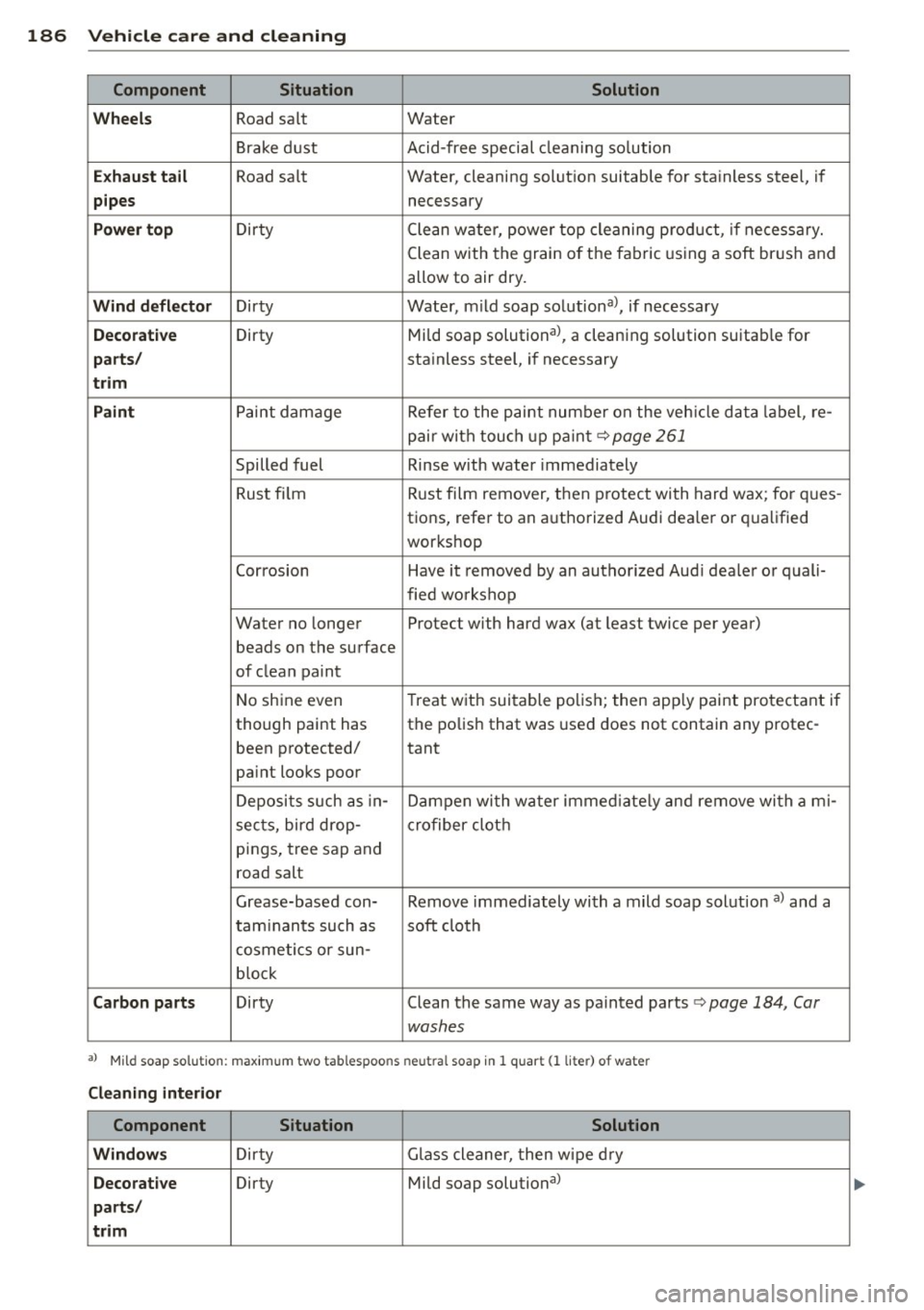
186 Vehicle care and cleaning
Component Situation Solution
Wheels
Road sa lt Water
Brake dust Acid-free special cleaning so lution
E x haust tail Road sa lt Water, cleaning solut ion suitable for sta inless steel, if
pipes necessary
Power top D irty Clean w ater, powe r top cleaning p rod uct, if necessa ry.
Clean with the grain o f the fabric using a soft br ush and
allow to air dry.
Wind d eflector Dirty Water, mild soap solutiona>, if necessary
Decorative Dirty Mild soap solutiona>, a cleaning solution suitab le for
parts/ sta inless steel, if necessary
trim
Paint
P aint dam age Re fer to the p aint num be r on the veh icle d ata lab el, re -
pair wi th tou ch up pa in t ¢
page 261
Spilled fuel Rinse with water immediately
Rust fi lm R
ust film remover, t hen protect wi th hard wax; for q ues -
tions, refe r to an a uthorized Audi dea ler or q ua lified
workshop
Corrosion Have it removed by an autho rized Aud i deale r or quali-
fied workshop
Water no longer Protect with hard wax (at least twice per year)
beads on the surface
of clean paint
No sh ine even T
reat w ith sui table polis h; then app ly paint pro tectant if
though paint has the polish that was used does not contain any protec-
been p rotected/
tant
pa int loo ks poo r
D eposi ts such as in- Dampen wi th w ater immed iate ly and remove wi th a mi-
sec ts, bird drop -
crofiber clot h
pings, t ree sap and
road salt
Grease-based con- Remove immediately with a mild soap sol ution a) and a
tam inants such as soft cloth
cosmetic s or sun-
b lo ck
Carbon parts Dirty Clean tlhe same way as painted parts¢ page 184, Car
washes
al M ild soap solution : max imu m two tablespo ons neutral soap in 1 quar t (1 liter) of water
Cleaning interior
Component Situation Solution
Windows
Dirty Glass cleaner, then w ipe d ry
Decorat ive Dirty Mild soap solutional
parts/
trim
Page 192 of 284

190 Fuel supply and filling your fuel tank
Fuel supply and filling
your fuel tank
Gasoline
Fuel supply
Using the righ t fuel helps keep the environ
ment cle an and preven ts engine dam age .
Fuel recommendation
The fuel recomme nded for you r vehicle is un
lead ed premium
g rade gasoline . Audi recom
mends using TO P TI ER D ete rgent Gaso line
wi th a minimum oc tane ra ting of 91 A KI ( 95
RON ). For more informa tio n o n TO P TIE R De
tergen t Gasoline, please go to the off icia l
website (www .to ptiergas .com) .
Th e re commended gasoline o ctane rating for
your eng ine can also be fo un d o n a label loc at
ed on the ins ide of the fue l filler flap . This ra t
in g may be specified as AKI or RON.
Your veh icle may also be operated using un
l e ad ed regular g asoline with a min imum o c
tane rating o f 87 AKI/9 1 RO N. H owever, using
87 AKI/91 RO N octane fue l w ill slightly re
d uce eng ine perfo rmance .
Use unleaded ga soline only. Unleaded g aso
li ne is availab le th rougho ut the USA, Canada,
and in most E uropean countries . We recom
mend that you do not ta ke yo ur vehicle to
areas or countries where unleaded gasoline
may not be ava ilable.
F or mo re informat io n on refue ling your ve hi
cle, see
¢ page 191.
Octane rating
Octane rating ind icates a gaso line' s abili ty to
r es ist eng ine da mag in g "kno ck" cau sed b y
p rem ature ign ition and detona tion. Therefore,
b uying the correct grade of gasoline is very
important to he lp prevent possible engi ne
damage and a loss o f engine performance.
Gasoline mos t commonly used in the Unite d
States an d Canada has the following octane
rat ings that can usually be fo und on the filler
p ump : -
Premium Grade: 9 1 -96 AKI
- Regular Gra de: 87 -90 AKI
Explanation of the abbreviations:
AKI = Anti Knock In d ex = (R+ M)/2 = (RO N
+ MO N)/2
R ON = Research Octane Number
MON = Moto r Octane Number .
@ Note
-Do not use a ny fue l w it h octane rat ings
lower tha n 87 A KI or 9 1 RO N othe rwise
ex pensive eng ine da mage w ill occu r.
- Do
not use lea ded gasoli ne. The use of
leaded g asoline w ill sev ere ly damag e
yo ur vehicle's ca ta lytic converter a nd its
a bi lity to cont rol exh aust emis sions.
Blended gasoline
Use of gasoline containing alcohol or
MTBE (methyl tertiary butyl ether )
You may use unleaded gasoline blende d with
alcohol or MTB E (commonly referred to as
oxygenates) if the blended m ixture meets t he
fo llow ing c riteria:
Blend of gasoline methanol (wood alcohol or
methyl alcohol )
-Anti -kno ck index mus t be 87 A KI or higher .
- Blend mus t contain no more t han 3% me th-
a nol.
- Blend must contain mo re than 2% co-sol -
ve nts .
Blend of gasoline and ethanol (grain alcohol
or ethyl alcohol)
- Anti-knock index must be 87 AKI or higher.
- Blend must not conta in mo re than 10%
ethanol.
Blend of gasoline and MTBE
- Anti -kno ck index mus t be 87 A KI or higher.
- Blend must contain not mo re than 15%
M TB E.
Seasonally adjusted gasoline