2015 AUDI A8 brake
[x] Cancel search: brakePage 264 of 312

26 2 T ire s and wheel s
chains because the vehicle will be ex
tremely low. If you do drive with snow
chains on while the vehicle is at this lev
el, the snow chains might severe ly dam
age the wheelhouse and other parts of
the veh icle.
(D} Tips
Where snow chains are mandatory oncer
tain roads, this normally also applies to
veh icles with All Wheel Drive.
Wheel bolts
Wheel bolts must always be tightened to the
correct torque .
The design of whee l bolts is matched to the
factory installed r ims. If different rims
are fit
ted, the correct wheel bolts with the right length and correctly shaped bolt heads must
be used. This ensures that wheels are fitted
secure ly and that the brake system functions
correctly .
In certain circumstances, you may not use
wheel bolts from a different vehicle -even if it
is the same mode l
¢page 292.
_& WARNING
Imprope rly tig htened o r maintained whee l
bolts can be come loose ca using loss of
contro l, a co llision and serious persona l in
jury.
- Always keep the wheel bol ts and the
threads in the wheel hubs clean so the
wheel bolts can tu rn easily and be prop
er ly tightened .
- Never grease or oil the wheel bo lts and
the threads in the wheel h ubs. They can
become loose w hile driving if greased or
oiled, even if tightened to the specif ied
torque.
- Only use wheel bolts that belong to the rim being installed.
- Never use different whee ls bolts on your
vehicle.
- Always maintain the correct tighten ing
torq ue for the wheel bo lts to reduce the risk of a whee
l loss. If the tightening tor
que of the wheel bolts is too low, they
can loosen and come out when the vehi
cle is mov ing. If the tighte ning torque is
too high, the wheel bolts a nd threads
can be damaged and the whee l can be
come loose.
([) Note
The specified torque for the whee l bolts is
90 ft lb (120 Nm) with a tolerance of± 7,4
ft lb(± 10 Nm). Torque whee l bolts diago
nally. Afte r changing a whee l, the torque
must be checked as soon as possible wi th a
torque wrench -pre ferably by an au thor
ized Audi dealer or qualified workshop .
Low aspect ratio tires
Your Audi is factory-equipped with low aspect
ratio tires. These tires have been thoro ughly
tested and been se lected specifically for your
model for their superb performance, road fee l
and hand ling u nder a var iety of d riv ing condi
t ions . As k your author ized Audi dealer for
more details.
The low aspect ratio of these tires is ind icated
by a numeral of
55 or less in the tire's s ize
designation . The numeral rep resents the ratio
of the t ire's s idewa ll height in relation to its
t read width ex pressed in percentage. Conven
tiona l tires have a he igh t/w idth rat io of 60 or
more.
The performanc e of low -a sp ec t-ratio tires i s
pa rticularly sensitive to improper inflation
pre ssure . It is therefore important that low
a spect ratio tires are inflated to the specified
pre ssure and th at the inflation pressure i s
regularly checked and maintained. Tire pre s
s u res should be checked at least once a
month and always befo re a long trip
¢ page 251, Checking tire pressure .
What you can do to avoid tire and rim
damage
Low aspect ratio tires can be damaged more
easily by impact w ith potholes, curbs, gull ies .,..
Page 271 of 312

.... N .... N
0 J:
-
"' ....
Spare wheel
Applies to vehicles: with spare wheel
The spare wheel is stored in the wheel well
underneath the floor panel in the luggage
compartment.
F ig. 220 Luggag e co mpartm ent : spar e wh eel
Taking out the sp are whee l
• Lift the cargo floor by the plast ic handle
c:::>fig . 220.
• Hook the hand le into the luggage compart
ment weather strip .
• Turn the large screw
c:::> fig. 220 counter
clockwise.
• Takeout the spare tire.
• Always store the vehicle tool kit , the jack*
and the replaced tire in the luggage com
partment
c:::> page 139 .
• Unhook the ca rgo floor before closing the
rear lid.
& WARNING
-
Loose items in the passenger compart
ment can cause serious pe rsonal in jury
during hard braking or in an accident.
- Never store the spare wheel or jack and
tools in the passenger compartment.
@ Tips
Check the inflat ion p ressu re of the spare
tire periodically to keep the tire ready for
use.
What do I d o now ? 269
Changing a wheel
Before changing a wheel
Observe the following precautions for your
own and your passenger's safety when chang
ing a wheel.
• After you experience a t ire failure, pull the
car well away from moving traffic and try to
reach
leve l ground before you stop c:::> ,&.
• All passengers should le av e t he ca r and
move to a safe location (for ins tance, behind
t he guardra il)
c:::> ,& .
• Engage the parki ng br ake to prevent your
vehicle from rolling unintentionally
c:::> ,& .
• Move sele ctor lever to po sit ion P c:::> ,&. .
• If you are towing a trailer, unhitch the trailer
from your ve hicle.
• Take the
jac k and the sp are tire out of the
luggage compartment
c:::> page 267,
c:::> page 268 .
& WARNING
You o r you r passengers could be i njured
while changing a wheel if you do not fo l
low these safety precaut ions:
-I f you have a flat tire, move a safe d is
tance off the road. Turn off the engine,
turn the eme rgency flashers on and use
other warning devices to a lert other mo
torists .
- Make sure that passengers wait in a safe
place away from the vehicle and well
away from the road and traffic.
- To help prevent the vehicle from moving
suddenly and possibly slipping off the
jack, always f ully set the parking brake
and b lock the wheel d iagonally opposite
the wheel be ing changed. When one
front wheel is lifted off the ground, plac ing the Automatic Transmission in "P"
(Par k) will
not prevent the vehicle from
mov ing .
- Before you change a wheel, be sure the
ground is level and firm. If necessary,
use a sturdy board under the jac k.
-
Page 274 of 312

272 What do I do now?
hold on to the car to keep your balance
and take care not to slip.
AB: Raising the vehicle
The vehicle must be lifted with the jack first
before the wheel can be removed.
Fig. 224 Sill pa nels : m ark ings
Fig. 225 Sill: position ing t he veh icle jack
.. Activate the vehicle jack mode in the MMI:
I CAR ! function button > Car systems control
button>
Servicing & checks> Air susp.:
jack mode
> On.
.. Engage the parking brake to prevent your
vehicle from rolling unintentionally.
.. Move the
selector lever to position P .
.. Find the marking (imprint) on the sill that is
nearest the wheel that will be changed
o
fig. 224. Behind the marking, there is a
lifting point on the sill for the vehicle jack.
.. Turn the
vehicle jack located under the lift
ing point on the sill to raise the jack until its
arm @o
fig. 225 is located under the des
ignated plastic mount o ,& o0 .
.. Align the jack so that its arm @ o
fig. 225
engages in the designated lifting point in
the door sill and the movable base @ lies
flat on the ground. The base @ must be
ver
tical
under the lifting point @. ..
Wind the jack up further until the flat tire
comes off the ground o
.&,.
Position the vehicle jack only under the desig
nated lifting points on the sill
c:> fig. 224.
There is exactly one location for each wheel.
The jack must not be positioned at any other
location
c:> .&, c:>Q).
An unstable surface under the jack can cause
the vehicle to slip off the jack. Always provide
a firm base for the jack on the ground. If nec
essary place a sturdy board or similar support
under the jack. On
hard, slippery surfaces
(such as tiles) use a rubber mat or similar to
prevent the jack from slipping
c:> .&,.
A WARNING ~
-You or your passengers could be injured
while changing a wheel if you do not fol
low these safety precautions:
- Position the vehicle jack only at the
designated lifting points and align the
jack. Otherwise, the vehicle jack could slip and cause an injury if it does not
have sufficient hold on the vehicle.
- A soft or unstable surface under the
jack may cause the vehicle to slip off
the jack . Always provide a firm base for
the jack on the ground. If necessary,
use a sturdy board under the jack.
- On hard, slippery surface (such as tiles)
use a rubber mat or similar to prevent
the jack from slipping.
- To help prevent injury to yourself and
your passengers:
- Do not raise the vehicle until you are
sure the jack is securely engaged.
- Passengers must not remain in the ve
hicle when it is jacked up.
- Make sure that passengers wait in a
safe place away from the vehicle and
well away from the road and traffic .
- Make sure jack position is correct, ad
just as necessary and then continue to
raise the jack.
- Changes in temperature or load can af
fect the height of the vehicle.
Page 275 of 312
.... N .... N
0 J:
'
"' ....
(D Note
Do not lift the vehicle by the sill. Position
the vehicle jack only at the designated lift
ing points on the sill. Otherwise, your vehi
cle will be damaged.
(D T ips
The vehicle jack mode switches off auto
matically at speeds above 10 km/h.
58: Raising the vehicle
The vehicle must be li~ed with the jack first
before the wheel can be removed.
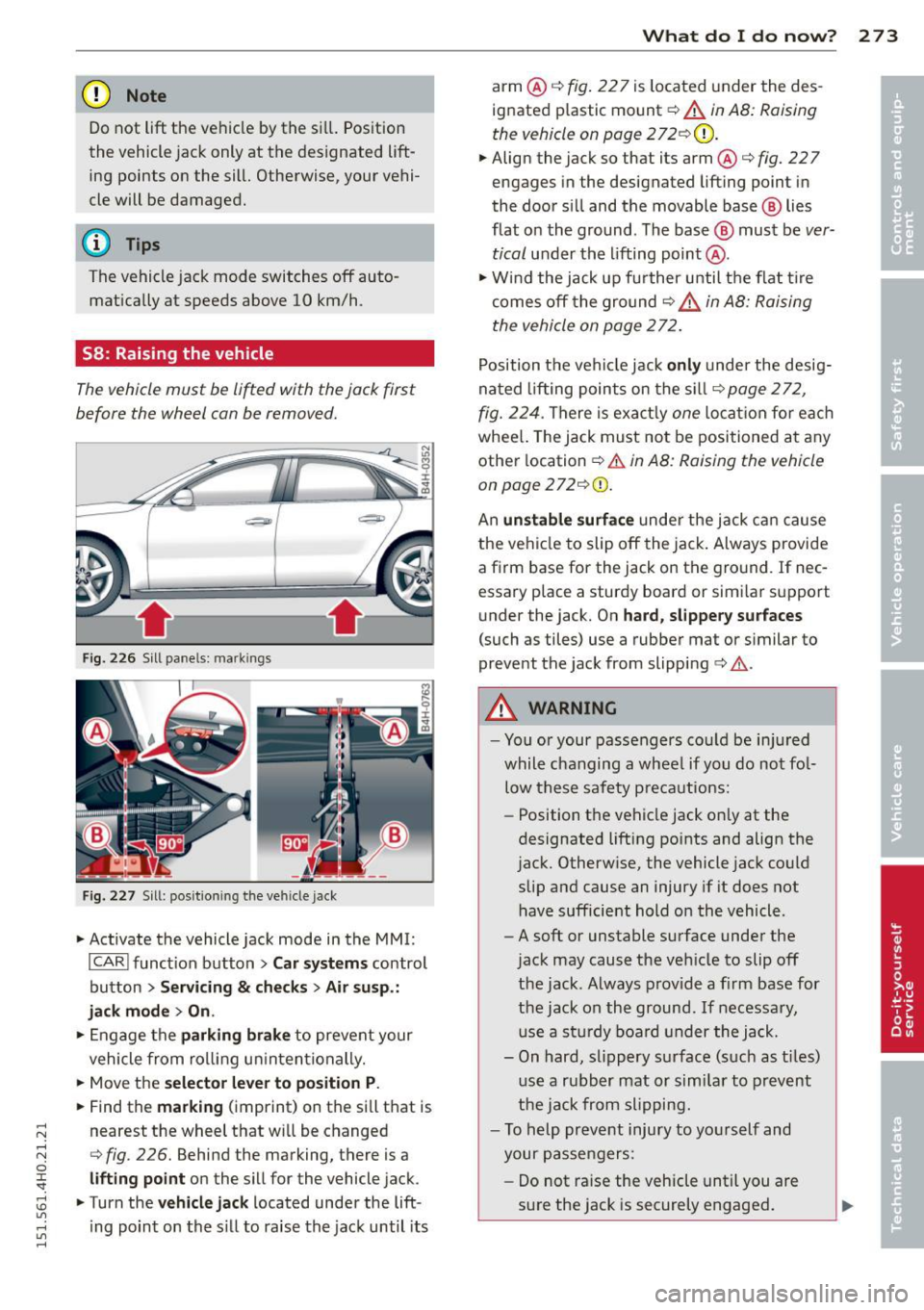
Fig . 226 S ill pane ls: mark ings
F ig. 227 S ill: posit ion ing the veh icle jack
.. Activate the vehicle jack mode in the MMI:
I CAR I funct ion button > Car syste m s control
button
> Se rvi cing & check s> Air sus p.:
ja ck m ode
> On.
.,. Engage the par kin g brake to prevent your
vehicle from rolling un intentionally.
.. Move the
sel ec tor le ver to po sition P .
.. Find the ma rki ng (imprint) on the sill that is
nearest the wheel that w ill be changed
r=> fig . 226. Behind the marking, there is a
lifti ng po int on the si ll for the vehicle jack.
.. Turn the
ve hicle jack located under the lift
i ng point on the sill to raise the jack until its
What do I d o now ? 273
arm @r=> fig . 22 7 is located under the des
ignated plastic mount
r=> A. in AB: Raising
the vehicle on page 272i::>(f).
.. Align the jack so that its arm @c::> fig. 22 7
engages in the designated lifting point in
the door sill and the movable base @ lies
flat o n the ground. The base @ must be
ver
tical
under the lifting point @.
.. Wi nd the jack up fu rther until the flat t ire
comes off the ground
r=> &,. in AB: Raising
the vehicle on page 272.
Position the vehicle jack only under the desig
na ted lifting points on the s ill
c::>page 272,
fig. 224 .
There is exact ly one l ocation fo r each
whee l. The jack must not be positioned at any
other location c::>
.&. in AB: Raising the vehicle
on page 2 72r=>
(J).
An un sta ble surf ace unde r the jack can cause
the ve hicle to slip
off the jack . Always provide
a firm base for the jack on the gro und. If nec
essary place a sturdy board or simi lar support
under the jack. On
h ard , sl ipp ery surf aces
(such as tiles) use a rubber mat or similar to
prevent the jack from slipping c::>
,&. .
.&_ WARNING
-You or your passengers cou ld be injured
while changing a wheel if you do not fo l
low these safety p re cautions:
- Position the vehicle jack on ly at the
designated lifting points and align the
j ack. Otherw ise, the vehicle jack could
slip and cause an injury if it does not
have sufficient hold on the vehicle.
- A soft or unstable surface under the
j ack may cause the veh icle to slip off
the jack . Always provide a firm base for
the jack on the ground .
If necessary,
u se a st urdy board under the jack .
- On hard, slippery surface (such as t iles)
use a rubber mat or similar to prevent
the jack from slipping .
- To help pr event injury to yourself and
your passengers:
- Do not raise the vehicle until you are
sure the jack is securely engaged .
Page 279 of 312

.... N .... N
0 J:
'SI: .... \!) 1.1'1
.... 1.1'1 ,-0
Fuse pa nel @ (brown )
No . Equipment
1 Headlight contro l switch
2
Emergency start coil (key
i dentification)
3
Rear door control module
(driver's side)
4 Head-up Display
5 Horn
6 Inter ior lights (head liner)
Steering column lever, mul-
8
tifunction steering wheel
controls, steering wheel
heat ing
10
Electric steering co lumn
lock
11 D river door contro l modu le
12
D iagnostic connector, light/
rain sensor
14
Power steering col umn ad -
justment
15
Power steering, A/C com-
presse r
16 Brake booster
Fu se pa nel © (b la ck)
No . Equipment
1 Front seat heating
2 Windshield w iper
3 Front exterior lighting
4 Sun roof
5 Driver power window
6 Driver seat (pneumat ic)
7 Panoramic sunroof
8 Dynamic steering
9 Front exterior lighting
10 Windshield/headlight
wash-
er system
11
Rear power w indow (driver's
side)
12 Panoramic sunroof
Amps
5
5
7,5 5
15
7,5
10/5
5
7,5 10
25
20
15
Amps
30 30
30 20
30
7,5
20 35
30
35
30
40
Fu ses and bulb s 2 77
Front passenger side cockpit fuse
assignment
Fig . 233 Fro nt passe nger side cockpit: f use pane l with
plast ic brac ket
Fu se panel @ (bl ac k)
No. Equipment Amps
1 Anti-theft alarm system 5
2
Transmission control mod-
15
ule
3 Front climate control fan 40
4 Engine supply 35
6
Engine cont ro l modu le 5
7
Front passenger door con-
7,5 trol module
8
Front passenger power win-
30 dow
9 ESC contro l module
10
10
ESC contro l modu le 25
1 1
Right rear power window 30
1 2
Front passenger seat (pneu-
7,5 matics)
•
•
Page 280 of 312

2 78 Fuses and bulbs
Luggage compartment fuse assignment
Fig. 234 Luggage compartment: fuse pa nel with plastic bracket
Fuse p ane l@ (black) No. Equipment Amps
No . Equ ipm ent Amps
11 E lectromechanical steering 5
ESC button, data logger, di· 12
Selector lever,
BCM-2
5
1 agnostic connector, BCM · 1, 5
13 Audi side ass ist 5
adaptive light ing system
14 Engine control module
5
2 Networking gateway
5
15 Starter 40
3 adaptive air suspension 5
4 Parking system
5 16 Left headlight/Headlight
10/5
range control system
5 Steering column lever
5
6 Suspension control system 5 sensor
Fu
se p an el@ (red )
No. Equipment Amps
7
Belt tensioners, airbag con-
5
trol module
Heated washer fluid nozzles, 1
Left reversible belt
tensioner
2S
2 Right reversible belt
ten-
25
sioner
H ome link (garage door
Starter diagnos is, DC/DC
8 opener), night vision system 5
3 converter (Start-Stop-Sys·
5
control module, sport differ- tern)
ential, ionizer
9
Electromechanical parking 5
brake control module 4
DC/DC converter (Start-
7,5 Stop-System)
5 Image processing
7,5
10 Rear
seat heating, cooler, in· 5 terior rearview mirror
Page 281 of 312
.... N .... N
0 J:
'SI: .... \!) 1.1'1
.... 1.1'1 ,....,
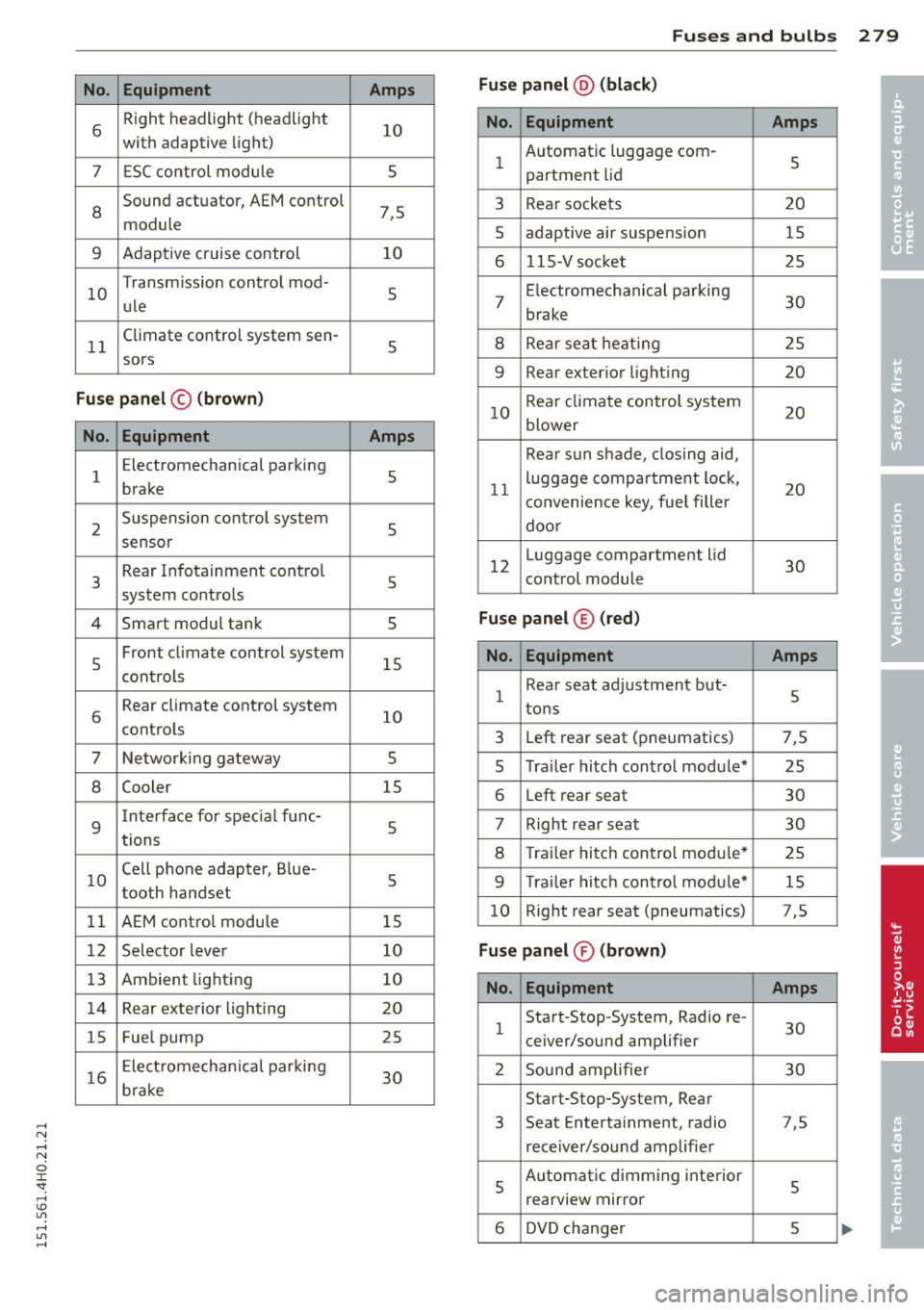
No. Equ ipment
6 R
ight headlight (headlight
with adaptive light)
7 ESC control module
8
Sound actuator, AEM control
module
9 Adaptive cruise control
10 Transmiss
ion control mod-
ule
11 Climate control
system sen-
sors
Fu se pan el© (bro w n)
No. Equipment
1 E
lectromechanical parking
brake
2 Suspension control system
sensor
3 Rear
Infotainment control
system controls
4 Smart modul tank
5 Front
climate control system
contro ls
6 Rear climate control
system
controls
7 Networking gateway
8 Cooler
9
I nterface for specia l func-
tions
10 Cell phone
adapter, Blue-
tooth handset
11 AEM control modu le
1 2 Selector lever
13 Ambient lighting
14 Rear exterior lighting
15 Fuel
pump
16 Electromechanical parking
brake
Amps
10
5
7,5 10
5
5
Amps
5
5
5
5
15
10
s
15
s
5
15
10
10
20
25
30
Fu ses and bulb s 2 79
Fus e pan el@ (bla ck)
•
No. Equipment Amps •
1 Automatic luggage com
-
5
partment lid
3 Rear sockets 20
5 adaptive air suspension
15
6 115-Vsocket 25
7 E
lectromechanical parking
30
brake
8 Rear seat heating 25
9 Rear exterior lighting
20
10 Rear climate control system
20
blower
Rear sun shade, closing aid,
11 luggage
compartment lock,
20
convenience key, fue l filler
door
12 Luggage compartment
lid
30
control module
Fuse panel ® (red)
No. Equipm ent Amps
1 Rear
seat adjustment but-
tons 5
3 Left rear seat (pneumatics) 7,5
5 Tra
iler hitch control module* 25
6 Left rear seat 30
7 Right rear seat 30
8 Trailer hitch contro l modu le*
25
9 Tra ile r hitc h control modu le* 15
10 Right rear
seat (pneumatics) 7,5
Fuse pan el® (brown )
No. Equipment Amps
1 Start-Stop-System,
Radio re-
30
ceiver/sound amplifier
2 Sound amplifie r 30
Start-Stop-System, Rear
3 Seat
Entertainment, radio 7,5
receiver/sound amplifier
5
Automatic dimming interior 5
rearview mirror
6 DVD changer 5
Page 284 of 312

282 Emergency situations
@ Tips
-The discharged battery must be properly
connected to the vehicle's electrical sys
tem. When jump starting or charging the
battery, never connect the negative
ground cable to the battery negative
post because the battery manager sys
tem must be able to detect the battery's
state of charge . Always connect the neg
ative ground cable to the negative
ground post of the battery manager con
trol unit.
Use of jumper cables
Make sure to connect the jumper coble
clomps in exactly the order described below!
Fig . 235 Engine co mpartment: connecto rs fo r jump
star t cab les and c harg er
Fig. 236 Ju m p sta rt in g w it h the ba ttery of anot her ve
h icle :@ - booster battery, @-discharge d ve hicle bat
tery
The procedure described below for connecting
jumper cables is intended to provide a jump
start for your vehicle.
Vehicle with discharged battery:
•Turnoff lights and accessories, move lever
of automatic transmission to N (Neutral) or
P (Park) and set parking brake.
Connect POSITIVE(+) to POSITIVE(+)
(red)
• Open the red cover on the pos itive terminal
¢ fig. 235 .
1. Connect one end of the red positive cable
on the
jump start bolt¢ fig. 236@ (bolt
under the red cover = "positive ") of the ve
hicle to be started @.
2. Connect the other end to the positive ter-
mina l@ of the booster battery@.
Connect NEGATIVE (-) to NEGATIVE (-)
(black)
3. Connect one end of the black negative ca
ble to the negat ive terminal @ of the
booster battery @.
4. Connect the other end to the
jump start
pin © (bolts with hex head bolt= "nega
tive") of the vehicle to be started @.
Starting the engine
• Start the engine of the veh icle w ith the
booster battery@. Run the engine at a
moderate speed.
• Start engine with discharged vehicle battery
@ in the usual manner.
• If the engine fails to start, do not keep the
starter cranking for longer than 10 seconds.
Wait for about 30 second s and then try
aga in.
• With engine running, remove jumper cables
from both vehicles in the exact
reverse o r
de r.
• Close the red cover on the positive term inal.
T he battery is vented to the outside to prevent
gases from entering the veh icle inter ior. Make
sure that the jumper clamps are well connect
ed with their metal parts in full contact with
the battery terminals.
_& WARNING
To avoid serious personal injury and dam
age to the vehicle, heed all warnings and
instructions of the jumper cable manufac
turer. If in doubt, call for road service.
- Jumper cables must be long enough so
that the veh icles do not touch.
-